Quick Verdict: The EV Pickup That Actually Camps
If you've been searching for a rivian r1t camper solution, the 2026 Rivian R1T Dual-Motor Max Pack is the closest thing to a turnkey electric overland rig on the market. With a 352-mile EPA range (in the Max Pack configuration), a full-size gear tunnel, and available Camp Kitchen accessories, it's designed from the ground up for backcountry weekends — not just suburban grocery runs. But real-world camping means cold nights, loaded beds, and remote charging deserts. This review puts Rivian's numbers to the test and tells you exactly what to expect when you leave the pavement.
Range Reality Check
EPA Estimated: 352 miles (Dual-Motor Max Pack, 20-inch All-Terrain tires)
Real-World Expectation: 280–310 miles at highway speeds (70–75 mph) in mild weather; 230–260 miles in sub-freezing temperatures with a loaded bed and rooftop tent. Towing a 5,000-lb camper trailer cuts range to roughly 160–190 miles.
Spec Sheet: 2026 Rivian R1T at a Glance
| Spec | Dual-Motor Standard | Dual-Motor Max Pack |
|---|---|---|
| EPA Range | 270 miles | 352 miles |
| Battery Capacity (usable) | ~106 kWh (NMC) | ~141 kWh (NMC) |
| Horsepower | 533 hp | 533 hp |
| Torque | 610 lb-ft | 610 lb-ft |
| 0–60 mph | 4.5 seconds | 4.5 seconds |
| Drivetrain | AWD (dual-motor) | AWD (dual-motor) |
| Max DC Fast Charge | 200 kW | 200 kW |
| 10–80% DC Charge Time | ~21 minutes | ~36 minutes |
| Level 2 Home Charging | 11.5 kW (~25 mi/hr) | 11.5 kW (~25 mi/hr) |
| MPGe (combined) | 70 MPGe | 70 MPGe |
| Efficiency | 48 kWh/100 mi | 48 kWh/100 mi |
| Max Towing Capacity | 11,000 lbs | 11,000 lbs |
| Payload Capacity | ~1,760 lbs | ~1,760 lbs |
| Bed Length | 4'6" (54 inches) | 4'6" (54 inches) |
| Gear Tunnel Volume | 11 cu ft | 11 cu ft |
| Ground Clearance (max) | 14.9 inches | 14.9 inches |
| Base MSRP | $69,900 | $83,900 |
| Battery/Powertrain Warranty | 8 yr / 175,000 mi | 8 yr / 175,000 mi |
Source: Rivian R1T specifications, fueleconomy.gov
Battery, Charging, and Off-Grid Power
The R1T Max Pack uses a 141 kWh usable nickel-manganese-cobalt (NMC) battery — one of the largest packs in any consumer EV. NMC chemistry offers higher energy density than LFP, which is how Rivian fits 352 miles of range into a truck frame. The trade-off: NMC cells are more sensitive to sustained 100% state-of-charge storage, so for daily driving, Rivian recommends charging to 85–90% and only hitting 100% before long trips.
| Charging Level | Power (kW) | Miles Added Per Hour | Full Charge Time |
|---|---|---|---|
| Level 1 (120V household) | ~1.4 kW | ~3 mi/hr | ~100 hours (Max Pack) |
| Level 2 (240V, Rivian Wall Charger) | 11.5 kW | ~25 mi/hr | ~14 hours (Max Pack) |
| DC Fast Charge (peak) | 200 kW | ~140 mi/30 min | 10–80% in ~36 min |
Charging curve reality: The R1T Max Pack hits its 200 kW peak only between roughly 10–30% state-of-charge. From 30–60%, expect sustained rates around 150–170 kW. Above 80%, the curve tapers sharply to protect the NMC cells — plan on 50 kW or less for that final stretch. On a road trip, this means the optimal strategy is short 10–80% stops (~36 minutes) rather than trying to top off to 100%.
Camping power advantage: The R1T doesn't offer full vehicle-to-home (V2H) capability, but its 120V and 240V bed outlets (available via the Camp Kitchen or Power Shield accessory) can run induction cooktops, lights, and CPAP machines for days without depleting the main pack significantly. Running a 1,500W induction burner for 30 minutes uses roughly 0.75 kWh — barely a rounding error on a 141 kWh battery.
Camper Setup: Gear Tunnel, Camp Kitchen, and Rooftop Tent
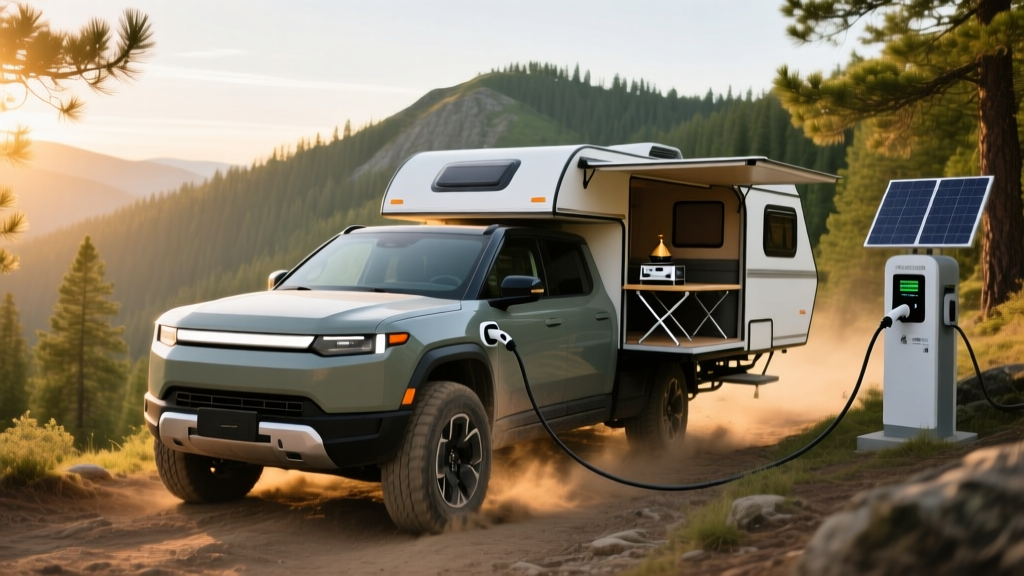
What separates the R1T from other electric pickups in the camping conversation is its purpose-built gear tunnel — an 11-cubic-foot pass-through compartment behind the rear seats that's accessible from both sides of the truck. Rivian sells a slide-out Camp Kitchen ($5,500) that nests inside, featuring a dual-burner induction cooktop, sink with a 4-gallon water tank, and storage for cookware. It's genuinely clever: the kitchen slides out to the driver's side, keeping prep work away from the bed.
Rooftop tent compatibility: The R1T's bed rails support rooftop tents from brands like Freespirit Recreation and Roofnest. With the adjustable air suspension, you can level the truck on uneven terrain — a real advantage over traditional pickups when setting up camp. The suspension also drops 2 inches in Park mode for easier tent access.
The bed itself: At 54 inches long, the R1T bed is shorter than a mid-size Ranger or Tacoma (both ~60–72 inches). A full-size mattress won't fit flat. Most R1T campers use a bed rack with a crossbar-mounted tent or sleep in the rooftop tent while storing gear in the bed. The powered tonneau cover is standard and supports up to 500 lbs of distributed load on top — enough for a rack system and tent.
Interior space: The R1T cabin seats five with 41.3 inches of front legroom and 36.6 inches rear. Rear seats fold flat, expanding interior cargo to roughly 34 cu ft. For two-person camping trips, the cabin is comfortable; for family trips with three kids, the rear seat is tight on longer drives compared to a full-size F-150 Lightning.
Performance and Off-Road Capability
The dual-motor AWD powertrain produces 533 hp and 610 lb-ft of torque, launching the R1T to 60 mph in 4.5 seconds — genuinely quick for a 7,100-lb truck. For overlanding, the relevant numbers are different: 14.9 inches of ground clearance in Off-Road mode (more than a Jeep Wrangler Rubicon), 34-degree approach angle, and a wading depth of 3+ feet thanks to sealed battery enclosures.
The R1T's quad-motor variant (668 hp, 3.0-second 0–60) was discontinued after the 2024 model year. The current dual-motor setup, with its torque-vectoring brake-based system, handles technical trails competently. Rock crawl mode modulates individual wheel braking to simulate locking differentials — effective on moderate trails, though hardcore rock crawlers will note it can't match a true locked-axle system on extreme terrain.
Pricing, Trims, and Federal Tax Credit Eligibility
| Trim / Configuration | Base MSRP | Est. As-Tested (w/ Camper Package) | Federal Tax Credit (§30D) |
|---|---|---|---|
| Dual-Motor Standard (270 mi) | $69,900 | $78,000–$84,000 | Up to $7,500* |
| Dual-Motor Large Pack (328 mi) | $75,900 | $84,000–$90,000 | Up to $7,500* |
| Dual-Motor Max Pack (352 mi) | $83,900 | $92,000–$100,000 | Up to $7,500* |
*Federal EV tax credit eligibility under IRS §30D is subject to multiple requirements:
- MSRP cap: The R1T qualifies as a pickup truck, so the MSRP cap is $80,000. The Standard and Large Pack base prices clear this, but adding options can push the as-tested price above the cap — check the window sticker.
- Buyer income limits: Modified AGI must not exceed $300,000 (joint filers), $225,000 (head of household), or $150,000 (single).
- Battery sourcing: A percentage of critical minerals and battery components must be sourced from the U.S. or FTA partners. Rivian's sourcing has evolved; verify current-year compliance on the IRS qualified vehicle list before purchasing.
- Point-of-sale transfer: As of 2024, eligible buyers can transfer the credit to the dealer at purchase, reducing the out-of-pocket price immediately rather than waiting for tax filing.
Bottom line on cost: A Dual-Motor Large Pack R1T at $75,900 base, with the Camp Kitchen ($5,500) and a rooftop tent rack ($2,500), lands near $83,900 before incentives. If you qualify for the full $7,500 federal credit plus any state incentives, your effective price drops to roughly $76,400. Compare that to a similarly equipped Toyota Tacoma TRD Off-Road with a camper build-out: lower sticker but higher fuel and maintenance costs over 5 years.
Who Should Buy the R1T as a Camper — And Who Shouldn't
Choose the Rivian R1T Camper If:
- You have home Level 2 charging and most camping trips are within 250 miles of home
- You value silent, zero-tailpipe-emission camping in sensitive wilderness areas
- You want integrated power for cooking, lighting, and devices without a separate generator
- You need a daily-driver truck that doubles as a weekend overlander
- You prioritize tech (over-the-air updates, Driver+ ADAS, app-based climate control) over raw bed length
Look Elsewhere If:
- You regularly tow a travel trailer over 5,000 lbs — range drops below 200 miles
- Your camping trips are in areas with zero DC fast-charging infrastructure (e.g., remote Nevada, eastern Montana)
- You need a 6-foot bed for hauling ATVs, motorcycles, or lumber
- You want a proven 10-year track record — Rivian's first R1T delivered in 2021
Pros, Cons, and Competitor Check
Pros
- 352-mile Max Pack range is the longest of any electric pickup
- Gear tunnel and Camp Kitchen are purpose-built for camping
- Adjustable air suspension levels the truck on uneven campsites
- 11,000-lb towing and genuine off-road clearance (14.9 inches)
- OTA updates continuously add features post-purchase
- 8-year/175,000-mile battery warranty exceeds the industry standard 8/100,000
Cons
- 54-inch bed is shorter than any mid-size gas pickup
- 200 kW peak DC charging lags behind Hyundai/Kia's 800V platforms (350 kW)
- Max Pack 10–80% charge time of ~36 minutes is long on road trips
- Camp Kitchen accessory adds $5,500 — expensive vs. aftermarket builds
- No vehicle-to-grid (V2G) or full vehicle-to-home (V2H) capability
- Service center network is still sparse outside major metro areas
Key competitors: The Ford F-150 Lightning offers a longer bed (5.5–6.5 ft), Pro Power Onboard (up to 9.6 kW of 240V output), and a lower starting price (~$55,000), but its max range tops out at 320 miles and it lacks the R1T's off-road suspension travel. The Chevrolet Silverado EV (4WT/Trail Boss) promises 400+ miles in max-range trims but is heavier, less off-road-capable, and lacks Rivian's integrated camping ecosystem. The Tesla Cybertruck offers comparable range and more bed length (6 ft), but its stainless-steel exoskeleton complicates aftermarket tent-rack mounting and its camping accessory ecosystem is less mature.
Warranty and Long-Term Ownership
Rivian covers the R1T battery and drive units for 8 years or 175,000 miles, whichever comes first, with a capacity retention threshold of 70%. This is significantly better than the federal minimum (8/100,000) and better than most competitors. The bumper-to-bumper warranty is 5 years/60,000 miles.
For camping-specific wear: the air suspension, gear tunnel mechanisms, and powered tonneau are covered under the standard warranty. Rivian's mobile service fleet handles many repairs on-site, but rural owners should confirm service coverage in their area before purchasing. Replacement battery cost, should it ever be needed out of warranty, is estimated at $15,000–$25,000 for the Max Pack — a significant sum, though NMC degradation data from early R1T owners shows less than 5% capacity loss at 60,000 miles under normal use.
Frequently Asked Questions
What is the real-world range of the Rivian R1T when loaded for camping?
With a rooftop tent, loaded bed, and two passengers on the highway at 70 mph in 65°F weather, expect 280–310 miles from the Max Pack (EPA 352). In freezing temperatures (below 32°F), plan on 230–260 miles. The NMC battery's thermal management system helps, but cold chemistry losses and cabin heating are unavoidable physics.
Can I tow a camper trailer with the R1T?
Yes — the R1T is rated for 11,000 lbs. But towing a 5,000-lb travel trailer reduces range to approximately 160–190 miles (Max Pack). A lighter teardrop trailer (1,500–2,500 lbs) is the sweet spot, yielding roughly 220–260 miles of range. Always plan charging stops carefully when towing; DC fast chargers that accommodate truck-trailer combinations are still uncommon.
Does the R1T qualify for the $7,500 federal EV tax credit?
The base Dual-Motor Standard ($69,900) and Large Pack ($75,900) models fall under the $80,000 pickup MSRP cap and can qualify — but you must also meet income limits ($300k joint / $150k single) and the vehicle must satisfy IRS battery-sourcing requirements for the current tax year. Verify on the IRS qualified vehicles list before finalizing your purchase.
How long does it take to charge the R1T at home overnight?
On a Level 2 Rivian Wall Charger (11.5 kW / 48A), the Max Pack charges from 10% to 90% in roughly 12–13 hours — enough for overnight replenishment after a day of driving. On a standard 120V outlet (Level 1), you'll add only ~3 miles per hour, which is impractical for anything beyond emergency trickle charging.
Is the R1T better for camping than an F-150 Lightning?
It depends on your priorities. The R1T wins on off-road capability (14.9" clearance vs. ~8.9"), integrated camping accessories (gear tunnel, Camp Kitchen), and range (352 vs. 320 miles max). The Lightning wins on bed length (6.5 ft vs. 4.5 ft), onboard power output (9.6 kW Pro Power vs. limited R1T outlets), and starting price. For technical overlanding, the R1T is superior. For car-camping with big gear, the Lightning's bed is more practical.
What's the biggest drawback of using the R1T as a camper?
The 54-inch bed length. It's the shortest bed on any production pickup, which limits what you can carry and means you'll almost certainly need a rooftop tent or bed-rack sleeping platform. If you prefer ground tents or need to haul long cargo (kayaks, lumber, a dirt bike), this is the R1T's most significant compromise.