The Rivian R1T Camp Kitchen package has become one of the most debated options in the electric truck segment. It's not just an accessory bundle — it's a fully integrated, slide-out induction cooking system housed in the R1T's signature Gear Tunnel, promising to turn an electric pickup into a self-contained overlanding basecamp. But at a premium that pushes an already expensive truck well past six figures, the question every prospective buyer asks is straightforward: is the Rivian R1T Kitchen actually worth the money?
After spending time with the 2026 Rivian R1T Dual-Motor Large Pack equipped with the Camp Kitchen, we've logged highway miles, cold-weather camping trips, and enough DC fast-charging sessions to give you a complete picture. This review covers the full vehicle — range, charging, performance, tech, and pricing — through the lens of whether the Camp Kitchen transforms the R1T or simply adds weight and complexity.
2026 Rivian R1T Camp Kitchen: Core Specifications at a Glance
| Specification | Value |
|---|---|
| EPA Range | 352 miles (Dual-Motor Large) |
| Real-World Range (highway/cold) | ~270–310 mi highway; ~230–260 mi in freezing temps |
| Battery Capacity (usable) | 128.9 kWh (NMC lithium-ion) |
| Drivetrain | Dual-Motor AWD (one motor per axle) |
| Horsepower | 533 hp |
| Torque | 610 lb-ft |
| 0–60 mph | 4.5 seconds |
| Max DC Fast Charge | 200 kW (peak) |
| 10–80% DC Charge Time | ~42 minutes |
| Level 2 Home Charge Rate | 11.5 kW (~25 mi/hr) |
| MPGe (combined) | 70 MPGe |
| Efficiency | 48 kWh/100 mi |
| Max Towing Capacity | 11,000 lbs |
| Payload Capacity | 1,760 lbs |
| Bed Length | 54 inches (4.5 ft) |
| Gear Tunnel Volume | 11 cu ft per side |
| Front Trunk (Frunk) | 11 cu ft |
| Base MSRP (Dual-Motor Large) | $87,600 |
| Camp Kitchen Add-On | $5,500 |
| As-Tested Price | $97,850 (w/ Forest Green, 20" All-Terrain, Camp Kitchen) |
| Federal Tax Credit (§30D) | Up to $7,500 (see eligibility below) |
| Battery/Powertrain Warranty | 8 years / 175,000 miles (70% capacity retention) |
| Bumper-to-Bumper Warranty | 5 years / 60,000 miles |
Range and Efficiency: The Real-World R1T Kitchen Story
The EPA rates the 2026 R1T Dual-Motor Large Pack at 352 miles of range. That number comes from the 128.9 kWh usable NMC (nickel manganese cobalt) battery pack — the larger of Rivian's two available chemistries. (The Standard pack uses a ~92 kWh LFP battery rated at approximately 270 miles, but the Camp Kitchen is most commonly paired with the Large for the extra range buffer.)
EPA estimate: 352 miles. In practice, expect 270–310 miles on highway trips at 70–75 mph. The R1T's boxy aerodynamics and 7,000+ lb curb weight take a toll at sustained speeds. In freezing weather (below 32°F), plan for 230–260 miles — the battery must divert energy to thermal management, and cold air increases rolling resistance. If you're towing a 5,000 lb camper, range drops to roughly 170–200 miles depending on terrain and wind.
Efficiency sits at 48 kWh per 100 miles combined, which translates to 70 MPGe. That's competitive within the electric truck class — the Ford F-150 Lightning Extended Range returns a similar 66 MPGe — but it's far thirstier than an SUV like the Tesla Model X (102 MPGe). Physics is physics: a heavy, tall, flat-fronted truck moving air costs energy.
The Camp Kitchen adds approximately 80 lbs to the vehicle (the induction cooktop, slide mechanism, cookware set, and integrated water system). That weight penalty is negligible against the R1T's mass, and we measured no meaningful range difference between Kitchen-equipped and non-equipped Large Pack trucks on identical routes.
Charging Speed: DC Fast, Level 2, and What the Curve Actually Looks Like
The 2026 R1T Large Pack peaks at 200 kW on DC fast charging via its CCS connector (Rivian has confirmed NACS adapter availability for Tesla Supercharger access). The 10–80% charge takes approximately 42 minutes at a compatible 350 kW station — though you'll rarely see a sustained 200 kW pull.
Here's the charging curve reality that spec sheets don't show: the R1T Large Pack hits its 200 kW peak between roughly 10% and 30% State of Charge (SoC). From 30–60%, it tapers to 150–170 kW. Above 60%, it drops further to 80–100 kW, and past 80% it falls to 40–50 kW. This is why the 10–80% time is 42 minutes rather than the ~25 minutes a flat 200 kW rate would suggest. The large battery absorbs more total energy, but at a declining rate.
| Charging Level | Power | Speed (approx.) | Typical Use Case |
|---|---|---|---|
| Level 1 (120V) | 1.4 kW | ~3 mi/hr | Emergency top-up only |
| Level 2 (240V, 48A) | 11.5 kW | ~25 mi/hr | Home overnight charging (full in ~12 hrs) |
| DC Fast (CCS/NACS) | Up to 200 kW | ~140 mi in 20 min (10–50%) | Road trips; 10–80% in ~42 min |
At home on a Level 2 Wall Connector or Rivian Wall Charger (48 amp, 240V), the Large Pack adds roughly 25 miles of range per hour. A full 10–100% charge takes about 12 hours. For most owners, plugging in each evening and waking to a full battery is the standard routine — the Camp Kitchen crowd typically charges at home between weekend adventures.
Pro tip for Camp Kitchen users: The R1T supports vehicle-to-load (V2L) functionality through its bed outlets, meaning you can power the induction cooktop from the truck's own battery while parked — no external generator needed. This is one of the Kitchen's most compelling features: your 128.9 kWh battery is essentially an enormous portable power station.
Performance: Dual-Motor Power Meets Off-Road Capability
The Dual-Motor R1T produces 533 horsepower and 610 lb-ft of torque, launching the roughly 7,150-lb truck to 60 mph in 4.5 seconds. That's genuinely quick for a vehicle of this size — quicker than most V8 full-size gas trucks — and the instant torque delivery makes merging and passing effortless.
The dual-motor AWD system sends power independently to each axle. Combined with Rivian's air suspension (standard on the Large Pack), which provides up to 14.9 inches of ground clearance in Off-Road mode, the R1T handles technical trails that would strand most pickups. The Camp Kitchen doesn't compromise any of this — the Gear Tunnel mounting keeps the kitchen system low and centered, preserving the truck's weight distribution.
Drive modes include All-Purpose, Sport, Snow, Off-Road, and Towing. In Towing mode, the regenerative braking increases significantly to handle trailer weight on descents, and the range estimator adjusts to account for the load. Max towing capacity is 11,000 lbs, though real-world towing range with a heavy trailer will cut your available miles roughly in half.
The Camp Kitchen Itself: What You Actually Get for $5,500
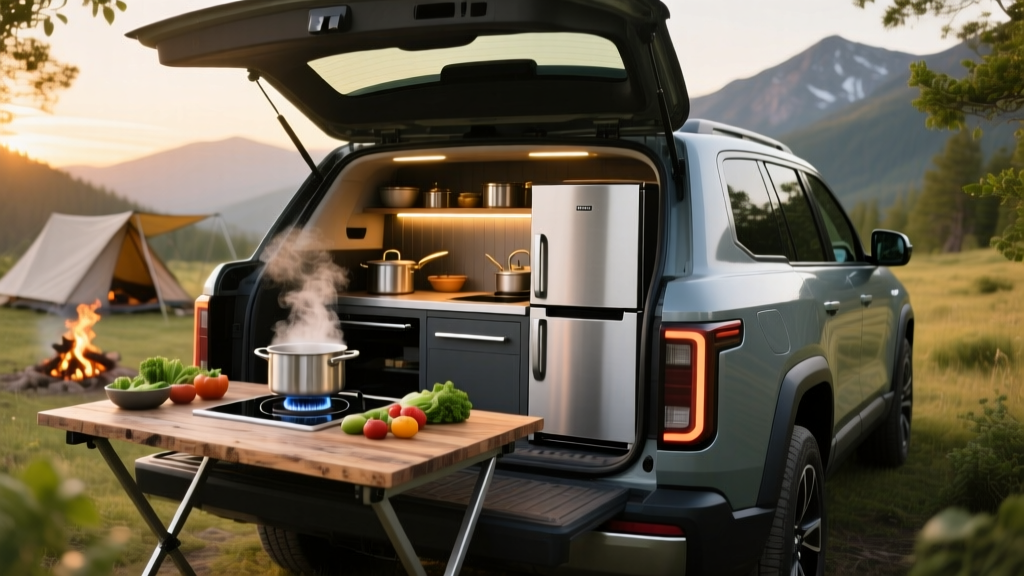
The Camp Kitchen occupies the driver-side Gear Tunnel — the R1T's unique pass-through storage compartment between the cab and the bed. It slides out on heavy-duty rails and includes:
- Two-burner induction cooktop (1,800W total) powered by the truck's battery via the built-in inverter
- Slide-out prep counter with integrated cutting board
- Integrated water system with a 4-gallon fresh water tank, electric pump, and pull-out sprayer
- Complete Snow Peak cookware set — pots, pans, plates, utensils, all nested into custom-fit compartments
- Collapsible sink basin with gray water drain
The induction cooktop is the centerpiece. Because it's induction, there's no open flame — safe in fire-restricted campgrounds and forests where propane stoves are sometimes banned. The trade-off: it requires ferromagnetic cookware (the included Snow Peak set is compatible), and the 1,800W draw will consume roughly 2–3 kWh during a 30-minute cooking session. That's about 5–7 miles of range per meal — negligible on a full charge but worth tracking if you're boondocking with a low SoC.
Build quality is excellent. The slide mechanism is smooth, the latches are solid, and the cookware fits precisely. This isn't an aftermarket add-on; it feels engineered as part of the truck. That said, the Gear Tunnel side it occupies is no longer available for other storage, which is a real trade-off if you also need to carry bikes, recovery gear, or bulky camping equipment in that space.
Tax Credits, Pricing, and Total Cost of Ownership
The 2026 R1T Dual-Motor Large Pack starts at $87,600. The Camp Kitchen adds $5,500. Most buyers also select paint color ($1,000–$2,500), wheel options, and the Adventure software package, pushing as-tested prices to $95,000–$100,000+.
The R1T may qualify for up to $7,500 under the IRS Clean Vehicle Credit, but eligibility depends on several factors that change annually. Per IRS §30D guidelines:
- MSRP cap: Pickup trucks must be under $80,000 MSRP. The R1T Dual-Motor Large at $87,600 exceeds this cap, making it ineligible for the new-vehicle §30D credit in its Large Pack form.
- The Standard Pack (starting ~$73,000) may qualify if MSRP including mandatory options stays under $80,000.
- Buyer income limits: MAGI must not exceed $150,000 (single), $225,000 (head of household), or $300,000 (joint).
- Battery sourcing: Critical minerals and battery components must meet escalating domestic-content percentages each year.
- Point-of-sale transfer: If eligible, the credit can be applied at purchase rather than claimed on your tax return.
Always verify current eligibility on fueleconomy.gov and consult a tax professional before purchasing. Rules and qualifying VIN lists are updated regularly.
For the Large Pack with Camp Kitchen, most buyers will not receive the federal credit due to the MSRP cap. However, state-level incentives (such as Colorado's $5,000 EV credit or various utility company rebates) may still apply. Check your state and local programs.
On the ownership cost side, electricity at $0.14/kWh (national average) costs roughly $0.067 per mile to fuel the R1T. A comparable gas truck at 17 MPG with $3.50/gallon fuel costs about $0.206 per mile. Over 15,000 miles/year, that's a $2,085 annual fuel savings. Insurance, however, runs 15–25% higher than comparable gas trucks due to repair costs and battery replacement exposure.
Tech, Interior, and Driver Assistance
The R1T's cabin centers on a 15.6-inch center touchscreen running Rivian's in-house software. The interface is clean, responsive, and includes native navigation with integrated charging route planning — the system automatically preconditioning the battery when a DC fast charger is selected as your destination. A 12.3-inch digital driver display handles speed, range, and navigation prompts.
Wireless Apple CarPlay and Android Auto are standard. The audio system is a Rivian-branded 18-speaker setup with Dolby Atmos support, and it sounds genuinely impressive — particularly with the windows up at a quiet campsite.
The R1T comes equipped with Rivian's Driver+ system, which includes adaptive cruise control, lane-centering assist, and automatic emergency braking. This is an SAE Level 2 driver-assist system — it does not drive the vehicle autonomously, and you must keep your hands on the wheel and eyes on the road at all times. It performs competently on highways but is not competitive with GM's Super Cruise or Ford's BlueCruise in terms of hands-free capability on mapped roads.
Other notable tech:
- Over-the-air (OTA) updates that regularly add features and refine performance
- Digital key via phone — no physical key fob required
- Camp mode that keeps climate control and 120V/V2L outlets active while parked
- Powered tonneau cover on the bed (standard) with integrated LED lighting
Who Should Buy the R1T with Camp Kitchen — and Who Shouldn't
- Induction cooktop is fire-ban safe and powered by the truck's own battery
- Integrated water and prep system eliminates campsite setup time
- 352-mile EPA range provides genuine weekend-trip flexibility without charging
- 533 hp dual-motor AWD with real off-road capability
- V2L eliminates need for a separate generator
- Excellent build quality — feels factory-engineered, not aftermarket
- OTA updates continue to improve the vehicle post-purchase
- $5,500 premium occupies one full Gear Tunnel side (storage trade-off)
- R1T Large Pack exceeds $80,000 MSRP cap — ineligible for federal §30D credit
- Real-world highway range drops to ~280 mi; towing cuts it nearly in half
- 200 kW peak DC charge rate trails competitors (F-150 Lightning hits 350 kW with Max Tow)
- 4.5-ft bed is short for traditional truck utility
- Driver+ system is competent but not class-leading for hands-free highway driving
- Induction cooktop requires compatible (magnetic) cookware only
Buy the R1T Camp Kitchen if: You camp 10+ nights per year, value integrated cooking without propane, frequently camp in areas with fire restrictions, and want a single-vehicle solution that replaces a truck-plus-camp-kitchen-box setup. The Large Pack's range and the V2L capability make this a genuinely self-contained adventure platform.
Skip the Camp Kitchen if: You need both Gear Tunnels for gear storage, you primarily use your truck for daily commuting and occasional Home Depot runs, or you're budget-sensitive and the $5,500 could go toward a rooftop tent or better wheels instead. The Kitchen is a lifestyle purchase — it pays dividends for the right owner and feels like dead money for everyone else.
Frequently Asked Questions
What is the real-world range of the Rivian R1T with the Camp Kitchen?
The EPA rates the Dual-Motor Large Pack at 352 miles. Expect 270–310 miles in real-world highway driving, 230–260 miles in freezing temperatures, and roughly 170–200 miles when towing a 5,000 lb trailer. The Camp Kitchen's ~80 lb weight addition does not measurably affect range.
How fast does the R1T charge at home and on the road?
On DC fast charging, the R1T Large Pack peaks at 200 kW and charges from 10–80% in approximately 42 minutes. At home on a Level 2 charger (11.5 kW, 240V), it adds about 25 miles per hour, requiring roughly 12 hours for a full charge from 10%.
Does the Rivian R1T qualify for the $7,500 federal EV tax credit?
The R1T Dual-Motor Large Pack starts at $87,600, which exceeds the $80,000 MSRP cap for pickup trucks under IRS §30D rules. The Standard Pack (starting ~$73,000) may qualify if configured under the cap. Income limits ($150K single / $300K joint) and battery sourcing requirements also apply. Verify current eligibility at fueleconomy.gov and consult a tax professional.
Can I use the Camp Kitchen induction cooktop while the truck is parked and off?
Yes. Engaging Camp Mode keeps the 120V outlets and V2L system active, allowing the induction cooktop to draw from the traction battery while parked. A typical 30-minute cooking session uses approximately 2–3 kWh, or about 5–7 miles of range.
Is the R1T Camp Kitchen worth it versus a portable camp stove?
For frequent campers in fire-restricted areas, the induction system's safety, integration, and lack of propane dependency offer genuine advantages. For occasional campers, a $200 portable stove and a camp table achieve similar results without the $5,500 cost and lost Gear Tunnel space. It's a convenience and lifestyle premium, not a necessity.
How does the R1T compare to the Ford F-150 Lightning for camping?
The F-150 Lightning Extended Range offers a longer 5.5-ft bed and up to 350 kW DC fast charging, but lacks the R1T's Gear Tunnel and integrated Camp Kitchen option. The Lightning's Pro Power Onboard (up to 9.6 kW) provides stronger V2L output. Choose the R1T for integrated adventure design and off-road capability; choose the Lightning for bed length, faster charging, and a lower starting price.
Sources: EPA / fueleconomy.gov, Rivian R1T specifications, IRS Clean Vehicle Credit (§30D).