Quick Verdict: The R1T Remains the EV Truck to Beat in 2026
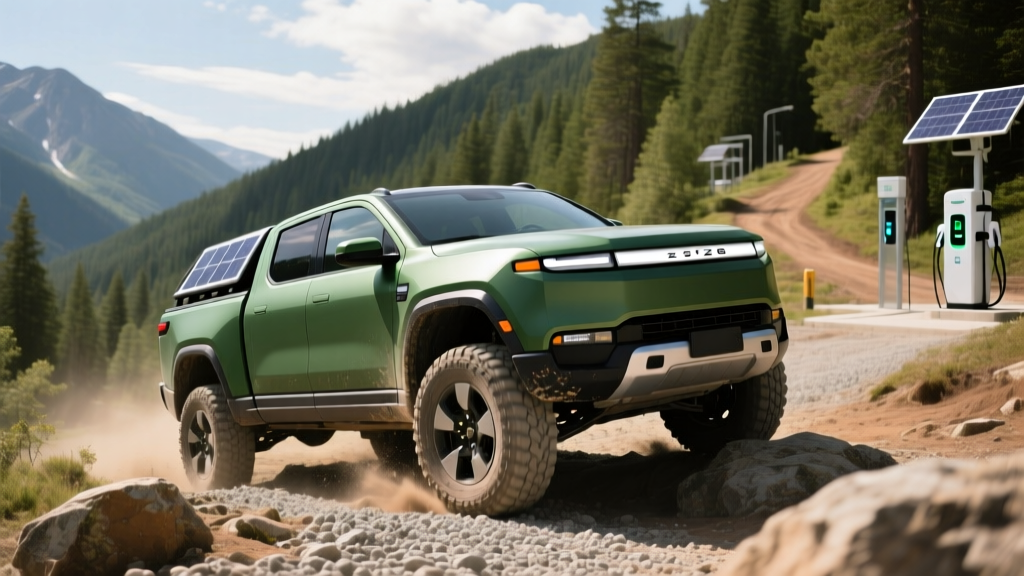
Rivian's second-generation R1T enters the 2026 model year with meaningful refinements: a new Tri-Motor powertrain option, improved thermal management for faster sustained DC charging, and a software stack that finally delivers on the brand's early promises. The R1T sits in a category it largely invented — a premium electric pickup that can genuinely off-road, tow over 10,000 lbs, and still serve as a daily commuter with frunk space that shames most crossovers.
For buyers researching a Rivian lifted configuration or considering the R1T's factory off-road packages, this review covers the exact specs, real-world range data, charging behavior, and ownership economics you need before committing to a $75,000–$100,000+ electric truck.
| Spec | Dual-Motor (Standard) | Performance Dual-Motor | Tri-Motor | Quad-Motor |
|---|---|---|---|---|
| EPA Range (Max Pack) | 420 mi | 390 mi | 380 mi (est.) | 352 mi |
| Battery (usable) | 149 kWh (Max Pack, NMC) | 149 kWh (Max Pack, NMC) | 149 kWh (Max Pack, NMC) | 149 kWh (Max Pack, NMC) |
| Battery (Standard Pack) | 106 kWh (LFP) | 106 kWh (LFP) | N/A | N/A |
| Max DC Fast Charge | 220 kW | 220 kW | 220 kW | 220 kW |
| 10–80% DC Time | ~42 min | ~42 min | ~42 min | ~42 min |
| Level 2 Home Charging | 11.5 kW (~25 mi/hr) | 11.5 kW (~25 mi/hr) | 11.5 kW (~25 mi/hr) | 11.5 kW (~25 mi/hr) |
| 0–60 mph | 4.5 sec | 3.4 sec | 2.9 sec (est.) | 3.0 sec |
| Horsepower | 533 hp | 665 hp | 850 hp (est.) | 835 hp |
| Drivetrain | AWD (dual-motor) | AWD (dual-motor) | AWD (tri-motor) | AWD (quad-motor, torque vectoring) |
| Max Tow Capacity | 11,000 lbs | 11,000 lbs | 11,000 lbs | 11,000 lbs |
| Ground Clearance (max) | 14.9 in | 14.9 in | 14.9 in | 14.9 in |
| Base MSRP | $74,800 | $82,300 | $99,900 (est.) | $99,900 |
Range & Efficiency: What the EPA Number Doesn't Tell You
The Dual-Motor Max Pack carries a 420-mile EPA estimate — best-in-class for an electric pickup. But real-world results depend heavily on how you drive:
- Highway cruising (75 mph, moderate temps): Expect 320–350 miles. Aerodynamic drag at speed costs any truck-shaped EV roughly 15–20% vs. the combined EPA cycle.
- Cold weather (below 32°F): Range drops 20–30% without preconditioning. With the heat pump engaged and battery preconditioned, expect 280–320 miles on the Max Pack.
- Towing (5,000+ lb trailer): Range effectively halves. Plan for 160–200 miles between charges when towing near max capacity. This is physics, not a Rivian-specific flaw — every EV truck behaves similarly.
- City/stop-and-go with regen: You can approach or slightly exceed the EPA number thanks to aggressive regenerative braking recapturing energy.
Efficiency for the Dual-Motor Max Pack is rated at 73 MPGe combined (approximately 46 kWh/100 mi) per fueleconomy.gov. That's competitive with the Ford F-150 Lightning Extended Range (70 MPGe) but below aerodynamic sedans — the R1T's truck profile and 7,000+ lb curb weight work against it on the highway.
The Standard Pack (106 kWh, LFP chemistry) yields approximately 270 miles EPA in Dual-Motor trim. LFP cells sacrifice energy density for longevity and lower cost — a smart trade for buyers who charge at home nightly and rarely road-trip beyond 200 miles.
Charging Speed: Gen 2 Architecture Delivers Where Gen 1 Struggled
| Charging Level | Power / Rate | Miles Added per Hour | Notes |
|---|---|---|---|
| Level 1 (120V household) | 1.4 kW | ~3 mi/hr | Emergency/trickle only; 149 kWh pack takes days |
| Level 2 (240V, 48A home charger) | 11.5 kW | ~25 mi/hr | Full Standard Pack in ~9.5 hr; Max Pack in ~13 hr |
| DC Fast Charge (peak) | 220 kW | ~140 mi in 20 min (peak) | Sustained rate tapers above 60% SoC |
| DC Fast Charge (10–80%) | Avg ~130 kW sustained | — | ~42 minutes, 10–80% |
| Tesla Supercharger (via NACS adapter) | Up to 250 kW (V3 stalls) | Varies by stall | NACS port now standard on 2026 models; CCS adapter available |
The Gen 2 R1T's 220 kW peak DC rate is a meaningful improvement over Gen 1's ~200 kW ceiling, but the more important story is the charge curve. Rivian's updated thermal management sustains higher power deeper into the session. Where Gen 1 tapered sharply past 60% state of charge (SoC), Gen 2 holds above 150 kW to roughly 70% before ramping down. This means real-world road-trip stops feel quicker than the peak number alone suggests.
Preconditioning matters. Navigate to a DC fast charger using the R1T's built-in navigation, and the battery will warm to optimal temperature before you arrive. Skip this step (e.g., plug in at a charger you found manually) and your first 10 minutes may peak below 100 kW, especially in cold weather.
For home charging, the Rivian Wall Connector (or any J3400/NACS-compatible Level 2 unit at 48 amps) delivers 11.5 kW — enough to replenish roughly 25 miles of range per hour. Most Max Pack owners will need a dedicated 60-amp circuit; consult a licensed electrician to confirm your panel has capacity. A panel upgrade from 100A to 200A service can add $1,500–$3,500 to your installation cost.
Performance & Off-Road: Where the R1T Earns Its Premium Price
The Quad-Motor R1T's 3.0-second 0–60 mph time (835 hp, individual wheel torque vectoring) remains a party trick that never gets old. But the Tri-Motor's estimated 2.9-second run and 850 hp pushes the R1T into hypercar-adjacent territory in a vehicle with a 5.5-foot bed and a Gear Tunnel.
More relevant for the Rivian lifted buyer: the R1T's air suspension delivers up to 14.9 inches of ground clearance in Off-Road mode — exceeding the Ford F-150 Lightning (10.3 in max) and rivaling purpose-built off-roaders. Approach, departure, and breakover angles are competitive with a stock Jeep Gladiator Rubicon in the air suspension's highest setting.
The quad-motor configuration enables tank turns (the vehicle pivots by driving left and right wheels in opposite directions) and precise low-speed rock crawling without the mechanical complexity of locking differentials. In real-world trail use, the system's instant torque delivery at zero RPM gives it an advantage over gas trucks that need to build revs.
On pavement, the adaptive air suspension lowers the truck at highway speeds for efficiency, then raises it for obstacles — a trick no body-on-frame competitor matches. The trade-off is complexity: air suspension repairs out of warranty can cost $2,000–$4,000 per corner.
Interior, Cargo & Tech: The Frunk Changes How You Use a Truck
The R1T's 11-cubic-foot front trunk (frunk) is lockable, weatherproof, and includes a drain plug — effectively a built-in cooler or secure gear storage that no conventional truck offers. Combined with the Gear Tunnel (11.7 cu ft of pass-through storage behind the rear seats, available on most configs), the R1T carries more secure, enclosed cargo than many SUVs despite its 4.5-foot bed.
Interior dimensions:
- Rear legroom: 38.2 inches (comfortable for adults on long trips)
- Bed length: 54.2 inches (with midgate closed); extends to ~82 inches with midgate open
- Max payload: 1,760 lbs
- Bed power: 120V and 240V outlets in the bed, plus a 2.4 kW onboard generator function
The 15.6-inch center touchscreen runs Rivian's in-house software, which received major over-the-air updates through 2025 improving route planning, camp mode functionality, and third-party charging network integration. Wireless Apple CarPlay and Android Auto are standard. The 12.3-inch driver display is clear but lacks the configurability of some competitors.
Driver assistance: Rivian's Driver+ system is a SAE Level 2 hands-on highway assist — it handles lane centering and adaptive cruise competently but requires driver engagement at all times. It is not autonomous driving. The system works well on marked highways but disengages frequently in construction zones and faded-lane scenarios. No hands-free mode (like GM's Super Cruise or Ford's BlueCruise) is currently offered, though Rivian has announced a hands-free feature for late 2026 availability.
Pricing, Tax Credit & Ownership Costs
| Trim | Base MSRP | As-Tested (typical config) | §30D Credit Eligible? |
|---|---|---|---|
| Dual-Motor Standard Pack | $74,800 | $78,000–$82,000 | Yes, up to $7,500 (subject to income + sourcing rules) |
| Dual-Motor Max Pack | $84,800 | $89,000–$95,000 | Yes, up to $7,500 (subject to income + sourcing rules) |
| Performance Dual-Motor | $82,300 | $90,000–$98,000 | Yes, up to $7,500 (subject to income + sourcing rules) |
| Tri-Motor | $99,900 (est.) | $105,000+ | Check current IRS guidance — MSRP cap for trucks is $80,000 |
| Quad-Motor | $99,900 | $108,000–$115,000 | Exceeds $80,000 MSRP cap — NOT eligible for §30D credit |
Federal tax credit nuances: Under IRS §30D rules, new clean vehicle credits are capped at $7,500 and subject to:
- MSRP cap: $80,000 for vans, SUVs, and pickup trucks. The R1T qualifies as a truck, so Dual-Motor trims under $80K MSRP are eligible; Quad-Motor and most Tri-Motor configurations exceed the cap.
- Buyer income limits: Modified AGI cannot exceed $300,000 (married filing jointly), $225,000 (head of household), or $150,000 (single).
- Battery sourcing requirements: The credit splits into $3,750 for critical minerals and $3,750 for battery component sourcing. Rivian's supply chain has progressively met more of these thresholds, but the exact credit amount can change quarterly. Verify current eligibility on the IRS website or with a tax professional before purchasing.
- Point-of-sale transfer: You can transfer the credit to the dealer at purchase, reducing your out-of-pocket cost immediately rather than waiting for a tax refund.
5-year ownership cost estimate (Dual-Motor Max Pack, 15,000 mi/yr, home charging at $0.14/kWh):
- Energy: ~$4,800 (vs. ~$9,500 in gas for a comparable F-150 at 18 MPG)
- Insurance: ~$12,000–$15,000 (EV truck premiums run 15–25% above gas equivalents per IIHS data)
- Maintenance: ~$1,500 (no oil changes, minimal brake wear with regen; cabin air filter, wiper fluid, tire rotation)
- Estimated 5-year depreciation: 45–55% (EV trucks have depreciated faster than sedans; the used market is still normalizing)
Warranty & Longevity: What Rivian Covers
Rivian's warranty package for the 2026 R1T:
- Battery & drive unit: 8 years / 175,000 miles (whichever comes first), with a minimum 70% capacity retention threshold. This is more generous than the industry-standard 8yr/100,000mi.
- Vehicle (bumper-to-bumper): 5 years / 60,000 miles
- Corrosion: 5 years / unlimited miles
- Roadside assistance: 5 years / unlimited miles
The 175,000-mile powertrain coverage is a genuine differentiator for high-mileage drivers and fleet buyers. LFP-equipped Standard Pack models should see slower degradation over time — LFP chemistry typically retains 90%+ capacity after 2,000 charge cycles, vs. ~85% for NMC at similar usage. However, NMC's higher energy density is why the Max Pack (long-range) still uses it.
Who the R1T Is For — And Who Should Look Elsewhere
- You need a genuine off-road-capable truck with EV economics for daily driving
- You value secure enclosed storage (frunk + Gear Tunnel) over a long bed
- You tow occasionally (under 10,000 lbs) but don't need daily max-tow range
- You have home Level 2 charging and access to DC fast charging for road trips
- You want a truck that drives like a performance SUV on pavement
- You tow heavy trailers long distances regularly (range while towing is a real limitation)
- You need a full 6–8 foot bed for commercial work
- Your budget is under $70,000 (consider the Ford F-150 Lightning or Chevy Silverado EV)
- You want hands-free highway driving today (GM Super Cruise or Ford BlueCruise are more mature)
- You lack home charging access — the R1T's large battery makes public-only charging expensive and time-consuming
- 420-mile Max Pack range leads the EV truck segment
- Air suspension with 14.9" ground clearance — genuine off-road capability
- Frunk + Gear Tunnel offer storage no conventional truck matches
- Quad-Motor torque vectoring and tank turns are unmatched
- Gen 2 charging sustains higher power deeper into the session
- 8yr/175,000mi battery warranty exceeds most competitors
- Over-the-air updates continuously add features
- Quad-Motor exceeds $80K MSRP cap — no federal tax credit
- Range while towing drops to 160–200 miles
- No hands-free driving mode (yet)
- Insurance premiums 15–25% above gas trucks
- Air suspension complexity = expensive out-of-warranty repairs
- 4.5-foot bed is short for commercial/trade use
- Charging network reliability still inconsistent in rural areas
Frequently Asked Questions
What is the real-world range of the Rivian R1T?
The EPA rates the Dual-Motor Max Pack at 420 miles, but real-world highway driving at 75 mph yields approximately 320–350 miles. In cold weather (below freezing), expect 280–320 miles with preconditioning and the heat pump active. Towing cuts range roughly in half — plan 160–200 miles between charges with a heavy trailer.
How fast does the R1T charge at home and on the road?
On a Level 2 home charger (11.5 kW, 48A), the R1T adds about 25 miles of range per hour — a full Standard Pack charges overnight in ~9.5 hours, while the Max Pack takes ~13 hours. On DC fast charging, the Gen 2 R1T peaks at 220 kW and charges from 10–80% in approximately 42 minutes, with improved sustained power compared to Gen 1.
Does the Rivian R1T qualify for the $7,500 federal tax credit?
Dual-Motor trims with a base MSRP under $80,000 are potentially eligible for up to $7,500 under IRS §30D, subject to buyer income limits ($150K single / $300K joint), battery critical-mineral sourcing requirements, and point-of-sale transfer rules. The Quad-Motor and most Tri-Motor configurations exceed the $80,000 MSRP cap for trucks and do not qualify. Always verify current eligibility on irs.gov or with a tax professional.
Is the Rivian R1T worth it vs. the Ford F-150 Lightning or Chevy Silverado EV?
The R1T wins on off-road capability (14.9" ground clearance vs. Lightning's 10.3"), performance (3.0s 0–60 Quad-Motor), and enclosed storage (frunk + Gear Tunnel). The F-150 Lightning wins on price (starts ~$55K), bed length (5.5–8 ft options), and dealer service network breadth. The Silverado EV offers the longest range (up to 440 mi on 4WT trim) and an available 8-foot bed with midgate. If off-road and performance matter most, the R1T justifies its premium. If budget and work-truck utility lead, the Lightning is the pragmatic pick.
Can I lift the Rivian R1T further beyond factory air suspension?
The factory air suspension already provides up to 14.9 inches of ground clearance in Off-Road mode, which exceeds most aftermarket static lifts on competing trucks. Third-party lift kits exist but may void the suspension warranty and interfere with the R1T's sensor suite (cameras, ultrasonics) and aerodynamic ride-height programming. We recommend using the factory system's full travel before pursuing aftermarket modifications.
What's the biggest drawback of owning a Rivian R1T?
The most common owner complaint is range reduction while towing — this is inherent to EV trucks, not unique to Rivian, but it's a genuine limitation for anyone who tows long distances regularly. Secondary concerns include insurance cost (15–25% above gas trucks), limited service center density in rural areas, and the short 4.5-foot bed for commercial users. For daily driving without towing, these drawbacks are manageable.