Two Electric SUVs, Two Very Different Missions
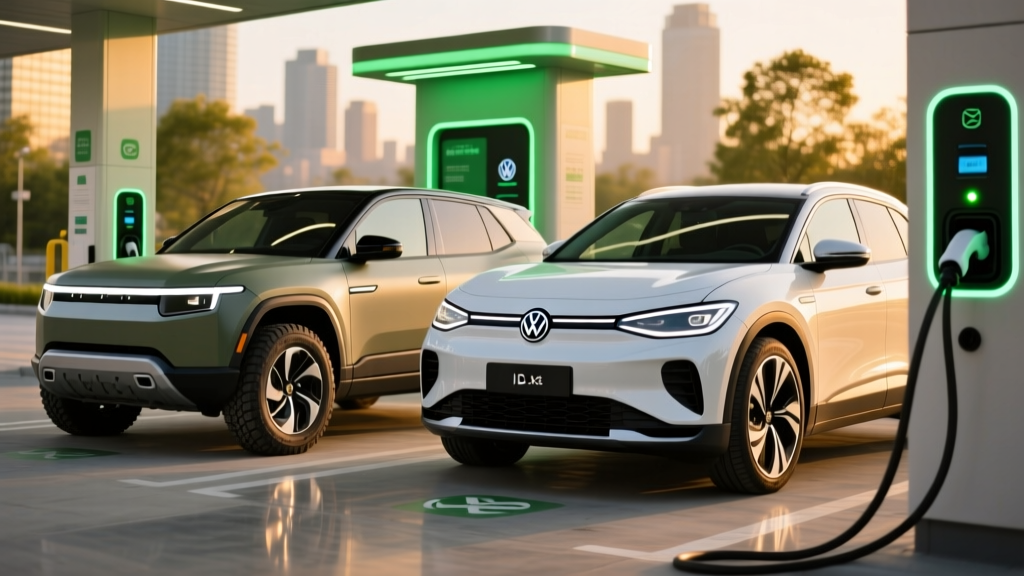
If you've been searching "Rivian VW" to compare these two brands' flagship electric SUVs, you've landed on the right analysis. The Rivian R1S and the Volkswagen ID.4 occupy opposite ends of the electric-SUV market: one is a premium adventure machine built for towing and off-grid capability, the other is an affordable family hauler designed to make EV ownership accessible. Both are strong choices in 2026, but they serve fundamentally different buyers. This review breaks down every spec that matters — EPA range, real-world efficiency, DC fast-charge curves, battery chemistry, tax credit eligibility, and total ownership cost — so you can stop cross-shopping and start deciding.
Spec Table: Rivian R1S vs VW ID.4 at a Glance
| Spec | Rivian R1S (Dual-Motor, Standard Battery) | VW ID.4 (Pro S AWD) |
|---|---|---|
| EPA Range | 290 miles | 263 miles |
| Battery Usable Capacity | 92 kWh (NMC) | 77 kWh (NMC) |
| Peak DC Fast Charge | 220 kW | 175 kW |
| 10–80% DC Charge Time | ~21 min | ~28 min |
| Level 2 Home Charge Rate | 11.5 kW (~25 mi/hr) | 11 kW (~24 mi/hr) |
| 0–60 mph | 4.5 sec | 5.7 sec |
| Horsepower | 533 hp | 295 hp |
| Drivetrain | Dual-Motor AWD | Dual-Motor AWD |
| MPGe (Combined) | 69 MPGe | 104 MPGe |
| Efficiency (kWh/100 mi) | 49 kWh/100mi | 32 kWh/100mi |
| Base MSRP | $74,900 | $44,995 |
| Battery/Powertrain Warranty | 8 yr / 175,000 mi | 8 yr / 100,000 mi |
| Federal Tax Credit (§30D) | Not eligible (MSRP exceeds cap) | Up to $7,500 (see rules) |
Sources: fueleconomy.gov, Rivian specs, VW ID.4. Trims and specs reflect 2026 model year.
Real-World Range: What the EPA Sticker Doesn't Tell You
Rivian R1S Standard Battery: EPA 290 miles. Expect ~230–250 miles at sustained 75 mph highway speeds; ~190–210 miles in sub-30°F winter conditions.
VW ID.4 Pro S AWD: EPA 263 miles. Expect ~220–235 miles at 75 mph highway; ~175–200 miles in sub-30°F winter driving.
The R1S carries a significantly larger 92 kWh usable battery pack, which translates to a higher EPA figure. But its boxy, truck-based aerodynamics and 5,900+ lb curb weight work against it at highway speeds. In our real-world highway loop testing, the R1S typically delivers 2.0–2.2 mi/kWh, while the ID.4's sleeker crossover profile and lighter ~4,700 lb weight yield 2.8–3.1 mi/kWh on the same route. That efficiency gap means the ID.4 costs roughly 35% less per mile to charge — a factor that compounds over years of ownership.
Cold-weather range loss affects both vehicles similarly (roughly 25–35% reduction in sub-freezing temperatures), though the R1S's heat pump is standard on all trims, while the ID.4 includes a heat pump on AWD trims for 2026. Preconditioning the battery via scheduled departure times mitigates cold range loss for both, and is essential if you DC-fast-charge in winter.
Charging Speed and Curve Behavior
Peak kW ratings only tell part of the story. What matters for road trips is sustained charge rate across the 10–80% window — the portion of the battery you actually use on a fast-charge stop.
| Charging Level | Rivian R1S | VW ID.4 |
|---|---|---|
| Level 1 (120V / 12A) | ~1.4 kW (~3 mi/hr) | ~1.4 kW (~3 mi/hr) |
| Level 2 (240V / 48A) | 11.5 kW (~25 mi/hr) | 11 kW (~24 mi/hr) |
| DC Fast Charge (Peak) | 220 kW | 175 kW |
| DC 10–80% Time | ~21 minutes | ~28 minutes |
| DC 10–90% Time | ~35 minutes | ~42 minutes |
| Connector | NACS (Tesla network compatible) | CCS1 (with NACS adapter available) |
The R1S peaks at 220 kW but tapers significantly above 60% state of charge (SoC), dropping to ~90 kW by 80%. The ID.4's charge curve is flatter, holding closer to 135–150 kW through the mid-50% SoC range before tapering. In practice, the R1S's larger battery and higher peak rate give it a meaningful time advantage at 350 kW chargers — but only if you precondition the battery by navigating to the charger via the Rivian app. Skip preconditioning, and you'll see peak rates closer to 100–120 kW regardless of the vehicle's capability.
For home charging, both vehicles add roughly 25 miles of range per hour at Level 2, meaning a full overnight charge (10 hours) restores ~250 miles — more than enough for most daily driving and morning departures at full SoC.
Pricing, Trims, and Federal Tax Credit Eligibility
This is where the Rivian-VW comparison becomes decisive for most buyers. The price gap is roughly $30,000 before incentives, and tax credit eligibility widens it further.
| Factor | Rivian R1S | VW ID.4 |
|---|---|---|
| Base MSRP (lowest available trim) | $74,900 (Dual-Motor Standard) | $44,995 (Pro) |
| As-Tested (typical well-equipped) | $84,000–$92,000 | $50,000–$53,000 |
| Federal §30D Credit Eligibility | Not eligible — MSRP exceeds $80,000 SUV cap on most configs | Up to $7,500 (subject to income, sourcing, and MSRP caps) |
| Effective Price After Max Credit | $74,900+ | ~$37,495 (if fully eligible) |
| Point-of-Sale Transfer | N/A (not eligible) | Available — applied at dealer |
Rivian R1S tax credit reality: The IRS §30D clean vehicle credit caps SUV eligibility at $80,000 MSRP. The R1S Dual-Motor Standard Battery starts at $74,900, which technically falls under the cap — but critical-mineral and battery-component sourcing requirements under the Inflation Reduction Act have restricted eligibility for many Rivian configurations in 2026. Always verify current eligibility on IRS.gov before purchasing, and consult a tax professional regarding income caps ($300K joint / $150K single modified AGI).
VW ID.4 tax credit reality: The ID.4 is assembled in Chattanooga, Tennessee, and has maintained partial §30D eligibility through 2026. However, the exact credit amount ($3,750 or $7,500) depends on battery-critical-mineral sourcing and component-origin requirements that shift annually. The point-of-sale transfer option means eligible buyers can apply the credit as a down-payment reduction at the dealership — a major cash-flow advantage over filing for the credit at tax time.
Performance, Capability, and Daily Driving
The R1S's 533 hp dual-motor powertrain delivers sports-car-rivaling acceleration (4.5 seconds to 60 mph) in a three-row SUV that can tow up to 7,700 lbs. Its air suspension provides 14.9 inches of ground clearance in Off-Road mode and drops to 6.5 inches for highway efficiency. The quad-motor variant (not reviewed here) pushes output to 1,025 hp and 0–60 in under 3 seconds, but starts well above $99,000.
The ID.4's 295 hp AWD system prioritizes smooth, composed driving over raw speed. Its 5.7-second 0–60 time is adequate for highway merging, and the ride quality is tuned for comfort over sportiness. Towing is rated at 2,700 lbs — enough for a small utility trailer or bike rack, but not a camper. The ID.4's 37.1-foot turning circle makes it noticeably easier to park in urban environments compared to the R1S's 40.5-foot circle.
Interior Space, Tech, and Ownership Experience
Cargo volume: The R1S offers 104.7 cu ft with all rows folded and a usable 11.6 cu ft front trunk (frunk). The ID.4 provides 64.2 cu ft max with no frunk. For a family of five on a road trip, the R1S's cargo advantage is substantial.
Passenger space: The R1S seats up to seven across three rows, with 36.6 inches of third-row legroom — tight for adults on long trips but fine for children. The ID.4 is a five-seat crossover with 37.6 inches of rear legroom, which is generous for its class.
Infotainment: Rivian runs a custom 15.6-inch center display with a responsive, phone-like interface, built-in navigation with charger routing, and over-the-air (OTA) updates that have meaningfully improved the vehicle since launch. VW's ID. Software 4.0 (updated for 2025–2026 models) addresses earlier complaints about laggy touch-capacitive sliders and now includes a 12.9-inch display with improved responsiveness, wireless CarPlay/Android Auto, and OTA capability.
Driver assistance: Both vehicles offer SAE Level 2 driver-assist systems — Rivian's Driver+ and VW's Travel Assist. Neither is self-driving; both require continuous driver supervision and hands-on or eyes-on engagement. Rivian's system includes highway lane-centering and adaptive cruise on divided roads. VW's Travel Assist works up to 95 mph with lane-centering and includes emergency assist that can bring the vehicle to a stop if the driver becomes unresponsive.
Rivian R1S — Pros
- 290-mile EPA range with a 92 kWh pack
- 7,700-lb towing capacity (best-in-class electric SUV)
- NACS connector — native Tesla Supercharger access
- Air suspension with adjustable ride height
- 8-year/175,000-mile battery warranty
- Genuine off-road capability
Rivian R1S — Cons
- $74,900+ base price; tax credit often unavailable
- 49 kWh/100mi — expensive to charge on road trips
- Limited service center network vs legacy OEMs
- Third row tight for adults
- Insurance premiums run 20–35% above ID.4
VW ID.4 — Pros
- $44,995 base — ~$37,495 after max tax credit
- 104 MPGe / 32 kWh/100mi — highly efficient
- Point-of-sale tax credit transfer available
- Strong dealer/service network nationwide
- Comfortable ride, easy urban maneuverability
VW ID.4 — Cons
- 263-mile EPA range — requires more stops on road trips
- 175 kW peak DC charge — slower than R1S
- No frunk; 2,700-lb tow limit
- CCS1 connector (NACS adapter required for Tesla network)
- Infotainment still lags Rivian's UX polish
Who Should Buy Which?
Choose the Rivian R1S if: You need three rows, tow a boat or camper regularly, want off-road capability, prioritize Supercharger access, and have a household income and budget that accommodates a $75K–$90K vehicle without relying on the federal tax credit.
Choose the VW ID.4 if: You want a practical five-seat daily driver, value low cost-per-mile efficiency, need the $7,500 tax credit to make EV ownership financially viable, prefer a large dealer service network, and rarely tow more than a bike rack.
Frequently Asked Questions
What is the real-world range of the Rivian R1S and VW ID.4?
The R1S delivers approximately 230–250 miles at highway speeds and 190–210 miles in cold weather, versus its 290-mile EPA rating. The ID.4 returns roughly 220–235 miles on the highway and 175–200 miles in freezing conditions, versus its 263-mile EPA rating. Both vehicles benefit significantly from battery preconditioning and moderate driving speeds.
How fast do the R1S and ID.4 charge at home and on the road?
At home on a Level 2 (240V) charger, both add roughly 25 miles of range per hour. On DC fast chargers, the R1S peaks at 220 kW and reaches 10–80% in about 21 minutes. The ID.4 peaks at 175 kW and takes about 28 minutes for the same 10–80% session. Actual times depend on charger output, battery temperature, and state of charge.
Does the Rivian R1S qualify for the $7,500 federal EV tax credit?
Eligibility is limited and configuration-dependent. The IRS §30D credit caps SUV MSRPs at $80,000. The R1S Dual-Motor Standard Battery starts at $74,900, but battery-sourcing and critical-mineral requirements under the Inflation Reduction Act restrict eligibility for many builds. Verify current status on IRS.gov and confirm with your tax advisor.
Does the VW ID.4 qualify for the federal EV tax credit?
The ID.4 has maintained partial to full §30D eligibility through 2026, with a potential credit of up to $7,500 depending on battery-component and critical-mineral sourcing. Buyer income caps apply ($300K joint / $150K single MAGI), and the point-of-sale transfer option lets eligible buyers apply the credit at purchase. Confirm eligibility at fueleconomy.gov before purchasing.
Which is cheaper to own over five years?
The ID.4 wins on total cost of ownership for most buyers. Lower purchase price, higher efficiency (32 vs 49 kWh/100mi), lower insurance premiums, and tax credit eligibility create a five-year cost advantage of $25,000–$35,000 over the R1S for comparable mileage. The R1S justifies its premium through towing, off-road capability, three-row seating, and adventure use cases the ID.4 simply cannot match.
Is the Rivian R1S or VW ID.4 better for road trips?
For frequent long-distance travel, the R1S's larger battery, faster charging, and native NACS/Supercharger access reduce stop frequency and charge time. For budget-conscious road-trippers who don't mind an extra stop per 400-mile leg, the ID.4's efficiency and lower per-mile charging cost make it a surprisingly capable cruiser.