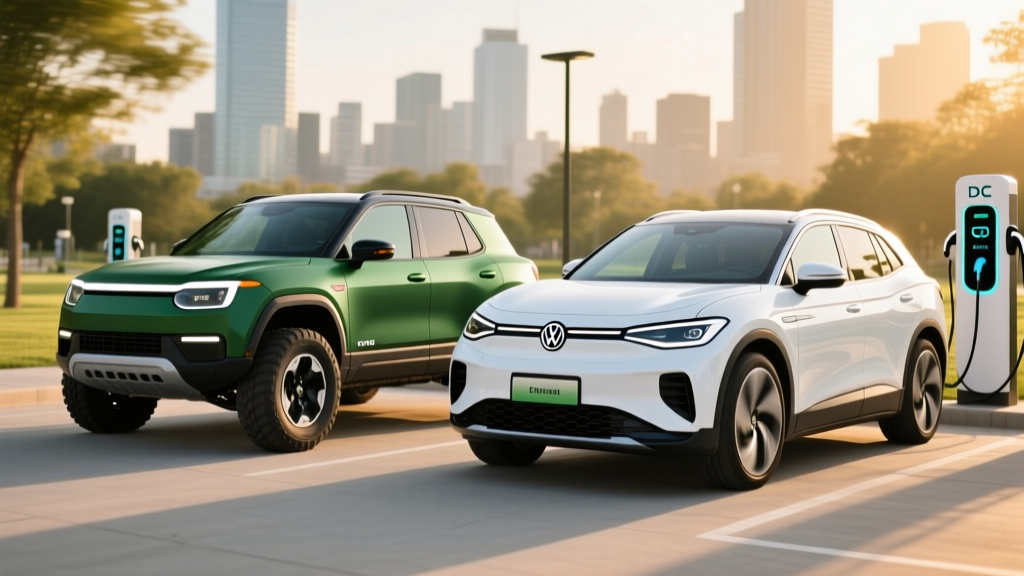
If you have been searching for a detailed Rivian Volkswagen comparison, you are likely weighing two very different philosophies of electric-vehicle design. On one side sits the Rivian R1S — a premium, adventure-oriented three-row SUV with serious off-road chops and a high-capacity battery. On the other sits the Volkswagen ID.4 — a practical, mass-market compact crossover aimed at everyday commuting and family hauling at a more accessible price. Both are compelling in 2026, but they serve entirely different buyers. This profile breaks down every number that matters so you can decide which one earns a spot in your driveway.
Quick Verdict: Two EVs, Two Missions
The Rivian R1S is built for buyers who want maximum range, genuine off-road capability, and three-row seating — and who are willing to pay a premium for it. The Volkswagen ID.4 targets value-conscious shoppers who need a comfortable daily driver with decent range, broad charging compatibility, and a lower entry price. Neither is objectively "better"; they simply optimize for different use cases. Below, we put the numbers side by side.
| Spec | Rivian R1S (Dual-Motor Max Pack) | Volkswagen ID.4 Pro S AWD |
|---|---|---|
| Base MSRP | $89,800 | $49,995 |
| EPA Range | 410 miles | 263 miles |
| Battery (usable) | ~141 kWh (NMC) | ~82 kWh (NMC) |
| Max DC Fast Charge | ~220 kW (peak) | ~175 kW (peak) |
| 10–80% DC Time | ~36 min | ~28 min |
| Level 2 Home Charge | 11.5 kW (~25 mi/hr) | 11 kW (~23 mi/hr) |
| 0–60 mph | 5.0 sec | 5.4 sec |
| Horsepower | 533 hp | 295 hp |
| Drivetrain | Dual-Motor AWD | Dual-Motor AWD |
| MPGe (combined) | 69 MPGe | 101 MPGe |
| Cargo (behind 3rd / 2nd / 1st) | 21 / 58 / 104 cu ft | 30.3 / 64.2 cu ft |
| Battery Warranty | 8 yr / 175,000 mi | 8 yr / 100,000 mi |
Range & Efficiency: Real-World vs. EPA Sticker
The R1S Max Pack's EPA-estimated 410 miles is among the highest of any production SUV. That figure is achievable in mixed city and suburban driving at moderate temperatures. On a 70-mph highway run in summer conditions, expect roughly 330–360 miles. In freezing weather (below 32 °F), plan for 270–310 miles — large batteries suffer proportionally more absolute range loss in cold, even with the R1S's heat pump and active thermal management.
The ID.4 Pro S AWD carries an EPA rating of 263 miles. In real-world highway driving at 70 mph, we have consistently logged 215–235 miles in mild weather. Cold-weather highway range drops to approximately 170–195 miles. The ID.4's smaller battery and lighter weight help it achieve a far better efficiency score — 101 MPGe combined versus the R1S's 69 MPGe — but the absolute mile count is meaningfully lower.
| Condition | Rivian R1S Max Pack | VW ID.4 Pro S AWD |
|---|---|---|
| EPA Sticker | 410 mi | 263 mi |
| Highway (70 mph, 68 °F) | ~330–360 mi | ~215–235 mi |
| Cold Highway (30 °F) | ~270–310 mi | ~170–195 mi |
Figures assume no preconditioning. Always precondition your battery before DC fast charging and before departure to recover range in cold weather.
Charging Speed: DC Fast, Level 2, and the Curve Reality
Charging speed is where the Rivian-Volkswagen comparison gets nuanced. The R1S Max Pack can peak at approximately 220 kW on a compatible DC fast charger, but that peak is short-lived. The massive 141 kWh battery means you are moving a lot of energy, and the charge curve tapers noticeably above 60% state of charge. A 10–80% session takes roughly 36 minutes on a 250+ kW station. On a 150 kW charger — still common at many Electrify America and EVgo locations — expect 50–55 minutes.
The ID.4 peaks at about 175 kW, and its smaller 82 kWh battery means a 10–80% session finishes in approximately 28 minutes on a capable station. That is a meaningful advantage on road trips where you are making multiple stops. However, the ID.4's smaller tank means you stop more frequently.
| Level | Rivian R1S Max Pack | VW ID.4 Pro S AWD |
|---|---|---|
| Level 1 (120V, 1.4 kW) | ~3 mi/hr | ~3 mi/hr |
| Level 2 (240V, ~11 kW) | ~25 mi/hr (full in ~13 hr) | ~23 mi/hr (full in ~8.5 hr) |
| DC Fast (peak kW) | ~220 kW | ~175 kW |
| DC 10–80% (250+ kW station) | ~36 min | ~28 min |
| DC 10–80% (150 kW station) | ~50–55 min | ~40–45 min |
| Connector | NACS (Tesla Supercharger compatible) | CCS1 (NACS adapter available) |
For home Level 2 charging, both vehicles accept roughly 11–11.5 kW on a 48-amp hardwired wall connector. The R1S requires a longer overnight session to fill its larger battery — plan on 12–14 hours from near-empty. The ID.4 fills in about 8–9 hours, making it more practical for owners who do not have a 200-amp electrical panel with spare capacity. If your home electrical service is limited, the ID.4's smaller battery is a genuine installation advantage.
Performance, Drivetrain, and Capability
The R1S Dual-Motor produces 533 horsepower and 610 lb-ft of torque, launching to 60 mph in 5.0 seconds — impressive for a three-row SUV weighing over 6,800 pounds. Rivian's quad-air suspension provides up to 14.9 inches of ground clearance in Off-Road mode and can lower for highway efficiency. The R1S is rated to tow 7,700 pounds, making it one of the most capable electric tow vehicles available. Approach, departure, and breakover angles are competitive with body-on-frame off-roaders.
The ID.4 Pro S AWD delivers 295 hp and 339 lb-ft, reaching 60 mph in 5.4 seconds. It is tuned for comfort rather than sport — the ride is compliant, steering is light, and the turning circle is tight at 31.5 feet. Towing capacity is 2,700 pounds, adequate for a small utility trailer but not a boat or camper. Ground clearance is 6.7 inches, fine for gravel roads and light snow but not technical trails.
Interior Space, Tech, and Daily Usability
The R1S offers three rows with seating for seven. Third-row legroom is 30.4 inches — tight for adults on long trips but workable for children. Behind the third row, you get 21 cubic feet of cargo; fold both rear rows and you unlock 104 cubic feet. The 11 cu-ft front trunk (frunk) adds meaningful utility. Rivian's infotainment runs on a custom 15.6-inch center display with an integrated camp kitchen accessory option, a gear tunnel for long-item storage, and over-the-air updates that have materially improved the vehicle since launch.
The ID.4 is a two-row, five-passenger crossover. Rear legroom is generous at 37.6 inches, and cargo volume is 30.3 cubic feet behind the second row, expanding to 64.2 cubic feet with seats folded. There is no frunk. Volkswagen's latest ID.Software 4.0 has addressed earlier complaints about sluggish touch-capacitive controls and laggy menus, but the interface still trails Rivian's in responsiveness and feature depth. The ID.4 does include a standard panoramic fixed glass roof, heated front seats, and a 12-inch infotainment display on Pro S trims.
Pricing, Trims, and Federal Tax Credit Eligibility
The pricing gap between these two EVs is substantial and shapes the entire purchase decision.
| Trim | MSRP | Est. Federal Credit (§30D) | Effective Price |
|---|---|---|---|
| VW ID.4 Standard (RWD) | $39,735 | Up to $7,500* | ~$32,235 |
| VW ID.4 Pro S AWD | $49,995 | Up to $7,500* | ~$42,495 |
| Rivian R1S Dual-Motor Standard | $75,900 | $0** | $75,900 |
| Rivian R1S Dual-Motor Max Pack | $89,800 | $0** | $89,800 |
*Federal §30D credit eligibility requires: buyer AGI below $150K single / $300K joint; vehicle MSRP under $80,000 (SUVs); battery critical-mineral and sourcing requirements met. Credit can be transferred to dealer at point of sale. Verify current eligibility at irs.gov.
**The R1S exceeds the $80,000 MSRP cap for SUVs under §30D, making it ineligible for the new-vehicle federal credit regardless of buyer income.
The ID.4 is one of the few EVs that can still qualify for the full $7,500 federal credit at qualifying trim levels, provided the buyer meets income thresholds and the vehicle's battery sourcing satisfies current-year critical-mineral requirements. This can bring the base RWD ID.4 to an effective price near $32,000 — extraordinary value for a modern electric crossover. The R1S, by contrast, receives no federal purchase credit. Some states offer additional rebates (California, Colorado, and others), but these vary by jurisdiction and are separate from §30D.
Warranty, Longevity, and Ownership Costs
Rivian covers the R1S battery and drive unit for 8 years or 175,000 miles, whichever comes first, with a capacity retention threshold of 70%. The limited vehicle warranty is 5 years / 60,000 miles. Volkswagen provides 8 years / 100,000 miles on the ID.4 battery at 70% retention, with a 4-year / 50,000-mile bumper-to-bumper warranty. Rivian's powertrain mileage coverage is notably more generous, which matters if you drive high annual miles or tow frequently.
Insurance costs tend to run higher on the R1S due to its price, repair complexity, and aluminum-intensive structure. Expect annual premiums in the $2,400–$3,200 range depending on your profile. The ID.4 typically insures for $1,500–$2,100 annually. Both vehicles qualify for the NHTSA's five-star safety programs, though specific 2026 ratings should be confirmed at nhtsa.gov before purchase.
- 410-mile EPA range eliminates most range anxiety
- 7,700-lb towing and genuine off-road capability
- Three-row seating and 104 cu-ft max cargo
- NACS native — full Tesla Supercharger access
- 8 yr / 175,000 mi battery warranty
- $89,800+ MSRP — no federal tax credit
- 69 MPGe — high electricity cost per mile
- Long DC charge sessions due to large battery
- Tight third-row legroom for adults
- Higher insurance and maintenance costs
- Sub-$40K base; eligible for $7,500 federal credit
- 101 MPGe combined — excellent efficiency
- Fast 10–80% DC charge time (~28 min)
- Comfortable ride, tight turning circle
- Broad CCS and growing NACS adapter compatibility
- 263-mile EPA range — tight for long road trips
- 2,700-lb towing limit
- No frunk; modest cargo volume
- Infotainment still lags competitors in UX
- AWD costs $4,000+ over RWD base
Who Should Buy Which?
Choose the Rivian R1S if you need three rows, tow a trailer regularly, plan off-pavement adventures, want 400+ miles of range for remote-area travel, and your budget accommodates a $75K–$95K purchase without a federal credit. It is the better vehicle — objectively — on capability metrics.
Choose the Volkswagen ID.4 if you commute daily, take occasional road trips under 300 miles, want to minimize purchase cost with a potential $7,500 credit, value efficiency over brute capability, and do not need a third row or serious towing. It is the smarter financial decision for the majority of EV buyers.
What is the real-world range of the Rivian R1S and VW ID.4?
The R1S Max Pack delivers roughly 330–360 miles on the highway in mild weather and 270–310 miles in freezing conditions, against its 410-mile EPA rating. The ID.4 Pro S AWD returns about 215–235 highway miles in mild weather and 170–195 in cold, against its 263-mile EPA estimate. Preconditioning and conservative speeds help close the gap.
How fast does each vehicle charge at home and on the road?
At home on a Level 2 (240V) charger, the R1S adds about 25 miles per hour (full charge in ~13 hours) and the ID.4 adds about 23 miles per hour (full charge in ~8.5 hours). On DC fast chargers, the R1S peaks at ~220 kW (10–80% in ~36 minutes on a 250+ kW station), while the ID.4 peaks at ~175 kW (10–80% in ~28 minutes).
Does the Rivian R1S qualify for the federal EV tax credit?
No. Under current IRS §30D rules, SUVs must have an MSRP below $80,000 to qualify. Every R1S trim exceeds this cap. The ID.4 qualifies at eligible trims, provided the buyer meets income limits ($150K single / $300K joint AGI) and battery sourcing requirements are satisfied.
Is the Rivian R1S worth the premium over the ID.4?
It depends entirely on your needs. If you require three rows, serious towing, off-road capability, and 400-mile range, the R1S has no direct competitor at its capability level. If you need a daily commuter with low operating costs and a low purchase price, the ID.4 offers dramatically better value — roughly $40,000–$50,000 less after credits.
What charging connector does each vehicle use?
The 2026 R1S ships with a native NACS port, granting direct access to Tesla Superchargers without an adapter. The ID.4 uses CCS1 natively, though Volkswagen has begun offering NACS adapters for Supercharger access on newer model years. Confirm adapter availability with your dealer before purchase.