The Rivian R1S occupies a rare niche: a three-row electric SUV that can genuinely off-road, tow over 7,500 pounds, and still fit a family's worth of gear. But for buyers cross-shopping the R1S against the Tesla Model X, Kia EV9, or even a three-row gas SUV, one question comes up constantly — how much cargo does the Rivian R1S trunk space actually deliver, and does the frunk make up for any shortfalls?
After driving the current-generation R1S on road trips, grocery runs, and camping weekends, and cross-referencing every dimension against the EPA, Rivian's spec sheets, and third-party testing, here's the complete picture. We'll cover cargo capacity with all three rows in use, the dual-motor and tri-motor powertrain options, real-world range versus the EPA sticker, charging speeds on NACS and CCS networks, and exactly what you'll pay after the federal tax credit.
Rivian R1S Trunk Space: Cargo Dimensions by Row Configuration
The R1S is a full-size, body-on-frame SUV built on Rivian's skateboard platform. That architecture gives it a flat floor and generous interior volume, but the third row does eat into rear cargo space when deployed. Here are the official cargo figures by configuration:
| Configuration | Cargo Volume (cu ft) | Real-World Notes |
|---|---|---|
| Behind 3rd row (all seats up) | ~20.3 cu ft | Fits 2-3 carry-ons or a week of groceries for a family of five. Tight for airport runs with six passengers. |
| 3rd row folded (5-passenger) | ~58.5 cu ft | Comfortable for a family road trip with large suitcases, a stroller, and camping gear. |
| 2nd & 3rd rows folded (max) | ~104.7 cu ft | Near-full-size-SUV volume. Handles furniture, bikes (with front wheel off), or a plywood sheet laid flat. |
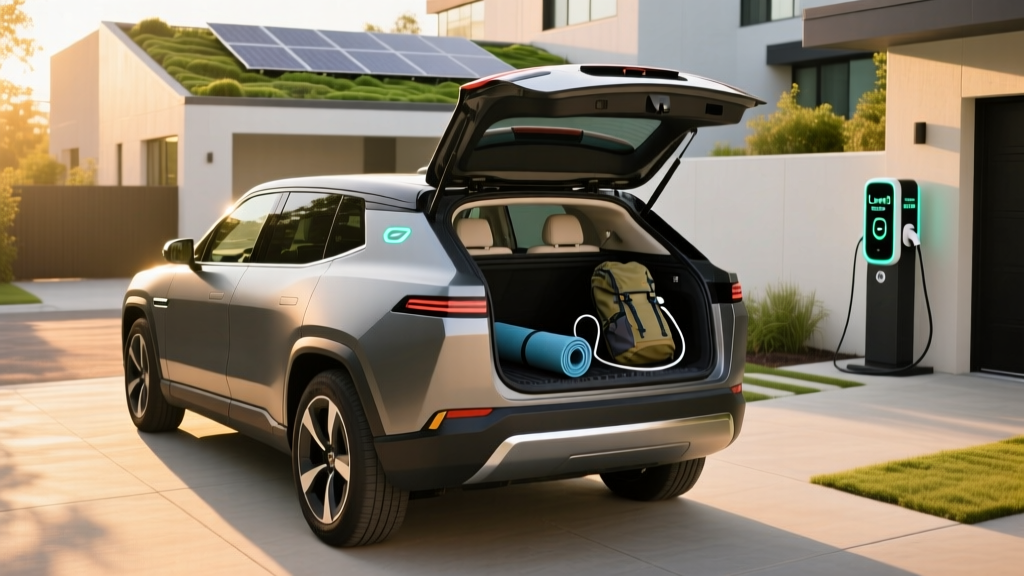
| Front trunk (frunk) | ~11.1 cu ft | Sealed, drainable, and perfect for muddy gear, charging cables, or a cooler. A major R1S advantage over most competitors. |
The bottom line on R1S trunk space: With all three rows up, the ~20 cu ft behind the third row is modest — less than a Toyota Highlander's ~16 cu ft but less generous than a Kia EV9's ~20.2 cu ft. For six- or seven-passenger airport runs, you'll need a roof box or trailer. Fold the third row and the R1S opens up dramatically, and the 11.1 cu ft frunk effectively acts as a bonus cargo zone that most three-row EVs don't offer.
Range, Battery & Efficiency: Real-World Expectations
Rivian offers the R1S with two battery packs across the 2025–2026 model years: the Standard (LFP chemistry, ~92 kWh usable) and the Max (NMC chemistry, ~141 kWh usable). A Large pack (~109 kWh, NMC) is also available on certain trims. EPA range varies significantly by pack, motor configuration, and wheel size.
EPA estimates assume a mixed city/highway drive at moderate temperatures. On a 70-mph highway run in 40°F weather, expect to lose roughly 20–30% from the EPA sticker. City driving with regenerative braking recovers more energy and typically matches or slightly beats EPA.
| Configuration | Battery (kWh, Chemistry) | EPA Range (mi) | Real-World Highway (est.) | Cold-Weather (est.) | MPGe (combined) |
|---|---|---|---|---|---|
| Dual-Motor Standard | ~92 kWh, LFP | 258 | ~215–230 | ~180–200 | 73 MPGe |
| Dual-Motor Large | ~109 kWh, NMC | 321 | ~265–285 | ~220–245 | 73 MPGe |
| Dual-Motor Max | ~141 kWh, NMC | 371 | ~310–335 | ~260–290 | 70 MPGe |
| Tri-Motor Performance Max | ~141 kWh, NMC | 342 | ~285–310 | ~240–270 | 67 MPGe |
Efficiency is listed by the EPA at roughly 70–73 MPGe combined, translating to about 47–49 kWh per 100 miles depending on configuration. For a 5,000+ lb SUV, that's competitive with the Model X and slightly behind the more aerodynamic Kia EV9. Source: fueleconomy.gov.
Charging Speed: DC Fast, Level 2 & the NACS Transition
Charging is where R1S ownership has gotten noticeably better since Rivian adopted the North American Charging Standard (NACS) port on new builds and opened access to Tesla's Supercharger network via adapter for older vehicles. Here's what to expect at each level:
| Level | Power / Rate | 10–80% Time | Notes |
|---|---|---|---|
| Level 1 (120V) | ~1.4 kW | Multi-day | Emergency/trickle only. ~3–4 mi/hr. |
| Level 2 (240V, Rivian Wall Charger) | 11.5 kW (48A) | Overnight (8–14 hrs depending on pack) | ~25 mi/hr. Ideal daily charging method. |
| DC Fast (Standard / LFP) | Peak ~200 kW | ~30 min (10–80%) | LFP packs tolerate frequent 100% charges; charge curve tapers sharply above 80%. |
| DC Fast (Large / Max, NMC) | Peak ~220 kW | ~27 min (10–80%) | Sustains strong power to ~60% SoC, then tapers. Preconditioning via nav is critical. |
Critical nuance: Peak kW is not sustained kW. The R1S Max pack will hold 180+ kW from roughly 20–55% SoC when preconditioned, then step down through the 80s and 90s. Charging from 10–80% in ~27 minutes is realistic on a 250+ kW Supercharger or Electrify America station; on a 150 kW charger, expect 35–40 minutes. Always precondition the battery by setting the charger as your navigation destination — skipping this can add 10+ minutes to your session in cold weather.
Performance: 0–60, Horsepower & Drivetrain
The R1S uses Rivian's dual-motor AWD layout as standard, with an available tri-motor Performance variant that adds a rear axle motor for serious output. All versions use a single-speed reduction gear — no traditional transmission.
| Trim | Drivetrain | Horsepower | Torque (lb-ft) | 0–60 mph | Towing |
|---|---|---|---|---|---|
| Dual-Motor Standard | AWD | 533 hp | 610 | 4.5 sec | 7,700 lbs |
| Dual-Motor Large/Max | AWD | 533 hp | 610 | 4.5 sec | 7,700 lbs |
| Tri-Motor Performance | AWD | 850 hp | 1,103 | 2.9 sec | 7,700 lbs |
Even the base dual-motor R1S will outrun most gas V8 SUVs off the line, and the tri-motor Performance variant enters supercar territory. Air suspension is standard and provides up to 14.9 inches of ground clearance in Off-Road mode, with approach/departure angles that rival a Jeep Wrangler. The R1S also wades through 3+ feet of water — an EV advantage since there's no air intake to flood.
Pricing, Trims & Federal Tax Credit (IRS §30D)
Rivian has simplified its trim structure for 2025–2026. The R1S is offered in Explore (base), Adventure, and Ascend (top luxury) trims, with battery and motor choices layered on top. Here's where pricing lands before and after incentives:
| Configuration | Base MSRP | As-Tested (typical) | §30D Federal Credit Eligibility |
|---|---|---|---|
| Dual-Motor Standard, Explore | ~$79,900 | ~$83,000 | Eligibility depends on battery sourcing & buyer income — see rules below. |
| Dual-Motor Max, Adventure | ~$94,900 | ~$100,000 | Subject to MSRP cap of $80,000 for SUVs — Max pack often exceeds cap. |
| Tri-Motor Performance, Ascend | ~$109,900 | ~$118,000 | Exceeds MSRP cap; not eligible for new-vehicle §30D credit. |
- MSRP cap: SUVs must be at or below $80,000 MSRP. Only the base Dual-Motor Standard R1S typically qualifies.
- Buyer income cap: $300,000 joint / $225,000 head of household / $150,000 single (MAGI, current or prior tax year).
- Battery sourcing: Critical minerals and battery components must meet escalating domestic-content thresholds. Rivian has been actively re-shoring supply chains, but eligibility can shift — verify at IRS.gov qualified vehicles list before purchasing.
- Point-of-sale transfer: Eligible buyers can transfer the credit to the dealer at purchase, reducing the out-of-pocket price by up to $7,500.
Tech, Driver Assists & Notable Drawbacks
The R1S runs Rivian's in-house software on a 15.6-inch center display and a 12.3-inch driver cluster. The UI is clean, over-the-air updates are frequent, and the built-in navigation integrates directly with charging networks to plan routes and precondition the battery. Apple CarPlay and Android Auto are wireless.
Driver assistance: The R1S comes with Rivian's Driver+ system, a SAE Level 2 feature combining adaptive cruise and lane-centering on divided highways. It is not self-driving — you must keep your hands on the wheel and eyes on the road. Hands-free highway assist has been rolling out via OTA but remains limited to mapped divided highways.
Rivian Driver+ is SAE Level 2. The driver is always responsible for steering, braking, and monitoring the road. This is the same automation class as Tesla Autopilot, Ford BlueCruise, and GM Super Cruise. Only Waymo and Zoox robotaxis operate at Level 4 (no driver required).
- Frunk adds 11.1 cu ft of sealed, drainable storage
- Class-leading off-road capability for an EV SUV
- 7,700-lb towing capacity
- Tri-motor Performance hits 0–60 in 2.9 sec
- Supercharger network access via NACS
- OTA updates continuously improve the vehicle
- ~20 cu ft behind 3rd row is tight for six passengers' luggage
- Base price near $80K; most configs exceed the §30D MSRP cap
- Efficiency (MPGe) trails the Kia EV9 and Model X
- Service center network still expanding in some regions
- Driver+ hands-free rollout has been slower than promised
Warranty, Ownership Costs & Who the R1S Is For
Rivian's warranty coverage is competitive with the premium EV segment:
| Coverage | Term |
|---|---|
| Basic Vehicle | 5 years / 60,000 miles |
| Battery & Drive Units | 8 years / 120,000 miles (retains ≥70% capacity) |
| Roadside Assistance | 5 years / 60,000 miles |
Insurance premiums on the R1S run higher than the segment average — expect $2,400–$3,600 annually depending on state, driver profile, and trim. Get quotes before purchasing. Rivian offers its own insurance product in some states, which can be competitive.
Who the R1S suits best:
- Active families who need three rows, tow a boat or camper, and want to take forest-service roads to the trailhead.
- Outdoor enthusiasts who value the frunk for muddy gear and the air suspension for variable terrain.
- Performance SUV buyers who want tri-motor acceleration without the Model X's polarizing styling.
Who should look elsewhere: Urban commuters who rarely use the third row (a Kia EV9 or Hyundai Ioniq 9 will cost less and park easier), and buyers whose budget tops out around $50K (consider the used-EV credit on a pre-owned R1S instead).
Rivian R1S Trunk Space FAQ
What is the real-world range of the Rivian R1S?
The EPA rates the Dual-Motor Large at 321 miles and the Max at 371 miles. In real-world highway driving at 70 mph in moderate weather, expect roughly 85% of the EPA number — around 270 miles for the Large and 315 for the Max. In freezing temperatures, subtract another 10–15% due to cabin heating and battery resistance.
How fast does the R1S charge at home and on the road?
At home on a Level 2 Rivian Wall Charger (11.5 kW / 48A), you'll add about 25 miles of range per hour — enough to fully replenish overnight. On a DC fast charger, the Large and Max packs peak around 220 kW and charge from 10–80% in roughly 27 minutes when preconditioned.
How much does the R1S cost after the federal tax credit?
Only the base Dual-Motor Standard R1S (MSRP near $79,900) typically falls under the $80,000 SUV cap for the §30D credit. If you qualify based on income and the battery meets sourcing requirements, the credit can bring the effective price to roughly $72,400 via point-of-sale transfer. Higher trims and Max-pack configurations exceed the MSRP cap and are not eligible for the new-vehicle credit.
Is the Rivian R1S worth it versus the Tesla Model X or Kia EV9?
If you need genuine off-road capability, 7,700-lb towing, and the sealed frunk, the R1S has no direct EV rival. The Model X offers more third-row cargo volume and faster Supercharger-native charging but starts higher and lacks ground clearance. The Kia EV9 is significantly cheaper and more efficient but cannot match the R1S on performance, towing, or off-road ability.
Does the Rivian R1S qualify for the federal EV tax credit?
Partially. The base Dual-Motor Standard R1S can qualify for up to $7,500 under IRS §30D if MSRP, buyer income, and battery-sourcing rules are all met. Verify on the IRS qualified clean vehicles list before purchase, as eligibility changes with supply-chain updates.
How much trunk space does the R1S have with all three rows up?
About 20.3 cubic feet behind the third row — enough for two to three carry-ons or a week of groceries. Add the 11.1 cu ft frunk and you have roughly 31.4 cu ft of combined enclosed storage, which is competitive with midsize gas SUVs. For full-family road trips, fold the third row to unlock 58.5 cu ft.