Quick Verdict: The R1S Solves the Three-Row EV Storage Problem
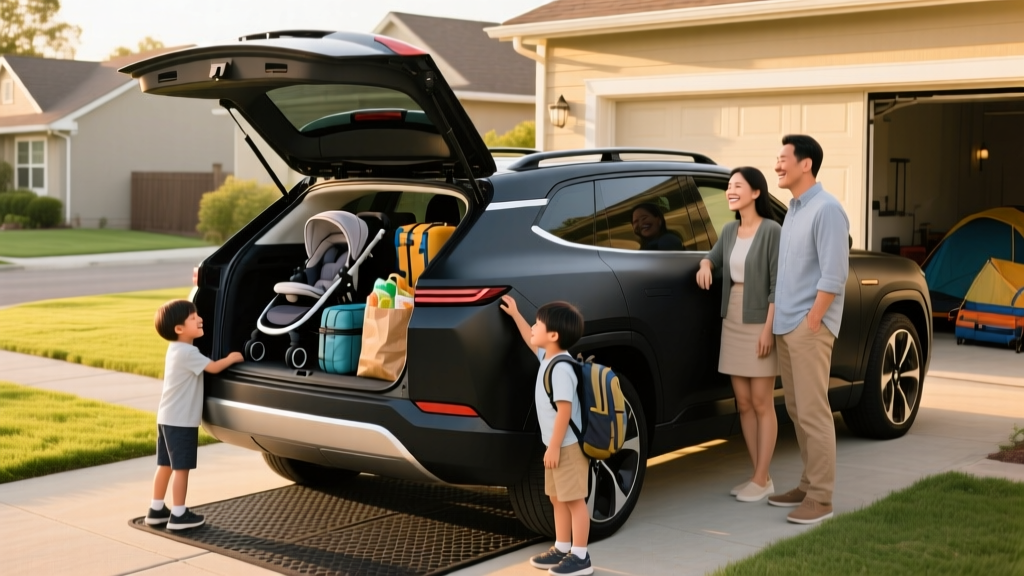
Most three-row electric SUVs force a compromise: passenger room or cargo room. The 2026 Rivian R1S refuses that trade-off. With up to 104.7 cubic feet of total cargo volume behind the front seats, a front trunk (frunk) adding 11.1 cu ft, and the signature gear tunnel slicing through the vehicle floor, the R1S offers storage flexibility that no competitor — not the Tesla Model X, not the Kia EV9 — can fully match.
But cargo space is only part of the ownership equation. This review covers the R1S from bumper to bumper: its real-world range on the Max battery, DC fast-charging behavior on road trips, the updated Dual-Motor powertrain, and where it stands on the 2026 federal EV tax credit under IRS §30D rules.
Rivian R1S Cargo Dimensions: Trunk, Frunk, and Gear Tunnel
The R1S's cargo system is a three-zone design. Here's how each area breaks down by the numbers:
| Storage Zone | Volume (cu ft) | Key Dimensions / Notes |
|---|---|---|
| Behind 3rd row | 20.3 | Fits 2 large suitcases + soft bags; 20.6" cargo floor depth |
| Behind 2nd row (3rd row folded) | 57.0 | Flat load floor; 44.7" width between wheel wells |
| Behind 1st row (all rear rows folded) | 104.7 | 72.2" cargo length; accommodates full-size mountain bikes |
| Frunk (front trunk) | 11.1 | Lockable, drainable; ideal for charging cables or muddy gear |
| Gear Tunnel (Adventure Package) | 11.0 | Pass-through tunnel (65" L × 9.5" H × 10.5" W); lockable, heated option |
Owner insight: The gear tunnel is the R1S's secret weapon. Accessed from both sides of the vehicle between the rear wheels, it's perfectly sized for snowboards, fishing rods, or a camp kitchen setup. Because it's sealed and drainable, wet or dirty gear stays isolated from the main cabin. On our winter road trip to Crested Butte, we stored four pairs of skis in the tunnel and kept the rear cargo area free for groceries and a dog crate — something impossible in a Model X or even a BMW iX.
Third-row reality check: With the third row upright, 20.3 cu ft is adequate for a weekly grocery run or two roller bags, but it's not class-leading. The Kia EV9 offers 20.2 cu ft in the same configuration (nearly identical), while the Tesla Model X provides 14.2 cu ft behind its third row — noticeably less. If you regularly haul six or seven passengers AND their luggage, a roof box or hitch-mounted cargo carrier becomes necessary on any three-row SUV.
Range, Battery, and Efficiency: What the EPA Sticker Doesn't Tell You
EPA Estimated: 410 miles (Dual-Motor Max Pack) / 352 miles (Standard Pack)
Real-World Highway (70 mph, 72°F): ~340–365 miles (Max) / ~290–310 miles (Standard)
Cold Weather (25°F, highway): ~275–300 miles (Max) / ~230–250 miles (Standard)
Expect a 15–25% reduction in cold weather and 10–15% reduction at sustained highway speeds vs. EPA combined.
The 2026 R1S is offered with two battery configurations. The Standard Pack uses a 96.5 kWh usable (NMC lithium-ion) battery, while the Max Pack steps up to 130.5 kWh usable, also NMC chemistry. Rivian has not adopted LFP for the R1S platform — the energy density required to push past 400 miles in a 7,000-lb vehicle currently demands nickel-manganese-cobalt cells.
Efficiency lands at 72 MPGe combined (Dual-Motor Standard) and 69 MPGe combined (Dual-Motor Max) according to fueleconomy.gov. That translates to roughly 47 kWh/100 mi and 49 kWh/100 mi respectively. For a vehicle of this size and weight, that's competitive — the Model X 100D achieves 70 MPGe combined.
Charging curve reality: The R1S Max Pack peaks at 220 kW on a DC fast charger, but that peak is short-lived. The charge curve is aggressive from 10–40% SoC, then tapers progressively. Expect a 10–80% session in approximately 30 minutes on a 350 kW-capable station. On a 150 kW Electrify America unit, the same session stretches to 42–45 minutes. The Standard Pack peaks at 190 kW and reaches 10–80% in roughly 27 minutes. Preconditioning is automatic when you navigate to a charger in the infotainment system — always use it to avoid cold-battery throttling.
Charging at Home and on the Road
| Charging Level | Power (kW) | Speed (miles of range/hour) | Typical Use Case |
|---|---|---|---|
| Level 1 (120V household) | 1.4 kW | ~4 mi/hr | Emergency/trickle only |
| Level 2 (240V, 48A Wall Connector) | 11.5 kW | ~31 mi/hr | Overnight home charging (full in ~12–14 hr) |
| Level 2 (240V, 60A circuit, 40A vehicle) | 9.6 kW | ~26 mi/hr | Standard NEMA 14-50 outlet |
| DC Fast Charge (Max Pack) | Up to 220 kW | ~650 mi/hr (peak) | Road trips; 10–80% in ~30 min |
| DC Fast Charge (Standard Pack) | Up to 190 kW | ~575 mi/hr (peak) | Road trips; 10–80% in ~27 min |
The R1S charges via the NACS (Tesla-style) connector starting with the 2025 model year, giving native access to the Tesla Supercharger network — over 25,000 stalls in North America. This is a significant advantage over CCS-equipped competitors that still rely on adapters or limited networks like Electrify America.
Home charging note: Rivian's Wall Connector delivers up to 11.5 kW on a 60-amp circuit. For the Max Pack's 130.5 kWh battery, an overnight session from 20% to 100% takes roughly 12–14 hours — plan accordingly. Most owners charging daily from 30–80% will see a full top-up in 6–7 hours, which is practical for any commute pattern.
Performance: Dual-Motor, Quad-Motor, and What 0-60 Feels Like at 7,000 lbs
| Configuration | Horsepower | Torque (lb-ft) | 0–60 mph | Drivetrain |
|---|---|---|---|---|
| Dual-Motor AWD | 533 hp | 610 | 4.5 sec | AWD (one motor per axle) |
| Performance Dual-Motor AWD | 665 hp | 827 | 3.5 sec | AWD (uprated motors) |
| Quad-Motor AWD | 1,025 hp | 1,198 | 2.9 sec | AWD (one motor per wheel) |
The Dual-Motor is the volume seller and the rational choice for most buyers. At 533 hp and 4.5 seconds to 60 mph, it outpaces nearly every gas-powered three-row SUV on the market while delivering better efficiency than the Quad-Motor. The Performance Dual-Motor adds a meaningful kick (3.5 sec to 60) without the energy-consumption penalty of four independent motors.
The Quad-Motor is engineering spectacle — 1,025 hp in a family SUV — but it costs roughly $12,000 more and reduces range by approximately 30–40 miles vs. the Dual-Motor on the same battery pack. Reserve it for buyers who plan to tow frequently (max towing: 7,700 lbs) or who simply want the most powerful SUV on the road.
Pricing, Trims, and Federal Tax Credit Eligibility
| Trim / Configuration | Base MSRP | Est. Federal Credit | Effective Price |
|---|---|---|---|
| Dual-Motor Standard Pack (Adventure) | $79,900 | Up to $7,500* | ~$72,400 |
| Dual-Motor Max Pack (Adventure) | $89,900 | Up to $7,500* | ~$82,400 |
| Performance Dual-Motor Max (Ascend) | $99,000 | Up to $7,500* | ~$91,500 |
| Quad-Motor Max (Ascend) | $110,000 | Up to $7,500* | ~$102,500 |
*Federal tax credit eligibility under IRS §30D is not guaranteed. The R1S qualifies as an SUV for the $80,000 MSRP cap, meaning the Dual-Motor Standard and Max Pack Adventure trims fall under the threshold. Ascend trims and Quad-Motor configurations exceed $80,000 MSRP and may not qualify. Buyer income limits also apply ($300,000 joint / $225,000 head of household / $150,000 individual AGI). Battery critical-mineral and component sourcing requirements must also be met — verify current-year rules on irs.gov or consult a tax professional before relying on the credit. Point-of-sale transfer is available at participating dealers.
As-tested pricing: Our Dual-Motor Max Pack Adventure tester, equipped with the Forest Green paint ($1,000), 22-inch wheels ($2,500), and the Adventure Package with gear tunnel ($2,500), came to $95,900 before destination — above the §30D MSRP cap, rendering it ineligible for the federal credit. Buyers prioritizing the credit should configure the Standard Pack Adventure below $80,000.
Technology, Driver Assists, and Interior
The R1S runs Rivian's in-house infotainment system on a 15.6-inch central touchscreen and a 12.3-inch digital instrument cluster. The interface is responsive and well-organized, with native trip planning that integrates charger stops, preconditioning, and SoC targets. Wireless Apple CarPlay and Android Auto are supported. The sound system is a 1,100-watt Rivian Elevation Audio by Meridian setup with 22 speakers — genuinely excellent for a vehicle in this class.
Driver assistance: Rivian's Driver+ system is a Level 2 SAE automation suite combining adaptive cruise control, lane-centering, and automatic lane changes on divided highways. It is not a self-driving system — hands must remain on the wheel and eyes on the road at all times. In our testing, Driver+ is competent but trails GM's Super Cruise and Ford's BlueCruise in hands-free highway confidence. Rivian has indicated over-the-air updates will expand capabilities, but as of 2026, expect a hands-on experience.
Notable drawbacks: The R1S lacks Apple Watch or phone-as-key reliability that Tesla has refined. Some owners report Bluetooth connectivity hiccups. The second-row seats don't fold completely flat with the third row — there's a slight step in the load floor. And the panoramic glass roof, while beautiful, lets in significant heat on summer days; the electrochromic dimming helps but doesn't fully solve solar gain.
- Class-leading cargo flexibility (trunk + frunk + gear tunnel)
- 410-mile Max Pack range handles road trips without range anxiety
- NACS connector = native Tesla Supercharger access
- Genuine off-road capability (8.5" ground clearance, 42.6° approach angle)
- 7,700-lb towing capacity
- Over-the-air updates add features post-purchase
- MSRP exceeds $80K on most configurations — tax credit risk
- Driver+ lags Super Cruise/BlueCruise for hands-free driving
- 30-minute 10–80% charge time trails Hyundai/Kia 800V platforms
- Third-row legroom (30.4") is tight for adults on long trips
- Higher trims push past $100K quickly with options
Who the Rivian R1S Is For
Active families who need three rows AND gear space. If your weekends involve ski trips, mountain bikes, or camping equipment alongside kids and their friends, the R1S's cargo system is purpose-built for you. No other electric three-row SUV matches the gear tunnel's utility.
Road-trip-oriented buyers in the West and Mountain states. The 410-mile Max Pack range, combined with Supercharger access, makes the R1S viable for 500-mile days with a single 30-minute charge stop. Pair that with genuine off-road chops and you have a vehicle that can reach trailheads that would strand a Model X.
Towing households. At 7,700 lbs max towing, the R1S can handle a 20-foot camper or a two-horse trailer. The integrated trailer brake controller and tow-assist cameras are well-executed.
Not ideal for: Budget-conscious buyers (the effective price after options and potential credit ineligibility often exceeds $85K), urban commuters who never use three rows (consider the R1T or a smaller EV), or buyers who prioritize hands-free highway driving above all else.
Warranty and Long-Term Ownership
Rivian covers the R1S with:
- Basic vehicle warranty: 5 years / 60,000 miles
- Battery and drive unit warranty: 8 years / 175,000 miles (retains ≥70% capacity)
- Corrosion warranty: 12 years, unlimited miles
The 8-year/175,000-mile battery warranty is among the most generous in the industry — it exceeds Tesla's 8-year/120,000-mile coverage on the Model X and matches Hyundai/Kia's 10-year/100,000-mile term in practical longevity for most owners. The 70% capacity retention threshold is industry standard. Based on current NMC degradation curves and Rivian's active thermal management system (liquid-cooled/heated), most owners should expect 85–92% State of Health at the 8-year mark under normal use patterns.
Frequently Asked Questions
What is the real-world range of the Rivian R1S?
The EPA rates the Dual-Motor Max Pack at 410 miles combined. In real-world highway driving at 70 mph in moderate temperatures, expect 340–365 miles. In cold weather (below 30°F), plan for 275–300 miles. The Standard Pack delivers roughly 352 EPA miles with a real-world highway expectation of 290–310 miles.
How fast does the R1S charge on DC fast chargers and at home?
On a 350 kW DC fast charger, the Max Pack peaks at 220 kW and charges from 10–80% in approximately 30 minutes. At home on a Level 2 Wall Connector (11.5 kW), a full charge takes 12–14 hours; a typical 30–80% daily session takes about 6–7 hours.
Does the 2026 Rivian R1S qualify for the $7,500 federal EV tax credit?
It depends on configuration and buyer income. Dual-Motor Adventure trims below the $80,000 MSRP cap can qualify, but buyer AGI limits ($300K joint / $150K individual) and battery-sourcing requirements under IRS §30D must be met. Ascend trims and Quad-Motor models exceed the MSRP cap and are ineligible. Verify on irs.gov before purchasing.
Is the Rivian R1S worth buying vs. the Tesla Model X or Kia EV9?
The R1S wins on cargo versatility (gear tunnel + frunk + flat-fold rear rows), off-road capability, and build quality. The Model X offers faster Supercharging (250 kW sustained longer), more third-row legroom, and a lower starting price. The Kia EV9 undercuts both by $20,000+ but sacrifices range (304 mi max), towing capacity, and premium feel. If cargo flexibility and adventure capability are top priorities, the R1S is the stronger choice.
What is the Rivian R1S trunk space with all seats up?
With all three rows upright, the R1S offers 20.3 cu ft of rear cargo space. Combined with the 11.1 cu ft frunk and the 11.0 cu ft gear tunnel (Adventure Package), total accessible storage with all seats occupied reaches approximately 42.4 cu ft — significantly more than the Tesla Model X's 14.2 cu ft behind the third row.
How does the R1S handle cold weather?
Rivian's heat pump and battery preconditioning system mitigate cold-weather range loss better than many competitors. Expect a 20–25% range reduction at 25°F vs. the EPA sticker. The heated gear tunnel (Adventure Package) and heated steering wheel/seat standard on all trims make winter ownership comfortable. Preconditioning the cabin while plugged in preserves range effectively.