Quick Verdict: The R1S in 2026
The 2026 Rivian R1S remains one of the only fully electric three-row SUVs that can genuinely handle off-road trails, tow over 7,000 pounds, and deliver a 350-mile EPA range estimate on a single charge. With the dual-motor and new tri-motor configurations, Rivian has refined the R1S into a sharper, faster, and more efficient machine than its 2022 launch version. But the real conversation this season centers on the Rivian Summer Adventure Offer — a limited-time incentive package that bundles accessories, charging credits, and subscription perks on top of the vehicle's already competitive positioning against the Tesla Model X, Kia EV9, and upcoming Jeep Wagoneer S.
Below, we break down every spec that matters — from real-world range to DC charging curves, tax credit eligibility, and whether the Summer Adventure Offer tips the scales for buyers on the fence.
Range, Battery, and Real-World Efficiency
| Spec | Dual-Motor (Standard) | Dual-Motor (Max Pack) | Tri-Motor (Max Pack) |
|---|---|---|---|
| EPA Est. Range | ~290 mi | ~350 mi | ~330 mi |
| Battery Capacity (usable) | ~92 kWh (NMC) | ~128 kWh (NMC) | ~128 kWh (NMC) |
| Battery Chemistry | NMC (Nickel Manganese Cobalt) | NMC | NMC |
| Efficiency (MPGe combined) | ~73 MPGe | ~69 MPGe | ~65 MPGe |
| Efficiency (kWh/100 mi) | ~46 kWh | ~49 kWh | ~52 kWh |
Rivian sticks with NMC lithium-ion cells across the R1S lineup, favoring energy density over the longer cycle life of LFP (lithium iron phosphate). This is the right call for a large SUV where packing maximum kWh matters more than 10,000+ charge cycles. The thermal management system is liquid-cooled and actively preconditioned during navigation to a DC fast charger — a critical feature that keeps charge speeds consistent.
Charging Speed: DC Fast, Level 2, and Home Setup
| Charging Level | Power / Rate | What You Get |
|---|---|---|
| DC Fast Charge (peak) | Up to 220 kW (Max Pack) | 10–80% in ~30 minutes; peak speed tapers significantly above 80% |
| DC Fast Charge (Standard) | Up to 200 kW | 10–80% in ~28 minutes |
| Level 2 (home, 48A / 11.5 kW) | 11.5 kW | ~25 miles of range per hour; full charge in ~10–13 hours |
| Level 2 (home, 32A / 7.7 kW) | 7.7 kW | ~17 miles of range per hour; full charge in ~15–18 hours |
| Level 1 (120V outlet) | ~1.4 kW | ~3 miles per hour — emergency/trickle only |
The R1S uses the NACS (North American Charging Standard) connector natively on 2025+ models, giving it direct access to Tesla Supercharger V3 and V4 stations without an adapter — a significant practical advantage over CCS-only vehicles. On Electrify America and other CCS networks, the NACS-to-CCS adapter (included with earlier models) still works, though Rivian recommends NACS-native stations for the most reliable handshake.
Charging curve reality check: The 220 kW peak on the Max Pack is sustained roughly from 10% to 35% State of Charge (SoC). After that, the curve tapers to ~150 kW through 60%, and drops below 100 kW past 75%. This is typical for large NMC packs — peak kW numbers are marketing-friendly, but your actual 10–80% session averages closer to 140–160 kW. Plan road-trip stops around the 20-minute mark for a 10–60% top-up rather than waiting for 80%.
For home charging, Rivian recommends a 60-amp dedicated circuit feeding a 48-amp Level 2 wall connector. Most buyers will need a licensed electrician to install a NEMA 14-60 outlet or hardwired EVSE. Expect $800–$2,500 for installation depending on panel capacity and run length; if your home has a 100-amp main panel, a $1,500–$3,000 panel upgrade to 200 amps may be necessary.
Performance, Drivetrain, and Capability
| Spec | Dual-Motor AWD | Tri-Motor AWD |
|---|---|---|
| Horsepower | 533 hp | 850 hp |
| Torque | 610 lb-ft | 1,103 lb-ft |
| 0–60 mph | ~4.5 seconds | ~2.9 seconds |
| Drivetrain | Dual-motor AWD | Tri-motor AWD (rear torque vectoring) |
| Max Towing Capacity | 7,700 lbs | 7,700 lbs |
| Ground Clearance (max) | 14.9 inches (air suspension) | 14.9 inches (air suspension) |
| Water Fording | ~36 inches | ~36 inches |
The tri-motor R1S is absurdly quick for a 6,800-pound SUV — 2.9 seconds to 60 mph puts it in supercar territory. But for most buyers, the dual-motor's 4.5-second sprint is more than adequate and comes with a meaningful range and price advantage. Both configurations feature Rivian's quad-motor-inspired torque distribution, adaptive air suspension with multiple ride heights, and a dedicated off-road mode that adjusts damping, throttle response, and regen behavior for loose surfaces.
Towing is a legitimate use case here. The 7,700-pound rating handles most boat trailers, small campers, and car haulers. However, towing cuts range roughly in half — expect 150–175 miles on the Max Pack when pulling 5,000+ pounds at highway speed. Rivian's built-in trailer brake controller and tow-assist cameras make the experience more manageable than most competitors.
Interior, Cargo, and Technology
The R1S seats up to seven passengers across three rows. Second-row captain's chairs (standard on Adventure and above) reduce capacity to six but dramatically improve comfort and third-row access.
| Dimension | Measurement |
|---|---|
| Cargo (behind 3rd row) | ~20 cu ft |
| Cargo (3rd row folded) | ~57 cu ft |
| Cargo (all rear rows folded) | ~104 cu ft |
| Front Trunk (frunk) | ~11 cu ft |
| 2nd-row legroom | ~39.5 inches |
| 3rd-row legroom | ~30.4 inches |
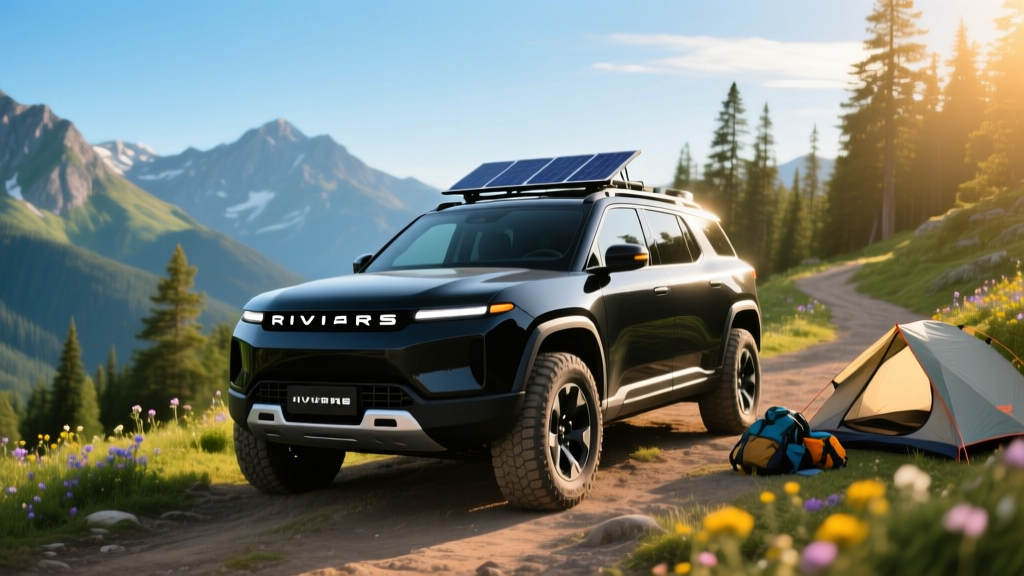
The third row is best suited for children or short-trip adults — 30.4 inches of legroom is tight compared to the Kia EV9's ~32 inches, but the R1S trades that space for its off-road hardware and frunk. The frunk itself is a standout feature: 11 cubic feet of lockable, drainable storage that doubles as a cooler for tailgating — a perfect tie-in to the summer adventure theme.
On the tech side, the R1S runs Rivian's in-house infotainment on a 15.6-inch landscape touchscreen with a secondary 12.3-inch driver cluster. Wireless Apple CarPlay and Android Auto are standard. The vehicle's software receives regular over-the-air (OTA) updates that have meaningfully improved navigation, charge planning, and driver-assist features since launch.
Driver assistance (SAE Level 2): Rivian's Driver+ system combines adaptive cruise control with lane-centering on divided highways. It is a hands-on system — you must keep your hands on the wheel. It does not support hands-free driving like GM's Super Cruise or Ford's BlueCruise. The system is competent but not class-leading; it occasionally hunts for lane markers on faded highway lines and can be conservative in merge scenarios. Rivian has indicated an enhanced highway assist feature is in development, but as of mid-2026, Driver+ remains a conventional Level 2 system.
Pricing, Trims, and the Rivian Summer Adventure Offer
| Trim / Config | Base MSRP | Est. Fed. Credit | Effective Price |
|---|---|---|---|
| Dual-Motor Standard (Adventure) | ~$79,900 | $0 (over MSRP cap) | ~$79,900 |
| Dual-Motor Max Pack (Adventure) | ~$89,400 | $0 (over MSRP cap) | ~$89,400 |
| Tri-Motor Max Pack (Ascend) | ~$105,000 | $0 (over MSRP cap) | ~$105,000 |
Federal tax credit reality: Under current IRS §30D rules, the new clean vehicle credit offers up to $7,500 — but SUVs must have an MSRP at or below $80,000 to qualify. The R1S Adventure Dual-Motor with the Standard battery pack sits right at that threshold, but once you add destination charges, paint upgrades, or any package, the adjusted MSRP typically exceeds the cap. The Max Pack and Tri-Motor configurations are well above the limit. Additionally, buyers must meet income caps ($150,000 single / $300,000 joint AGI), and the vehicle's battery must satisfy critical-mineral and component sourcing requirements. Consult a tax professional before assuming eligibility.
The Rivian Summer Adventure Offer (2026): This seasonal promotional package is Rivian's answer to the lack of federal credit eligibility on most R1S configurations. While exact terms vary by delivery window and inventory, recent Summer Adventure Offers have included:
- $3,000–$5,000 in accessory credits redeemable toward Rivian's gear shop (roof racks, crossbars, camp kitchen, all-weather floor liners)
- Complimentary DC fast charging credits on partner networks (typically 500–1,000 kWh of free charging — roughly 1,500–3,000 miles of driving)
- One year of Rivian Premium connectivity included (satellite maps, music streaming, OTA features)
- Discounted or included Gear Tunnel or Camp Kitchen accessories for Adventure-trim buyers
The combined value of these perks can reach $5,000–$8,000, partially offsetting the gap left by the federal tax credit's MSRP cap. For buyers who plan to use the R1S as an adventure and overlanding platform — which is arguably its strongest use case — the accessory credits alone can cover a roof-top tent rack, all-terrain tires, and recovery gear.
Warranty and Long-Term Ownership
| Coverage | Term |
|---|---|
| Basic Vehicle Warranty | 5 years / 60,000 miles |
| Battery & Drive Unit (Powertrain) | 8 years / 175,000 miles |
| Battery Capacity Guarantee | 70% retention at 8 yr / 175,000 mi |
| Corrosion Perforation | 12 years / unlimited miles |
| Roadside Assistance | 5 years / 60,000 miles |
Rivian's battery warranty is competitive and slightly more generous on mileage than Tesla's 8-year/150,000-mile coverage on the Model X. The 70% capacity retention threshold is industry-standard — if the battery degrades below 70% of original usable kWh within the warranty window, Rivian will repair or replace it. Based on NMC degradation data from similar large-format packs, most owners can expect roughly 5–8% capacity loss in the first 100,000 miles under normal use, stabilizing afterward. Avoiding routine 100% charges and extreme heat exposure will help preserve long-term State of Health (SoH).
One ownership consideration: Rivian's service center network is still expanding. As of 2026, the company operates roughly 50+ service centers and a growing mobile service fleet, but rural owners may face longer wait times for bodywork or complex diagnostics compared to legacy brands. Rivian's mobile service vans handle many routine repairs at your home, which partially mitigates the gap.
How It Compares: R1S vs. the Competition
The Tesla Model X remains the R1S's closest rival in price and performance, but its aging interior, panel-gap reputation, and lack of genuine off-road capability make it a different animal. The R1S wins on build quality, outdoor utility, and overall design cohesion. The Model X wins on Supercharger network maturity (though the gap is closing with NACS adoption) and its available hands-free-capable Autosteer on more road types.
Pros, Cons, and Who Should Buy
- Class-leading off-road capability and 7,700-lb towing
- Up to 350 miles EPA range (Max Pack)
- NACS native — direct Supercharger access
- Excellent build quality and thoughtful adventure features (frunk, gear tunnel, camp kitchen)
- Tri-motor performance is supercar-level in a family SUV
- Summer Adventure Offer adds meaningful value via accessories and charging credits
- Strong OTA update track record improving the vehicle over time
- Does not qualify for the $7,500 federal tax credit on most configurations (MSRP cap)
- Third row is tight for adults on long trips
- Driver+ is competent but behind Super Cruise and BlueCruise in hands-free capability
- Service center network still growing — rural owners may face wait times
- Towing cuts range roughly in half
- Premium pricing — fully loaded tri-motor exceeds $105,000
Choose the Kia EV9 if: Your priority is family hauling on pavement, you want federal tax credit eligibility, and you don't need off-road capability or heavy towing.
Choose the Tesla Model X if: You prioritize the most mature Supercharger network, want available hands-free-capable driving assist on highways, and don't plan to go off-road or tow heavy loads regularly.
Frequently Asked Questions
What is the real-world range of the 2026 Rivian R1S?
The EPA rates the R1S Max Pack at approximately 350 miles. In real-world highway driving at 70–75 mph in warm weather, expect 280–310 miles. Cold weather (below 30°F) drops that to roughly 260–290 miles. The Standard pack delivers around 230–255 real-world highway miles.
How fast does the R1S charge at home and on the road?
On a DC fast charger, the Max Pack peaks at 220 kW and charges from 10–80% in approximately 30 minutes, though the average session speed is closer to 140–160 kW due to charge-curve tapering. At home on a 48-amp Level 2 charger (11.5 kW), you'll add about 25 miles of range per hour, fully recharging overnight in 10–13 hours.
Does the Rivian R1S qualify for the federal EV tax credit?
Most R1S configurations do not qualify for the §30D federal tax credit. The IRS caps SUV eligibility at $80,000 MSRP, and most R1S builds — especially with options, destination, and Max Pack batteries — exceed that threshold. Buyer income limits ($150K single / $300K joint) and battery sourcing requirements add further restrictions. The Rivian Summer Adventure Offer is designed to partially offset this gap with accessory credits and free charging.
Is the R1S worth buying over the Tesla Model X or Kia EV9?
If your use case includes off-roading, towing, and outdoor adventure, the R1S has no real competitor. The Model X is faster in a straight line (Plaid) but can't match the R1S off-pavement. The EV9 is more affordable and credit-eligible but is a pavement-only family hauler. For pure adventure utility, the R1S is the segment leader.
What's included in the Rivian Summer Adventure Offer?
While terms vary by delivery window, the 2026 Summer Adventure Offer typically includes $3,000–$5,000 in accessory credits, complimentary DC fast charging credits (500–1,000 kWh), and one year of premium connectivity. Combined value can reach $5,000–$8,000, helping offset the lack of federal tax credit eligibility.
What is the battery warranty on the R1S?
Rivian covers the R1S battery and drive unit for 8 years or 175,000 miles, whichever comes first, with a guaranteed minimum of 70% capacity retention during that period. The basic vehicle warranty covers 5 years or 60,000 miles.