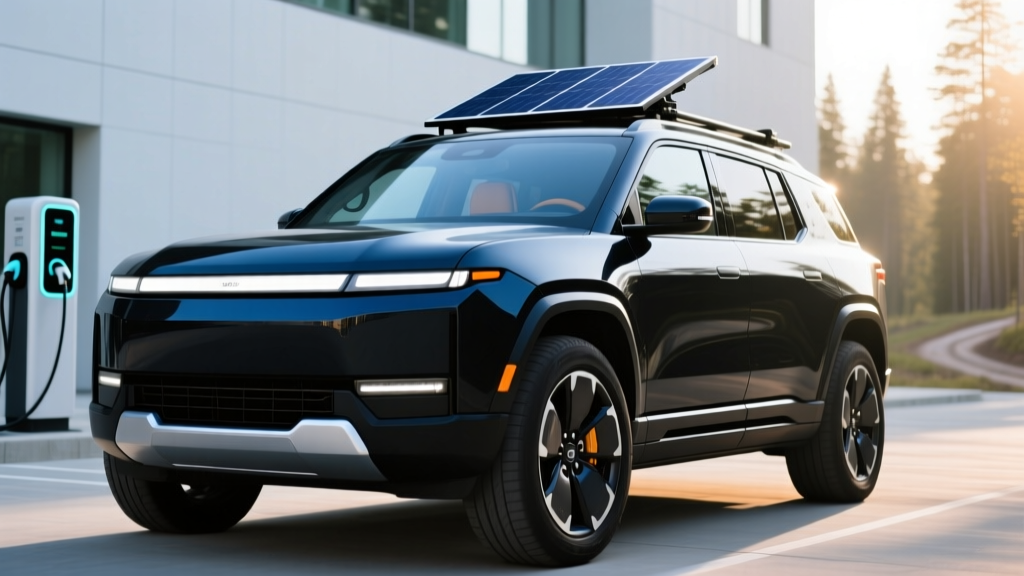
The Rivian R1S occupies a rare niche: a three-row electric SUV that can tow 7,700 pounds, ford 36 inches of water, and still fit in a standard American garage. But for buyers researching the Rivian R1S size — whether for garage clearance, third-row usability, or cargo capacity — the details matter. This guide covers the 2026 Rivian R1S across every dimension that counts, from exterior footprint to real-world range, charging speed, and total cost after federal incentives.
Exterior Dimensions: How Big Is the Rivian R1S?
The R1S rides on the same platform as the R1T pickup but wraps its underpinnings in a three-row SUV body. Here is how the physical footprint breaks down:
| Dimension | Measurement |
|---|---|
| Overall Length | 200.8 inches |
| Width (mirrors out) | 81.8 inches |
| Width (mirrors folded) | 77.3 inches |
| Height (standard ride) | 73.0 inches |
| Wheelbase | 121.1 inches |
| Ground Clearance (max) | 14.4 inches |
| Curb Weight (Dual-Motor) | ~7,150 lbs |
| Turning Circle | 40.7 ft |
At just under 17 feet long, the R1S fits a standard two-car garage (typically 18–20 feet deep), but the 81.8-inch width with mirrors extended demands attention. Fold the mirrors and you drop to 77.3 inches — still wider than a Toyota Sequoia (79.9 in) but within most garage door openings. The air suspension can lower the vehicle roughly 1.6 inches for easier entry and garage clearance, which helps in tight parking structures with 6'8" height limits.
Interior Space: Cargo Volume, Legroom, and Three-Row Reality
The R1S seats up to seven passengers in a 2-3-2 configuration. Here is where the size story gets nuanced — the R1S is a genuine three-row SUV, but the third row is best suited for children or occasional adult use on short trips.
| Measurement | Specification |
|---|---|
| Front Headroom | 41.0 in |
| Front Legroom | 41.3 in |
| Second-Row Legroom | 37.7 in |
| Third-Row Legroom | 30.4 in |
| Cargo (behind 3rd row) | 10.4 cu ft |
| Cargo (3rd row folded) | 46.7 cu ft |
| Cargo (all rear rows folded) | 83.5 cu ft |
| Front Trunk (Frunk) | 11.0 cu ft |
The 10.4 cubic feet behind the third row is tight — think two carry-on bags and a backpack. Fold the third row and you unlock a practical 46.7 cu ft, enough for a week's family luggage or a large dog crate. The 11-cu-ft frunk adds secure, weatherproof storage that competitors like the Jeep Grand Cherokee 4xe simply don't offer. Compared to the Kia EV9 (itself a three-row electric SUV), the R1S gives up a small amount of third-row legroom but gains significant ground clearance and off-road capability in exchange.
Battery, Range, and Real-World Efficiency
Rivian offers the 2026 R1S in three battery configurations. All use NMC (nickel manganese cobalt) lithium-ion chemistry, chosen for its higher energy density — critical in a 7,000+ pound vehicle. LFP chemistry is not currently available in the R1S, as the pack size required for acceptable range at this weight would be impractically heavy.
| Battery Pack | Usable Capacity | Drivetrain | EPA Range | MPGe (Combined) |
|---|---|---|---|---|
| Standard | ~92 kWh | Dual-Motor AWD | 270 mi | 73 MPGe |
| Large | ~109 kWh | Dual-Motor AWD | 321 mi | 73 MPGe |
| Max | ~141 kWh | Dual-Motor AWD | 410 mi | 72 MPGe |
For the most current EPA figures, refer to fueleconomy.gov.
Charging Speed: DC Fast Charge and Home Level 2
Charging speed remains one of the most consequential ownership factors for any EV — especially a family hauler like the R1S that will see road trips. Rivian upgraded the R1S charging architecture significantly for the 2025 model year, and those improvements carry into 2026.
| Charging Level | Power / Rate | Time / Speed |
|---|---|---|
| DC Fast Charge (peak) | 220 kW (Large/Max Pack) | 10–80% in ~21 min (Large Pack) |
| DC Fast Charge (Standard Pack) | 190 kW | 10–80% in ~24 min |
| Level 2 (home, 48A / 11.5 kW) | 11.5 kW | ~20 mi/hr added; full charge in 10–14 hrs |
| Level 2 (32A / 7.7 kW) | 7.7 kW | ~13 mi/hr added |
| Level 1 (120V outlet) | ~1.4 kW | ~3 mi/hr added |
The 220 kW peak rate on Large and Max Packs is a meaningful upgrade from the original ~200 kW cap. In practice, the R1S sustains above 175 kW through roughly 50% state of charge before tapering. On a road trip, plan for 20–25 minute stops at Electrify America or Tesla Supercharger stations (via Rivian's NACS adapter or the native NACS port on 2025+ models) to add 150–200 miles. The charge curve is competitive with the BMW iX and slightly behind the Kia EV9's 800V architecture, which peaks at ~236 kW.
For home charging, Rivian recommends a 48-amp Level 2 wall connector on a 60-amp circuit. Expect a full overnight charge from 20% to 100% in roughly 10 hours for the Large Pack. Installation costs typically range from $600 to $2,200 depending on panel proximity and whether a service upgrade is needed — consult a licensed electrician for a site-specific quote.
Performance and Drivetrain
Every 2026 R1S comes with dual-motor all-wheel drive as standard. The quad-motor configuration was discontinued after the 2024 model year, but the dual-motor setup delivers more than enough capability for both on-road performance and off-road crawling.
| Specification | Dual-Motor | Performance Dual-Motor |
|---|---|---|
| Horsepower | 533 hp | 665 hp |
| Torque | 610 lb-ft | 826 lb-ft |
| 0–60 mph | 4.5 sec | 3.4 sec |
| Top Speed | 125 mph | 130 mph |
| Towing Capacity | 7,700 lbs | 7,700 lbs |
| Payload | ~1,565 lbs | ~1,565 lbs |
The 3.4-second 0–60 time on the Performance Dual-Motor is remarkable for a 7,150-pound three-row SUV — it out-accelerates most sports sedans. The standard 533 hp Dual-Motor is the smarter value pick, offering strong highway merging and confident towing without the $5,000+ performance premium. Both configurations include Rivian's sophisticated air suspension with adjustable ride height, which contributes to both off-road clearance (14.4 inches max) and highway efficiency (lowered stance at speed).
Pricing, Trims, and Federal Tax Credit Eligibility
The 2026 R1S lineup has been streamlined into clear tiers. All prices below are base MSRP before options and destination fees.
| Trim / Configuration | Base MSRP | §30D Credit Eligible? |
|---|---|---|
| Dual-Motor Standard Pack | $74,900 | Yes (if under MSRP cap) |
| Dual-Motor Large Pack | $79,900 | Yes (SUV MSRP cap: $80,000) |
| Dual-Motor Max Pack | $89,900 | No (exceeds $80K SUV cap) |
| Performance Dual-Motor Large | $84,900 | No (exceeds $80K SUV cap) |
Tax credit specifics matter here. Under IRS §30D rules, the R1S qualifies as an SUV with an $80,000 MSRP cap. The Dual-Motor Standard and Large Pack base models fall at or under this threshold and may be eligible for up to $7,500, but eligibility depends on three additional factors:
- Buyer income caps: Modified AGI must not exceed $300,000 (joint), $225,000 (head of household), or $150,000 (single).
- Battery sourcing requirements: Critical minerals and battery components must meet phased-in domestic/content thresholds that tighten annually. Rivian has worked to qualify, but verify current-year compliance on the IRS eligible vehicles list.
- Point-of-sale transfer: As of 2024, buyers can transfer the credit to the dealer at purchase, reducing the out-of-pocket cost immediately rather than waiting for tax filing.
The Max Pack and Performance trims exceed the $80,000 SUV cap at base MSRP and are ineligible regardless of buyer income. Always confirm current eligibility before purchasing — rules change and manufacturer sourcing evolves.
Technology, Safety, and Driver Assistance
The R1S runs Rivian's proprietary software stack on a 15.6-inch center touchscreen and a 12.3-inch digital instrument cluster. The system is responsive, receives regular over-the-air updates, and integrates navigation with charging-route preconditioning (the battery is preheated as you approach a DC fast charger, reducing charge times in cold weather).
Key technology features include:
- Rivian Driver+: A Level 2 driver-assistance system combining adaptive cruise control and lane centering on highways. This is not autonomous driving — the driver must maintain attention and keep hands on the wheel at all times.
- Highway Assist: Hands-on lane centering with automatic lane change on command (similar in capability to GM's Super Cruise but requiring hand contact).
- 360-degree camera system with trailer-reverse assist — critical for a vehicle this size when towing.
- Over-the-air updates that have historically added features, improved range estimation, and enhanced ride quality.
- Adventure Network: Rivian's proprietary charging network at adventure-oriented locations (national parks, trailheads), supplementing public networks.
Safety ratings: The R1S earned a 5-star overall rating from NHTSA and Top Safety Pick recognition from IIHS in recent evaluations.
Warranty and Long-Term Ownership
| Coverage | Terms |
|---|---|
| Battery Pack | 8 years / 175,000 miles (retains ≥70% capacity) |
| Powertrain (motors, gearbox) | 8 years / 175,000 miles |
| Vehicle (bumper-to-bumper) | 5 years / 60,000 miles |
| Roadside Assistance | 5 years / 60,000 miles |
| Corrosion Perforation | 12 years / unlimited miles |
Rivian's 8-year/175,000-mile battery warranty is above the industry standard of 8 years/100,000 miles, reflecting confidence in the NMC pack's longevity. The 70% capacity retention threshold is standard — if the battery degrades below 70% of original capacity within the warranty period, Rivian will repair or replace it. Real-world degradation data from early R1S owners (2022–2024 models) suggests approximately 4–6% loss over the first 50,000 miles, which is within expectations for NMC chemistry with active thermal management.
Who the Rivian R1S Is For — and Who Should Look Elsewhere
- You need a genuine three-row EV with off-road capability (Jeep-like clearance, air suspension, wading depth).
- You tow a boat, camper, or horse trailer (7,700-lb rating is best-in-class for electric SUVs).
- You want 350+ real-world highway miles on road trips (Max Pack) without relying on a trailer battery.
- You value OTA updates and a vertically integrated software experience.
- Third-row space is a daily necessity for adults — the Kia EV9 or a minivan PHEV offers more room.
- Budget is under $65,000 — the R1S starts near $75K before options.
- You prioritize charging speed above all else — the 800V Kia EV9 charges faster (10–80% in ~18 min).
- You want a luxury badge and dealer white-glove service — BMW iX or Mercedes EQS SUV may suit better.
Pros and Cons at a Glance
- Class-leading 7,700-lb towing capacity
- Up to 410 mi EPA range (Max Pack)
- Excellent off-road capability with air suspension
- 8-yr/175,000-mi battery warranty (above average)
- Frunk + gear tunnel storage options
- Regular OTA updates adding real features
- Starting price near $75K; most trims exceed tax credit cap
- Third row tight for adults on long trips
- Charging speed trails 800V competitors (EV9, Ioniq 9)
- No LFP battery option for cost-sensitive buyers
- Service center network still expanding in rural areas
- High insurance premiums relative to segment
Frequently Asked Questions
What is the real-world range of the Rivian R1S?
The Large Pack Dual-Motor R1S carries a 321-mile EPA rating. In real-world highway driving at 70–75 mph in fair weather, expect 270–290 miles. In freezing conditions, range drops to approximately 220–250 miles due to battery heating demands and increased cabin energy use. The Max Pack extends real-world highway range to roughly 350 miles.
How fast does the R1S charge at home and on the road?
On a DC fast charger, the Large and Max Packs peak at 220 kW, achieving a 10–80% charge in approximately 21 minutes. At home on a 48-amp Level 2 charger (11.5 kW), you add about 20 miles of range per hour, meaning a full overnight charge is realistic. Level 1 (standard 120V outlet) adds roughly 3 miles per hour — usable only for occasional top-ups.
Does the 2026 Rivian R1S qualify for the $7,500 federal EV tax credit?
The Dual-Motor Standard Pack ($74,900) and base Dual-Motor Large Pack ($79,900) fall at or below the $80,000 SUV MSRP cap and may qualify. However, eligibility also depends on buyer income limits ($150K–$300K MAGI thresholds) and battery critical-mineral/component sourcing requirements that tighten annually. The Max Pack and Performance trims exceed the MSRP cap and are ineligible. Verify current-year rules on irs.gov and consult a tax professional.
Is the Rivian R1S worth buying over the Kia EV9 or BMW iX?
It depends on your use case. If you need serious towing (7,700 lbs), off-road clearance, and adventure-oriented range, the R1S has no true electric rival. If you prioritize third-row adult comfort and faster 800V charging at a lower price, the Kia EV9 is compelling. If you want a luxury-badge two-row SUV with premium materials and dealer service, the BMW iX is the benchmark. The R1S wins on versatility and capability; it loses on price and third-row space.
What is the Rivian R1S size compared to other three-row SUVs?
At 200.8 inches long and 81.8 inches wide (mirrors out), the R1S is similar in footprint to a Toyota Grand Highlander (203.4 in long, 78.3 in wide) but taller (73.0 in vs. 70.1 in) due to its air suspension and off-road stance. It fits a standard garage but is noticeably wider than most crossovers when navigating tight parking structures.
How does the air suspension affect daily driving?
Rivian's air suspension provides roughly 1.6 inches of lowering for easy entry and garage clearance, a standard ride height for normal driving, and up to 14.4 inches of ground clearance for off-road use. The system automatically lowers at highway speeds to reduce drag and improve efficiency. Ride quality is notably compliant — better than most body-on-frame SUVs and competitive with luxury unibody rivals.