The Rivian R1S remains one of the few fully electric three-row SUVs on the market that can genuinely seat seven adults, tow over 7,000 pounds, and handle off-road trails — all while delivering class-leading range. For 2026, the R1S continues to refine its dual-motor and quad-motor powertrains on the second-generation Gen 2 platform introduced for the 2025 model year, adding incremental software and packaging updates. But how does the seating actually work in practice, and does the rest of the package hold up under real-world scrutiny?
This review covers the 2026 Rivian R1S with a specific lens on Rivian R1S seating flexibility, plus the full spec sheet buyers need: EPA range, charging curves, battery chemistry, pricing, and federal tax credit eligibility under current IRS §30D rules.
Rivian R1S Seating: Three Rows That Actually Work
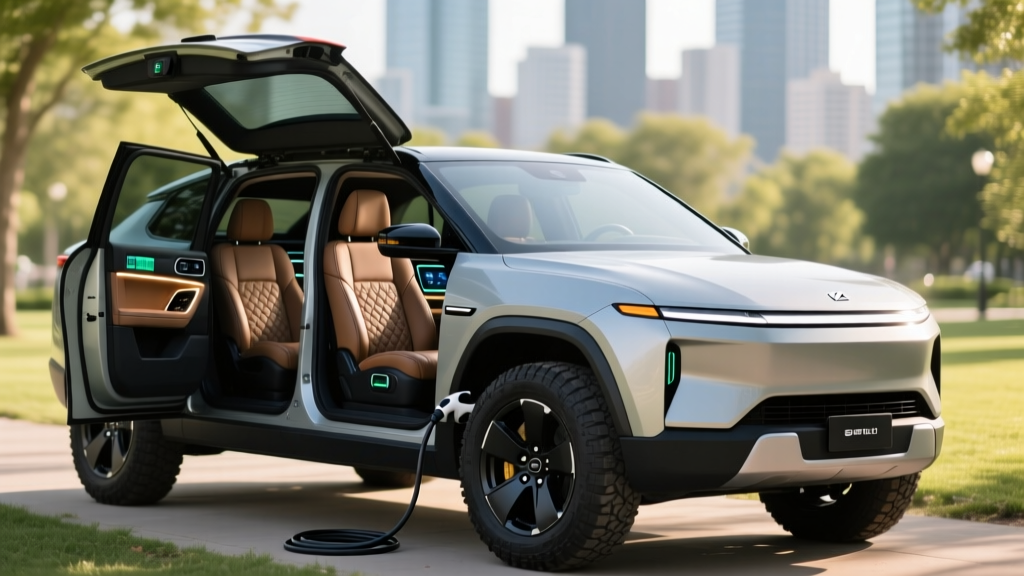
The R1S is configured as a 7-passenger SUV with a 2-3-2 seating layout. Unlike many three-row crossovers where the third row is a penalty box, the R1S offers genuine adult-capable space across all rows, aided by its flat skateboard platform and tall roofline.
| Specification | Measurement |
|---|---|
| First-row headroom | 41.1 in |
| First-row legroom | 41.5 in |
| Second-row headroom | 39.7 in |
| Second-row legroom | 38.3 in |
| Third-row headroom | 37.3 in |
| Third-row legroom | 32.1 in |
| Cargo behind 3rd row | 10.8 cu ft |
| Cargo behind 2nd row | 46.7 cu ft |
| Cargo behind 1st row (max) | 88.2 cu ft |
| Front trunk (frunk) | 11.0 cu ft |
The second row features a 60/40 split-folding bench (not captain's chairs), which is a deliberate trade-off: you gain the seventh seat but lose the walk-through convenience some competitors offer. The third row folds flat electronically, and the second row folds nearly flat, creating a long, usable cargo floor. The 11-cubic-foot frunk is large enough for a soft-sided cooler or charging cables — a real advantage over ICE SUVs that use that space for an engine.
Seat materials include vegan synthetic leather standard, with available premium textile and Nappa leather options. All three rows get USB-C ports, and the second and third rows have dedicated climate vents — critical for keeping rear passengers comfortable on long road trips.
Range, Battery, and Real-World Efficiency
The 2026 R1S is offered with three battery pack options on the Gen 2 platform. Rivian uses a mix of LFP (lithium iron phosphate) and NMC (nickel manganese cobalt) chemistries depending on pack size, and understanding the difference is essential for long-term ownership.
| Pack | Chemistry | Usable Capacity | EPA Range (Dual-Motor) | EPA Range (Performance Dual) |
|---|---|---|---|---|
| Standard | LFP | ~92 kWh | 270 mi | 258 mi |
| Large | NMC | ~109 kWh | 355 mi | 340 mi |
| Max | NMC | ~141 kWh | 410 mi | 390 mi |
Efficiency for the Dual-Motor Large pack is rated at approximately 73 MPGe combined (about 46 kWh per 100 miles). That's less efficient than a sedan like the Hyundai Ioniq 6, but competitive for a 7,000-lb three-row SUV. The quad-motor variants are thirstier, dropping to roughly 65 MPGe.
Charging Speed: DC Fast and Home Level 2
Charging is where the Gen 2 R1S made a major leap, and the 2026 model carries that forward. The Max pack supports peak DC fast-charging rates up to 300 kW, while the Large pack peaks around 220 kW and the Standard pack around 200 kW.
| Charging Method | Rate | Time / Miles Added |
|---|---|---|
| DC Fast Charge (Max pack, 10–80%) | Peak 300 kW | ~25 minutes |
| DC Fast Charge (Large pack, 10–80%) | Peak 220 kW | ~30 minutes |
| DC Fast Charge (Standard pack, 10–80%) | Peak 200 kW | ~28 minutes |
| Level 2 Home (11.5 kW / 48A) | 11.5 kW | ~25 miles per hour |
| Level 2 Home (19.2 kW / 80A, Max pack) | 19.2 kW | ~42 miles per hour |
| Level 1 (120V, 12A) | 1.4 kW | ~3 miles per hour |
Understanding the charge curve: Peak kW is not sustained kW. The Max pack hits 300 kW only at a low state of charge (roughly 10–25%) on a compatible 350 kW charger, then tapers progressively. You'll average closer to 180–200 kW across a full 10–80% session. Above 80%, charging slows dramatically to protect the NMC cells — plan to charge to 80% on road trips and only top off to 100% when needed.
The R1S uses the NACS (North American Charging Standard) connector natively on 2025+ models, giving direct access to the Tesla Supercharger network without an adapter. This is a significant practical advantage over CCS-equipped competitors that still rely on adapters for Supercharger access.
For home charging, the R1S's onboard charger accepts up to 19.2 kW (80 amps) on the Max pack — among the highest in any consumer EV. This means a full overnight charge even from near-empty is realistic, but it requires a hardwired 100-amp circuit and a professional electrician installation. Most buyers with the Large pack will be well served by a 48-amp / 11.5 kW setup on a 60-amp circuit, which adds roughly 25 miles of range per hour and fills the battery in about 10 hours.
Performance and Drivetrain
The R1S offers two main dual-motor configurations for 2026, plus a tri-motor option on the Adventure trim:
- Dual-Motor AWD: 533 horsepower, 610 lb-ft torque, 0–60 mph in 4.5 seconds
- Performance Dual-Motor AWD: 665 horsepower, 829 lb-ft torque, 0–60 mph in 3.4 seconds
- Tri-Motor AWD (Adventure): 850 horsepower, 1,100+ lb-ft torque, 0–60 mph in ~2.9 seconds
All variants use a dual-motor all-wheel-drive system with independent front and rear motors — no mechanical driveshaft. Torque vectoring is handled electronically, and the available Quad-Motor system (if equipped on future trims) offers independent wheel-level control for serious off-road use.
Towing capacity is rated at 7,700 pounds across most trims, making the R1S one of the most capable electric tow vehicles available. Expect range to drop 40–50% when towing near max capacity — plan charging stops accordingly.
Pricing, Trims, and Federal Tax Credit Eligibility
| Trim | Battery | Base MSRP | Est. As-Tested |
|---|---|---|---|
| Adventure (Dual-Motor) | Standard (LFP) | $74,900 | $78,000–$82,000 |
| Adventure (Dual-Motor) | Large (NMC) | $79,900 | $84,000–$90,000 |
| Adventure (Dual-Motor) | Max (NMC) | $89,900 | $95,000–$102,000 |
| Adventure (Performance) | Large (NMC) | $84,900 | $90,000–$96,000 |
| Ascend (Tri-Motor) | Max (NMC) | $99,900 | $105,000–$112,000 |
- MSRP cap: SUVs must have an MSRP at or below $80,000
- Income cap: Adjusted gross income ≤ $300,000 (joint) / $150,000 (single)
- Battery sourcing: Critical minerals and battery components must meet escalating domestic-content thresholds
Tech, Safety, and Driver Assistance
The R1S runs Rivian's proprietary software stack on a 15.6-inch center touchscreen and a 12.3-inch digital instrument cluster. Key tech highlights include:
- Rivian Driver+ (Level 2 ADAS): Adaptive cruise control with lane centering on highways. This is a hands-on, eyes-on SAE Level 2 system — not self-driving. The driver must remain engaged at all times.
- Over-the-air updates: Regular software improvements to powertrain, infotainment, and driver-assist features.
- Embedded connectivity: Built-in LTE with navigation, streaming, and remote features via the Rivian app.
- Off-road modes: Dedicated drive modes for snow, sand, rock crawl, and all-terrain, with adjustable air suspension providing up to 14.9 inches of ground clearance.
- Vehicle-to-load (V2L): Power external devices from the vehicle's battery via bed/frunk outlets — useful for camping or job-site power.
Safety ratings from NHTSA and IIHS should be checked for the latest model-year results. The R1S has historically performed well in crash testing, with a rigid skateboard chassis and low center of gravity contributing to strong rollover resistance.
Warranty and Ownership Costs
| Coverage | Term |
|---|---|
| Limited vehicle warranty | 5 years / 60,000 miles |
| Battery & drive unit | 8 years / 120,000 miles |
| Battery capacity retention | ≥70% over warranty period |
| Roadside assistance | 5 years / 60,000 miles |
| Corrosion perforation | 5 years / unlimited miles |
The 8-year/120,000-mile battery warranty exceeds the federal minimum of 8/100,000 and is competitive with Tesla and Hyundai. Rivian guarantees at least 70% capacity retention during the warranty period — in line with industry norms. Real-world degradation data from early R1S owners suggests NMC packs lose roughly 5–8% capacity in the first 50,000 miles before leveling off, while the LFP Standard pack may show even less degradation due to LFP's superior cycle life.
Insurance costs for the R1S tend to run 15–25% higher than comparable ICE SUVs, driven by high repair costs and parts availability. Get quotes before ordering.
Pros and Cons
Pros
- Class-leading 410-mile EPA range (Max pack)
- True 7-passenger seating with usable third row
- NACS connector = native Supercharger access
- Up to 300 kW DC fast charging
- 7,700-lb towing capacity
- Best-in-class off-road capability (air suspension, 14.9" clearance)
- 11 cu ft frunk + 88.2 cu ft max cargo
Cons
- High starting price; most trims exceed $80K MSRP cap for tax credit
- No hands-free highway driving (Level 2 only, no Super Cruise equivalent)
- Third-row cargo space is tight (10.8 cu ft) when all seats are up
- No captain's chair option for second row
- Insurance premiums run high
- Service center network still expanding in rural areas
Is the Rivian R1S Worth It vs. Competitors?
The R1S competes primarily with the Tesla Model X, the Kia EV9, and the upcoming electric extensions of legacy SUVs. Here's how it stacks up:
- vs. Tesla Model X: The R1S offers more rugged capability, better off-road credentials, and a more traditional SUV design. The Model X has falcon-wing doors, a slightly faster Supercharger network experience, and available hands-free driving features, but costs significantly more in comparable trims.
- vs. Kia EV9: The EV9 is substantially cheaper (starting ~$55K) and qualifies for the tax credit more easily, but offers less range (304 mi max), lower towing (5,000 lb), and no real off-road capability. Choose the EV9 for family commuting on a budget; choose the R1S for range, towing, and adventure.
- vs. Jeep Grand Wagoneer (ICE): The R1S delivers far lower running costs and instant torque, but the Grand Wagoneer offers more established dealer service and no range anxiety for remote-area towing.
Decision Framework
Choose the R1S if: You need genuine 7-passenger seating, want 350+ real-world road-trip miles, tow a boat or trailer, or plan off-pavement adventures — and your budget supports an $80K+ vehicle.
Look elsewhere if: You primarily commute in the city and don't need a third row (consider the Ioniq 5 or Model Y), you need the lowest possible monthly payment and want the full tax credit (Kia EV9), or you want hands-free highway driving (GM Super Cruise vehicles).
Frequently Asked Questions
What is the real-world range of the 2026 Rivian R1S?
With the Max pack, the EPA rates the Dual-Motor R1S at 410 miles. In real-world highway driving at 70–75 mph, expect 350–370 miles. In cold weather below freezing, plan for 280–320 miles unless you precondition the battery. The Large pack delivers roughly 300–320 highway miles, and the Standard pack around 230–250 highway miles.
How fast does the R1S charge at home and on the road?
On a DC fast charger, the Max pack peaks at 300 kW and charges from 10–80% in roughly 25 minutes. At home on a 48-amp Level 2 charger, you'll add about 25 miles of range per hour. The Max pack can accept up to 19.2 kW (80A) at home, cutting a full charge to under 8 hours — but this requires a dedicated 100-amp circuit.
Does the 2026 Rivian R1S qualify for the $7,500 federal EV tax credit?
Possibly, but only the base Adventure Dual-Motor with the Standard battery pack ($74,900 MSRP) falls under the $80,000 SUV MSRP cap. Eligibility also depends on your income (≤$300,000 joint AGI) and whether the battery meets current critical-mineral and component sourcing thresholds under IRS §30D. Most R1S buyers will not qualify due to MSRP. Consult a tax professional before ordering.
Is the Rivian R1S third row actually comfortable for adults?
Yes, for trips of a few hours. With 37.3 inches of headroom and 32.1 inches of legroom, the third row fits adults up to about 5'10" comfortably. It's more usable than the Tesla Model Y's optional third row (which is children-only) and comparable to the Kia EV9. For 6+ hour trips, rotating passengers through the second row is advisable.
What's the biggest drawback of the R1S?
Price relative to tax-credit eligibility. Most configurations exceed $80,000, disqualifying them from the $7,500 federal credit. Combined with higher-than-average insurance premiums and a still-growing service network, the total cost of ownership is premium-tier. If budget is the primary concern, the Kia EV9 or a used Model Y offers more financial upside.
Can the R1S use Tesla Superchargers?
Yes. The 2025+ R1S comes equipped with a native NACS charge port, providing direct access to Tesla's Supercharger network without any adapter. This is one of the strongest practical advantages for road-trip charging reliability in North America.