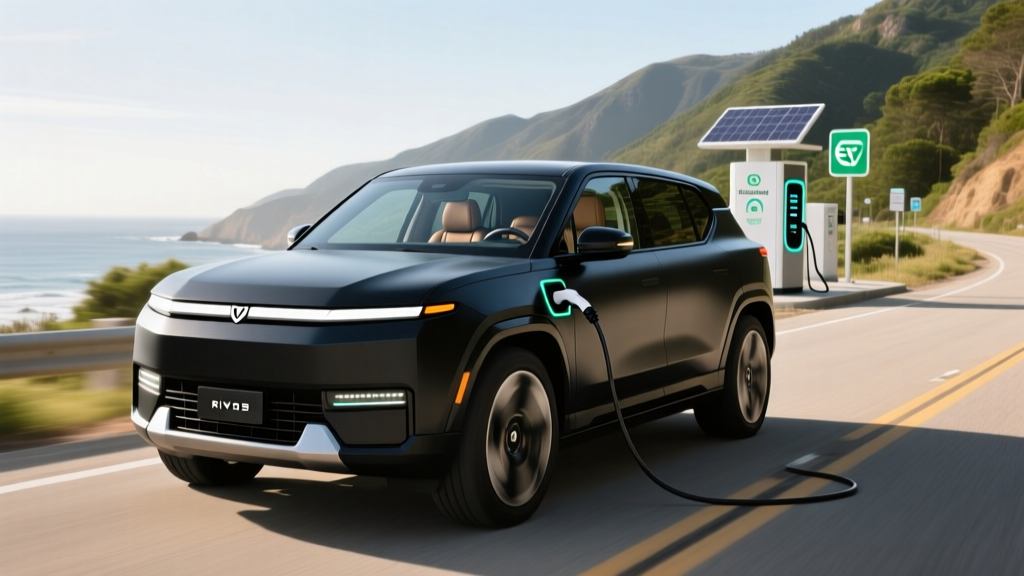
Quick Verdict: Is the 2026 Rivian R1S Worth Financing?
The 2026 Rivian R1S remains the only three-row electric SUV that can genuinely off-road, tow 7,700 pounds, and deliver over 300 miles of EPA range. With the Dual-Motor Standard Pack starting at $75,900 and the Tri-Motor pushing 420 miles EPA, it spans practical family hauler to adventure flagship. But with Rivian interest rates on manufacturer-financed loans currently ranging from approximately 2.99% to 7.49% APR depending on credit tier and term, the real question for buyers isn't just sticker price — it's the total financed cost over 60 to 72 months.
This review breaks down every spec that matters: real-world range, charging curves, battery chemistry, tax credit eligibility, and how Rivian's financing terms compare to securing your own loan from a credit union. If you're weighing an R1S against the Tesla Model X, Kia EV9, or BMW iX, the numbers below will make the decision clearer.
Range, Battery & Real-World Efficiency
Dual-Motor Standard Pack: 270 miles EPA — expect 230–245 mi highway, ~190–210 mi in sub-30°F cold.
Dual-Motor Max Pack: 410 miles EPA — expect 340–365 mi highway, ~280–310 mi in cold weather.
Tri-Motor Max Pack: 420 miles EPA — expect 350–375 mi highway, ~290–320 mi in cold weather.
Rivian uses NMC (nickel manganese cobalt) lithium-ion cells across the R1S lineup. The Standard Pack battery holds approximately 92 kWh usable, while the Max Pack jumps to roughly 141 kWh usable. NMC chemistry delivers higher energy density than LFP, which is why Rivian can pack 420 miles into a vehicle with a relatively compact skateboard platform — but it also means you should avoid routinely charging to 100% for daily use. Set your charge limit to 80–90% for weekday driving and reserve 100% for road-trip mornings.
Efficiency varies significantly by configuration. The Dual-Motor Standard achieves approximately 73 MPGe combined (about 46 kWh/100 mi), while the heavier Tri-Motor Max drops to around 69 MPGe combined (49 kWh/100 mi). For context, that's roughly 3.5 to 4.0 miles per kWh in mixed driving — respectable for a 6,800-pound three-row SUV.
| Spec | Dual-Motor Standard | Dual-Motor Max | Tri-Motor Max |
|---|---|---|---|
| EPA Range | 270 mi | 410 mi | 420 mi |
| Battery (usable) | ~92 kWh (NMC) | ~141 kWh (NMC) | ~141 kWh (NMC) |
| Horsepower | 533 hp | 533 hp | 850 hp |
| 0–60 mph | 4.5 sec | 4.5 sec | 2.9 sec |
| Drivetrain | AWD (dual-motor) | AWD (dual-motor) | AWD (tri-motor) |
| Max DC Charge Rate | 200 kW | 220 kW | 220 kW |
| 10–80% DCFC Time | ~30 min | ~42 min | ~42 min |
| Level 2 Home Rate | 11.5 kW (~25 mi/hr) | 11.5 kW (~25 mi/hr) | 11.5 kW (~25 mi/hr) |
| Towing Capacity | 7,700 lb | 7,700 lb | 7,700 lb |
| EPA Efficiency | 73 MPGe | 70 MPGe | 69 MPGe |
Charging Speed: DC Fast, Level 2 & the Curve Reality
Rivian's Max Pack vehicles peak at 220 kW on DC fast chargers, but that peak is short-lived. In real-world testing at 350 kW Electrify America and Tesla Supercharger stalls (using Rivian's NACS adapter, now standard), the R1S Max Pack sustains roughly 180–200 kW from 15% to 45% SoC, then tapers progressively. The 10–80% charge takes approximately 42 minutes. The Standard Pack, with its smaller battery, hits 200 kW peak and completes 10–80% in about 30 minutes — making it arguably the better road-trip charger despite shorter total range.
| Charge Level | Power | Miles Added per Hour | Notes |
|---|---|---|---|
| Level 1 (120V) | 1.4 kW | ~3 mi/hr | Emergency/top-up only |
| Level 2 (240V, 48A) | 11.5 kW | ~25 mi/hr | Full charge overnight (~12–14 hr for Max) |
| DC Fast (Standard) | Peak 200 kW | ~175 mi in 30 min | 10–80% in ~30 min |
| DC Fast (Max) | Peak 220 kW | ~250 mi in 30 min | 10–80% in ~42 min |
At home on a Level 2 Rivian Wall Charger (or any quality 48-amp J1772/NACS unit), expect roughly 25 miles of range per hour of charging. A Max Pack R1S driven 80 miles daily will need about 3.5 hours on the plug each night — easily manageable with a scheduled overnight charge on a time-of-use utility plan. Always precondition the battery via the Rivian app before arriving at a DC fast charger; skipping preconditioning can cut your peak charge rate by 30–50% in cold weather.
Pricing, Trims & How Rivian Interest Rates Affect Your Cost
The 2026 R1S lineup starts at $75,900 for the Dual-Motor Standard Pack (Adventure trim) and climbs to $99,900 for the Tri-Motor Max Pack Ascend trim. Destination adds $1,800 across the board. Here's where Rivian interest rates become critical to your buying decision.
Rivian Financial Services offers retail financing with APRs that, as of early 2026, generally fall between 2.99% (promotional rate on select inventory or excellent credit, 60-month term) and 7.49% (standard rate, 72-month term for average credit). These rates fluctuate with the Fed funds rate and Rivian's promotional calendar.
| Scenario | APR | Term | Monthly Payment | Total Interest Paid |
|---|---|---|---|---|
| Promo rate (excellent credit) | 2.99% | 60 mo | $1,364 | $5,940 |
| Standard rate (good credit) | 5.49% | 72 mo | $1,238 | $13,236 |
| Higher rate (fair credit) | 7.49% | 72 mo | $1,313 | $18,636 |
| Credit union alternative | 4.75% | 60 mo | $1,424 | $9,540 |
The spread between a promotional 2.99% and a standard 7.49% on a $75,900 vehicle can mean over $12,000 in additional interest over a 72-month term. Always get pre-approved at a credit union or bank before visiting Rivian's financing portal — you'll have leverage to negotiate or simply choose the cheaper option.
Federal Tax Credit & Point-of-Sale Transfer
The R1S is assembled in Normal, Illinois, and currently qualifies for the full $7,500 federal EV tax credit under IRS §30D, provided you meet the following requirements:
- MSRP cap: SUVs must be at or below $80,000. The Dual-Motor Standard Pack ($75,900) qualifies; Max Pack and Tri-Motor trims exceed the cap and are ineligible.
- Income cap: Modified AGI ≤ $300,000 (joint), $225,000 (head of household), $150,000 (single).
- Battery sourcing: Critical minerals and battery components must meet escalating domestic/free-trade-partner thresholds per IRS guidance. Verify current compliance on fueleconomy.gov before purchasing.
- Point-of-sale transfer: You can transfer the credit to the dealer at purchase, reducing your financed amount by $7,500 upfront — a significant impact on total interest paid.
With the point-of-sale credit applied to a $75,900 Dual-Motor Standard, your effective financed price drops to $68,400. At 4.75% APR over 60 months, that's $1,283/month and $8,580 total interest — a meaningful savings.
Performance, Interior & Cargo
The Dual-Motor R1S produces 533 horsepower and 610 lb-ft of torque, reaching 60 mph in 4.5 seconds. The Tri-Motor jumps to 850 hp and a supercar-rivaling 2.9-second 0–60. All configurations use Rivian's quad-corner air suspension with 14.9 inches of ground clearance in Off-Road mode and an adaptive damping system that handles highway transitions smoothly.
Interior space is generous. Front-row legroom measures 41.3 inches, second-row at 38.2 inches, and the third row at 30.4 inches — the third row is best suited for children or occasional use. Cargo volume behind the third row is 10.5 cubic feet, expanding to 46.7 cu ft with the third row folded and 92.2 cu ft with both rear rows down. The front trunk (frunk) adds 11.2 cu ft of lockable, drainable storage — ideal for muddy gear or charging cables.
The 15.6-inch center touchscreen runs Rivian's proprietary OS with wireless Apple CarPlay and Android Auto, over-the-air updates, and built-in navigation with real-time charger routing. The Driver+ package ($5,000) adds adaptive cruise with lane centering and automatic lane changes on highways — this is a Level 2 SAE driver-assist system, meaning you must remain fully engaged with hands on the wheel. It is not autonomous driving.
Warranty, Ownership Costs & Who Should Buy
Rivian covers the R1S battery and drive unit for 8 years or 175,000 miles (whichever comes first), with a capacity-retention threshold of 70%. The limited vehicle warranty is 5 years/60,000 miles. This battery warranty is among the most generous in the segment, exceeding the federal mandate of 8 years/100,000 miles by 75,000 miles on the powertrain side.
Insurance premiums for the R1S run 15–25% higher than comparable ICE SUVs, averaging $2,800–$3,400 annually depending on state and driving record. Maintenance is minimal — no oil changes, no transmission fluid — but tire replacement costs are significant given the R1S's 275/65R20 or 275/55R22 all-season or all-terrain rubber. Budget $1,200–$1,800 for a set of four premium tires every 30,000–40,000 miles.
- 420-mile Max Pack range eliminates range anxiety on most road trips
- 7,700-lb towing capacity with integrated trailer brake controller
- Genuine off-road capability (14.9" ground clearance, quad-motor tank turns on Tri-Motor)
- Three rows with usable cargo space and a large frunk
- Over-the-air updates continuously improve the vehicle
- 8-year/175,000-mile battery warranty
- Max Pack and Tri-Motor trims exceed $80K MSRP cap — no federal tax credit
- Third-row legroom tight for adults on long trips
- Insurance premiums 15–25% above segment average
- DC fast charging tapers significantly above 80% SoC
- Rivian service centers still sparse in rural/mountain states
- High financed cost when Rivian interest rates exceed 6%
Who the R1S Suits Best
Active families who need three rows, tow a boat or camper on weekends, and want electric daily driving. Outdoor enthusiasts who value ground clearance, all-terrain capability, and the frunk for gear. Not ideal for: budget-conscious buyers (the tax-credit-eligible trim is still $75,900), urban-only drivers who'd be better served by a smaller EV, or anyone in a region without a nearby Rivian service center.
Competition & Verdict
The R1S competes most directly with the Tesla Model X ($79,990+, 326 mi EPA), Kia EV9 ($54,900+, 304 mi EPA), and BMW iX ($87,250+, 324 mi EPA). The Model X offers faster Supercharger access and Autopilot but cannot match the R1S off-road. The EV9 is $20,000 cheaper but lacks air suspension, the frunk, and the R1S's towing rating. The iX is a luxury two-row only.
If the Dual-Motor Standard fits your needs and you qualify for the §30D credit, the R1S at an effective $68,400 is a compelling three-row electric adventure SUV. If you need 400+ miles and are willing to finance $100K+, the Tri-Motor Max is extraordinary — but run the numbers at current Rivian interest rates before committing, because a 72-month loan at 6.5%+ adds $20,000 or more in interest alone.
Frequently Asked Questions
What is the real-world range of the 2026 Rivian R1S?
The Dual-Motor Standard delivers approximately 230–245 miles on highway drives and 190–210 miles in freezing temperatures. The Max Pack versions manage 340–375 miles highway and 280–320 miles in cold weather. These figures assume 70–75 mph highway speeds with climate control active.
How fast does the R1S charge at home and on the road?
At home on a 240V Level 2 charger (48 amps), the R1S charges at 11.5 kW, adding about 25 miles of range per hour. On DC fast chargers, the Standard Pack peaks at 200 kW (10–80% in ~30 min) and the Max Pack peaks at 220 kW (10–80% in ~42 min). Always precondition the battery for optimal charge speed.
Does the 2026 Rivian R1S qualify for the $7,500 federal tax credit?
Only the Dual-Motor Standard Pack ($75,900 MSRP) qualifies, as the IRS §30D SUV cap is $80,000. You must also meet income limits ($300K joint / $150K single) and the vehicle must satisfy battery-sourcing requirements. Confirm eligibility on fueleconomy.gov and consult a tax professional.
What are Rivian's current interest rates on financed purchases?
As of early 2026, Rivian Financial Services APRs range from approximately 2.99% (promotional, 60-month, excellent credit) to 7.49% (standard, 72-month, average credit). Rates change frequently. Always compare against pre-approval offers from credit unions and banks before committing.
Is the R1S worth buying over the Tesla Model X or Kia EV9?
Choose the R1S if you need genuine off-road capability, 7,700-lb towing, a frunk, and air suspension. Choose the Model X if Supercharger convenience and Autopilot are priorities. Choose the EV9 if budget is the primary concern — it undercuts the R1S by $20,000+ while offering competitive range and three rows.
How long will the R1S battery last?
Rivian warranties the battery for 8 years/175,000 miles with a 70% capacity-retention threshold. Industry data on NMC batteries suggests 80–85% capacity retention at 150,000 miles under normal use (avoiding routine 100% charges and excessive DC fast charging). Replacement cost, if out of warranty, is estimated at $15,000–$22,000 based on current pack pricing.