Quick Verdict: The R1S in 2026
The 2026 Rivian R1S remains the benchmark electric three-row SUV for buyers who need genuine off-road capability, class-leading towing, and a tech-forward cabin — including Rivian's integrated dashcam and camera system that eliminates the need for aftermarket hardware. With the Dual-Motor Standard battery now anchoring the lineup at a lower entry price, and the Tri-Motor pushing performance into supercar territory, the R1S covers a wider spread of use cases than ever. But real-world range, charging logistics, and federal tax credit eligibility require careful math before you sign.
| Spec | Dual-Motor Standard | Dual-Motor Max | Tri-Motor Max |
|---|---|---|---|
| EPA Range | 270 mi | 352 mi | 321 mi |
| Battery (usable) | 92.5 kWh (LFP) | 128.9 kWh (NMC) | 128.9 kWh (NMC) |
| Horsepower | 533 hp | 533 hp | 850 hp |
| 0-60 mph | 4.5 sec | 4.5 sec | 2.9 sec |
| Max DC Fast Charge | 200 kW | 220 kW | 220 kW |
| 10-80% DC Time | ~30 min | ~36 min | ~36 min |
| Level 2 Home Rate | 11.5 kW (~25 mi/hr) | 11.5 kW (~25 mi/hr) | 11.5 kW (~25 mi/hr) |
| Towing Capacity | 7,700 lb | 7,700 lb | 7,700 lb |
| Base MSRP | $75,900 | $89,900 | $99,900 |
Real-World Range: What the EPA Sticker Doesn't Tell You
Rivian's thermal management system includes a heat pump that mitigates some cold-weather loss, but physics wins: a 129 kWh NMC pack moving 6,000+ pounds of SUV at highway speeds consumes energy quickly. City driving with regenerative braking recovers more range — many owners report exceeding the EPA estimate in stop-and-go commuting. The LFP Standard Pack battery tolerates regular 100% charging, which effectively gives you the full 270 miles daily, whereas the NMC Max Pack performs best when charged to 80-90% for routine use (reserving 100% for road trips), effectively giving you ~280-315 usable daily miles.
Efficiency lands at approximately 70 MPGe combined for the Dual-Motor Max and roughly 73 MPGe for the Standard Pack, or about 48-50 kWh/100 miles. That's thirstier than a Tesla Model X but competitive with the Mercedes EQS SUV when you factor in the R1S's off-road hardware and towing capability.
Charging Speed: DC Fast, Home, and the NACS Factor
| Charging Level | Power | Rate / Time | Connector |
|---|---|---|---|
| Level 1 (120V outlet) | 1.4 kW | ~3 mi/hr | NACS (native) |
| Level 2 (240V home) | 11.5 kW | ~25 mi/hr (full in 10-13 hr) | NACS (native) |
| DC Fast (Standard Pack) | 200 kW peak | 10-80% in ~30 min | NACS (native) |
| DC Fast (Max Pack) | 220 kW peak | 10-80% in ~36 min | NACS (native) |
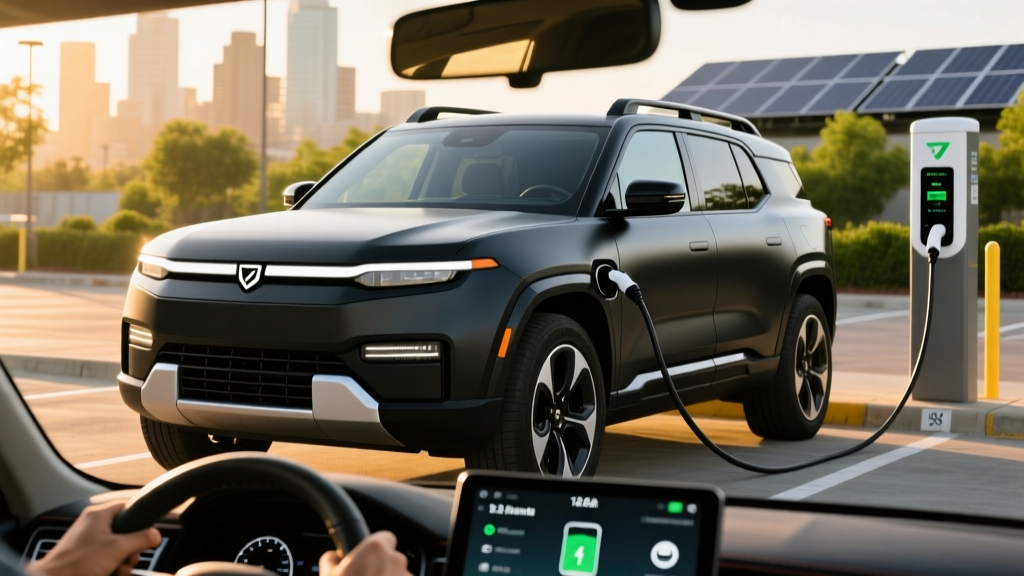
The 2026 R1S ships natively with the NACS (Tesla-style) charge port, meaning direct access to Tesla Supercharger stalls — now the largest and most reliable DC fast-charging network in the U.S. This is a significant practical advantage over CCS-equipped competitors still relying on adapters.
Charging-curve reality check: the 220 kW peak on Max Pack models holds roughly from 10-30% State of Charge (SoC), then tapers progressively. From 50-80%, expect sustained rates closer to 120-150 kW. The larger battery means more total energy to push, so while the peak rate is competitive, the 10-80% time of ~36 minutes trails lighter SUVs like the Hyundai Ioniq 5 (18 minutes at 350 kW). Plan road-trip stops around 25-30 minutes for meaningful range recovery.
Home charging on a 48-amp Level 2 circuit (60-amp breaker) delivers the full 11.5 kW, replenishing the Max Pack overnight in about 12-13 hours. Most R1S owners install a Rivian Wall Charger or equivalent NACS-compatible unit. Budget $500-$1,200 for equipment and professional electrician installation, plus potential panel-upgrade costs if your home has a 100-amp service panel.
Rivian Dashcam and Integrated Camera System
The search for a reliable Rivian dashcam solution ends with the vehicle itself. The R1S features an integrated multi-camera array — originally designed for the Driver+ ADAS suite — that doubles as a full dashcam and sentry system. Rivian's software enables continuous forward-facing recording, incident-triggered clip saving, and a 360-degree surround-view capture when parked.
Key capabilities of the built-in system:
- Forward dashcam recording at 1080p, saved to the vehicle's internal storage with automatic overwrite
- Incident auto-save triggered by sudden deceleration, airbag deployment, or impact detection
- Sentry mode using all exterior cameras to record activity around the parked vehicle
- Camp mode recording for off-grid security when sleeping in the vehicle
- Clip export via the Rivian mobile app or USB download
This eliminates the $150-$400 cost and wiring complexity of an aftermarket dashcam. The trade-off: Rivian controls the feature roadmap, and some owners report that video resolution and low-light performance don't match dedicated dashcams like the BlackVue or Garmin Dash Cam series. For most insurance-claim and incident-documentation purposes, the integrated system is more than adequate.
Performance, Drivetrain, and What 850 Horsepower Feels Like
The Dual-Motor powertrain (one motor per axle, AWD standard across the lineup) delivers 533 hp and 610 lb-ft of torque in all Standard and Max Pack configurations. The 4.5-second 0-60 mph time is brisk for a three-row SUV and more than sufficient for highway merging, passing, and towing.
The Tri-Motor adds a rear-axle motor for 850 hp and 900+ lb-ft, dropping the 0-60 time to a staggering 2.9 seconds. This is supercar acceleration in a vehicle with 7,700-pound towing capacity. The trade-off is range (321 mi EPA vs. 352 mi for the Dual-Motor Max) and a $10,000 price premium.
All R1S models feature Rivian's quad-motor-ready air suspension with adjustable ride height (up to 14.9 inches of ground clearance), enabling genuine off-road capability — approach, departure, and breakover angles that rival body-on-frame SUVs. The hydraulic roll-control system eliminates traditional anti-roll bars, providing flat cornering without sacrificing wheel articulation on trails.
Pricing, Trim Levels, and Federal Tax Credit Eligibility
| Trim | Base MSRP | §30D Credit (est.) | Effective Price* |
|---|---|---|---|
| Dual-Motor Standard | $75,900 | Up to $7,500 | ~$68,400 |
| Dual-Motor Max | $89,900 | Up to $7,500 | ~$82,400 |
| Tri-Motor Max | $99,900 | Up to $7,500 | ~$92,400 |
*Effective price assumes full §30D credit eligibility. Actual credit depends on battery sourcing, buyer income, and MSRP caps. See IRS §30D guidelines.
Federal tax credit eligibility for the R1S requires navigating several rules under current IRS §30D regulations:
- MSRP cap: SUVs must be at or below $80,000 MSRP. The Dual-Motor Standard ($75,900) qualifies. The Max Pack and Tri-Motor trims exceed the cap and do NOT qualify for the federal credit.
- Buyer income cap: Modified AGI must not exceed $150,000 (single), $225,000 (head of household), or $300,000 (joint).
- Battery sourcing: The credit splits into two $3,750 halves — one for critical-mineral sourcing and one for battery-component manufacturing. Rivian has been progressively shifting supply chains to meet these requirements, but eligibility can change by production batch. Verify the specific VIN's eligibility at the point of sale.
- Point-of-sale transfer: Qualified buyers can transfer the credit to the dealer at purchase, reducing the out-of-pocket price immediately rather than waiting for a tax refund.
Bottom line: only the Dual-Motor Standard Pack R1S is realistically eligible for the full $7,500 federal credit, and only if your income and the battery's sourcing comply. Higher trims should be budgeted at full MSRP. Always confirm eligibility with your tax professional before committing.
Interior, Cargo, and Livability
The R1S seats up to seven passengers across three rows. Second-row captain's chairs (standard) provide generous legroom, while the third row accommodates children or adults on shorter trips. Cargo volume behind the third row is approximately 10.4 cu ft, expanding to 46.7 cu ft with the third row folded and 79.4 cu ft with both rear rows down.
The front trunk (frunk) adds 11.0 cu ft of sealed, drainable storage — ideal for muddy gear, groceries, or charging cables. The gear tunnel (a pass-through compartment behind the rear seats on some configurations) provides an additional 11.6 cu ft.
The 15.6-inch center touchscreen runs Rivian's in-house infotainment OS, which has matured significantly since launch. Wireless Apple CarPlay and Android Auto are standard. The digital driver display, head-up display, and 18-speaker Meridian audio system round out the tech stack. Build quality in the 2026 model year reflects continuous improvement — panel gaps and interior material quality have tightened noticeably compared to early 2022-2023 production.
Warranty and Long-Term Ownership
Rivian provides an 8-year/175,000-mile battery and drive unit warranty, which exceeds the industry-standard 8-year/100,000-mile coverage. The battery warranty guarantees retention of at least 70% of original capacity during the coverage period. The vehicle limited warranty is 5 years/60,000 miles.
The LFP chemistry in the Standard Pack offers a longevity advantage: LFP cells typically endure 3,000+ full charge cycles before reaching 80% State of Health (SoH), compared to roughly 1,000-1,500 cycles for NMC. For an owner who charges daily, that translates to well over 250,000 miles before meaningful degradation. The NMC Max Pack provides higher energy density (more range per pound) but benefits from keeping daily charge levels between 20-80% for maximum lifespan.
Insurance costs for the R1S tend to run 15-25% higher than comparable internal-combustion SUVs, driven by repair-cost data for aluminum body panels and specialized drivetrain components. Get quotes before purchasing.
Pros, Cons, and Who Should Buy
Pros
- Class-leading 7,700-lb towing for an EV SUV
- Genuine off-road capability with air suspension
- Native NACS port — direct Supercharger access
- Integrated dashcam/sentry system eliminates aftermarket hardware
- 8-year/175,000-mile battery warranty (best in class)
- LFP option for daily-driving longevity
Cons
- Only the $75,900 Standard trim qualifies for the §30D credit
- Real-world highway range trails EPA by 10-15%
- DC fast-charge times lag 800V competitors (Ioniq 5, EV6)
- Third-row space tight for adults on long trips
- Insurance premiums above segment average
- Service center availability still limited in some regions
Who this EV suits best: Active families who tow boats or campers, need three rows, and want to explore unpaved roads. The R1S is overkill for a pure commuter — if you never leave pavement, the Tesla Model X or BMW iX may serve you at lower cost. But if your weekends involve trails, ski trips, or trailer towing, the R1S is the most capable electric SUV on the market.
Competitor Comparison: R1S vs. Model X vs. EQS SUV
| Attribute | Rivian R1S (DM Max) | Tesla Model X (LR) | Mercedes EQS 580 SUV |
|---|---|---|---|
| EPA Range | 352 mi | 335 mi | 305 mi |
| Starting MSRP | $89,900 | $79,990 | $104,400 |
| 0-60 mph | 4.5 sec | 3.8 sec | 4.4 sec |
| Towing | 7,700 lb | 5,000 lb | 3,500 lb |
| Off-Road | Excellent | Limited | None |
| §30D Eligible | No (over MSRP cap) | Partial | No (over MSRP cap) |
Frequently Asked Questions
Does the Rivian R1S have a built-in dashcam?
Yes. The R1S uses its ADAS camera array as an integrated dashcam, offering forward recording, incident auto-save, sentry mode, and clip export via the Rivian app. No aftermarket hardware is required for standard dashcam functionality.
What is the real-world highway range of the R1S?
The Dual-Motor Max Pack delivers approximately 290-310 miles at highway speeds in moderate weather, versus its 352-mile EPA estimate. Cold weather (below 32°F) reduces this to roughly 240-265 miles. The Standard Pack achieves about 220-240 real-world highway miles.
How fast does the R1S charge at home and on the road?
On a 240V Level 2 home charger, the R1S charges at 11.5 kW, adding about 25 miles per hour and fully replenishing overnight. On DC fast chargers, the Max Pack peaks at 220 kW and reaches 10-80% in approximately 36 minutes. The Standard Pack peaks at 200 kW with a ~30-minute 10-80% time.
Which R1S trims qualify for the federal EV tax credit?
Only the Dual-Motor Standard Pack at $75,900 MSRP falls under the $80,000 SUV cap for §30D eligibility. Max Pack and Tri-Motor trims exceed the cap. Buyer income limits and battery-sourcing requirements further restrict eligibility — verify with your tax professional and at the point of sale.
Is the R1S worth it versus the Tesla Model X?
If you need towing capacity (7,700 lb vs. 5,000 lb), off-road capability, and a more traditional SUV interior layout, the R1S wins clearly. If you prioritize Supercharger network reliability (though the R1S now has native NACS access), lower starting price, and faster acceleration, the Model X is compelling. For adventure-oriented families, the R1S is the stronger fit.
How long will the R1S battery last?
Rivian warranties the battery for 8 years or 175,000 miles with a 70% capacity-retention guarantee. The LFP Standard Pack battery is rated for 3,000+ cycles, potentially exceeding 250,000 miles before significant degradation. The NMC Max Pack lasts 1,000-1,500 cycles — still well over 150,000 miles with proper charging habits (20-80% daily).