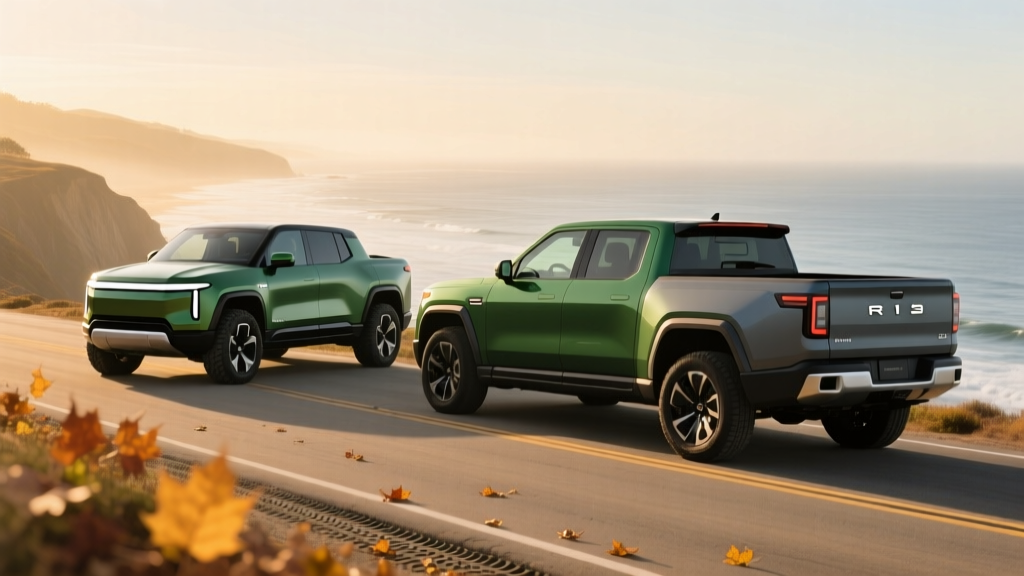
If you've been searching for a comprehensive wiki Rivian buyer's reference, you've found it. Rivian's second-generation R1S (three-row SUV) and R1T (pickup) launched for the 2025 model year with a redesigned architecture, new battery chemistries, and a NACS charge port — and the 2026 lineup carries those improvements forward with expanded trim availability and refined software. This guide consolidates every spec, real-world number, and ownership fact you need before buying.
Rivian R1S and R1T: 2026 Lineup at a Glance
Rivian offers the R1S and R1T across three battery sizes — Standard, Large, and Max — and three motor configurations: Dual-Motor, Performance Dual-Motor, and Tri-Motor. All use Rivian's in-house developed skateboard platform with an 800-volt electrical architecture on Large and Max packs (Standard uses a 400V architecture). The R1S seats up to seven; the R1T seats five with a 4.5-foot bed and the signature Gear Tunnel.
| Spec | R1S (SUV) | R1T (Truck) |
|---|---|---|
| EPA Range (Max Pack) | Up to 420 mi | Up to 420 mi |
| Battery (Max Pack) | ~149 kWh (NMC) | ~149 kWh (NMC) |
| Battery (Large Pack) | ~106 kWh (NMC) | ~106 kWh (NMC) |
| Battery (Standard Pack) | ~92 kWh (LFP) | ~92 kWh (LFP) |
| Peak DC Fast Charge | 220 kW (Max/Large) | 220 kW (Max/Large) |
| 10–80% DC Time (Max) | ~42 min | ~42 min |
| 0–60 mph (Tri-Motor) | ~2.9 sec | ~2.7 sec |
| Max Towing | 7,700 lb | 11,000 lb |
| Ground Clearance (max) | 14.9 in | 14.9 in |
Real-World Range: What the EPA Sticker Doesn't Tell You
Rivian's Max Pack achieves its headline EPA number partly through the 800V architecture's efficiency gains and improved thermal management. The LFP-based Standard Pack, while offering less total range, provides a significant longevity advantage — LFP chemistry tolerates repeated 100% charging without the degradation concerns of NMC. For daily commuting, Rivian recommends charging NMC packs to 85–90% and LFP packs to 100% regularly.
Efficiency varies significantly by configuration. The Dual-Motor Large Pack R1S returns approximately 79 MPGe combined (about 42 kWh/100 mi) per EPA data on fueleconomy.gov. The Tri-Motor drops to roughly 70 MPGe combined due to the added weight and power of the third motor.
Charging Speed: DC Fast, Level 2, and the NACS Transition
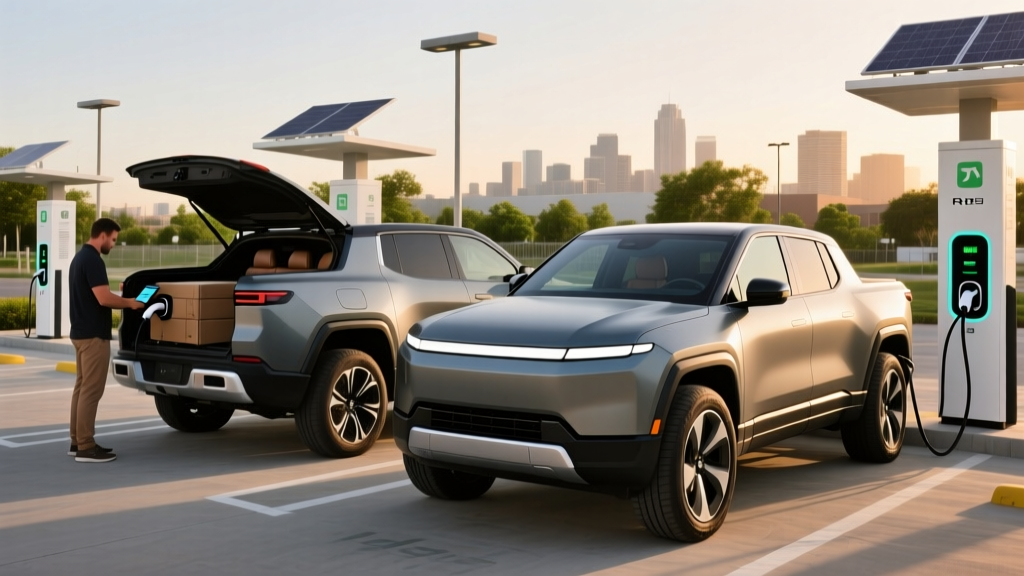
For 2026, all Rivian R1S and R1T vehicles ship with the NACS (Tesla-style) charge port, giving native access to the Tesla Supercharger network — the most reliable DC fast-charging network in the U.S. Rivian owners who purchased earlier CCS-equipped models can use a Rivian-provided NACS adapter.
| Charging Level | Power / Rate | Miles Added per Hour | Notes |
|---|---|---|---|
| Level 1 (120V) | ~1.4 kW | ~3–4 mi/hr | Emergency/trickle only |
| Level 2 (240V, 48A) | 11.5 kW | ~25–28 mi/hr | Home Wall Connector; full charge overnight |
| Level 2 (240V, 32A) | 7.7 kW | ~17–19 mi/hr | Portable/mobile charger on 240V outlet |
| DC Fast (Max/Large) | Peak 220 kW | ~140 mi in 15 min | 800V architecture; tapers above 80% |
| DC Fast (Standard) | Peak 175 kW | ~110 mi in 15 min | 400V architecture; LFP chemistry |
The 800V Large and Max packs sustain strong charging rates through the mid-range of the battery. Expect peak 220 kW between roughly 15–45% State of Charge, with a gradual taper beginning around 60% and a steep taper past 85%. On a road trip, plan your stops around 10–80% charges for the best time efficiency — charging from 80–100% at a DC fast charger can take as long as the 10–80% session itself.
For home charging, Rivian's Wall Connector on a 60-amp circuit (48A continuous) adds roughly 25–28 miles per hour. A full overnight charge from 20% to 90% takes about 8–10 hours on the Large Pack. Installation typically requires a 240V/60A circuit; if your electrical panel lacks capacity, a panel upgrade can add $1,500–$3,000 to the installation cost.
Performance and Drivetrain Configurations
Rivian's 2026 lineup offers three drivetrain tiers:
- Dual-Motor (AWD): ~533 hp, ~610 lb-ft torque. 0–60 mph in approximately 4.5 seconds. Available with Standard, Large, or Max Pack.
- Performance Dual-Motor (AWD): ~665 hp, ~829 lb-ft torque. 0–60 mph in approximately 3.4 seconds. Requires Large or Max Pack.
- Tri-Motor (AWD): ~850 hp, ~1,100+ lb-ft torque. 0–60 mph in approximately 2.7–2.9 seconds (R1T slightly quicker due to shorter wheelbase). Requires Max Pack.
All configurations feature Rivian's quad-corner air suspension with adjustable ride height — from a low "Park" mode for easier entry to a maximum 14.9 inches of ground clearance for off-road use. The R1T includes a unique tank-turn capability on Tri-Motor models (using independent motor control to rotate the vehicle around its center), and a wading mode rated for up to 36 inches of water depth.
Pricing, Trim Levels, and Federal Tax Credit Eligibility
Rivian's pricing has shifted significantly with the introduction of the Standard Pack and the Tri-Motor tier. Here's where the 2026 lineup stands:
| Configuration | R1S MSRP | R1T MSRP | §30D Credit Eligible? |
|---|---|---|---|
| Dual-Motor Standard Pack | ~$75,900 | ~$69,900 | See rules below |
| Dual-Motor Large Pack | ~$82,900 | ~$76,900 | MSRP cap issue* |
| Performance Dual-Motor Large | ~$89,900 | ~$83,900 | MSRP cap issue* |
| Tri-Motor Max Pack | ~$104,900 | ~$99,900 | Exceeds MSRP cap |
*The IRS §30D federal EV tax credit imposes an MSRP cap of $80,000 for SUVs/vans/pickups and $55,000 for sedans. The R1S qualifies as an SUV and the R1T as a pickup, both subject to the $80,000 cap. The R1T Dual-Motor Standard Pack at ~$69,900 falls under the cap; the R1S Standard Pack at ~$75,900 also qualifies on MSRP. Higher trims exceed the limit. See IRS §30D rules for current requirements.
- MSRP cap: ≤$80,000 for SUVs/pickups (R1S/R1T qualify as such)
- Buyer income cap: AGI ≤$300,000 (MFJ), $225,000 (HoH), $150,000 (single)
- Battery sourcing: Critical minerals and battery components must meet phased-in domestic/Fta-partner thresholds — verify current-year compliance on Rivian's order page
- Point-of-sale transfer: Eligible buyers can transfer the credit to the dealer for an immediate price reduction at purchase
- Credit amount: Up to $7,500 if both mineral and component requirements are met; $3,750 if only one is satisfied
Always confirm eligibility with a tax professional before relying on the credit in your purchase decision.
Cargo, Passenger Space, and Practical Utility
The R1S offers three rows of seating for up to seven passengers. Behind the third row, cargo volume is approximately 10.4 cu ft. Fold the third row and you get roughly 46.7 cu ft; fold both rear rows for up to 91.6 cu ft of flat-load space. Second-row legroom measures approximately 38.5 inches, and third-row legroom is about 30.2 inches — adequate for children on longer trips, tight for adults.
The R1T provides a 4.5-foot bed (54 inches) with a lockable tonneau cover option. Its standout feature is the Gear Tunnel — a full-width, lockable pass-through compartment behind the rear seats offering roughly 11 cu ft of secure, weather-sealed storage. Combined with the front trunk (frunk) at approximately 11 cu ft, the R1T delivers surprisingly versatile cargo options despite its shorter bed. The R1T's rear-seat legroom is generous at approximately 40.5 inches.
Both vehicles feature an integrated air compressor in the bed/frunk area, and the R1T offers available powered tonneau and a camp kitchen option that slides out from the Gear Tunnel.
Battery Chemistry, Warranty, and Long-Term Ownership
Rivian uses two distinct battery chemistries across its lineup:
- NMC (Nickel Manganese Cobalt): Used in Large and Max Packs. Higher energy density enables the 350–420 mile EPA ranges. Best charged to 85–90% for daily use; 100% reserved for road trips.
- LFP (Lithium Iron Phosphate): Used in the Standard Pack. Lower energy density (~270 mi EPA) but superior cycle life and tolerance for daily 100% charging. No cobalt or nickel in the cathode — a sourcing and cost advantage.
Rivian's battery and drivetrain warranty covers 8 years or 175,000 miles (whichever comes first) for the battery pack, with a guaranteed minimum capacity retention of 70%. The vehicle limited warranty is 5 years or 60,000 miles. Rivian offers service through its own network of service centers and mobile service vans — no third-party dealer network — which has been a point of both praise (convenience) and criticism (wait times in lower-density markets).
Pros:
- Class-leading off-road capability with air suspension and 14.9" clearance
- NACS port provides native Supercharger access (2025+ models)
- 800V architecture enables strong sustained DC charging rates
- LFP Standard Pack offers affordable entry with excellent battery longevity
- R1T Gear Tunnel is a genuinely unique utility feature
- Tri-Motor performance rivals supercars in a truck/SUV body
Cons:
- High starting price; most trims exceed the §30D MSRP cap
- Real-world highway range falls notably below EPA estimates
- Third-row space in R1S is tight for adults
- R1T bed is only 4.5 feet — shorter than most midsize trucks
- Service center availability still limited in rural markets
- Insurance premiums run 15–25% higher than comparable ICE vehicles
Rivian vs. Key Competitors: Where It Stands
The R1S competes most directly with the Tesla Model X (starting ~$79,990, EPA up to 335 mi), the BMW iX (starting ~$87,250, EPA up to 324 mi), and the Kia EV9 (starting ~$54,900, EPA up to 304 mi). The R1S undercuts the Model X and iX on off-road capability and ground clearance, but the EV9 offers three-row family hauling at a far lower price point — albeit without the Rivian's adventure credentials or Max Pack range.
The R1T occupies a unique space. The Ford F-150 Lightning (starting ~$54,995, EPA up to 320 mi) is larger and cheaper but less refined in ride quality and off-road tech. The Chevrolet Silverado EV (starting ~$57,900, EPA up to 440 mi on 4WT trim) offers a longer bed and competitive range but lacks the R1T's Gear Tunnel and compact agility. For buyers who need a true work truck, the Lightning or Silverado EV make more sense; for lifestyle-oriented truck use with serious off-road chops, the R1T has no direct rival.
Who Should Buy a Rivian — And Who Shouldn't
Choose the Rivian R1S if:
- You need three rows but refuse to drive a minivan
- Off-road capability and camping are part of your lifestyle
- You want 400+ miles of EPA range (Max Pack) for road trips
- Home Level 2 charging is available and your daily commute is under 100 miles round-trip
Choose the Rivian R1T if:
- You want a pickup for lifestyle use (bikes, kayaks, camping) rather than heavy commercial work
- The Gear Tunnel's secure storage solves a real problem for your gear
- You value acceleration and handling that defy truck physics
- You tow occasionally (up to 11,000 lb) but don't need a full-size bed daily
Look elsewhere if:
- Budget is under $60,000 — consider the Kia EV9, Hyundai Ioniq 5, or Ford F-150 Lightning Pro
- You need a full-size truck bed for daily commercial use
- You lack home charging access and depend entirely on public infrastructure
- Third-row adult seating is a regular requirement (consider a minivan PHEV like the Chrysler Pacifica Hybrid)
Frequently Asked Questions
What is the real-world range of the Rivian R1S and R1T?
The EPA rates the Max Pack Dual-Motor at up to 420 miles, but real-world highway driving at 70–80 mph typically yields 330–360 miles. In cold weather (below 30°F), expect a 20–30% reduction. The Standard Pack (LFP) with an EPA rating of ~270 miles delivers roughly 220–240 miles in mixed real-world driving and may drop to ~200 miles in winter highway use.
How fast does the Rivian charge at home and on the road?
At home on a Level 2 Rivian Wall Connector (11.5 kW / 48A), expect ~25–28 miles of range added per hour — a full overnight charge for most use cases. On DC fast chargers, the Large and Max Packs peak at 220 kW (800V architecture), achieving a 10–80% charge in roughly 42 minutes. The Standard Pack peaks at ~175 kW. All 2026 Rivians have a native NACS port for seamless Supercharger access.
Does the Rivian R1S or R1T qualify for the $7,500 federal EV tax credit?
It depends on the trim. The IRS §30D credit requires the vehicle MSRP to be ≤$80,000 (SUVs and pickups), buyer AGI to be within income caps ($300K MFJ / $150K single), and battery components and critical minerals to meet domestic-sourcing thresholds. The R1T Dual-Motor Standard (~$69,900) and R1S Dual-Motor Standard (~$75,900) fall under the MSRP cap. Most Large Pack and all Tri-Motor trims exceed it. Battery sourcing requirements change annually — verify current compliance on irs.gov or with your tax advisor.
Is the Rivian worth buying over the Tesla Model X or Ford F-150 Lightning?
For off-road capability, build quality, and adventure-oriented design, the Rivian holds an edge over both. The Model X offers better Supercharger-native convenience (though Rivian now shares that access), a more established service network, and slightly lower pricing. The F-150 Lightning is larger, cheaper, and has a longer bed, but its ride quality, interior refinement, and off-road tech trail the R1T. If budget is the primary concern, the Lightning or Kia EV9 wins; if lifestyle and capability matter most, Rivian is hard to beat.
What is Rivian's battery warranty?
Rivian covers the battery pack for 8 years or 175,000 miles, whichever comes first, with a minimum capacity retention guarantee of 70%. The general vehicle warranty is 5 years / 60,000 miles. Rivian services vehicles through its own service centers and mobile service fleet.
Can the Rivian R1T tow, and how does towing affect range?
The R1T is rated to tow up to 11,000 pounds (R1S up to 7,700 lb). Towing significantly impacts range — expect a 40–60% reduction depending on trailer weight and aerodynamics. A Max Pack R1T towing a 5,000 lb trailer may see real-world range drop to approximately 180–220 miles. Plan charging stops accordingly and use Rivian's built-in trailer-assist features for hitching and backing.
Sources: EPA Fuel Economy (fueleconomy.gov), IRS New Clean Vehicle Tax Credit, Rivian Official Specifications.