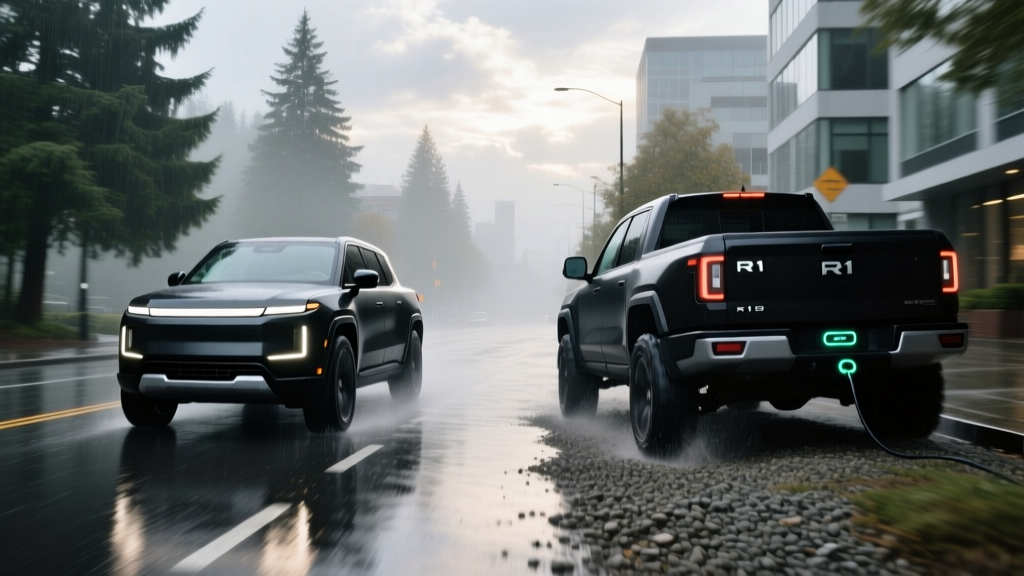
If you've watched a matte-green Rivian R1S glide past you on I-5 or spotted an R1T cresting Snoqualmie Pass with kayaks strapped to the gear tunnel, you're not alone. Seattle and the broader Puget Sound region have become one of the densest Rivian markets in the country — a mix of tech-industry early adopters, outdoor enthusiasts, and families looking for a three-row electric SUV that can actually handle a muddy trailhead. But buying a $75,000+ EV in the Pacific Northwest comes with its own set of variables: persistent 40°F winter mornings, relentless rain that increases rolling resistance, mountain passes that devour battery, and a public charging network that's improving but still spotty outside the I-5 corridor.
This guide is built specifically for Seattle-area shoppers considering the 2026 Rivian R1S (three-row SUV) or R1T (pickup). We'll cover EPA range versus what you'll actually see on the 520 bridge in February, charging realities from Capitol Hill condos to Bellevue single-family homes, and whether the federal tax credit still applies to your household.
2026 Rivian R1S and R1T: Spec Snapshot
Rivian refreshed both the R1S and R1T for the 2025 model year with a new electrical architecture, redesigned interior, and the introduction of a Standard battery pack alongside the existing Large and Max packs. The 2026 lineup carries forward with minor trim adjustments. Here's what you're working with across the core configurations:
| Spec | R1S (SUV) | R1T (Pickup) |
|---|---|---|
| EPA Range (Large Pack) | 352 miles | 342 miles |
| Usable Battery Capacity | ~109 kWh (NMC) | ~109 kWh (NMC) |
| Max DC Fast Charge Rate | ~220 kW (peak) | ~220 kW (peak) |
| 10–80% DC Fast Charge | ~30 minutes | ~30 minutes |
| Level 2 Home Charge Rate | 11.5 kW (~25 mi/hr) | 11.5 kW (~25 mi/hr) |
| Drivetrain | Dual-Motor AWD | Dual-Motor AWD |
| Horsepower | 533 hp (Dual) / 665 hp (Performance Dual) | 533 hp (Dual) / 665 hp (Performance Dual) |
| 0–60 mph | 4.5 sec (Dual) / 3.5 sec (Performance) | 4.5 sec (Dual) / 3.0 sec (Performance) |
| MPGe (Combined) | 73 MPGe | 70 MPGe |
| Efficiency | 46 kWh/100 mi | 48 kWh/100 mi |
| Towing Capacity | 7,700 lbs | 11,000 lbs |
| Base MSRP (Adventure) | $75,900 | $69,900 |
| Battery Warranty | 8 years / 175,000 miles | 8 years / 175,000 miles |
Note: The Standard pack (~87 kWh usable, LFP chemistry) starts lower but delivers approximately 270 miles EPA in the R1S. The Max pack (~141 kWh, NMC) pushes range to roughly 410 miles EPA but adds significant cost and weight. Source: fueleconomy.gov and Rivian specifications.
Real-World Range in the Pacific Northwest
EPA Sticker: 352 miles (R1S Dual-Motor, Large Pack)
Real-World Expectation — Seattle Metro: 290–320 miles in mild weather (50–65°F); 250–280 miles in winter (35–45°F with rain and defroster use); 220–250 miles on a sustained highway run at 70+ mph over Cascade passes.
The EPA number is a useful baseline, but Seattle's climate and topography conspire against range in specific ways. Rivian's Large Pack uses NMC (nickel manganese cobalt) chemistry, which offers high energy density but is more sensitive to cold than LFP. On a typical January morning in Bellevue — 38°F, steady drizzle, cabin heat set to 70°F, and seat warmers on — expect to lose roughly 20–25% from the EPA figure during mixed city/highway driving. The R1S doesn't currently offer a heat pump (it uses resistive heating), which compounds cold-weather consumption compared to competitors like the Hyundai Ioniq 9 or Tesla Model X.
Highway driving over Snoqualmie or Stevens Pass is the real test. Sustained 70 mph speeds combined with 3,000+ feet of elevation gain will push consumption above 55 kWh/100 mi on the ascent. Regenerative braking recovers meaningful energy on the descent — Rivian's one-pedal driving mode is well-calibrated — but you won't fully recoup the climb. Plan for roughly 220–240 miles of usable range on a Seattle-to-Leavenworth trip in winter before you need to stop.
For daily Seattle commuting — say, Fremont to South Lake Union or Redmond to downtown — the Large Pack is massively overkill. A 40-mile round trip with errands still leaves you with 80%+ battery most days. If your driving rarely exceeds 150 miles between charges, the Standard pack saves $6,000+ and offers LFP chemistry that tolerates daily 100% charging without degradation concerns.
Charging at Home and on the Road
Rivian's charging ecosystem has matured significantly. Every 2026 R1S and R1T ships with the NACS (Tesla) charge port as standard, meaning native access to Tesla Superchargers — critical for Pacific Northwest road trips where Electrify America and EVgo coverage thins out east of the Cascades.
| Charging Level | Power / Rate | Miles Added per Hour | Notes |
|---|---|---|---|
| Level 1 (120V) | ~1.4 kW | ~3 mi/hr | Emergency/top-up only; a full charge takes 3+ days |
| Level 2 (240V, Rivian Wall Charger) | 11.5 kW | ~25 mi/hr | Full charge in ~10 hrs; requires 60A circuit |
| Level 2 (240V, 40A circuit) | ~7.7 kW | ~17 mi/hr | Common in older Seattle homes without panel upgrades |
| DC Fast Charge (Tesla Supercharger V3/V4) | Peak ~220 kW | ~550 mi/hr (at peak) | 10–80% in ~30 min; tapers sharply above 80% |
| DC Fast Charge (EA / EVgo CCS via adapter) | Up to ~150 kW (adapter-limited) | ~340 mi/hr (at peak) | NACS-to-CCS adapter required; Rivian provides one |
Home Charging in Seattle: What to Expect
Seattle City Light and Puget Sound Energy both offer residential EV rates, but your actual installation cost depends heavily on your home's electrical panel. Many Seattle homes — particularly pre-1960s builds in Capitol Hill, Wallingford, and West Seattle — have 100A panels that can't support a 60A EV charger circuit without a panel upgrade ($2,000–$4,000). Newer construction in Issaquah, Bothell, and Redmond typically has 200A service, making a Rivian Wall Charger installation straightforward ($500–$1,500 for electrician labor plus $450 for the charger itself).
Rivian's Wall Charger is a solid unit — 11.5 kW output, 25-foot cable, NACS connector — but it's not the fastest on the market. The ChargePoint Home Flex or Emporia Vue offer comparable performance with better energy monitoring. Any of these will fully replenish a Large Pack overnight.
Public DC Fast Charging on I-5 and Beyond
The Seattle-to-Portland corridor is well-served by Tesla Superchargers (now open to Rivians natively) at locations like the Tacoma Dome, Centralia, and Vancouver WA. Expect peak charge rates around 200–220 kW at V3/V4 stalls, with a realistic 10–80% session taking 28–32 minutes. The charge curve tapers significantly above 80% — a 10–90% session stretches to 45+ minutes, so plan your stops around 80% unless you need the extra range to reach the next charger.
Heading east over the Cascades, Supercharger access exists in Ellensburg and Moses Lake, but gaps remain on US-2 toward Leavenworth and on US-12 toward White Pass. Rivian's built-in route planner accounts for elevation and weather, and it's generally accurate within 5–8% of actual arrival SoC — a strong tool for trip planning.
Pricing, Trims, and Federal Tax Credit Eligibility
The 2026 Rivian lineup spans a wide price range depending on pack size, motor configuration, and trim. Here's the current pricing landscape and how the federal tax credit factors in:
| Model / Configuration | Base MSRP | Typical As-Tested | Federal Credit Eligible? |
|---|---|---|---|
| R1T Dual-Motor, Standard Pack | $69,900 | $72,000–$76,000 | Up to $7,500 (if sourcing rules met) |
| R1S Dual-Motor, Large Pack (Adventure) | $75,900 | $80,000–$88,000 | Up to $7,500 (SUV MSRP cap: $80,000) |
| R1S Tri-Motor, Max Pack | $99,000+ | $105,000+ | Not eligible (exceeds $80K SUV cap) |
| R1T Performance Dual, Large Pack | $79,900 | $84,000–$90,000 | Up to $7,500 (truck MSRP cap: $80,000) |
Critical tax credit caveats for 2026: Under IRS §30D, the federal EV tax credit is subject to multiple requirements that change frequently:
- MSRP caps: $80,000 for SUVs and pickups (vans). Many R1S/R1T configurations with options exceed this threshold.
- Buyer income limits: Modified AGI must not exceed $150,000 (single), $225,000 (head of household), or $300,000 (joint). Seattle-area tech salaries frequently push buyers above these limits.
- Battery sourcing: Critical minerals and battery components must meet escalating domestic-content percentages that tighten each year. Rivian has worked to shift sourcing, but eligibility can change mid-year.
- Point-of-sale transfer: As of 2024, you can transfer the credit to the dealer at purchase for an immediate price reduction rather than waiting for tax filing.
Always verify current eligibility on IRS.gov and consult a tax professional before relying on the credit in your purchase math. Washington State also offers its own EV incentives, though these have been subject to legislative changes — check the DOE Alternative Fuels Data Center for current state-level programs.
Interior, Tech, and Daily Livability
R1S: Three-Row Family Hauler
The R1S seats up to seven (or six with optional second-row captain's chairs). Third-row legroom is 30.4 inches — adequate for children on longer trips but tight for adults beyond 30 minutes. Behind the third row, cargo space is 10.4 cu ft, expanding to 57.6 cu ft with the third row folded and 104.7 cu ft with both rear rows down. The front trunk (frunk) adds 11.1 cu ft — useful for charging cables, groceries, or a small cooler.
R1T: The Gear Tunnel Advantage
The R1T's defining feature is the gear tunnel — a 11.6 cu ft pass-through compartment between the cab and bed that's perfect for skis, fishing rods, or camping gear. The 4.5-foot bed is shorter than a traditional pickup, but the tunnel and frunk (11.1 cu ft) make the R1T surprisingly practical for Seattle's weekend-warrior crowd. Towing capacity of 11,000 lbs handles most boat and camper trailer needs, though towing at capacity will cut range roughly in half.
Infotainment and Driver Assistance
Rivian's 15.6-inch center display runs a proprietary OS that's responsive and well-organized, with native integration for trip planning, charging stops, and over-the-air updates. The 2025 refresh brought improved navigation and a redesigned camera system with a 360-degree view that's genuinely useful for tight Seattle parking garages.
Rivian's Driver+ system is a SAE Level 2 driver-assistance suite — it provides highway lane centering and adaptive cruise control, but requires continuous driver supervision. It is not self-driving. The system works well on I-5 and SR-520 but can struggle with faded lane markings on older state highways. It's competitive with Toyota Safety Sense and Honda Sensing, though it falls short of GM's Super Cruise in hands-free capability on mapped roads.
Driver+ Limitations: This is a Level 2 system, not Level 4 autonomy. You must keep your hands on or near the wheel and eyes on the road at all times. The system will issue escalating warnings and eventually slow the vehicle if it detects inattention. It does not navigate complex urban intersections, construction zones, or unmapped roads autonomously.
Pros, Cons, and the Competition
Strengths
- Class-leading adventure capability — genuine off-road modes, air suspension with 14.9 inches of ground clearance, wading depth of 3+ feet
- NACS native — seamless Supercharger access without adapters for most road trips
- Over-the-air updates that meaningfully improve the vehicle (range optimization, new features)
- R1T gear tunnel is a genuinely unique utility feature no competitor matches
- Strong build quality post-2025 refresh; panel gaps and interior materials improved significantly
- 8-year/175,000-mile battery warranty exceeds the industry-standard 100,000 miles
Drawbacks
- No heat pump — cold-weather range loss is worse than competitors with heat pump systems
- Efficiency is middling for the segment (46–48 kWh/100 mi) — a heavy, boxy vehicle shows its physics
- Price quickly exceeds $80K tax credit cap with popular option combinations
- Service center network in the PNW is still limited — expect wait times for non-emergency repairs
- Third-row space in the R1S is tight for adults on longer drives
- Rear visibility in the R1S is compromised by thick D-pillars; camera system compensates but isn't ideal
Key Competitors for Seattle Buyers
The R1S competes most directly with the Tesla Model X (more Supercharger convenience, falcon-wing doors impractical in tight parking, lower starting price), Hyundai Ioniq 9 (heat pump, better efficiency, lower price, less off-road capability), and Kia EV9 (value leader, shorter range, less premium feel). The R1T has virtually no direct electric pickup rival at its price point — the Ford F-150 Lightning is larger and more truck-focused but less refined; the Tesla Cybertruck is similarly priced but polarizing and with limited availability.
Who Should Buy a Rivian in Seattle?
Buy the R1S if: You need three rows for family hauling, want genuine off-road capability for Cascade trailheads, value Supercharger access for PNW road trips, and your typical configuration stays under the $80K tax credit cap.
Buy the R1T if: You want an electric pickup that's daily-drivable in Seattle traffic, need the gear tunnel for outdoor gear, tow a boat or camper occasionally, and don't need a full-size truck bed.
Look elsewhere if: Your budget is under $60K (consider the Ioniq 5 or EV6), you need maximum efficiency over capability (Ioniq 9), you want the longest possible range regardless of price (Lucid Gravity, when available), or you need a full-size truck bed for work use (F-150 Lightning or Silverado EV).
Frequently Asked Questions
What is the real-world range of the Rivian R1S in Seattle winter conditions?
In typical Seattle winter conditions (35–45°F, rain, cabin heat active), expect 250–280 miles from the Large Pack's 352-mile EPA rating. The absence of a heat pump means resistive cabin heating draws directly from the traction battery, compounding range loss. Preconditioning the cabin while plugged in at home mitigates this significantly.
How fast does a Rivian charge at home and on DC fast chargers?
On a Level 2 home charger (11.5 kW / 60A circuit), the R1S Large Pack adds roughly 25 miles of range per hour, achieving a full charge in about 10 hours. On DC fast chargers (Tesla Supercharger V3/V4), the R1S peaks at approximately 220 kW and charges from 10–80% in about 30 minutes. Above 80%, the charge rate tapers sharply — expect 10–90% to take 45+ minutes.
Does the 2026 Rivian R1S qualify for the $7,500 federal EV tax credit?
It depends on your specific configuration and household income. The R1S qualifies as an SUV under §30D (MSRP cap: $80,000), so base Adventure trims with the Standard or Large pack can qualify if the as-configured MSRP stays at or below $80,000 and your modified AGI is within limits ($300K joint / $150K single). Battery sourcing requirements must also be met. Verify on IRS.gov before purchasing.
Is the Rivian R1T practical as a daily driver in Seattle?
Yes, with caveats. The R1T is roughly the size of a mid-size pickup (similar to a Toyota Tacoma) and fits in most Seattle parking structures, though tight parallel-parking spots on Capitol Hill or Ballard can be a squeeze. The 360-degree camera system helps enormously. Ride quality on Seattle's rougher streets is excellent thanks to the air suspension, and one-pedal driving reduces brake wear in stop-and-go traffic.
How does Rivian's service network look in the Seattle area?
As of early 2026, Rivian operates a service center in Seattle (SoDo district) and a mobile service fleet that covers most of King, Snohomish, and Pierce counties. Wait times for non-urgent repairs can stretch 2–4 weeks during peak demand. Mobile service handles many software-related issues, tire rotations, and minor hardware fixes at your home or office. Major body or battery work requires the service center. This is a genuine limitation compared to Tesla's or legacy automakers' service density.
Should I get the Standard, Large, or Max battery pack?
For Seattle-area commuting with occasional Cascade crossing or Portland trip, the Large Pack (109 kWh, ~352 mi EPA) is the sweet spot — enough range for most road trips with one charging stop, without the price premium of the Max. The Standard Pack (~87 kWh, LFP, ~270 mi EPA) is ideal if you charge at home nightly, rarely drive more than 150 miles between charges, and want to save $6,000+. LFP chemistry also tolerates daily 100% charging, which simplifies ownership. The Max Pack (~141 kWh, ~410 mi EPA) makes sense only if you frequently tow or regularly drive 300+ miles between charging opportunities — it adds significant weight, cost, and pushes most configurations past the tax credit cap.