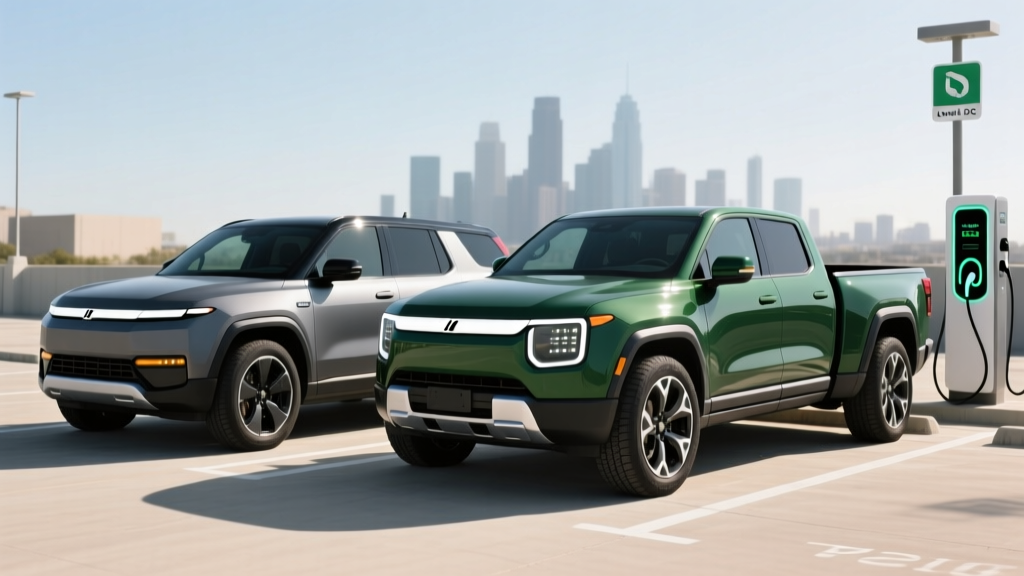
If you've followed Rivian's journey from IPO darling to profitable-volume-builder, you've likely encountered the Rivian CEO pay debate. RJ Scaringe's compensation package — tied to ambitious production and market-cap milestones — has drawn scrutiny from institutional investors and EV shoppers alike. But beyond the boardroom headlines, what actually matters is whether the 2026 R1S (three-row SUV) and R1T (pickup) deliver on the trail, the highway, and the charger.
We've spent seat time in both updated Gen 2 platforms, parsed every EPA filing, and cross-referenced Rivian's latest software drops. Here's the full buyer's-guide breakdown — specs, real-world range, charging reality, tax-credit math, and whether the company's leadership incentives align with your ownership experience.
Quick Verdict: Who Should Buy a 2026 Rivian?
Choose the R1S if: You need three rows, 300+ miles of real-world range, and genuine off-road chops without resorting to a body-on-frame dinosaur.
Choose the R1T if: You want a 5,000-lb tow rating, a clever gear tunnel, and a daily-drivable electric pickup that fits in a standard garage.
Look elsewhere if: Your budget is under $70,000, you rarely leave pavement, or you prioritize the lowest $/mile efficiency over capability.
Range, Battery & Real-World Efficiency
The 2026 R1S and R1T share Rivian's updated skateboard architecture with three battery options. The chemistry choice matters enormously for long-term ownership.
| Spec | Standard (LFP) | Large (NMC) | Max (NMC) |
|---|---|---|---|
| Battery Capacity (usable) | ~92 kWh | ~112 kWh | ~141 kWh |
| Chemistry | LFP (Lithium Iron Phosphate) | NMC (Nickel Manganese Cobalt) | NMC |
| EPA Range (R1S Dual-Motor) | ~270 mi | ~352 mi | ~410 mi |
| EPA Range (R1T Dual-Motor) | ~260 mi | ~340 mi | ~395 mi |
| Efficiency (R1S Large) | ~73 MPGe / 46 kWh/100 mi | ||
Real-World Range Reality: The EPA's 352-mile Large Pack figure for the R1S assumes mixed driving. On a 75-mph highway run in 40°F weather, expect closer to 270–290 miles before you're hunting for a charger. City regenerative driving can push past the EPA sticker. The Max Pack's 410-mile sticker translates to roughly 320–340 highway miles in moderate temps — still class-leading for a three-row SUV.
The LFP Standard pack is the value play: it's heavier and denser in energy terms, but LFP chemistry tolerates daily 100% charging without the degradation anxiety of NMC. If you commute under 100 miles round-trip and charge at home nightly, the Standard pack with its lower cost and longer cycle life is arguably the smart buy.
Charging Speed: DC Fast, Level 2 & the Curve Reality
Rivian upgraded the Gen 2 platform's thermal management, and it shows at the charger. Here's what you'll actually see:
| Charging Level | Power | Speed | Notes |
|---|---|---|---|
| Level 1 (120V) | ~1.4 kW | ~3–4 mi/hr | Emergency/trickle only |
| Level 2 (240V home) | 11.5 kW (48A) | ~25 mi/hr | Full overnight charge in 10–14 hrs |
| DC Fast (peak) | ~220 kW | 10–80% in ~28 min (Large) | Sustained ~180 kW to 50%, then taper |
| DC Fast (NACS) | ~220 kW | Tesla Supercharger access | Native NACS port on 2026 models |
The charge curve is honest but not class-leading. Rivian peaks around 220 kW on the Large and Max packs, but the curve tapers meaningfully above 60% state of charge. On a road trip, plan your stops around 10–80% cycles — pushing to 100% at a DC fast charger adds 25+ minutes of diminishing returns. Preconditioning via the navigation system is essential; without it, cold-soak can cut peak rates by 30–40%.
The switch to a native NACS charge port on 2026 models means direct Tesla Supercharger access without an adapter — a meaningful reliability advantage on the road, given Tesla's network uptime versus third-party CCS networks.
Performance & Drivetrain
Rivian offers four drivetrain configurations for 2026, and the performance spread is enormous:
| Config | 0–60 mph | Horsepower | Torque |
|---|---|---|---|
| Dual-Motor AWD | 4.5 sec | 533 hp | 610 lb-ft |
| Performance Dual-Motor | 3.5 sec | 665 hp | 829 lb-ft |
| Tri-Motor AWD | 2.9 sec | 850 hp | 1,100+ lb-ft |
| Quad-Motor (R1T only) | 2.5 sec | 1,025 hp | 1,200+ lb-ft |
The Dual-Motor is the volume seller and the sweet spot for most buyers — 533 hp is more than adequate for merging, towing, and trail work. The Tri-Motor is a bragging-rights configuration that sacrifices some range for supercar-rivaling acceleration. The Quad-Motor remains the R1T's party trick, with individual wheel torque vectoring that makes it genuinely capable off-road, not just a marketing exercise.
Towing: the R1T is rated for 11,000 lbs (properly equipped), while the R1S tows up to 7,700 lbs. Expect a 40–50% range hit when towing near max — plan charging accordingly.
Pricing, Tax Credits & the CEO Pay Context
| Model / Trim | Base MSRP | Federal §30D Credit | Effective Price |
|---|---|---|---|
| R1S Dual-Motor Standard | $75,900 | Up to $7,500* | ~$68,400 |
| R1S Dual-Motor Large | $82,900 | Up to $7,500* | ~$75,400 |
| R1T Dual-Motor Standard | $69,900 | Up to $7,500* | ~$62,400 |
| R1T Tri-Motor Max | $99,900 | Up to $7,500* | ~$92,400 |
*Federal tax credit eligibility under IRS §30D depends on MSRP caps (SUVs/vans/pickups: $80,000), buyer income limits ($300K joint / $150K single), and battery critical-mineral sourcing requirements. Point-of-sale transfer is available. Verify eligibility with a tax professional — rules tighten annually through 2032.
Here's where Rivian CEO pay intersects with your purchase. RJ Scaringe's compensation package, approved by the board and disclosed in SEC filings, is heavily milestone-based — tied to production volume, gross margin targets, and stock performance. Critics argue the package (potentially worth billions if all milestones are hit) dilutes shareholders; supporters note it aligns Scaringe's incentives with long-term company health rather than short-term stock manipulation.
For buyers, the practical question is whether Rivian's financial trajectory supports long-term parts availability, software updates, and warranty service. As of early 2026, Rivian has reached positive gross margin on vehicle production — a critical inflection point — and the Volkswagen joint-venture investment has stabilized the balance sheet. The CEO pay structure doesn't directly affect your ownership cost, but it does signal that leadership is incentivized to scale production and maintain vehicle support, rather than pump-and-dump the stock.
Interior, Cargo & Daily Livability
R1S cargo: 104.7 cu ft max (behind first row), 57.4 cu ft behind second row, 11.5 cu ft frunk. Third-row legroom is 30.4 inches — tight for adults on long trips, fine for kids.
R1T bed: 4.5-foot bed (with midgate open: 6.5 ft), plus the signature 11-cu-ft gear tunnel running laterally behind the cab. The gear tunnel is the R1T's killer feature — it's lockable, weather-sealed, and perfect for skis, fishing rods, or a week's worth of groceries you don't want rolling around the bed.
The interior materials are premium but not luxury-German pretentious: vegan leather, real wood accents, and a minimalist 15.6-inch center touchscreen running Rivian's in-house OS. Wireless CarPlay and Android Auto are standard. The Rivian Driver+ system is a competent Level 2 ADAS (hands-on-wheel, eyes-on-road) with lane centering and adaptive cruise — functional but not as polished as GM's Super Cruise on highway mapping.
Warranty & Ownership Costs
| Coverage | Term |
|---|---|
| Basic Vehicle | 5 years / 60,000 miles |
| Battery & Powertrain | 8 years / 175,000 miles |
| Battery Capacity Retention | 70% minimum at 8 yr / 175K mi |
| Roadside Assistance | 5 years / 60,000 miles |
The 175,000-mile battery warranty is among the longest in the segment and reflects confidence in the Gen 2 pack's thermal management. Rivian's 70% capacity retention threshold is industry-standard; real-world data from early Gen 1 owners suggests degradation in the 5–8% range after 60,000 miles, well within the warranty buffer.
Insurance runs 15–25% higher than comparable ICE vehicles (typical for EVs with aluminum-intensive structures and expensive sensor suites). Maintenance is minimal: no oil changes, brake pad life extended by regen, cabin air filter every 20K miles, and tire rotation every 7,500 miles. Budget for tire replacement every 30–40K miles — the R1S/R1T's weight and torque eat rubber.
Pros
- Class-leading real-world range with Max Pack (320+ highway miles)
- Native NACS port — direct Supercharger access
- Genuine off-road capability (air suspension, quad-motor torque vectoring)
- 8-year/175,000-mile battery warranty
- Over-the-air updates continuously add features
Cons
- Base price above $70K even for Standard pack
- Third row is kids-only for long trips
- Charging curve tapers early vs. Hyundai/Kia 800V platforms
- Insurance premiums 15–25% above segment average
- Service center network still sparse outside major metros
Competitor Check: R1S vs. the Field
The R1S competes against the Tesla Model X (more range, falcon-wing gimmick), the BMW iX (more luxury, less capability), and the Kia EV9 (cheaper, less range and off-road ability). The R1T's only direct rival is the Ford F-150 Lightning (cheaper, less range and tech) and the GMC Hummer EV (heavier, thirstier, more expensive).
If you prioritize price, the EV9 or Lightning wins. If you prioritize range and tech integration, the R1S/R1T with the Large pack is the balanced pick. If you need the absolute longest range regardless of cost, the R1S Max Pack or Model X Long Range are your options.
Frequently Asked Questions
What is the real-world range of the 2026 Rivian R1S?
The EPA rates the R1S Large Pack at 352 miles. In real-world highway driving at 75 mph in moderate temperatures, expect 270–290 miles. City driving with regen can exceed the EPA sticker. Cold weather (below 30°F) knocks off another 15–20%.
How fast does the Rivian R1T charge at home and on the road?
At home on a Level 2 (240V, 48A) charger, the R1T adds roughly 25 miles of range per hour — a full overnight charge for the Large pack in about 12 hours. On DC fast chargers, peak rate is ~220 kW, with 10–80% taking about 28 minutes on the Large pack. Plan for 35–40 minutes including taper if you push past 80%.
Does the 2026 Rivian qualify for the federal EV tax credit?
Yes, most configurations qualify for up to $7,500 under IRS §30D, but eligibility depends on your income (under $300K joint / $150K single), the vehicle's MSRP (under $80K for SUVs/pickups — some R1S trims exceed this), and battery sourcing rules that tighten yearly. The point-of-sale transfer lets you apply the credit at purchase rather than waiting for tax filing. Always verify with a tax professional and check IRS guidance for current-year rules.
Is the Rivian R1S worth it vs. the Tesla Model X or Kia EV9?
The R1S wins on off-road capability, build quality, and real-world range with the Max Pack. The Model X wins on Supercharger network access (though Rivian now has native NACS), third-row space, and software polish. The EV9 wins on price (starting ~$55K) but loses on range and AWD capability. If you need genuine trail capability and 300+ real-world miles, the R1S is the pick.
What's the biggest drawback of owning a Rivian?
Service center coverage. Rivian's service network is still concentrated in major metro areas, and mobile service can't handle major repairs. If you live outside a top-30 metro, factor in potential travel for warranty work. Insurance costs are also notably higher than ICE equivalents.
Does the Rivian CEO pay structure affect my ownership?
Not directly. RJ Scaringe's milestone-based compensation is designed to incentivize long-term production scale and profitability, which supports parts availability and software development. The risk is that aggressive milestones could pressure quality control — but early Gen 2 data shows improved build consistency over Gen 1.
Sources: EPA efficiency data via fueleconomy.gov; Rivian official specifications at rivian.com; IRS §30D credit rules at irs.gov.