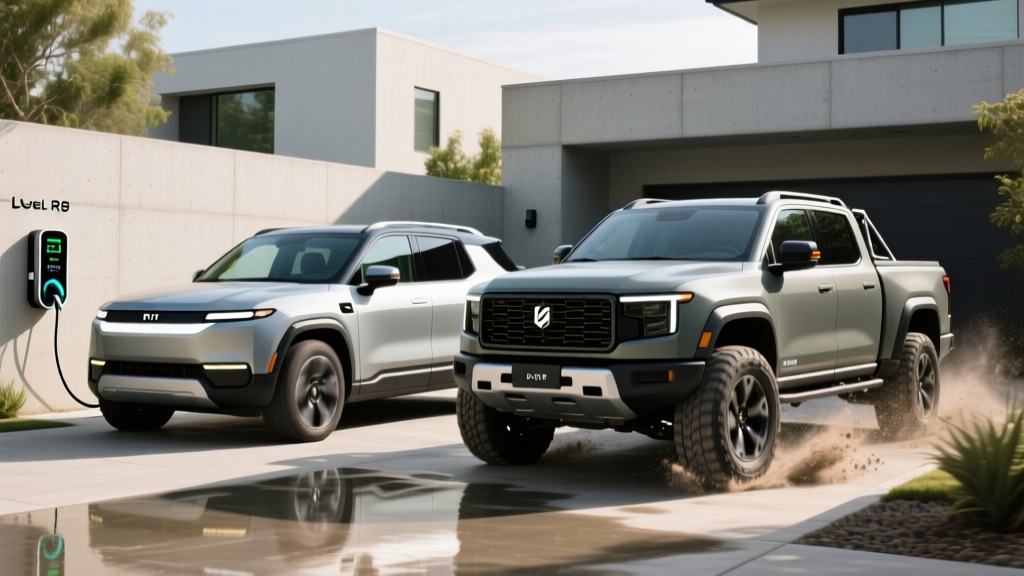
Rivian has matured from an ambitious startup into one of the most recognizable names in American EVs. The 2026 Rivian electric car lineup centers on two vehicles built on the same flexible skateboard platform: the R1S three-row SUV and the R1T pickup truck. Both received significant updates for the 2025 model year with the Gen 2 platform—new battery packs, redesigned interiors, faster charging, and the long-awaited addition of the NACS charge port for native Tesla Supercharger access. Those improvements carry into 2026, making this the most complete version of Rivian's consumer vehicles to date.
But specs on a window sticker only tell part of the story. After extensive real-world driving, charging, and ownership analysis, here's everything you need to know before putting down a deposit on a 2026 Rivian.
2026 Rivian R1S and R1T: Core Specifications at a Glance
| Spec | R1S (SUV) | R1T (Truck) |
|---|---|---|
| EPA Range (Max Pack) | Up to 410 mi | Up to 420 mi |
| Battery (Max Pack) | ~149 kWh usable, NMC | ~149 kWh usable, NMC |
| Battery (Standard) | ~95 kWh usable, LFP | ~95 kWh usable, LFP |
| Max DC Fast Charge | 220 kW peak | 220 kW peak |
| 10–80% DCFC Time | ~28 min (Max Pack) | ~28 min (Max Pack) |
| Level 2 Home Charging | 11.5 kW (~25 mi/hr) | 11.5 kW (~25 mi/hr) |
| 0–60 mph (Dual-Motor) | 4.5 sec / 533 hp | 4.5 sec / 533 hp |
| 0–60 mph (Tri-Motor) | 2.9 sec / 850 hp | 2.9 sec / 850 hp |
| Drivetrain | AWD (Dual/Tri/Quad) | AWD (Dual/Tri/Quad) |
| Towing Capacity | 7,700 lbs | 11,000 lbs |
| Cargo Volume (behind 3rd row) | 10.6 cu ft / 91.5 cu ft max | 54 cu ft bed + 11 cu ft frunk |
| Starting MSRP | $79,900 (Dual-Motor Standard) | $71,700 (Dual-Motor Standard) |
| Battery/Powertrain Warranty | 8 yr / 175,000 mi | 8 yr / 175,000 mi |
Real-World Range: What the EPA Number Doesn't Tell You
Rivian's efficiency numbers tell the underlying story. The Dual-Motor R1S achieves roughly 73 MPGe combined (about 46 kWh/100 miles), which is respectable for a 7,000-pound vehicle but far from the efficiency of a sedan-class EV. The boxy aerodynamics, aggressive all-terrain tire options, and sheer mass all work against highway efficiency.
If your typical week involves a 30-mile round-trip commute with weekend errands, even the Standard Pack (EPA ~270 mi R1S) will easily cover your needs with nightly Level 2 top-ups. For road trips exceeding 300 miles one-way, you'll want the Max Pack—or a willingness to plan a single DC fast-charge stop.
Charging Speed and Infrastructure
Rivian's Gen 2 platform brought meaningful charging improvements. Both the R1S and R1T now feature a native NACS charge port, granting direct access to Tesla's Supercharger network—over 25,000 stalls in North America—without an adapter. This was one of the most requested features from early owners, and it fundamentally changes the road-trip calculus for Rivian drivers.
| Charge Level | Power / Rate | Miles Added per Hour | Notes |
|---|---|---|---|
| Level 1 (120V) | ~1.4 kW | ~3 mi/hr | Emergency/trickle only |
| Level 2 (240V, 48A) | 11.5 kW | ~25 mi/hr | Full charge overnight (~10–12 hrs Max Pack) |
| DC Fast Charge (peak) | 220 kW | ~500 mi/hr (peak) | 10–80% in ~28 min; tapers significantly above 80% |
A critical note on the DC fast-charging curve: the 220 kW peak is just that—a peak, typically sustained between roughly 10–40% state of charge. As the battery fills, charge speed throttles down to protect cell health. By 80%, you're pulling closer to 60–80 kW. Plan road-trip stops around 10–80% sessions rather than attempting full charges at public stations, where the last 20% can add 25+ minutes.
For home charging, Rivian's Wall Charger delivers 11.5 kW on a 240V/48A circuit. Most owners will need a 60A dedicated circuit installed by a licensed electrician. Installation costs typically range from $800–$2,500 depending on panel proximity and whether your home's electrical panel needs an upgrade from 100A to 200A service.
Performance, Drivetrain, and Capability
The 2026 Rivian lineup offers three motor configurations:
- Dual-Motor (AWD): 533 hp, 610 lb-ft torque, 0–60 in 4.5 seconds. The volume seller and the best value.
- Tri-Motor (AWD): 850 hp, 1,100+ lb-ft, 0–60 in ~2.9 seconds. Absurdly quick for a vehicle this size.
- Quad-Motor (AWD): 1,025 hp, independent torque vectoring at each wheel. Enthusiast/off-road focused.
All configurations use a single-speed reduction gear—no multi-speed transmission. Regenerative braking is adjustable through multiple levels, though Rivian does not offer true one-pedal driving that brings the vehicle to a complete stop without brake application.
Off-road capability remains a genuine Rivian differentiator. The available air suspension provides up to 14.9 inches of ground clearance, and the R1T's Gear Tunnel—a full-width pass-through storage compartment behind the cab—is a feature no competitor offers. The R1T also includes a built-in air compressor and multiple 120V/240V outlets in the bed for job-site or camping use.
Pricing, Trim Levels, and Federal Tax Credit Eligibility
| Model / Trim | Base MSRP | As-Tested (Typical) |
|---|---|---|
| R1T Dual-Motor Standard | $71,700 | $75,000–$80,000 |
| R1T Dual-Motor Max | $82,700 | $88,000–$95,000 |
| R1T Tri-Motor Max | $100,700 | $105,000–$115,000 |
| R1S Dual-Motor Standard | $79,900 | $83,000–$90,000 |
| R1S Dual-Motor Max | $90,900 | $95,000–$105,000 |
| R1S Tri-Motor Max | $108,900 | $112,000–$120,000 |
Does the 2026 Rivian Qualify for the Federal EV Tax Credit?
This is where Rivian buyers need to pay close attention. Under IRS §30D rules, the $7,500 federal tax credit is available for qualifying new EVs, but eligibility depends on three intersecting requirements that change frequently:
- MSRP Cap: SUVs and pickups (including the R1S and R1T) must have an MSRP at or below $80,000. This means only the Dual-Motor Standard battery trims qualify on paper.
- Buyer Income Cap: Modified adjusted gross income must not exceed $300,000 (joint), $225,000 (head of household), or $150,000 (single).
- Battery Sourcing: Critical minerals and battery components must meet escalating domestic-content thresholds. As of 2026, these requirements are stringent, and eligibility can shift with supply-chain changes. Always verify current status at irs.gov before purchasing.
The credit can now be transferred to the dealer at the point of sale, effectively reducing your purchase price by $7,500 upfront rather than waiting for a tax refund. Consult a tax professional to confirm your personal eligibility.
Interior, Technology, and Driver Assistance
The Gen 2 interior is a meaningful step up from early-build Rivians. Materials quality, panel fit, and seat comfort have all improved. The 15.6-inch center touchscreen runs Rivian's proprietary infotainment OS—responsive and well-organized, though it lacks Apple CarPlay and Android Auto. Rivian's position is that its native system provides deeper EV-specific integration (route planning with charging, preconditioning, battery health monitoring), but smartphone mirroring remains a top request from buyers accustomed to it.
Driver assistance comes through Rivian Driver+, a Level 2 SAE system offering adaptive cruise control, lane centering, and hands-on-wheel highway assist. It is competent and predictable but does not approach the hands-free capability of GM's Super Cruise or Ford's BlueCruise on mapped highways. The driver must maintain steering-wheel contact and visual attention at all times.
Notable tech highlights include:
- Over-the-air software updates adding features post-purchase
- Camp Mode (maintains climate and power outlets while parked)
- Pet Mode (climate stays on for animals in the vehicle)
- Powered tonneau cover on R1T with integrated LED lighting
- Available camp kitchen accessory for the R1T Gear Tunnel
Pros, Cons, and the Bottom Line
Pros
- Genuine off-road capability with 14.9" ground clearance
- Native NACS port — direct Tesla Supercharger access
- Class-leading 410–420 mi max range (Max Pack)
- R1T Gear Tunnel is a unique, highly practical feature
- 8-year/175,000-mile battery warranty exceeds most competitors
- Tri-Motor performance is supercar-quick in a family vehicle
Cons
- No Apple CarPlay or Android Auto
- Starting price above $70K; tax credit eligibility limited to base trims
- Heavy vehicle — efficiency lags sedan/crossover EVs
- Third-row seat in R1S is tight for adults on long trips
- Driver+ is capable but behind Super Cruise/BlueCruise in hands-free functionality
- Service center network still expanding in rural areas
Who Should Buy a 2026 Rivian?
The Rivian electric car lineup is best suited for:
- Active families who need three rows (R1S) or a truck bed (R1T) and want to eliminate tailpipe emissions without sacrificing weekend adventure capability.
- Outdoor enthusiasts who value off-road clearance, integrated camping features, and the R1T's bed power outlets and Gear Tunnel.
- Tech-forward buyers who appreciate OTA updates and a vertically integrated software experience—and don't mind forgoing CarPlay.
It is not the best choice for budget-conscious shoppers (the Ford F-150 Lightning and Chevy Silverado EV offer lower entry prices), commuters prioritizing maximum efficiency (a Tesla Model Y or Hyundai Ioniq 5 will use far less electricity per mile), or those who need a mature service network in every zip code.
Frequently Asked Questions
What is the real-world range of the 2026 Rivian R1S and R1T?
EPA estimates reach 410 miles (R1S Max Pack) and 420 miles (R1T Max Pack). Real-world highway driving at 70+ mph typically yields 310–340 miles from the Max Pack. Cold weather can reduce this by 20–30%. The Standard Pack (EPA ~270 mi) delivers roughly 220–250 miles in mixed real-world use.
How fast does a Rivian charge at home and on the road?
At home on a Level 2 (240V/48A) charger, both vehicles add roughly 25 miles of range per hour, or a full charge in 10–12 hours for the Max Pack. On a DC fast charger, the Gen 2 platform peaks at 220 kW, achieving a 10–80% charge in approximately 28 minutes. Charging slows considerably above 80% SoC.
Does the 2026 Rivian qualify for the $7,500 federal EV tax credit?
Possibly, but only on base Dual-Motor Standard trims that fall under the $80,000 MSRP cap for SUVs and pickups. Buyer income limits and battery-sourcing requirements also apply. Eligibility shifts with supply-chain and regulatory changes—verify at irs.gov before purchasing, and consult a tax professional.
Is the Rivian worth it versus the Tesla Model X or Ford F-150 Lightning?
Against the Model X, the R1S offers superior off-road capability, a more conventional SUV design, and a more premium interior—but less charging infrastructure (though NACS access narrows this gap) and no Autopilot-level hands-free driving. Against the F-150 Lightning, the R1T is more expensive but significantly more refined, with better range, the Gear Tunnel, and genuine off-road chops. The Lightning remains the value play for truck buyers.
What battery chemistry does Rivian use?
The Standard Pack uses LFP (lithium iron phosphate) chemistry—known for excellent cycle life, tolerance for regular 100% charging, and lower cost, but with reduced energy density. The Max Pack uses NMC (nickel manganese cobalt), which offers higher energy density for maximum range but benefits from daily charging limits around 80–90% for longevity.
How long is the Rivian battery warranty?
Rivian provides an 8-year / 175,000-mile battery and powertrain warranty, covering defects and capacity loss below a specified threshold. This exceeds the industry-standard 8-year/100,000-mile warranty offered by most competitors and reflects confidence in the Gen 2 battery architecture.