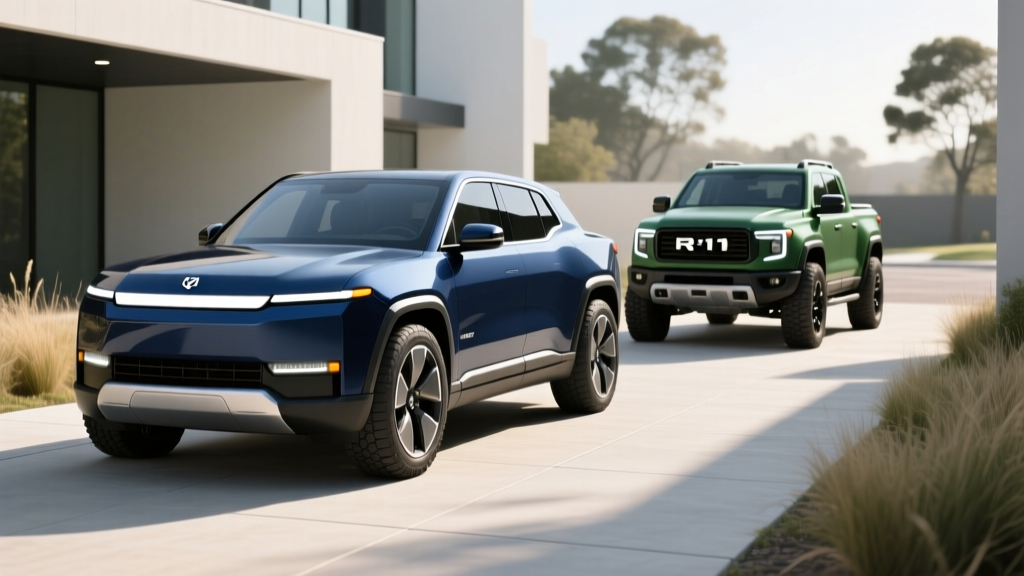
Rivian's Q1 2026 production cycle marks a pivotal moment for the R1S SUV and R1T pickup. Following the sweeping Gen 2 platform updates introduced in mid-2024 and refined through 2025, the latest build batches now reflect stabilized manufacturing at the Normal, Illinois facility, expanded battery pack options, and the maturation of Rivian's proprietary software stack. For buyers evaluating an R1S or R1T in early 2026, the question is no longer whether Rivian can build a compelling electric adventure vehicle — it's which configuration delivers the best real-world value.
We've analyzed the current spec sheets, EPA data, and owner-reported charging behavior to give you the exact numbers that matter before you configure or order.
2026 Rivian R1S and R1T: What's Changed for Q1 Production
The Q1 2026 production window encompasses vehicles built roughly January through March 2026. These units benefit from several iterative improvements over the original 2022–2023 Gen 1 platform:
- Tri-Motor and Dual-Motor configurations continue with updated thermal management software for improved sustained charge rates.
- Max Pack availability has expanded across more trims after initial supply constraints eased in late 2025.
- Software-defined vehicle architecture — Rivian's Gen 2 electrical system uses fewer ECUs and zonal controllers, reducing weight and improving over-the-air update reliability.
- NACS (Tesla Supercharger) native port is now standard on all new production, eliminating the need for a CCS-to-NACS adapter that earlier adopters relied on.
Rivian reported producing approximately 10,000–12,000 vehicles per quarter through late 2025, and Q1 2026 output is expected to remain in that band as the company balances demand against supply-chain realities for its large-format cylindrical cells.
EPA Range and Real-World Expectations
Rivian offers the R1S and R1T in three battery configurations for 2026. Here's what the EPA rates them at — and what you should actually plan for.
| Configuration | Battery (kWh usable) | Chemistry | R1S EPA Range | R1T EPA Range | Efficiency (kWh/100mi) |
|---|---|---|---|---|---|
| Dual-Motor Standard | ~95 kWh | NMC (2170 cells) | 270 mi | 270 mi | 35–37 |
| Dual-Motor Large | ~113 kWh | NMC (2170 cells) | 340 mi | 330 mi | 33–35 |
| Tri-Motor Max Pack | ~141 kWh | NMC (46mm cells) | 410 mi | 420 mi | 34–36 |
The Max Pack's 46mm-diameter cylindrical cells (sourced from Samsung SDI) represent Rivian's highest energy-density option. These larger cells also support faster sustained charge rates, which we'll cover next.
For a real-world frame: a Dual-Motor Large R1S owner driving from Denver to Moab in winter (elevation changes, 35°F, 70 mph cruise) should budget roughly 260–280 usable miles before needing to charge — well below the 340-mile EPA sticker but still sufficient for most single-day trips with one fast-charge stop.
Charging Speed: DC Fast Charge and Home Level 2
Charging speed is where the Max Pack distinguishes itself most clearly. Rivian's Gen 2 architecture supports up to 220 kW peak DC fast charging on Max Pack vehicles, while Standard and Large packs peak around 190–200 kW.
| Metric | Standard Pack | Large Pack | Max Pack |
|---|---|---|---|
| Peak DC fast-charge rate | ~190 kW | ~200 kW | ~220 kW |
| 10–80% DC fast-charge time | ~28 min | ~27 min | ~25 min |
| Level 2 home charging (kW) | 11.5 kW | 11.5 kW | 11.5 kW |
| Level 2 miles added per hour | ~25 mi/hr | ~25 mi/hr | ~25 mi/hr |
| Full Level 2 charge (0–100%) | ~8.5 hr | ~10 hr | ~12.5 hr |
| Connector | NACS (native); CCS via adapter (legacy) | ||
Charging-curve reality: The 220 kW peak on the Max Pack is sustained roughly from 10% to 35% state of charge. Beyond 50%, the curve tapers progressively — by 80% SoC, you're pulling roughly 80–90 kW. This is standard behavior for NMC chemistry managed by an aggressive thermal system. The 10–80% time of ~25 minutes for the Max Pack is competitive with the best large-battery EVs on the market, though smaller-pack rivals like the Hyundai Ioniq 5 or Kia EV9 can match or beat it due to smaller absolute energy fills.
At home on a 48-amp Level 2 circuit (the typical Rivian Wall Connector install), the 11.5 kW onboard charger adds about 25 miles of range per hour. For a Max Pack owner, a full overnight charge from near-empty takes about 12–13 hours — plan your charging window accordingly, or set a scheduled departure time with preconditioning to optimize.
Performance: 0–60, Horsepower, and Drivetrain
Rivian's dual-motor and tri-motor setups deliver serious performance, especially given the R1S and R1T's curb weights (roughly 6,800–7,100 lbs depending on configuration).
| Configuration | Drivetrain | Horsepower | Torque (lb-ft) | 0–60 mph |
|---|---|---|---|---|
| Dual-Motor | AWD | 533 hp | 610 | ~4.5 sec |
| Performance Dual-Motor | AWD | 665 hp | 829 | ~3.4 sec |
| Tri-Motor (Max Pack) | AWD | 850 hp | 1,103 | ~2.9 sec |
The Tri-Motor's sub-3-second 0–60 time places it in supercar territory, which is absurd for a 7,000-pound SUV — but it's real, and it's repeatable thanks to Rivian's torque-vectoring rear axle and sophisticated traction control.
For towing, the R1T is rated at 11,000 lbs and the R1S at 7,700 lbs. Note that towing near max capacity will slash your effective range by 40–50%, so a Max Pack R1T towing a 6,000-lb trailer should expect roughly 200–240 miles before needing to charge.
Pricing, Trims, and Federal Tax Credit Eligibility
Rivian's pricing has shifted several times since launch. As of Q1 2026 production, here's where the lineup stands:
| Model & Config | Base MSRP | Federal §30D Credit | Effective Price (if eligible) |
|---|---|---|---|
| R1T Dual-Motor (Standard) | $69,900 | Up to $7,500 | ~$62,400 |
| R1T Dual-Motor (Large) | $75,900 | Up to $7,500 | ~$68,400 |
| R1T Tri-Motor Max Pack | $99,900 | Up to $7,500 | ~$92,400 |
| R1S Dual-Motor (Standard) | $74,900 | Up to $7,500 | ~$67,400 |
| R1S Dual-Motor (Large) | $79,900 | Up to $7,500 | ~$72,400 |
| R1S Tri-Motor Max Pack | $104,900 | Up to $7,500 | ~$97,400 |
- MSRP cap: SUVs/pickups (R1S/R1T qualify as light trucks) must have an MSRP at or below $80,000. This means Tri-Motor Max Pack configurations exceed the cap and do NOT qualify.
- Income cap: Modified AGI must not exceed $150,000 (single), $225,000 (head of household), or $300,000 (joint filers).
- Battery sourcing: Critical minerals and battery component requirements tighten annually. Rivian has worked to qualify its supply chain, but confirm current-year eligibility at IRS.gov before ordering.
- Point-of-sale transfer: Eligible buyers can transfer the credit to the dealer at purchase, reducing the out-of-pocket price immediately rather than waiting for a tax refund.
In practice, the Dual-Motor Standard and Large configurations of both R1S and R1T fall under the $80,000 MSRP cap and are the trims most likely to benefit from the full $7,500 credit — assuming the buyer meets income thresholds and the battery-sourcing requirements are satisfied for that specific build month. Always verify eligibility with your tax professional and check the latest fueleconomy.gov listings.
Cargo, Passenger Space, and Interior Practicality
The R1S (three-row SUV) and R1T (crew-cab pickup) serve different use cases, but both leverage Rivian's skateboard platform to maximize interior volume.
R1S Cargo:
- Behind 3rd row: ~10.5 cu ft
- Behind 2nd row (3rd row folded): ~46.7 cu ft
- Max (all rear rows folded): ~91.6 cu ft
- Front trunk (frunk): ~11.0 cu ft — one of the largest in the EV segment
R1T Cargo:
- Bed length: 4.5 ft (standard) with the gear tunnel offering an additional ~11.0 cu ft of enclosed, lockable storage running the width of the vehicle
- Frunk: ~11.0 cu ft
- Tonneau cover available as a weather-sealed option
Passenger space (R1S):
- 1st-row legroom: ~41.3 in
- 2nd-row legroom: ~38.2 in
- 3rd-row legroom: ~30.4 in (best for children or short trips)
The R1T offers generous front and rear legroom comparable to a midsize crew-cab truck, though the lack of a traditional rear seat fold-flat limits in-cabin cargo flexibility versus an SUV.
Tech, Driver Assistance, and Standout Features
Rivian's software stack remains one of the strongest in-house-developed platforms among EV startups. Key highlights for Q1 2026 production vehicles:
- 15.6-inch center touchscreen running Rivian OS with native navigation, route planning with charge-stop integration, and over-the-air updates.
- Rivian Driver+ — a Level 2 (SAE) driver-assistance suite combining adaptive cruise control, lane-centering, and automatic emergency braking. This is not a hands-free system like GM's Super Cruise or Ford's BlueCruise; the driver must keep hands on the wheel. Rivian has indicated hands-free highway capability is in development but has not announced a release date for Q1 2026 vehicles.
- Camp Kitchen accessory (R1T): a slide-out kitchen system that integrates into the gear tunnel — a genuinely unique feature for the overlanding community.
- Vehicle-to-Load (V2L): The R1T and R1S can output up to 3.6 kW via bed and frunk outlets, enough to power campsite equipment, tools, or serve as emergency home backup for essential circuits.
- Phone-as-key and configurable drive modes (All-Purpose, Sport, Snow, Off-Road, Towing) that adjust suspension height, throttle mapping, and regen intensity.
Warranty Coverage
Rivian's warranty structure is competitive with mainstream EV manufacturers:
- Battery & Drive Unit: 8 years / 175,000 miles (whichever comes first), with a capacity retention threshold of 70% during the warranty period.
- Limited Vehicle Warranty: 5 years / 60,000 miles bumper-to-bumper.
- Corrosion Perforation: 5 years / unlimited miles.
- Roadside Assistance: 5 years / 60,000 miles, including towing to the nearest Rivian service center or charger.
The 175,000-mile battery warranty is notably generous compared to the industry-standard 100,000 miles (Tesla, Hyundai, Ford). For high-mileage drivers or those planning long-term ownership, this is a meaningful advantage. Rivian publishes battery degradation data sparingly, but early Gen 1 fleet data suggests approximately 5–8% capacity loss over the first 50,000 miles — consistent with well-managed NMC packs. For more on long-term degradation trends, see Recurrent Auto's fleet reports.
Pros
- Class-leading real-world range with Max Pack (410+ mi EPA)
- Native NACS — full Tesla Supercharger network access
- 8-yr / 175,000-mi battery warranty
- Unique adventure features (gear tunnel, camp kitchen, V2L)
- Sub-3-sec 0–60 (Tri-Motor) in a 7,000-lb vehicle
- Large frunk (~11 cu ft) across both models
- Strong OTA update cadence improving vehicle over time
Cons
- Tri-Motor Max Pack exceeds $80K MSRP cap — no federal tax credit
- Third row in R1S is tight for adults (~30 in legroom)
- Level 2 driver-assist only; no hands-free highway driving yet
- Home Level 2 full charge takes 12+ hours for Max Pack
- Service center network still expanding — rural owners may face long tow distances
- Real-world highway range drops 10–15% below EPA at 75+ mph
- Premium pricing even after credit vs. Hyundai/Kia EV9 or Ford F-150 Lightning
Who Should Buy a Q1 2026 Rivian?
Choose the Rivian R1S/R1T if:
- Outdoor/adventure use: You need genuine off-road capability, gear storage, and V2L for camping — the R1 platform was designed for this and executes better than any competitor.
- Long-range road trips: The Max Pack's 410+ mile EPA range plus Supercharger access makes cross-country travel viable with 1–2 stops.
- Towing (R1T): 11,000-lb capacity with integrated trailer brake controller and dedicated tow mode.
- Family SUV with frunk: R1S offers three rows plus a massive frunk that no competitor matches for combined cargo flexibility.
Look elsewhere if:
- Budget is primary: The Ford F-150 Lightning or Chevy Silverado EV starts thousands lower; the Kia EV9 undercuts the R1S significantly while offering three rows.
- Hands-free highway driving matters: GM's Super Cruise and Ford's BlueCruise offer true hands-off (eyes-on) operation on mapped highways today. Rivian does not.
- Urban commuting only: The R1's size, weight, and premium price are overkill for city driving. A smaller EV like the Tesla Model Y or Hyundai Ioniq 5 offers better efficiency and easier parking.
Rivian R1S vs. R1T vs. Key Competitors
| Spec | Rivian R1S (Dual-Motor Large) | Kia EV9 (GT-Line AWD) | Tesla Model X (Long Range) |
|---|---|---|---|
| EPA Range | 340 mi | 270 mi | 335 mi |
| Battery (kWh) | ~113 | ~99.8 | ~100 |
| 0–60 mph | 4.5 sec | 5.0 sec | 3.8 sec |
| Peak DC Charge | ~200 kW | ~236 kW | ~250 kW |
| 10–80% DC Time | ~27 min | ~24 min | ~25 min |
| 3rd Row | Yes (tight) | Yes (adequate) | Yes (tight) |
| Base MSRP | $79,900 | $73,900 | $79,990 |
| Frunk | 11.0 cu ft | None | 6.7 cu ft |
| Towing | 7,700 lbs | 5,000 lbs | 5,000 lbs |
The Rivian R1S holds a clear edge in frunk capacity, towing, and off-road capability. The Kia EV9 wins on value and third-row comfort. The Tesla Model X remains the efficiency and Supercharger-native benchmark but at a similar price point with less cargo versatility.
Frequently Asked Questions
What is the real-world range of the 2026 Rivian R1S and R1T?
EPA estimates range from 270 miles (Standard Pack) to 420 miles (R1T Max Pack). In real-world highway driving at 70–75 mph, expect 10–15% below the EPA sticker. In cold weather (below 32°F), plan for 20–30% reduction without preconditioning. A Dual-Motor Large R1S with 340 miles EPA typically delivers 280–300 miles on a warm-weather highway trip and 240–270 in winter.
How fast does the 2026 Rivian charge at home and on the road?
On a DC fast charger, the Max Pack peaks at ~220 kW and reaches 10–80% in about 25 minutes. Standard/Large packs peak at 190–200 kW with 10–80% in 27–28 minutes. At home on Level 2 (11.5 kW), you add roughly 25 miles per hour — a full Max Pack charge takes about 12–13 hours.
Does the 2026 Rivian qualify for the $7,500 federal EV tax credit?
It depends on the configuration. Dual-Motor Standard and Large trims (MSRP under $80,000) are potentially eligible for the full $7,500 under IRS §30D, subject to buyer income caps ($150K single / $300K joint) and battery-sourcing requirements. Tri-Motor Max Pack models exceed the $80,000 MSRP cap and do not qualify. Always verify current eligibility at IRS.gov and consult a tax professional.
Is the Rivian R1S or R1T worth buying versus competitors in 2026?
If your priority is adventure capability, off-road performance, massive cargo flexibility (frunk + gear tunnel), and maximum range, the Rivian platform remains the best-executed option in its class. If budget, third-row comfort, or hands-free driving tech matter more, the Kia EV9, Ford F-150 Lightning, or GM's Super Cruise-equipped vehicles may be better fits.
What are the biggest drawbacks of the 2026 Rivian?
The most common complaints are: premium pricing (especially Max Pack trims above $100K), a tight third row in the R1S, no hands-free highway driver-assist yet, a still-growing service center network, and the loss of federal tax credit eligibility on top trims due to the MSRP cap. Charging speed, while competitive, trails the 800V architectures of Hyundai/Kia in peak rate.
What battery chemistry does Rivian use, and how long will it last?
All 2026 R1 configurations use NMC (nickel manganese cobalt) lithium-ion chemistry in cylindrical cells — 2170 format for Standard/Large packs and 46mm format for the Max Pack. Rivian warrants the battery for 8 years / 175,000 miles at 70% capacity retention. Early fleet data suggests 5–8% degradation over 50,000 miles, which projects to roughly 85–90% capacity at 150,000 miles under normal use.