Rivian in Palo Alto: Why the R1S and R1T Keep Winning Bay Area Driveways
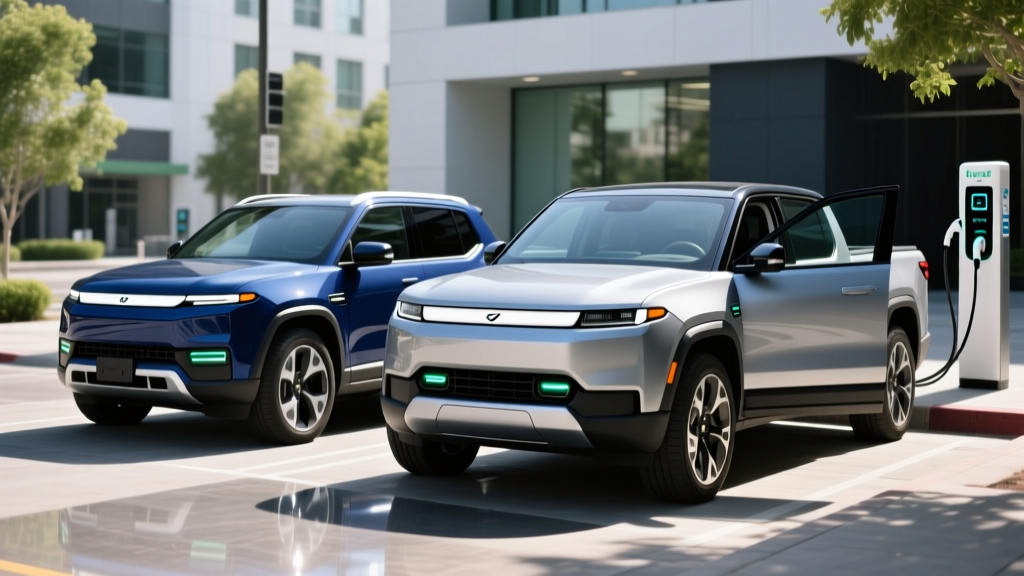
If you drive through Palo Alto's Professorville, Old Palo Alto, or Green Acres neighborhoods, you'll spot a pattern: Rivian R1S SUVs and R1T pickups parked alongside Tesla Model Xs and Porsche Taycans. The Bay Area has become one of Rivian's strongest markets, and for good reason — these are vehicles built for the exact mix of school runs, Highway 101 commutes, and weekend Sierra trips that define South Bay life.
But owning a Rivian in Palo Alto also means navigating some specific realities: PG&E electricity rates that make home charging cost-sensitive, a tightening federal tax credit landscape under IRS §30D, and the question of whether a 100+ kWh battery pack makes sense when most trips stay inside Santa Clara County. This review breaks down the 2026 Rivian R1S (three-row SUV) and R1T (crew-cab pickup) with the exact numbers Palo Alto shoppers need — real-world range, charging curves, trim pricing, and credit eligibility — so you can decide which configuration actually fits your life.
| Spec | R1S Dual-Motor (Standard) | R1T Dual-Motor (Standard) | R1S Tri-Motor | R1T Quad-Motor |
|---|---|---|---|---|
| EPA Range | 270 mi | 270 mi | 352 mi (Max Pack) | 352 mi (Max Pack) |
| Battery Capacity (usable) | ~92 kWh (LFP) | ~92 kWh (LFP) | ~141 kWh (NMC) | ~141 kWh (NMC) |
| Horsepower | 533 hp | 533 hp | 850 hp | 1,025 hp |
| 0-60 mph | 4.5 sec | 4.5 sec | 2.9 sec | 2.5 sec |
| Drivetrain | AWD (dual-motor) | AWD (dual-motor) | AWD (tri-motor) | AWD (quad-motor) |
| Peak DC Fast Charge | 200 kW | 200 kW | 220 kW | 220 kW |
| 10-80% DCFC Time | ~27 min | ~27 min | ~41 min | ~41 min |
| Level 2 Home Rate | 11.5 kW (~25 mi/hr) | 11.5 kW (~25 mi/hr) | 11.5 kW (~25 mi/hr) | 11.5 kW (~25 mi/hr) |
| MPGe (combined) | 73 MPGe | 70 MPGe | 73 MPGe | 70 MPGe |
| Towing Capacity | 7,700 lb | 11,000 lb | 7,700 lb | 11,000 lb |
| Cargo (behind 3rd row / bed) | 10.4 cu ft (all rows up: 104.8 cu ft folded) | Bed: 54 cu ft + 11 cu ft Gear Tunnel | Same as Dual-Motor | Same as Dual-Motor |
| Battery/Powertrain Warranty | 8 yr / 175,000 mi | 8 yr / 175,000 mi | 8 yr / 175,000 mi | 8 yr / 175,000 mi |
Real-World Range: What the EPA Number Doesn't Tell You
EPA Sticker: 270 mi (Standard Pack) / 352 mi (Max Pack)
Real-World Expectation — Palo Alto Climate: In the Bay Area's mild 50-75°F climate, expect ~245-260 mi highway from the Standard Pack and ~310-330 mi from the Max Pack at 70 mph. Cold-weather trips to Tahoe (20-35°F with cabin heat and elevation) can drop range 20-30%, bringing the Standard Pack to ~190-210 mi effective range on the I-80 corridor.
Rivian's EPA numbers are conservative compared to some competitors, but real-world efficiency depends heavily on your driving profile. The R1S and R1T are heavy vehicles (over 6,800 lb curb weight for the R1S, ~7,100 lb for the R1T), and that mass shows up on the freeway. At steady 65-70 mph on US-101 or I-280, the Dual-Motor Standard Pack averages about 2.2-2.4 kWh/mile, which maps to roughly 245-260 miles before you'd want to stop at 10-15% state of charge.
The Max Pack's 141 kWh NMC battery is the range king, but it adds significant weight and cost. For Palo Alto owners whose daily driving is mostly within a 30-mile radius — school drop-offs in Midtown, Stanford commutes, grocery runs on El Camino — the Standard Pack's LFP battery is more than adequate, and you'll rarely dip below 50% SoC before plugging in at home.
Efficiency tip: Rivian's regenerative braking is strong enough for near one-pedal driving in stop-and-go traffic on Oregon Expressway or during school pickup congestion. Use it to recapture energy and reduce brake wear.
Charging Speed: DC Fast Charging and Home Setup for PG&E Customers
Charging speed is where Rivian's 2026 generation shows its engineering maturity. The Standard Pack (LFP) peaks at 200 kW on DC fast chargers, while the Max Pack (NMC) peaks at 220 kW. But peak kW is only half the story — the charge curve matters more.
| Charge Level | Power (kW) | Miles Added per Hour | Typical Use Case |
|---|---|---|---|
| Level 1 (120V / 12A) | ~1.4 kW | ~3 mi/hr | Emergency trickle; not practical for daily |
| Level 2 (240V / 48A) | 11.5 kW | ~25 mi/hr | Home overnight; full charge in ~8-12 hours |
| DC Fast Charge (Standard Pack) | Peak 200 kW | ~140 mi in 20 min | 10-80% in ~27 minutes |
| DC Fast Charge (Max Pack) | Peak 220 kW | ~170 mi in 20 min | 10-80% in ~41 minutes (larger battery) |
On the Rivian Adventure Network and Electrify America stations along I-5 and I-80, the Standard Pack sustains ~170-180 kW from 10-50% SoC, then tapers to ~120 kW from 50-70%, and drops further to ~60-80 kW above 80%. This is typical LFP behavior — the chemistry tolerates higher average SoC better than NMC but tapers more aggressively near the top.
For Palo Alto home charging, you'll want a 48-amp Level 2 wall connector on a 60-amp dedicated circuit. At 11.5 kW, a depleted Standard Pack charges fully overnight in about 8 hours. PG&E's EV2-A time-of-use rate (off-peak ~$0.12/kWh overnight) makes home charging roughly $11 for a full Standard Pack — about $0.04/mile, dramatically cheaper than $4.50/gal gasoline at 20 MPG.
Panel upgrade note: Many older Palo Alto homes (pre-1970s) have 100-amp main panels. Adding a 60-amp EV circuit may require a panel upgrade to 200 amps, which costs $2,000-$4,500 depending on your electrician and whether a utility service upgrade is needed. Budget for this before purchase.
Performance: From School Zones to Sierra Passes
Even the base Dual-Motor Rivian delivers 533 horsepower and a 4.5-second 0-60 mph time — quicker than most sport sedans from a decade ago. The Tri-Motor R1S drops that to 2.9 seconds, and the Quad-Motor R1T hits 2.5 seconds, making it one of the fastest pickups ever sold.
But the performance story in Palo Alto isn't about drag racing; it's about the air suspension and quad-corner ride-height adjustment. The R1S and R1T can raise up to 14.4 inches of ground clearance for snow runs to Mammoth or trail driving in Big Basin, then drop to a low ride height for easier loading and better highway aerodynamics. The air suspension also provides a genuinely comfortable ride over the Bay Area's increasingly rough pavement.
The R1T's 11,000-lb towing capacity (Dual-Motor and Quad-Motor) is best-in-class for electric pickups, though towing at that limit will cut range roughly in half. For a boat trailer to the Sacramento Delta or a small camper to Point Reyes, plan charging stops accordingly.
Pricing, Trims, and the 2026 Federal EV Tax Credit
Rivian's pricing has settled after several years of adjustment. Here's where the 2026 lineup stands before incentives:
| Model / Trim | Base MSRP | As-Tested (Popular Config) | Est. §30D Credit* | Effective Price |
|---|---|---|---|---|
| R1S Dual-Motor Standard | $75,900 | $79,400 | $3,750 - $7,500 | $68,400 - $75,650 |
| R1S Dual-Motor Max Pack | $85,900 | $91,200 | $3,750 - $7,500 | $78,400 - $87,450 |
| R1S Tri-Motor Max Pack | $99,900 | $106,500 | $0 - $7,500** | $92,400 - $106,500 |
| R1T Dual-Motor Standard | $69,900 | $74,200 | $3,750 - $7,500 | $62,400 - $70,450 |
| R1T Dual-Motor Max Pack | $79,900 | $85,800 | $3,750 - $7,500 | $72,400 - $82,050 |
| R1T Quad-Motor Max Pack | $94,900 | $101,300 | $0 - $7,500** | $87,400 - $101,300 |
*Credit amount depends on battery-sourcing and critical-minerals compliance, which varies by production batch. Some Rivian configurations qualify for the full $7,500; others qualify for $3,750 (critical minerals only). Check the latest IRS §30D guidance and Rivian's eligibility tool before purchasing.
**SUVs (R1S) are subject to an $80,000 MSRP cap; pickups (R1T) have a $80,000 cap. Tri-Motor and Quad-Motor trims may exceed the cap depending on options, eliminating credit eligibility. Income caps also apply: $300,000 joint / $225,000 head of household / $150,000 individual MAGI.
Palo Alto buyers should also check for California's CVRP rebate (income-dependent, up to $7,000 for lower-income households) and any local Bay Area Air Quality Management District incentives, which can stack with the federal credit.
Interior, Cargo, and Tech: Built for Bay Area Families
The R1S three-row SUV offers 10.4 cubic feet behind the third row — tight for a weekly Costco run with all seats up. Fold the third row and you get 46.7 cu ft; fold both rear rows for 104.8 cu ft of flat cargo space, enough for furniture or camping gear. The R1T's 4.5-foot bed holds 54 cu ft, and the innovative Gear Tunnel (an 11 cu ft pass-through between the cab and bed) is ideal for skis, surfboards, or muddy hiking boots after a trip to Ano Nuevo.
Second-row legroom in the R1S is 36.5 inches — adequate for adults on short trips, tight for tall teenagers on long drives. Third-row legroom is 28.6 inches, best reserved for children. If third-row space is a dealbreaker, the Tesla Model X (37.1 in third-row legroom) or the upcoming three-row competitors may suit better.
Rivian's infotainment runs on a custom 15.6-inch center touchscreen with a clean, tile-based interface. Wireless Apple CarPlay and Android Auto are standard. The driver display is a 12.3-inch digital cluster, and a 6.8-inch rear touchscreen handles climate and media for back-seat passengers. Over-the-air updates have consistently added features — Rivian's software team ships regularly.
Driver assistance comes via Rivian's Highway Assist and Adaptive Cruise Control — this is SAE Level 2 driver assistance, meaning you must keep your hands on the wheel and eyes on the road at all times. It is not autonomous driving. The system performs well on Highway 101 and I-280 but requires active supervision, especially in construction zones and during lane-merge scenarios.
SAE Level 2 — Not Self-Driving: Rivian's Highway Assist is a Level 2 driver-assist system. The driver remains fully responsible for vehicle control at all times. Do not confuse this with Level 4 robotaxi services like Waymo (which operates in San Francisco and Phoenix). Rivian has announced plans for higher-level autonomy, but no Level 3+ system is available to consumers as of 2026.
Pros and Cons: The Honest Assessment
Pros
- Best-in-class adventure capability: air suspension, wading, ground clearance
- R1T Gear Tunnel is a genuinely unique, useful feature no competitor offers
- Strong DC fast charging (200-220 kW peak) with usable charge curves
- 8-year / 175,000-mile battery and powertrain warranty exceeds industry norm
- LFP Standard Pack option offers lower cost and longer cycle life for daily drivers
- Consistent OTA updates adding real features, not just bug fixes
- Rivian Adventure Network expanding along key California corridors
Cons
- Heavy curb weight (6,800-7,100+ lb) hurts highway efficiency
- Third-row space in the R1S is cramped for adults
- Base MSRP above $70,000 puts many trims near or over §30D MSRP caps
- No Apple CarPlay-native navigation — Rivian's built-in nav is good but not Google-level
- Service center network still thin outside major metros; Bay Area coverage is adequate but appointment wait times can stretch
- Insurance premiums run 15-25% higher than comparable ICE SUVs in Santa Clara County
Who Should Buy a Rivian in Palo Alto — and Who Shouldn't
Buy the R1S if: You need three rows for carpool duty, want genuine off-road capability for Sierra and coastal trips, value the air suspension's ride quality, and can charge at home. The Dual-Motor Standard Pack at ~$75,900 (potentially ~$68,400 after the full $7,500 credit) is the value sweet spot for Bay Area families who drive under 40 miles daily and road-trip a few times a year.
Buy the R1T if: You need a pickup for towing, hauling, or the Gear Tunnel lifestyle (surf, ski, bike). The Dual-Motor Standard at $69,900 undercuts the R1S and is more likely to clear the §30D MSRP cap cleanly.
Look elsewhere if: You need maximum third-row adult comfort (consider the Kia EV9 or Tesla Model X), you can't install a Level 2 charger at home, or your budget tops out below $65,000 even after incentives.
Quick Decision Guide
- Choose R1S Standard Pack if your daily driving is under 50 mi and you want the lowest entry price with LFP longevity.
- Choose R1S Max Pack if you regularly drive to Tahoe, LA, or beyond and need 350+ mi buffer.
- Choose R1T Standard Pack if you need a truck bed and want to stay under the $80K MSRP cap for the tax credit.
- Choose R1T Quad-Motor only if you value sub-3-second acceleration and tank turns — it's a luxury/performance play, not an efficiency one.
Frequently Asked Questions
What is the real-world range of the Rivian R1S and R1T?
The EPA rates the Standard Pack (92 kWh LFP) at 270 miles and the Max Pack (141 kWh NMC) at 352 miles. In real-world Bay Area driving at 65-70 mph with mild temperatures, expect 245-260 miles from the Standard Pack and 310-330 miles from the Max Pack. Cold mountain trips can reduce range by 20-30%.
How fast does a Rivian charge at home and on DC fast chargers?
At home on a 48-amp Level 2 charger (11.5 kW), a Rivian adds about 25 miles of range per hour, fully charging the Standard Pack overnight in ~8 hours. On DC fast chargers, the Standard Pack peaks at 200 kW (10-80% in ~27 minutes) and the Max Pack peaks at 220 kW (10-80% in ~41 minutes).
Does the Rivian R1S or R1T qualify for the $7,500 federal EV tax credit?
Possibly. Under IRS §30D, eligibility depends on the vehicle's MSRP (must be under $80,000 for SUVs and pickups), the buyer's modified adjusted gross income (under $300,000 joint / $150,000 individual), and battery critical-mineral and component sourcing. Many Dual-Motor Standard configurations qualify for the full $7,500 or partial $3,750 credit. Higher trims may exceed the MSRP cap. The credit can be transferred to the dealer at point of sale as an instant discount. Always verify current eligibility on IRS.gov and consult a tax professional.
Is the Rivian R1S worth buying vs the Tesla Model X or Kia EV9?
The R1S wins on off-road capability, build quality, and adventure-oriented design. The Model X wins on third-row space, Supercharger network access, and acceleration (Plaid). The EV9 wins on price ($54,900 starting) and family practicality, though it's less capable off-road. For Palo Alto buyers who value weekend Sierra trips and premium fit-and-finish, the R1S is the stronger pick.
What are the biggest drawbacks of owning a Rivian?
Highway efficiency suffers due to the vehicle's weight (6,800+ lb), meaning more frequent charging stops on long road trips compared to lighter EVs. Service center availability outside major metros can mean longer wait times. Insurance costs run higher than average. And the R1S third row is tight for adults.
How long will the Rivian battery last?
Rivian warranties the battery pack for 8 years or 175,000 miles (whichever comes first) against degradation below 70% capacity. The LFP Standard Pack chemistry is known for longer cycle life (3,000+ cycles to 80% SoH in lab testing) compared to NMC, making it a smart choice for daily drivers who charge to 100% regularly. Real-world data from 2022-2024 model-year Rivians shows minimal degradation in the first 50,000 miles.
Can I charge a Rivian at Tesla Superchargers?
Rivian vehicles come with NACS (Tesla) charge ports as standard on 2025+ models, granting direct access to Tesla's Supercharger network without an adapter. This is a major advantage for road-trip charging infrastructure in California and beyond. Earlier model-year Rivians (CCS-equipped) can use a NACS adapter.