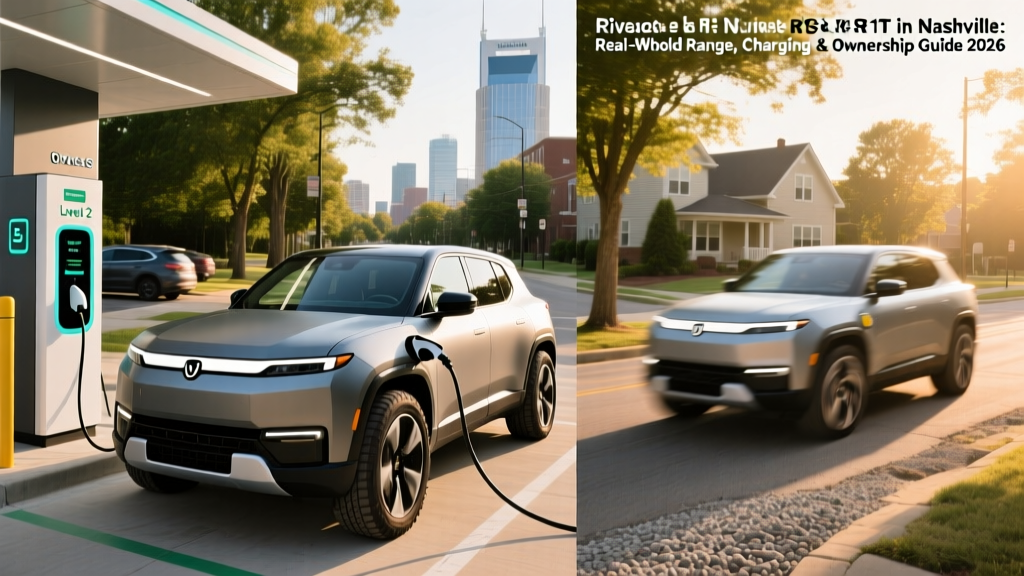
Nashville's rapid EV adoption and expanding charging infrastructure make it an increasingly practical city for Rivian ownership. But Music City drivers face specific challenges—humid summers, occasional ice storms, and highway-heavy commutes on I-40 and I-65—that separate EPA sticker promises from real-world performance. This profile examines what owning a 2026 Rivian R1S (three-row SUV) or R1T (pickup) actually looks like for Nashville-area buyers, covering range expectations, charging logistics, tax credit eligibility, and total cost of ownership.
2026 Rivian Lineup: R1S and R1T at a Glance
For 2026, Rivian continues to offer the R1S SUV and R1T pickup in three battery configurations: Standard (lithium iron phosphate/LFP chemistry), Large (NMC chemistry), and Max (NMC chemistry). Dual-Motor and Quad-Motor drivetrains are available across trims. Here's how the core specs stack up for the most popular Nashville configurations:
| Spec | R1S Dual-Motor Large | R1T Dual-Motor Large | R1T Quad-Motor Max |
|---|---|---|---|
| EPA Range | 352 miles | 352 miles | 420 miles |
| Battery Capacity | 106 kWh (NMC) | 106 kWh (NMC) | 141 kWh (NMC) |
| Drivetrain | AWD (Dual-Motor) | AWD (Dual-Motor) | AWD (Quad-Motor) |
| Horsepower | 665 hp | 665 hp | 1,025 hp |
| 0-60 mph | 3.5 sec | 3.5 sec | 2.6 sec |
| Towing Capacity | 7,700 lbs | 11,000 lbs | 11,000 lbs |
| Base MSRP | $82,700 | $74,800 | $99,900 |
| Efficiency (MPGe) | 73 MPGe combined | 73 MPGe combined | 70 MPGe combined |
| Warranty | 8 yr/125,000 mi battery | 8 yr/125,000 mi battery | 8 yr/125,000 mi battery |
Source: fueleconomy.gov and Rivian's official spec sheets. Specs subject to change; verify at purchase.
Real-World Range in Nashville Conditions
The EPA's range estimate assumes a mix of city and highway driving at moderate temperatures. Nashville drivers should calibrate expectations based on local conditions:
EPA Estimate: 352 miles (R1S/R1T Dual-Motor Large)
Highway-Heavy Commute (I-40/I-65 at 70-75 mph): Expect 280-310 miles. Aerodynamic drag increases significantly above 65 mph, reducing efficiency by 15-20%.
Summer with A/C: 320-340 miles. Nashville's humidity demands heavy climate control, but heat is less punishing on batteries than cold.
Winter (20-40°F): 250-290 miles. Cold temperatures increase battery internal resistance and cabin heating draws substantial energy. Preconditioning while plugged in mitigates this.
Towing (5,000+ lb trailer): 150-200 miles. Towing cuts range roughly in half regardless of EV brand.
Nashville's relatively mild winters (compared to Chicago or Denver) are an advantage, but the city's sprawl and highway-centric commute patterns mean most drivers will operate in the lower end of the EPA range. If your daily round trip exceeds 120 miles, the Max pack's 420-mile EPA rating provides a more comfortable buffer.
Charging Speed: DC Fast Charging and Home Level 2
Charging speed is where Rivian's 2026 models shine, particularly for road trippers. Here's what Nashville owners can expect:
| Charging Method | Power (kW) | Speed | Time to Charge |
|---|---|---|---|
| DC Fast Charging (peak) | 220 kW | ~190 miles in 20 min | 10-80% in ~25 minutes |
| DC Fast Charging (sustained avg) | ~150 kW | Varies with SoC/temp | 10-80% in ~35 minutes |
| Level 2 Home (48A/11.5 kW) | 11.5 kW | ~25 miles/hour | 0-100% in ~9-12 hours |
| Level 2 Home (32A/7.7 kW) | 7.7 kW | ~17 miles/hour | 0-100% in ~14-18 hours |
| Level 1 (120V/12A) | 1.4 kW | ~3 miles/hour | Emergency/trickle only |
Important charging-curve reality: The 220 kW peak rate applies only between 10-40% State of Charge (SoC) under optimal battery temperature conditions. Above 60% SoC, the charge rate tapers significantly to protect battery health. This is why the 10-80% time is ~25 minutes, not a linear calculation.
Nashville charging infrastructure: As of early 2026, the Nashville metro area has 12+ Rivian Adventure Network chargers (all 200+ kW capable) plus numerous Electrify America, EVgo, and ChargePoint DC fast stations. Most Nashville-area Rivian owners install a Level 2 home charger, which we'll detail next.
Home Charging Installation in Nashville
Most Rivian owners opt for a 48-amp Level 2 home charger (like the Rivian Wall Connector or ChargePoint Home Flex) to achieve overnight charging. Here's what Nashville-area installation typically costs:
| Component | Cost Range | Notes |
|---|---|---|
| Level 2 Charger (48A) | $500-$750 | Rivian Wall Connector, ChargePoint Home Flex, or similar |
| Electrician Labor | $800-$2,500 | Depends on panel proximity, conduit run length |
| Electrical Panel Upgrade | $1,500-$3,500 | Required if existing panel lacks capacity (common in older Nashville homes) |
| Permits & Inspection | $100-$300 | Nashville Metro codes require permits for 240V circuits |
| Total (no panel upgrade) | $1,400-$3,550 | Most common scenario for homes built after 2000 |
| Total (with panel upgrade) | $2,900-$7,050 | Older homes with 100A service |
Nashville Electric Service (NES) and Middle Tennessee Electric (MTE) both offer time-of-use rates that make overnight charging (10 PM - 6 AM) significantly cheaper—roughly $0.08-$0.12 per kWh vs. $0.14-$0.18 during peak hours. For a 106 kWh battery, a full charge costs $8.50-$15.00 depending on your rate plan.
Federal Tax Credit Eligibility (IRS §30D)
The 2026 Rivian R1S and R1T do qualify for the federal EV tax credit under IRS §30D, but eligibility depends on your income, the vehicle's MSRP, and battery sourcing requirements. Here's the breakdown:
| Requirement | R1S Status | R1T Status |
|---|---|---|
| MSRP Cap (SUVs/Pickups: $80,000) | ✅ R1S qualifies (MSRP cap $80k for SUVs) | ✅ R1T qualifies (MSRP cap $80k for trucks) |
| Buyer Income Cap (Joint: $300k; Single: $150k) | ⚠️ Depends on your AGI | ⚠️ Depends on your AGI |
| Battery Component Manufacturing (North America) | ✅ Meets requirement | ✅ Meets requirement |
| Critical Minerals Sourcing | ✅ Meets 2026 threshold | ✅ Meets 2026 threshold |
| Maximum Credit | $7,500 | $7,500 |
| Point-of-Sale Transfer | ✅ Available | ✅ Available |
Key caveats: The $7,500 credit applies only if your modified adjusted gross income (MAGI) falls below the caps, and the vehicle's MSRP must not exceed $80,000 for SUVs and trucks. Higher-trim Rivians (like the R1T Quad-Motor Max at $99,900) exceed the MSRP cap and are not eligible. The credit can be transferred to the dealer at point of sale, reducing your purchase price upfront, or claimed on your federal tax return. Consult a tax professional and verify current rules at IRS.gov.
Effective pricing after credit (eligible buyers):
- R1S Dual-Motor Standard: $74,900 MSRP → $67,400 after $7,500 credit
- R1T Dual-Motor Standard: $69,900 MSRP → $62,400 after $7,500 credit
- R1S Dual-Motor Large: $82,700 MSRP → $75,200 after $7,500 credit
- R1T Dual-Motor Large: $74,800 MSRP → $67,300 after $7,500 credit
Performance, Cargo Space, and Technology
Rivian's dual-motor and quad-motor setups deliver sports-car acceleration in vehicles that can also tow boats and trailers. The R1S offers three-row seating (up to 7 passengers) with 104.7 cu ft of cargo space behind the first row, while the R1T provides a 4.5-foot bed with a unique Gear Tunnel for secure storage. Both feature:
- Driver+ Assistance: SAE Level 2 driver-assist system with adaptive cruise control, lane-keeping, and automatic emergency braking. Not self-driving—driver must remain engaged.
- 15.6-inch touchscreen with built-in navigation, charging route planning, and over-the-air updates
- Powered tonneau cover (R1T) and powered liftgate (R1S)
- Vehicle-to-Load (V2L): Power tools, camping gear, or home appliances (up to 3.5 kW continuous) from the vehicle's battery
- Quad-Motor tank turns (Max pack only): 360-degree rotation for tight off-road maneuvers
Notable drawbacks: Third-row space in the R1S is best suited for children; adults will find it cramped on longer trips. The R1T's bed is shorter than full-size pickups (4.5 ft vs. 5.5-6.5 ft), limiting its utility for contractors. Insurance costs run 20-30% higher than comparable gas vehicles due to repair complexity and parts cost.
Who Should Buy a Rivian in Nashville?
✅ You need a family vehicle (R1S) or utility vehicle (R1T) with genuine off-road capability
✅ You have home charging access and can install a Level 2 charger
✅ You tow boats, trailers, or campers (11,000-lb capacity) but want EV efficiency for daily driving
✅ You qualify for the $7,500 federal tax credit based on income and MSRP
✅ You value over-the-air updates and a tech-forward ownership experience
Consider alternatives if:
❌ You lack home charging and rely solely on public infrastructure
❌ Your budget is under $60,000 (even after tax credits)
❌ You need a full-size truck bed for commercial/construction use
❌ You prioritize lowest cost per mile over performance and capability
Pros and Cons
- Class-leading acceleration and handling for an SUV/truck
- Fast DC charging (220 kW peak, 10-80% in ~25 min)
- Strong towing capacity (11,000 lbs) with integrated trailer brake controller
- Spacious interior with clever storage (Gear Tunnel, frunk)
- Eligible for $7,500 federal tax credit (qualifying trims/buyers)
- Over-the-air updates continuously add features
- High starting price ($70k-$100k before credits)
- Third-row space in R1S is tight for adults
- R1T bed is shorter than traditional pickups
- Insurance costs 20-30% higher than gas equivalents
- Service center network still expanding (Nashville has one, but wait times can stretch weeks)
- Towing cuts range roughly in half
Frequently Asked Questions
What is the real-world range of a Rivian R1S or R1T in Nashville?
For the Dual-Motor Large pack (106 kWh), expect 280-310 miles on highway-heavy commutes, 320-340 miles in summer city driving, and 250-290 miles in winter. The EPA's 352-mile estimate assumes mixed driving at moderate temperatures. Cold weather, high speeds, and towing all reduce range significantly.
How fast does a Rivian charge at home and on the road?
At home with a 48-amp Level 2 charger (11.5 kW), you'll add ~25 miles per hour, fully charging overnight in 9-12 hours. On DC fast chargers, Rivian peaks at 220 kW, achieving 10-80% in ~25 minutes under optimal conditions. Sustained average is closer to 150 kW due to charge-curve taper above 60% SoC.
How much does a Rivian cost after the federal tax credit?
Qualifying buyers (income under $300k joint/$150k single) can receive up to $7,500 off eligible trims. The R1T Dual-Motor Standard starts at $69,900 ($62,400 after credit), while the R1S Dual-Motor Large is $82,700 ($75,200 after credit). Higher trims like the Quad-Motor Max ($99,900) exceed the MSRP cap and are ineligible.
Is Rivian worth buying vs. Tesla Model X, Ford F-150 Lightning, or Chevrolet Silverado EV?
Rivian excels for buyers who want genuine off-road capability, premium build quality, and a tech-forward experience. The Tesla Model X offers more range (348 miles EPA) and Supercharger access but lacks off-road chops and costs $10k+ more. The Ford F-150 Lightning is $10k-$15k cheaper and has a larger bed but slower DC charging (150 kW peak). The Silverado EV offers 400+ mile range (Max pack) but is newer with less proven reliability. For Nashville buyers prioritizing adventure and family utility, Rivian's package is compelling.
Does Rivian qualify for the federal EV tax credit in 2026?
Yes, most Rivian R1S and R1T trims qualify for the full $7,500 federal tax credit under IRS §30D, provided the buyer meets income caps and the vehicle's MSRP is under $80,000 (which excludes the Quad-Motor Max pack). The credit can be transferred to the dealer at point of sale or claimed on your tax return. Verify eligibility at IRS.gov and consult a tax professional.
What's the warranty coverage for Rivian's battery and powertrain?
Rivian provides an 8-year/125,000-mile warranty on the battery and drive unit, guaranteeing at least 70% capacity retention over that period. The basic vehicle warranty is 5 years/60,000 miles. This is competitive with Tesla (8 yr/120k-150k mi) and exceeds Ford's 8 yr/100k mi coverage.
For the most current EPA range, efficiency, and tax credit information, visit fueleconomy.gov and IRS.gov. Specs and pricing subject to change; verify with Rivian before purchase.