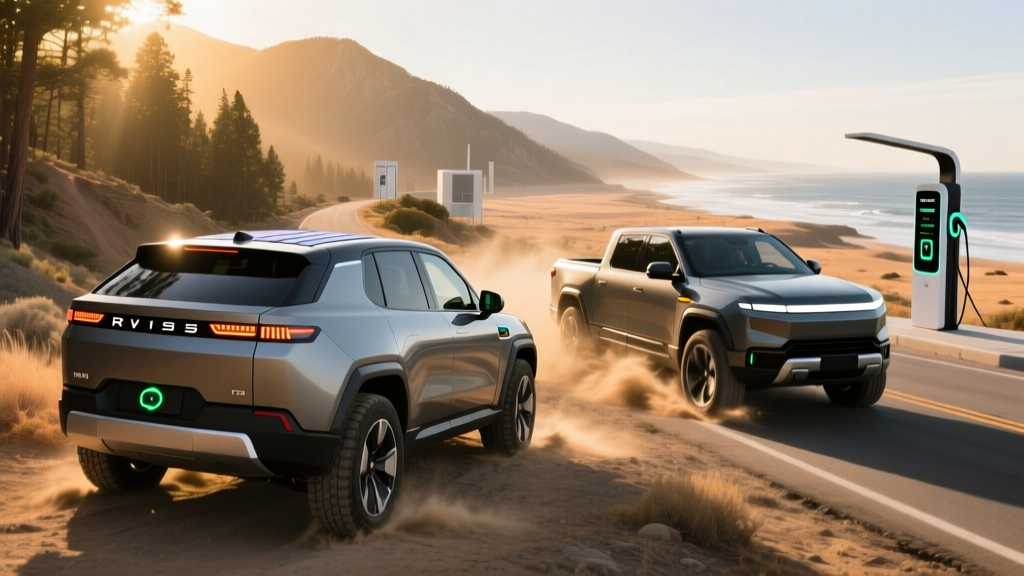
If you've searched who makes Rivian autos, the answer is straightforward: Rivian Automotive, Inc. designs, engineers, and manufactures its own electric vehicles at a dedicated factory in Normal, Illinois. Unlike many EV startups that outsource production or rely on contract manufacturers, Rivian is a fully vertically integrated American automaker — handling everything from battery-pack assembly and software development to final vehicle delivery. Founded in 2009 by MIT graduate RJ Scaringe, the company went public in November 2021 and has since scaled to produce two consumer vehicles: the R1S three-row SUV and the R1T pickup truck, both substantially refreshed for the 2025 model year and carried into 2026.
This profile covers what Rivian actually builds today — the current-generation R1S and R1T with their updated Gen 2 platform — and gives you the exact numbers you need to evaluate one: EPA range, battery chemistry, DC fast-charge speeds, 0-60 times, cargo dimensions, and real ownership costs after federal tax credits.
Rivian at a Glance: The Company Behind the Vehicles
Rivian Automotive is headquartered in Irvine, California, with additional engineering offices in Palo Alto, Detroit, and Plymouth, Michigan. The Normal, Illinois assembly plant — a former Mitsubishi factory — is where all R1S and R1T vehicles are built. As of early 2026, Rivian also produces Amazon's EDV (Electric Delivery Van) at the same facility, though that's a commercial product outside our consumer scope.
The company employs roughly 14,000 people and operates its own direct-to-consumer sales model — no franchised dealers. You configure, order, and take delivery through Rivian's website or one of their retail "Spaces" in major metro areas. This matters for buyers because it means pricing is fixed (no dealer markups or negotiation), and service is handled through Rivian-owned service centers and a mobile service fleet.
2026 R1S and R1T: Full Spec Breakdown
Both the R1S (SUV) and R1T (truck) now share Rivian's Gen 2 platform, which introduced a new battery architecture, updated drive units, and a revised interior for 2025 that carries forward. Here are the core specifications for the most popular configurations:
| Spec | R1S (SUV) | R1T (Truck) |
|---|---|---|
| EPA Range | 270 miles | 270 miles |
| Battery (usable) | ~95 kWh (NMC) | ~95 kWh (NMC) |
| Drivetrain | Dual-Motor AWD | Dual-Motor AWD |
| Horsepower | 533 hp | 533 hp |
| 0-60 mph | 4.5 sec | 4.5 sec |
| Max DC Fast Charge | 220 kW peak | 220 kW peak |
| 10-80% DCFC Time | ~30 min | ~30 min |
| Level 2 Home Charge | 11.5 kW (~25 mi/hr) | 11.5 kW (~25 mi/hr) |
| MPGe (combined) | 73 MPGe | 70 MPGe |
| Efficiency | 46 kWh/100 mi | 48 kWh/100 mi |
| Towing Capacity | 7,700 lbs | 11,000 lbs |
| Base MSRP | $75,900 | $69,900 |
| Battery Warranty | 8 yr / 175,000 mi | 8 yr / 175,000 mi |
Higher-capacity battery options are available. The Large Pack (~120 kWh usable, NMC) pushes EPA range to approximately 352 miles for the R1S and 342 miles for the R1T, at a cost premium of roughly $6,000-$8,000 depending on configuration. A Max Pack option (~149 kWh) offers up to 410 miles in the R1S but adds significant weight and reduces DC fast-charging speed due to the larger battery's C-rate limitations.
The EPA estimates 270 miles for the Standard Pack dual-motor. In real-world highway driving at 70-75 mph, expect 235-250 miles. In freezing temperatures (below 32°F), range drops an additional 20-30%, putting realistic cold-weather highway range around 185-210 miles. The Large Pack's 352-mile EPA figure translates to roughly 300-315 miles on a warm-weather highway trip. These are large, heavy vehicles (over 7,000 lbs curb weight) — efficiency is the trade-off for capability.
Charging: How Fast Can a Rivian Actually Charge?
Rivian uses the NACS (North American Charging Standard) connector on all 2025+ models, meaning native access to the Tesla Supercharger network — currently the most reliable and expansive DC fast-charging network in the U.S. This is a significant advantage over vehicles still using CCS1 that require adapters.
| Charging Level | Power | Speed (approx.) | Notes |
|---|---|---|---|
| Level 1 (120V) | 1.4 kW | ~3 mi/hr | Emergency/trickle only |
| Level 2 (240V, 48A) | 11.5 kW | ~25 mi/hr | Full charge overnight (~10 hrs for Standard Pack) |
| DC Fast Charge | 220 kW peak | ~140 mi in 20 min | 10-80% in ~30 min; tapers sharply above 80% |
The Gen 2 Rivian platform peaks at around 220 kW on a compatible DC fast charger. However, like all EVs, the charge curve tapers significantly above 80% State of Charge. Charging from 80-100% can take an additional 25-35 minutes — so on road trips, it's faster to charge to 80% and drive more, rather than waiting for a full battery. Battery preconditioning activates automatically when you navigate to a charger in the Rivian app or onboard nav, warming the pack to optimize charge speed.
For home charging, a 48-amp Level 2 wall connector on a 60-amp dedicated circuit delivers the full 11.5 kW. Installation typically costs $800-$2,000 depending on your panel capacity and run distance from your electrical panel to the garage. If your home has a 100-amp main panel, a panel upgrade to 200 amps may be necessary — adding $1,500-$3,500 to the project.
Performance and Driving Dynamics
The dual-motor AWD configuration produces 533 horsepower and delivers a 4.5-second 0-60 mph time — brisk for a vehicle this size. The available Quad-Motor setup (one motor per wheel) pushes output to 1,025 horsepower and drops 0-60 to approximately 3.0 seconds, though at a $10,000+ premium and a reduction in EPA range due to the added weight and power consumption.
Rivian's air suspension provides up to 14.9 inches of ground clearance in Off-Road mode, making both the R1S and R1T genuinely capable off-pavement. The suspension also enables a kneeling feature for easier entry and cargo loading. On-road, the ride quality is firm but controlled — these are heavy vehicles, and the suspension manages weight transfer competently, though you'll feel the mass during aggressive cornering.
Regenerative braking offers multiple levels, including a one-pedal driving mode that brings the vehicle to a complete stop without touching the brake pedal. The system is well-calibrated and predictable — one of the better regen implementations among current EVs.
Interior, Cargo, and Practicality
The 2025+ interior refresh brought meaningful improvements: updated materials, a redesigned center console, and a second-generation infotainment system running on Rivian's proprietary software. The 15.6-inch landscape touchscreen handles navigation, climate, media, and vehicle settings. Apple CarPlay and Android Auto are not supported — Rivian uses its own interface exclusively, which is a dealbreaker for some buyers.
| Dimension | R1S (SUV) | R1T (Truck) |
|---|---|---|
| Seating | 7 passengers (3 rows) | 5 passengers (2 rows) |
| Cargo (behind 3rd row) | 20.7 cu ft | N/A |
| Cargo (behind 2nd row) | 57.6 cu ft | N/A |
| Cargo (max, seats folded) | 104.7 cu ft | N/A |
| Bed Length | N/A | 54.5 in (4.5 ft) |
| Frunk (front trunk) | 11.1 cu ft | 11.1 cu ft |
| Gear Tunnel (R1T only) | N/A | 11.7 cu ft |
| 2nd-Row Legroom | 38.2 in | 38.2 in |
| 3rd-Row Legroom | 30.4 in | N/A |
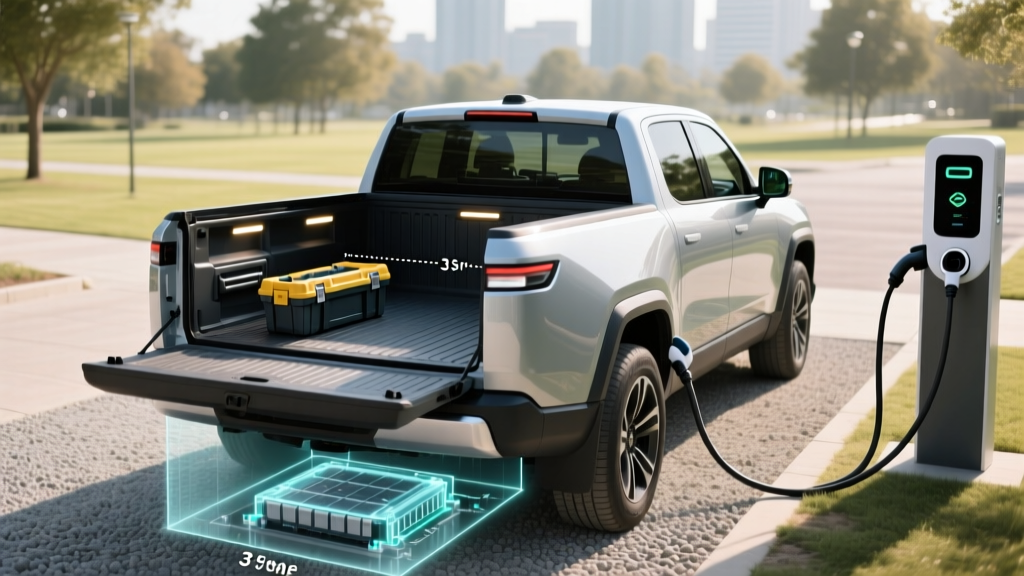
The R1T's signature feature is the Gear Tunnel — a lockable, pass-through storage compartment spanning the width of the truck between the cab and bed. It's ideal for skis, camping gear, or groceries and is available with an optional slide-out camp kitchen. The R1S third row is best suited for children; adults will find the 30.4 inches of legroom tight on longer trips.
Pricing, Trims, and Federal Tax Credit Eligibility
Rivian's pricing has shifted multiple times since launch. As of early 2026, the lineup breaks down as follows:
| Model / Trim | Base MSRP | Typical As-Tested |
|---|---|---|
| R1T Dual-Motor Standard | $69,900 | $74,000-$82,000 |
| R1T Dual-Motor Large | $75,900 | $80,000-$88,000 |
| R1T Quad-Motor Large | $87,900 | $92,000-$100,000 |
| R1S Dual-Motor Standard | $75,900 | $80,000-$90,000 |
| R1S Dual-Motor Large | $81,900 | $86,000-$95,000 |
| R1S Quad-Motor Large | $93,900 | $98,000-$108,000 |
Federal Tax Credit (§30D): Rivian vehicles face significant tax credit hurdles. Under current IRS rules, the §30D Clean Vehicle Credit offers up to $7,500, but eligibility requires meeting all of the following:
- MSRP Cap: Vans, SUVs, and pickups must have an MSRP at or below $80,000. This eliminates most Quad-Motor and Large/Max Pack R1S configurations, though base R1T Standard Pack models may qualify.
- Buyer Income Cap: Modified adjusted gross income must not exceed $150,000 (single), $225,000 (head of household), or $300,000 (joint filing).
- Battery Sourcing: Critical minerals and battery components must meet escalating domestic-content thresholds. As of 2026, the critical minerals requirement is 80% from the U.S. or FTA partners, and 100% of battery components must be manufactured or assembled in North America. Rivian has been working to localize its supply chain, but full compliance on every configuration is not guaranteed — verify specific VIN eligibility on fueleconomy.gov before purchasing.
- Point-of-Sale Transfer: Eligible buyers can transfer the credit to the dealer (Rivian) at purchase, reducing the purchase price directly rather than waiting for a tax refund.
In practice, the base R1T Dual-Motor Standard at $69,900 is the most likely configuration to fall under the MSRP cap. However, battery sourcing compliance is the variable — always confirm your specific vehicle's eligibility. Consult a tax professional and check the IRS Clean Vehicle Credit page for the latest rules.
Driver Assistance and Technology
Rivian's driver-assistance suite is called Rivian Driver+™, which includes adaptive cruise control, lane-centering assist, automatic emergency braking, blind-spot monitoring, and rear cross-traffic alert. This is an SAE Level 2 system — meaning the driver must remain fully engaged and keep hands on the steering wheel at all times. It is not autonomous driving.
Rivian Driver+ is a Level 2 driver-assistance system. You are the driver. The system assists with steering and speed but does not handle construction zones, unmapped roads, severe weather, or unpredictable traffic scenarios. You must monitor the road and be prepared to take over instantly. No current consumer Rivian offers Level 3 or Level 4 autonomy.
The infotainment system is responsive and visually clean, but the lack of Apple CarPlay and Android Auto is a notable gap compared to competitors like the Ford F-150 Lightning, Hyundai Ioniq 5, and BMW iX. Over-the-air (OTA) updates regularly add features and refine existing ones — Rivian has a strong track record of post-purchase software improvements.
Warranty and Long-Term Ownership
Rivian's warranty coverage is competitive within the premium EV segment:
- Battery: 8 years / 175,000 miles (whichever comes first), covering defects and capacity loss below 70% of original capacity.
- Powertrain (drive units): 8 years / 175,000 miles.
- Limited Vehicle Warranty: 5 years / 60,000 miles bumper-to-bumper.
- Corrosion Perforation: 5 years / unlimited miles.
The 175,000-mile battery warranty is above the industry standard of 100,000 miles and signals confidence in the NMC cells. Rivian uses large-format cylindrical cells (similar in form factor to Tesla's approach) with an active liquid thermal management system to maintain battery health across temperature extremes. Long-term degradation data for the Gen 2 pack is still accumulating, but Gen 1 packs (2022-2024) have shown typical NMC degradation curves — approximately 5-8% capacity loss over the first 50,000 miles before leveling off.
Who Should Buy a Rivian — and Who Shouldn't?
Pros
- Genuine off-road capability with 14.9" ground clearance
- NACS native — full Tesla Supercharger access
- Class-leading towing for an EV truck (11,000 lbs R1T)
- 175,000-mile battery warranty exceeds most competitors
- Direct sales model — no dealer markups
- Strong OTA update track record
Cons
- Base pricing above $69K; tax credit eligibility uncertain
- No Apple CarPlay or Android Auto
- Third-row space in R1S is tight for adults
- Service center network still limited in rural areas
- Heavy vehicles — efficiency trails lighter EVs
- Insurance premiums run 15-25% above segment average
Best for: Adventure-oriented families who need genuine towing and off-road capability, have home Level 2 charging, and want a premium EV that can handle ski trips, boat hauls, and backcountry camping. The R1T is particularly compelling for buyers who want a daily-drivable electric truck without sacrificing utility.
Not ideal for: Budget-conscious buyers (the Kia EV9 or Hyundai Ioniq 5 offer more range per dollar), urban commuters who don't need towing or off-road clearance, or anyone who considers Apple CarPlay essential. If your priority is maximum efficiency and lowest cost per mile, lighter unibody crossovers will serve you better.
Frequently Asked Questions
Who actually manufactures Rivian vehicles?
Rivian Automotive manufactures all R1S and R1T vehicles at its own factory in Normal, Illinois. The company is not a subsidiary of another automaker. Volkswagen Group invested $5.8 billion in Rivian in 2024 as part of a joint venture for shared software and electrical architecture, but VW does not own or control Rivian, and Rivian vehicles are independently designed and built.
What is the real-world range of a Rivian R1S or R1T?
The Standard Pack (270 mi EPA) delivers roughly 235-250 miles on a warm-weather highway trip and 185-210 miles in freezing conditions. The Large Pack (352 mi EPA for R1S) yields approximately 300-315 real-world highway miles. Towing cuts range dramatically — expect a 40-50% reduction when pulling a loaded trailer near max capacity.
Does the Rivian R1T qualify for the $7,500 federal tax credit?
The base R1T Dual-Motor Standard at $69,900 falls under the $80,000 MSRP cap for trucks, making it potentially eligible. However, you must also meet income limits ($150K single / $300K joint) and the vehicle must satisfy critical minerals and battery component sourcing requirements, which change annually. Verify your specific VIN on fueleconomy.gov and consult a tax professional before relying on the credit.
How does Rivian compare to the Ford F-150 Lightning or Tesla Cybertruck?
The R1T is more premium and off-road focused than the F-150 Lightning, with superior ground clearance and a more refined interior, but at a higher price point. Compared to the Cybertruck, the R1T offers a more conventional (and practical) truck bed, better build quality, and NACS Supercharger access — though the Cybertruck's stainless-steel exoskeleton and available rear-wheel steering appeal to a different buyer. The Lightning remains the value leader for electric truck buyers who prioritize cost and fleet availability.
Is Rivian at risk of going out of business?
Rivian's financial position has improved significantly since the 2024 Volkswagen investment and ongoing Amazon van production. The company still operates at a loss per vehicle but has substantial cash reserves and a clear path to higher-volume, lower-cost models (the upcoming R2 platform, expected in 2026-2027). While no startup is risk-free, Rivian is past the most precarious early-production phase. Your warranty coverage and parts availability should be considered in any purchase decision for a newer automaker.