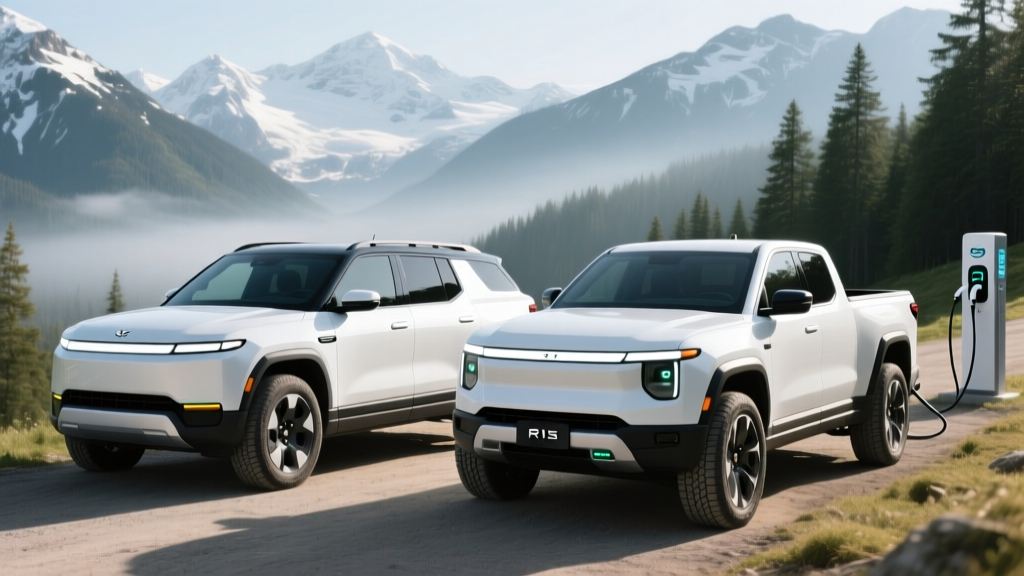
Rivian's Flagship EVs in Glacier White: What Buyers Need to Know
The Rivian R1T pickup and R1S SUV remain two of the most capable electric vehicles on the market, blending serious off-road chops with daily-driver refinement. For 2026, both models carry over the Gen 2 powertrain architecture introduced for the 2025 model year, featuring Rivian's in-house dual-motor and quad-motor configurations, NMC lithium-ion battery packs in three sizes, and a refreshed software stack. This review focuses on the Glacier White exterior — Rivian's no-cost standard paint option and one of the most popular choices among buyers — while covering the full mechanical and financial picture you need before ordering.
Whether you're cross-shopping the R1T against the Ford F-150 Lightning and Tesla Cybertruck, or weighing the R1S against the Kia EV9 and Tesla Model X, the data below gives you the exact numbers to make an informed decision.
Range, Battery, and Efficiency: The Real-World Picture
Rivian offers three battery pack sizes for 2026: the Standard Pack (92 kWh usable, LFP chemistry), the Large Pack (106 kWh usable, NMC), and the Max Pack (141 kWh usable, NMC). The chemistry split matters: the LFP Standard Pack is heavier and less energy-dense but offers longer cycle life and can be routinely charged to 100% without degradation concerns. The NMC packs deliver more range per pound but benefit from an 80% daily charge ceiling for longevity.
| Configuration | EPA Range | Real-World Highway (70 mph) | Cold Weather (20°F) |
|---|---|---|---|
| R1T Dual-Motor Max Pack | 420 mi | ~340–360 mi | ~280–310 mi |
| R1T Dual-Motor Large Pack | 342 mi | ~280–300 mi | ~230–250 mi |
| R1T Standard Pack (LFP) | 270 mi | ~220–235 mi | ~180–200 mi |
| R1S Dual-Motor Max Pack | 410 mi | ~330–350 mi | ~270–300 mi |
| R1S Dual-Motor Large Pack | 330 mi | ~270–290 mi | ~220–240 mi |
Source: EPA / fueleconomy.gov. Real-world estimates based on independent highway and cold-weather testing; actual results vary with terrain, payload, and driving style.
Efficiency for the Dual-Motor Large Pack R1T lands around 48 kWh/100 mi (roughly 70 MPGe combined), which is typical for a 7,000+ lb electric truck. The R1S, slightly lighter and more aerodynamic, edges to about 46 kWh/100 mi (73 MPGe). The heat pump, standard on all 2026 models, helps preserve range in cold climates compared to resistive cabin heating.
Charging Speed: DC Fast Charge and Home Level 2
Charging speed is where Rivian's Gen 2 platform made meaningful gains. The Max Pack peaks at 200 kW on DC fast chargers, while the Large Pack peaks at 190 kW and the Standard Pack at 150 kW. All configurations use the NACS (Tesla-style) charge port natively, giving access to Tesla Superchargers without an adapter — a significant network advantage in 2026.
| Charge Level | Max Pack (141 kWh) | Large Pack (106 kWh) | Standard Pack (92 kWh LFP) |
|---|---|---|---|
| DC Fast Charge (peak) | 200 kW | 190 kW | 150 kW |
| 10–80% DCFC Time | ~42 min | ~30 min | ~32 min |
| Level 2 (240V / 48A) | 11.5 kW (~25 mi/hr) | 11.5 kW (~25 mi/hr) | 11.5 kW (~25 mi/hr) |
| Level 1 (120V / 12A) | ~1.4 kW (~3 mi/hr) | ~1.4 kW (~3 mi/hr) | ~1.4 kW (~3 mi/hr) |
A key real-world note: the charge curve tapers significantly above 80% SoC. On a 200 kW Max Pack session, you'll sustain peak rates only between roughly 15–55% SoC; the final 20% (80–100%) can add another 25+ minutes. Plan road-trip stops around the 10–80% window for optimal throughput. At home on a 48-amp Level 2 wall connector, a full overnight charge from 20% to 80% takes about 5.5 hours for the Large Pack — easily covering a full day's driving.
Performance and Drivetrain
The 2026 Rivian lineup offers three motor configurations:
- Dual-Motor AWD: 533 hp, 610 lb-ft torque, 0–60 mph in 4.5 seconds (R1T). The volume seller and best efficiency-to-capability balance.
- Performance Dual-Motor AWD: 665 hp, 829 lb-ft, 0–60 in 3.4 seconds. Adds a sport-tuned suspension mode.
- Quad-Motor AWD: 1,025 hp, 1,198 lb-ft, 0–60 in 2.6 seconds (R1T). Independent motor per wheel enables true torque vectoring and tank turns.
All configurations feature a single-speed reduction gear, standard air suspension with up to 14.9 inches of ground clearance, and a wading depth of over 3 feet. Towing capacity maxes out at 11,000 lbs for the R1T and 7,700 lbs for the R1S — class-leading for electric SUVs. Note that towing at maximum capacity will cut range by roughly 40–50%, a physics reality every EV truck buyer should plan for.
Pricing, Trim Levels, and Federal Tax Credit
Rivian simplified its trim structure for 2026 into Adventure (base), Adventure Plus, and Ascend (premium). Glacier White is a no-cost standard color across all trims; premium paints like Rivian Blue and El Cap Granite add $1,000.
| Model / Trim | MSRP (incl. destination) | Est. §30D Credit | Effective Price |
|---|---|---|---|
| R1T Dual-Motor Adventure (Standard) | $69,900 | Up to $7,500* | ~$62,400 |
| R1T Dual-Motor Adventure (Large) | $75,900 | Up to $7,500* | ~$68,400 |
| R1T Dual-Motor Plus (Large) | $81,500 | Up to $7,500* | ~$74,000 |
| R1T Quad-Motor Ascend (Max) | $99,900 | Up to $7,500* | ~$92,400 |
| R1S Dual-Motor Adventure (Standard) | $74,900 | Up to $7,500* | ~$67,400 |
| R1S Dual-Motor Plus (Large) | $84,900 | Up to $7,500* | ~$77,400 |
| R1S Quad-Motor Ascend (Max) | $104,900 | Up to $7,500* | ~$97,400 |
*Federal tax credit caveats (IRS §30D, 2026 rules):
- MSRP cap: Trucks and SUVs must have an MSRP at or below $80,000 to qualify. This eliminates the Quad-Motor Ascend trims from credit eligibility.
- Income cap: Modified AGI must not exceed $150,000 (single), $225,000 (head of household), or $300,000 (joint filers).
- Battery sourcing: A percentage of critical minerals and battery components must be sourced from the U.S. or FTA partners. Rivian has been progressively reshoring supply chains, but the exact credit amount ($3,750 or $7,500) depends on current-year sourcing compliance. Verify at IRS.gov.
- Point-of-sale transfer: Eligible buyers can transfer the credit to the dealer at purchase, reducing the upfront price rather than waiting for a tax refund.
Cargo, Passenger Space, and Daily Practicality
The R1T's 4.5-foot bed is shorter than a full-size pickup's but includes the signature Gear Tunnel — a 17-cu-ft lockable pass-through behind the cab that's ideal for skis, golf bags, or camping gear. The front trunk (frunk) adds 11 cu ft of sealed, drainable storage.
- R1T bed volume: ~29.2 cu ft (bed) + 17 cu ft (Gear Tunnel) + 11 cu ft (frunk)
- R1S cargo (behind 3rd row): 21 cu ft
- R1S cargo (3rd row folded): 57 cu ft
- R1S cargo (all rows folded): 105 cu ft
- Front legroom: 41.3 in (R1T/R1S)
- Rear legroom: 38.5 in (R1T) / 36.2 in (R1S 2nd row)
- Third-row legroom (R1S): 30.1 in — best for children on short trips
The R1S seats up to seven with its optional third row. Rivian's camp kitchen accessory and the built-in air compressor remain standout lifestyle features that no competitor matches out of the box.
Tech, Driver Assistance, and Notable Drawbacks
The 2026 Rivian software platform (Rivian OS 3.x) runs on a 15.6-inch central touchscreen with a 12.3-inch driver cluster. Wireless Apple CarPlay and Android Auto are standard. Over-the-air updates continue to add features post-purchase — recent additions include enhanced route planning with charge-stop integration and a revamped pet mode.
The Rivian Driver+ system bundles adaptive cruise control, lane centering, and automatic lane changes on divided highways. This is an SAE Level 2 driver-assistance system — the driver must keep hands on the wheel and eyes on the road at all times. It is not autonomous driving. The system performs well on interstates but can be hesitant in dense urban merging situations.
Pros
- Class-leading off-road capability with air suspension and quad-motor torque vectoring
- NACS native — full Tesla Supercharger access without adapters
- Massive Gear Tunnel and frunk for adventure gear
- Strong build quality and OTA software improvements
- Competitive range (up to 420 mi EPA with Max Pack)
Cons
- MSRP above $80k on higher trims eliminates federal tax credit
- Max Pack 10–80% charge time (~42 min) lags some competitors
- R1S third row is cramped for adults
- No rear wiper on R1T (odd omission for a truck)
- Insurance premiums run 15–25% above comparable ICE trucks
Warranty and Long-Term Ownership
Rivian's warranty coverage for 2026:
- Basic vehicle: 5 years / 60,000 miles
- Battery & drive unit: 8 years / 175,000 miles (retains ≥70% capacity)
- Corrosion: 10 years / unlimited miles
The 175,000-mile battery warranty is among the most generous in the segment. Rivian's mobile service fleet handles many repairs at your home or office, reducing dealer-dependency. However, body-shop repair networks remain less widespread than legacy automakers — a consideration for collision-prone areas.
Who Should Buy the Rivian R1T or R1S?
The Decision Framework
Choose the R1T if: You need a pickup bed for work or adventure, want genuine off-road capability with electric torque, and can charge at home. The Dual-Motor Large Pack Adventure ($75,900) hits the sweet spot for value, range, and tax-credit eligibility.
Choose the R1S if: You need three-row seating for a family of 5–7, prioritize cargo versatility over a pickup bed, and plan road trips where the Max Pack's 410-mile EPA range reduces charging stops.
Look elsewhere if: You need a full-size 6.5-foot bed (consider the F-150 Lightning), want the lowest possible entry price (the Chevrolet Silverado EV starts lower), or require a proven dealer network in rural areas.
Frequently Asked Questions
What is the real-world range of the Rivian R1T and R1S?
The EPA rates the R1T Dual-Motor Max Pack at 420 miles and the Large Pack at 342 miles. In real-world highway driving at 70 mph, expect roughly 80–85% of those figures — around 340–360 miles for the Max Pack and 280–300 miles for the Large Pack. Cold weather (below freezing) can reduce range by an additional 15–25%.
How fast does the Rivian charge at home and on the road?
On a DC fast charger, the Max Pack peaks at 200 kW and charges 10–80% in approximately 42 minutes; the Large Pack at 190 kW in about 30 minutes. At home on a 48-amp Level 2 charger (11.5 kW), both packs add roughly 25 miles of range per hour, fully replenishing overnight.
Does the Rivian R1T or R1S qualify for the $7,500 federal EV tax credit?
It depends on trim and your income. Trims with an MSRP at or below $80,000 are eligible, provided your modified AGI falls under IRS limits ($150k single / $300k joint). Battery-sourcing rules also apply — the exact credit may be $3,750 or $7,500 depending on current-year mineral and component compliance. Always verify at IRS.gov before purchasing.
Is the Rivian worth buying over the Ford F-150 Lightning or Tesla Cybertruck?
The R1T offers superior off-road capability, a more premium interior, and NACS Supercharger access compared to the Lightning. The Cybertruck offers a stainless-steel exoskeleton and available rear-wheel steering but has a more polarizing design and limited trim availability. For adventure-focused buyers who value build quality and range, the R1T remains the strongest all-around choice. For fleet or work-truck buyers on a budget, the Lightning's lower starting price may win.
What are the biggest drawbacks of owning a Rivian?
Higher trims exceed the $80,000 MSRP cap for the federal tax credit. The Max Pack's 42-minute 10–80% charge time is slower than the Hyundai Ioniq 5 or Porsche Macan EV. The R1S third row is tight for adults. Insurance costs run higher than average for the segment, and Rivian's service network, while growing, is still thinner than legacy brands in rural markets.
What battery chemistry does Rivian use, and does it matter?
The Standard Pack uses LFP (lithium iron phosphate) chemistry — heavier but more durable, with no penalty for daily 100% charges. The Large and Max Packs use NMC (nickel manganese cobalt), offering higher energy density and more range but benefiting from an 80% daily charge limit to maximize long-term health. Both chemistries are covered under Rivian's 8-year / 175,000-mile battery warranty with a 70% capacity retention guarantee.