Quick Verdict: Rivian's 2026 Lineup at a Glance
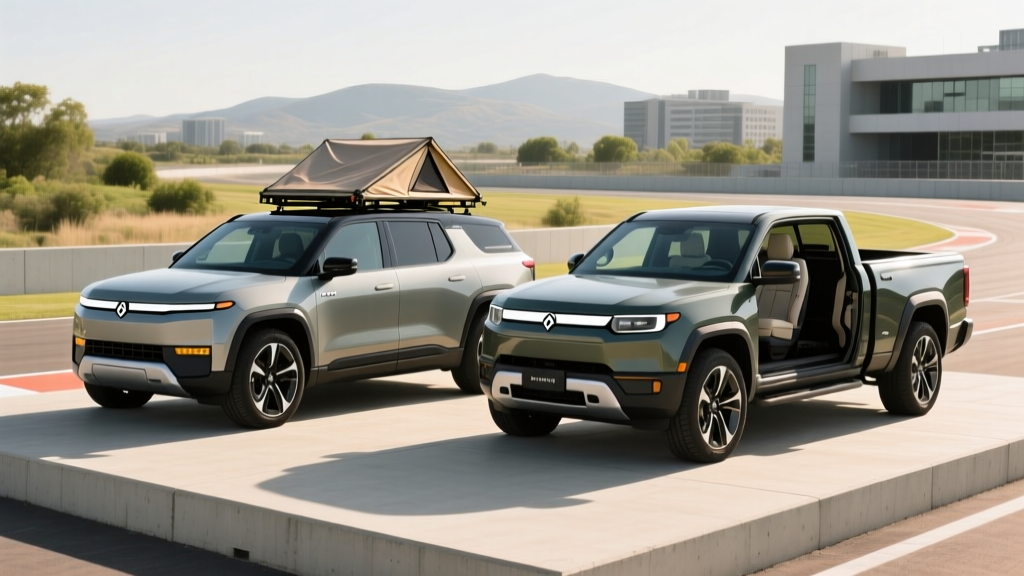
Rivian enters 2026 with a streamlined R1S (SUV) and R1T (truck) lineup built on its second-generation platform. Both models share the same core architecture: a 149-kWh Max Pack using 4680-format cylindrical cells, a Dual-Motor AWD setup as standard, and an available Quad-Motor configuration that produces up to 1,025 horsepower. The R1S seats up to seven, while the R1T offers a 4.5-foot bed with the signature Gear Tunnel. Pricing starts at $79,900 for the R1T Dual-Motor Adventure and $84,900 for the R1S equivalent — before any incentives or financing adjustments.
For buyers weighing how to pay for one, Rivian financing rates through partner lenders currently range from approximately 4.99% to 7.49% APR for well-qualified buyers on 60- to 72-month terms, depending on credit tier and loan structure. These rates, combined with the vehicle's eligibility for the federal §30D tax credit (up to $7,500 for qualifying buyers), significantly affect monthly out-of-pocket cost.
Range, Battery, and Real-World Efficiency
The 2026 R1 platform offers three battery configurations across trims:
| Configuration | Battery (kWh usable) | Chemistry | EPA Range (R1T / R1S) |
|---|---|---|---|
| Standard (Dual-Motor) | ~106 kWh | NMC (2170 cells) | 270 mi / 275 mi |
| Large Pack (Dual-Motor) | ~128 kWh | NMC (2170 cells) | 340 mi / 345 mi |
| Max Pack (Dual/Quad) | ~149 kWh | NMC (4680 cells) | 420 mi / 410 mi |
Efficiency for the Dual-Motor Large Pack R1T lands at approximately 73 MPGe combined (46 kWh/100 mi), per fueleconomy.gov. The Quad-Motor drops to roughly 69 MPGe due to added weight and power. These figures are typical for body-on-frame electric trucks but trail unibody crossovers significantly.
Charging Speed: DC Fast and Home Level 2
Rivian uses the NACS (Tesla-style) connector natively on all 2026 models, granting access to the Tesla Supercharger network without adapters — a major practical advantage over CCS-equipped competitors.
| Charging Level | Power / Rate | Time or Miles Added |
|---|---|---|
| Level 1 (120V, 12A) | ~1.4 kW | ~3–4 miles per hour |
| Level 2 (240V, 48A) | 11.5 kW | ~25–28 miles per hour; full charge ~12–14 hrs (Large Pack) |
| DC Fast Charge (Max Pack) | Peak 220 kW | 10–80% in ~30 minutes |
| DC Fast Charge (Large Pack) | Peak 200 kW | 10–80% in ~28 minutes |
The 4680-cell Max Pack sustains higher charging power deeper into the curve than the 2170-cell packs. Expect the Max Pack to hold above 150 kW through roughly 60% state of charge before tapering. Above 80%, charge rate drops sharply to protect cell longevity — plan to unplug at 80% on road trips unless you need the extra range to reach your next stop.
At home, a 48-amp Level 2 wall connector on a 60-amp circuit adds roughly 25 miles per hour of charging. Most owners with a Large Pack will wake to a full battery overnight. Installation costs typically run $800–$2,000 depending on panel proximity and local permitting; a 200-amp panel upgrade can add $1,500–$3,000 if your home requires it.
Performance and Drivetrain
Every 2026 R1 comes with all-wheel drive. The Dual-Motor setup produces 533 horsepower and 610 lb-ft of torque, launching the R1T from 0–60 mph in approximately 4.5 seconds. The Quad-Motor variant — with an independent motor at each wheel — delivers 1,025 hp and 1,198 lb-ft, dropping the 0–60 time to 2.9 seconds. That puts it in supercar territory despite a curb weight exceeding 7,000 pounds.
Towing capacity maxes out at 11,000 pounds for the R1T and 7,700 pounds for the R1S when properly equipped. However, towing at or near capacity cuts range roughly in half — plan charging stops accordingly. Rivian's integrated trailer brake controller and hitch camera system are best-in-class for electric truck towing.
Off-road, the R1 platform offers up to 14.9 inches of ground clearance via its adjustable air suspension, with approach/departure angles that rival dedicated off-road SUVs. The Quad-Motor's tank turn feature (spinning the vehicle in place by running left and right wheels in opposite directions) is more than a party trick on tight trails.
Pricing, Trims, and Rivian Financing Rates
Rivian offers three main content levels across both body styles:
| Trim | R1T MSRP | R1S MSRP | Key Features |
|---|---|---|---|
| Adventure (Dual-Motor, Standard) | $79,900 | $84,900 | Base adventure equipment, 270–275 mi range |
| Adventure (Dual-Motor, Large) | $87,900 | $92,900 | 340–345 mi range, premium interior options |
| Ascend (Dual/Quad, Large/Max) | $99,900–$119,900 | $104,900–$124,900 | Quad-Motor option, Max Pack, full luxury trim |
Understanding Rivian Financing Rates in 2026
Rivian does not operate a captive finance arm like Ford Credit or Toyota Financial Services. Instead, the company partners with third-party lenders (including Chase and local credit unions) to offer retail financing. As of early 2026, advertised Rivian financing rates for qualified buyers span:
- 60-month term: 4.99%–5.99% APR (excellent credit, 740+ FICO)
- 72-month term: 5.49%–6.49% APR
- 84-month term: 6.29%–7.49% APR
Lease options are also available through partner banks, typically with money factors equivalent to roughly 5.5%–7.0% APR depending on residual values and creditworthiness.
| Scenario | Down Payment | Rate (APR) | Term | Est. Monthly |
|---|---|---|---|---|
| Finance (no credit) | $10,000 | 5.49% | 72 mo | ~$1,310 |
| Finance (with $7,500 credit) | $10,000 | 5.49% | 72 mo | ~$1,195 |
| Finance (84 mo, good credit) | $10,000 | 6.49% | 84 mo | ~$1,190 |
Estimates for illustration only. Actual payments depend on taxes, fees, trade-in, and lender terms.
Federal Tax Credit Eligibility (§30D)
The R1S and R1T can qualify for the full $7,500 federal EV tax credit under IRS §30D, but only if you meet all current requirements:
- MSRP cap: Vans, SUVs, and pickup trucks must have an MSRP at or below $80,000. This means the base R1T Adventure with Standard Pack ($79,900) qualifies, but any configuration above $80,000 does not. The R1S, classified as an SUV, also falls under the $80,000 cap.
- Buyer income limits: Modified AGI must not exceed $300,000 (joint filers), $225,000 (head of household), or $150,000 (single). See IRS §30D guidelines for details.
- Battery sourcing: Critical minerals and battery components must meet escalating domestic-content thresholds. Rivian has worked to localize supply chains, but buyers should verify current-year compliance on the manufacturer's spec sheet or via the IRS eligible-vehicle list before purchase.
- Point-of-sale transfer: As of 2024, qualifying buyers can transfer the credit to the dealer at purchase, reducing the financed amount directly — effectively lowering both the loan principal and monthly payment.
Critical note: Because most R1 configurations exceed the $80,000 MSRP cap, only the base R1T Adventure with the Standard Pack currently sits at the threshold. Buyers configuring a Large Pack or Max Pack should assume they will not receive the federal credit and plan financing accordingly. Consult a tax professional for your specific situation.
Interior, Cargo, and Technology
The R1S provides seating for up to seven across three rows, with 38.9 inches of second-row legroom and a usable third row for children or shorter adults. Cargo volume behind the third row is 10.6 cu ft, expanding to 46.7 cu ft with the third row folded and 91.6 cu ft with both rear rows down.
The R1T's 4.5-foot bed (54 inches long) is compact by full-size truck standards, but the 11.0-cu-ft Gear Tunnel — a pass-through compartment between the cab and bed — is a genuinely useful differentiator for storing camping gear, skis, or groceries. A front trunk (frunk) adds 11.0 cu ft of lockable, weatherproof storage.
On the tech front, the 15.6-inch center touchscreen runs Rivian's proprietary software, which has matured considerably since launch. Wireless Apple CarPlay and Android Auto are supported. The digital driver display and head-up projection are clear and configurable. Over-the-air updates continue to add features — recent additions include improved route planning with automatic battery preconditioning for DC fast stops.
Driver assistance is handled by Rivian's Driver+ system, a Level 2 SAE automation suite that includes adaptive cruise control, lane-centering, and automatic lane changes on divided highways. It is not self-driving: you must keep hands on the wheel and eyes on the road at all times. The system is competent but trails GM's Super Cruise and Ford's BlueCruise in hands-free highway capability.
Warranty and Long-Term Ownership
| Coverage | Term |
|---|---|
| Limited Vehicle Warranty | 5 years / 60,000 miles |
| Battery & Drive Unit Warranty | 8 years / 175,000 miles |
| Battery Capacity Retention | ≥70% over warranty period |
Rivian's 8-year/175,000-mile battery warranty is competitive and slightly above the industry-standard 100,000-mile threshold. The 70% capacity retention guarantee means that if your battery degrades below that level within the warranty window, Rivian will repair or replace it. Based on current data from early R1 owners, degradation has been modest — most reporting 3–6% loss over the first 40,000 miles, consistent with NMC chemistry managed by an active liquid thermal system.
Service remains a consideration. Rivian operates a growing network of service centers and mobile service vans, but coverage in rural areas is still sparse compared to legacy automakers. Owners in major metro areas report reasonable service turnaround; those in smaller markets should factor in potential travel for warranty work.
Pros, Cons, and Who Should Buy
- Class-leading range with Max Pack (420 mi EPA)
- Native NACS connector — full Supercharger network access
- Quad-Motor performance (1,025 hp, 2.9s 0–60)
- Gear Tunnel and frunk give R1T unmatched storage versatility
- 11,000-lb towing capacity with integrated trailer tech
- Air suspension with 14.9" ground clearance for serious off-road use
- OTA updates continue to improve the vehicle post-purchase
- Base MSRP near or above $80,000 limits federal tax credit access
- Real-world highway and cold-weather range drops 20–30%
- Service center coverage still limited outside major metros
- Rivian financing rates (4.99%–7.49%) trail promotional OEM captive rates
- Driver+ is competent but not hands-free like Super Cruise
- R1T bed is short (4.5 ft) for traditional truck buyers
- Insurance premiums run 15–25% higher than comparable ICE trucks
Who This EV Suits Best
The R1T is ideal for: Outdoor enthusiasts who need towing capability and off-road chops but want daily-driver refinement. It replaces a midsize truck like the Tacoma or Colorado for weekend warriors who also commute. The Gear Tunnel alone justifies the purchase for camping and gear-heavy lifestyles.
The R1S is ideal for: Active families needing three rows, serious range for road trips, and off-road capability for ski trips or trail access. It competes directly with the Tesla Model X and the upcoming electric Explorer, but offers more rugged utility than either.
Neither is ideal for: Budget-conscious buyers (the realistic entry point is ~$80K before options), fleet buyers needing captive financing at sub-3% rates, or anyone in a rural area far from a Rivian service hub.
Rivian vs. Key Competitors
In the electric truck and large SUV space, the R1T and R1S face three primary rivals:
- Ford F-150 Lightning: Starts ~$20,000 lower, offers comparable towing (10,000 lb), and benefits from Ford's massive dealer/service network. However, the Lightning uses CCS (requiring an adapter for Superchargers), has lower max range (~320 mi), and doesn't match the R1T's off-road capability or Gear Tunnel utility.
- Chevrolet Silverado EV: The 4WT and RST trims offer up to 440 miles of range and a larger bed, but pricing creeps into R1 territory at higher trims. Build quality and software refinement currently trail Rivian.
- Tesla Model X (for R1S buyers): Faster charging (peak 250 kW), more Supercharger stalls, and access to FSD (Supervised). But the Model X offers no off-road pretension, less cargo versatility, and polarizing styling.
The R1 platform wins on overall capability breadth — nothing else combines this level of range, off-road clearance, towing, and storage innovation in a single package. You pay a premium for that versatility, and Rivian financing rates reflect the vehicle's position as a premium product without captive-lender subsidies.
Frequently Asked Questions
What is the real-world range of the 2026 Rivian R1T and R1S?
The EPA rates the Max Pack R1T at 420 miles and the R1S at 410 miles. In real-world highway driving at 70–75 mph, expect 340–370 miles. In cold weather (below freezing), plan for 290–330 miles. The Standard Pack's 270-mile EPA rating realistically yields 210–230 miles on a winter road trip.
How fast does the Rivian R1 charge?
On a DC fast charger, the Max Pack peaks at 220 kW and charges from 10–80% in approximately 30 minutes. At home on a 48-amp Level 2 charger (11.5 kW), you'll add about 25–28 miles per hour, fully replenishing the Large Pack overnight in roughly 12–14 hours.
Does the Rivian R1 qualify for the $7,500 federal EV tax credit?
Possibly, but only the base R1T Adventure with Standard Pack ($79,900) sits at or below the $80,000 MSRP cap for trucks/SUVs under §30D. You must also meet income limits ($300K joint / $150K single) and the vehicle must satisfy battery-sourcing requirements. Most R1 configurations exceed the cap and will not qualify. Always verify on IRS.gov before purchasing.
What are Rivian financing rates in 2026?
Rivian partners with third-party lenders offering rates from approximately 4.99% APR (60-month, excellent credit) to 7.49% APR (84-month, good credit). These are competitive for a premium EV but higher than promotional captive-lender rates from legacy automakers. Applying the $7,500 point-of-sale credit (if eligible) reduces the financed principal and monthly payment.
Is the Rivian R1T worth buying over the Ford F-150 Lightning?
If you prioritize off-road capability, Gear Tunnel storage, native NACS/Supercharger access, and premium build quality, the R1T justifies its higher price. If budget, dealer service proximity, and a full-size bed matter more, the Lightning is the pragmatic choice. Both are excellent electric trucks for different buyers.
What's the biggest drawback of owning a Rivian?
Service access remains the most common complaint. Rivian's service center and mobile-service footprint is growing but is far thinner than Ford, Chevy, or Toyota networks. If you live more than 60–90 minutes from a service center, factor that into your decision. Insurance costs also run higher than ICE equivalents.