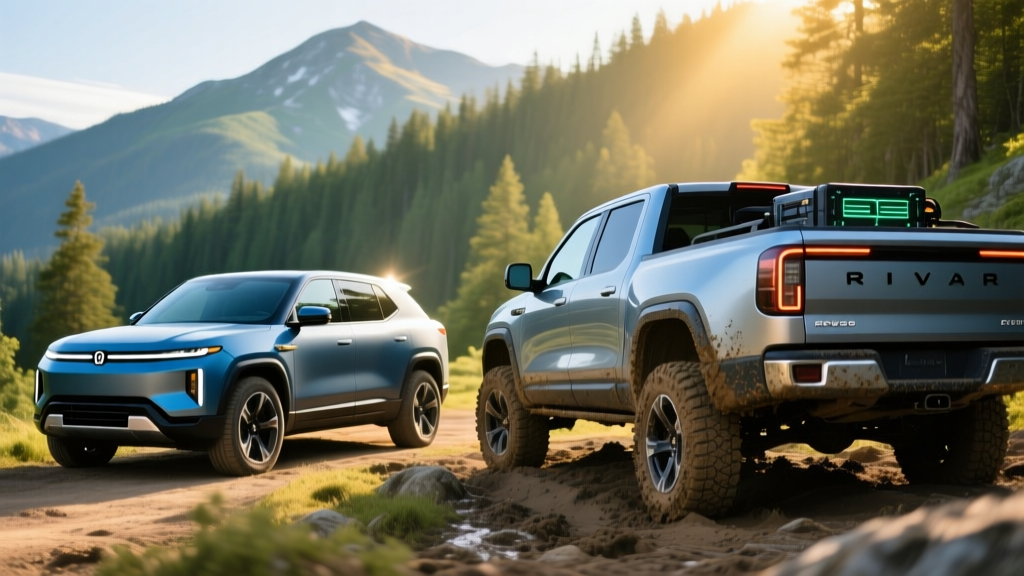
If you’ve seen a boxy, adventure-ready electric SUV or pickup on the trail and wondered who makes the Rivian car, you’re not alone. Rivian Automotive, Inc. designs, engineers, and manufactures its vehicles in the United States — specifically at a repurposed 3.3-million-square-foot assembly plant in Normal, Illinois. Founded in 2009 by MIT-trained engineer RJ Scaringe, Rivian launched its first consumer vehicles, the R1T pickup and R1S SUV, for the 2022 model year and has since expanded into delivery vans (the EDV, built for Amazon) and a second generation of its flagship R1 lineup for 2025–2026.
This profile focuses on the current-generation R1S (three-row SUV) and R1T (crew-cab pickup) — covering EPA range, battery chemistry, charging speed, real-world efficiency, pricing, and federal tax-credit eligibility so you can decide whether a Rivian fits your garage.
Who Is Rivian and Where Are Its Vehicles Built?
Rivian is a publicly traded American EV manufacturer (NASDAQ: RIVN) headquartered in Irvine, California. Every R1S and R1T rolls off the line at the Rivian Normal plant in Illinois — a facility originally built for Mitsubishi in the 1990s and retooled for EV production. Unlike many EV startups that contract-build overseas, Rivian vertically integrates much of its powertrain, battery-pack assembly, and software stack in-house.
In 2024–2025, Rivian secured a major joint-venture investment from Volkswagen Group (up to $5.8 billion), aimed at co-developing a next-generation EV architecture and stabilizing Rivian’s balance sheet. For buyers, this signals long-term parts and platform support — a legitimate concern with any younger automaker.
2026 R1S and R1T: Range, Battery, and Efficiency
Rivian offers the R1S and R1T with two battery pack sizes for the 2025–2026 model years. Both use NMC (nickel-manganese-cobalt) lithium-ion chemistry in a cylindrical-cell format, chosen for energy density and cold-weather performance. (Rivian has not adopted LFP chemistry for the R1 lineup as of 2026.)
| Spec | Standard Battery | Large Battery |
|---|---|---|
| Usable capacity | ~95 kWh (NMC) | ~117 kWh (NMC) |
| EPA range (R1S Dual-Motor) | 270 mi | 352 mi |
| EPA range (R1T Dual-Motor) | 270 mi | 352 mi |
| Efficiency (R1S Large) | ~73 MPGe / 46 kWh per 100 mi | |
| Drivetrain | Dual-motor AWD (standard); Quad-motor AWD (Tri/Quad trims) | |
Charging: DC Fast-Charge Speed, 10–80% Time, and Home Level 2
Charging speed is where Rivian’s Gen 2 platform (2025+) improved substantially over the 2022–2024 models. The updated R1S and R1T now support peak DC fast-charging rates up to 220 kW on the Large Battery pack, with a more sustained charge curve that resists the steep taper older Rivians experienced above 60% state of charge (SoC).
| Level | Power / Rate | Speed / Time |
|---|---|---|
| Level 1 (120V household) | ~1.4 kW | ~3–4 miles per hour |
| Level 2 (240V home / public) | 11.5 kW (48A onboard charger) | ~25–28 miles per hour; 0–100% in ~11–13 hrs |
| DC Fast Charge (CCS/NACS) | Peak 220 kW (Large Battery) | 10–80% in ~27 minutes (peak); taper begins ~75% SoC |
Rivian transitioned to the NACS (Tesla-style) charge port beginning with the 2025 model year, granting native access to Tesla Supercharger stations (now open to non-Tesla EVs via NACS). For older CCS-port Rivians, Rivian offers a CCS-to-NACS adapter. Home charging on a 48-amp Level 2 wall connector will replenish the Large Battery overnight — a practical setup for daily driving of 40–60 miles.
Source: Rivian R1S official specs
Performance: 0–60, Horsepower, and Drivetrain Options
Rivian offers four powertrain configurations across the R1S and R1T:
- Dual-Motor AWD: ~533 hp, 610 lb-ft torque; 0–60 mph in ~4.5 seconds
- Performance Dual-Motor: ~665 hp, 829 lb-ft; 0–60 in ~3.4 seconds
- Tri-Motor AWD: ~850 hp; 0–60 in ~2.9 seconds (R1T only)
- Quad-Motor AWD: ~1,025 hp; 0–60 in ~2.5 seconds (limited availability)
All R1 vehicles feature a single-speed reduction gear (no multi-speed transmission) and Rivian’s proprietary torque-vectoring system. The air suspension provides up to 14.9 inches of ground clearance in Off-Road mode and can lower for highway efficiency. Towing capacity reaches 7,700 lbs for the R1S and 11,000 lbs for the R1T — though towing at max capacity cuts range roughly in half.
Pricing, Trims, and Federal Tax Credit Eligibility
| Model / Trim | Base MSRP | §30D Credit Eligibility |
|---|---|---|
| R1S Dual-Motor (Standard) | $75,900 | Not eligible — MSRP exceeds $80,000 SUV cap when options added; some base configs may qualify if under cap |
| R1S Dual-Motor (Large) | $82,400 | Not eligible — exceeds $80,000 SUV MSRP cap |
| R1T Dual-Motor (Standard) | $69,900 | Potentially eligible — truck MSRP cap is $80,000; must meet income + sourcing rules |
| R1T Dual-Motor (Large) | $76,400 | Potentially eligible — under $80K truck cap; verify battery sourcing |
| R1T Tri-Motor | $99,900+ | Not eligible — exceeds $80,000 truck MSRP cap |
The federal EV tax credit under IRS §30D has strict rules for 2026:
- MSRP caps: $80,000 for SUVs, vans, and trucks; $55,000 for sedans
- Buyer income caps: $150K single / $225K head of household / $300K joint (modified AGI)
- Battery sourcing: Critical minerals and battery components must meet escalating North American/free-trade-partner thresholds
- Point-of-sale transfer: Eligible buyers can apply the credit at purchase, reducing the upfront price
Because Rivian’s R1S is classified as an SUV, any trim optioned above $80,000 loses credit eligibility. The R1T, classified as a truck, has the same $80,000 cap — meaning base Dual-Motor configurations may qualify, but Tri-Motor and most Large Battery upgrades push past the threshold. Always verify current-year sourcing requirements at IRS.gov §30D guidance and consult a tax professional before relying on credit eligibility.
Interior, Cargo, Tech, and Driver Assistance
The R1S seats up to seven passengers across three rows, with 104.7 cu ft of total cargo volume (seats folded). The R1T offers a 4.5-foot bed plus the signature Gear Tunnel — a 11.7 cu ft pass-through compartment behind the cab — and a front trunk (frunk) of 11.0 cu ft. Rear-seat legroom in both vehicles is generous at ~38 inches.
Standard tech includes a 15.6-inch center touchscreen, 12.3-inch digital instrument cluster, Rivian’s in-house software (updated over-the-air), and the Rivian Driver+ suite (adaptive cruise, lane centering, automatic emergency braking). Driver+ is a SAE Level 2 system — it requires continuous driver supervision and does not permit hands-off driving. Rivian does not currently offer a hands-free highway system comparable to GM’s Super Cruise or Ford’s BlueCruise.
Warranty and Long-Term Ownership
Rivian provides a 5-year/60,000-mile limited vehicle warranty and an 8-year/175,000-mile battery and drive-unit warranty. The battery warranty guarantees at least 70% capacity retention over the coverage period. Rivian operates its own service network (Rivian Service Centers and mobile service vans), though coverage in rural areas remains thinner than legacy automaker dealer networks.
Source: Rivian R1T official page
Pros, Cons, and Who Should Buy a Rivian
- Class-leading off-road capability with air suspension and quad-motor torque vectoring
- Gear Tunnel (R1T) and 7-seat layout (R1S) offer unique utility
- Strong DC fast-charge curve on Gen 2 (220 kW peak)
- NACS port = native Supercharger access
- 11,000-lb towing (R1T) is best-in-class for electric pickups
- Pricing starts near $70K; most trims exceed §30D credit cap
- No hands-free highway driving feature (Level 2 only)
- Service network still expanding; rural coverage limited
- High efficiency penalty when towing (range halves at max load)
- Third-row R1S space is tight for adults on long trips
Best for: Active families and outdoor enthusiasts who need genuine off-road capability, towing, and cargo versatility — and who can charge at home. The R1T suits truck buyers who want daily-driver refinement with weekend trail capability. The R1S fits three-row EV shoppers who prioritize adventure over luxury-brand prestige.
Consider instead: Tesla Model X (more Supercharger-native infrastructure, lower starting price), Ford F-150 Lightning (more affordable, broader dealer service), or Hyundai Ioniq 9 (upcoming three-row value option).
Frequently Asked Questions
Who makes the Rivian car?
Rivian Automotive, Inc., an American EV company founded in 2009 and headquartered in Irvine, California. Vehicles are manufactured at the Rivian Normal plant in Normal, Illinois.
What is the real-world range of the Rivian R1S and R1T?
The EPA rates the Large Battery Dual-Motor at 352 miles. Real-world highway driving yields ~290–310 miles; cold weather (below 20°F) can reduce range to 245–280 miles. The Standard Pack delivers ~220–240 highway miles.
How fast does a Rivian charge?
Gen 2 R1 vehicles peak at 220 kW on DC fast chargers, achieving 10–80% in roughly 27 minutes. Home Level 2 charging at 11.5 kW adds ~25–28 miles per hour.
Does the Rivian qualify for the federal EV tax credit?
It depends on trim, MSRP, buyer income, and battery sourcing. Base R1T Dual-Motor configurations under the $80,000 truck cap may qualify. Most R1S configurations exceed the $80,000 SUV cap when optioned. Verify at IRS.gov.
Is Rivian worth buying over a Tesla Model X or Ford F-150 Lightning?
If you need off-road capability, the Gear Tunnel, or a 7-seat adventure SUV, Rivian is uniquely positioned. If budget, service network breadth, or hands-free driving are priorities, the Lightning or Model X may suit better.
What battery chemistry does Rivian use?
Rivian uses NMC (nickel-manganese-cobalt) lithium-ion cells in both the Standard and Large battery packs for the R1S and R1T.