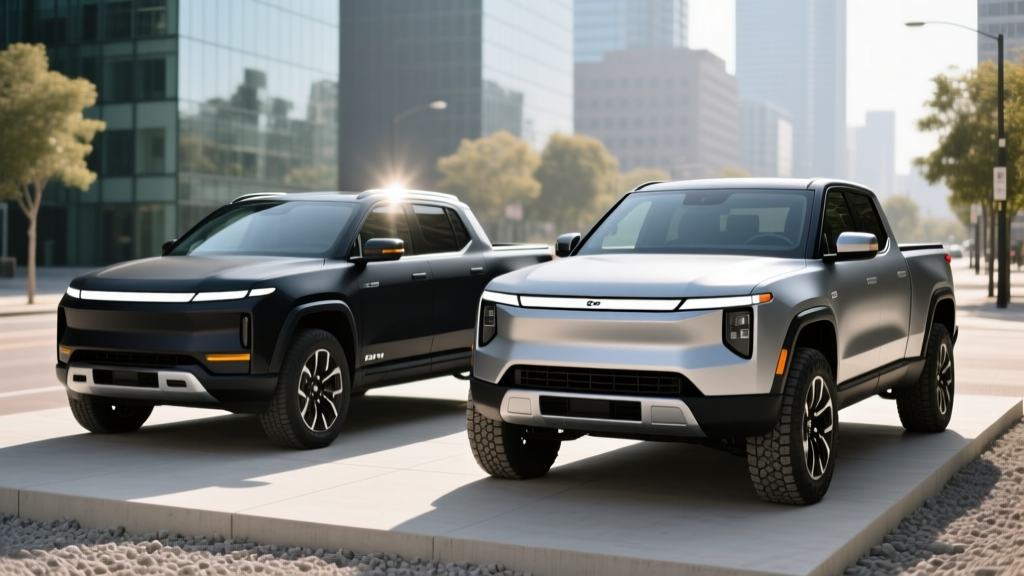
Weight is one of the most consequential — and least discussed — variables in electric vehicle ownership. It affects range, tire wear, braking distance, ferry and bridge toll classifications, and even the structural load on your garage floor. If you've been searching how much does a Rivian weigh, you're not alone: the R1S SUV and R1T pickup are among the heaviest consumer vehicles on the road, and understanding exactly what that means for your daily driving is essential before you sign a purchase agreement.
This guide breaks down the curb weight of every current Rivian configuration, explains why those numbers matter for range and efficiency, and delivers the full spec sheet — charging speed, battery chemistry, pricing, and federal tax credit eligibility — you need to make an informed decision.
Rivian Curb Weight by Model and Battery Pack
Rivian offers the R1S (three-row SUV) and R1T (crew-cab pickup) with two battery pack sizes and multiple motor configurations. The weight difference between the lightest and heaviest variants is substantial — over 700 pounds — and directly impacts EPA-estimated range and efficiency.
| Model | Battery Pack | Usable Capacity | Curb Weight | GVWR |
|---|---|---|---|---|
| R1S (SUV) | Standard | ~92 kWh (LFP) | 6,826 lbs | ~8,000 lbs |
| R1S (SUV) | Max | ~141 kWh (NMC) | 7,148 lbs | ~8,500 lbs |
| R1T (Pickup) | Standard | ~92 kWh (LFP) | 6,896 lbs | ~8,050 lbs |
| R1T (Pickup) | Max | ~141 kWh (NMC) | 7,218 lbs | ~8,550 lbs |
Sources: Rivian R1S specs, Rivian R1T specs. Weights are for dual-motor AWD configurations. Tri-motor and quad-motor variants add approximately 100–200 lbs.
For context, a Toyota RAV4 Hybrid weighs roughly 3,800 lbs, and a Ford F-150 Lightning Extended Range comes in around 6,500 lbs. The Rivian Max-pack models push past 7,200 lbs — territory usually reserved for heavy-duty diesel trucks.
Why Rivian Weight Matters for Range and Efficiency
Mass is the enemy of efficiency. Every additional pound requires more energy to accelerate, climb grades, and sustain highway speed. Rivian's weight penalty shows up in two ways: lower MPGe relative to lighter EVs and steeper range loss under load.
R1S Max Pack (EPA): 410 miles
R1T Max Pack (EPA): 420 miles
R1S/R1T Standard Pack (EPA): ~270 miles
Real-world caveat: Expect 85–90% of EPA at sustained highway speeds (70+ mph). In freezing temperatures (below 32°F), range can drop 20–30% due to battery heating demands and cabin climate load. Towing a 5,000-lb trailer cuts range roughly in half regardless of pack size.
The Standard pack's lithium iron phosphate (LFP) chemistry is heavier per kWh than the Max pack's nickel-manganese-cobalt (NMC) cells, but LFP offers superior cycle life and can be charged to 100% daily without degradation concerns. NMC provides higher energy density (more miles per pound of battery) but benefits from an 80% daily charge limit for longevity.
Charging Speed: DC Fast and Home Level 2
Heavier vehicles with larger batteries need robust charging infrastructure. Rivian's second-generation platform (2025+ models) uses the NACS connector natively, granting direct access to Tesla Superchargers without an adapter.
| Charge Level | Standard Pack (LFP) | Max Pack (NMC) |
|---|---|---|
| DC Fast Charge (Peak) | ~200 kW | ~220 kW |
| 10–80% DC Time | ~28 minutes | ~42 minutes |
| Level 2 Home (11.5 kW) | ~16 mi/hr (9–10 hrs full) | ~16 mi/hr (12–14 hrs full) |
| Level 2 Home (7.7 kW) | ~11 mi/hr | ~11 mi/hr |
The Max pack's larger capacity means longer absolute charge times, even at higher peak kW. On a road trip, expect the Standard pack to get you from 10% to 80% in under 30 minutes at a 250+ kW charger, while the Max pack will keep you plugged in closer to 45 minutes due to the charge curve tapering significantly above 80%. Always precondition the battery via the navigation system before arriving at a DC fast charger to hit peak rates.
Performance, Efficiency, and Drivetrain Specs
Rivian's dual-motor AWD system delivers torque independently to front and rear axles. The performance-oriented Tri-Motor and Quad-Motor variants (available on Adventure and Ascend trims) trade some efficiency for dramatic acceleration gains.
| Config | Horsepower | 0–60 mph | EPA MPGe (Combined) | kWh/100 mi |
|---|---|---|---|---|
| Dual-Motor AWD | 533 hp | 4.5 sec | ~78 MPGe | ~43 kWh |
| Tri-Motor AWD | 850 hp | 2.9 sec | ~70 MPGe | ~48 kWh |
At 43–48 kWh per 100 miles, Rivian's efficiency trails lighter EVs like the Tesla Model Y (~28 kWh/100 mi) and Hyundai Ioniq 5 (~30 kWh/100 mi). You're paying an energy premium for ground clearance, off-road capability, and a body-on-frame platform. Home electricity at $0.15/kWh means roughly $6.45 per 100 miles — still dramatically cheaper than a comparable gas truck at 16 MPG.
Pricing, Trims, and Federal Tax Credit Eligibility
Rivian pricing has shifted with the introduction of the more affordable Standard pack and the dual-motor base configuration. Here's where the lineup stands for 2025 delivery:
| Model / Trim | Base MSRP | Federal §30D Credit | Effective Price |
|---|---|---|---|
| R1S Dual-Motor Standard | $75,900 | $0 (MSRP cap exceeded) | $75,900 |
| R1T Dual-Motor Standard | $69,900 | $0 (MSRP cap exceeded) | $69,900 |
| R1S Tri-Motor Max | $99,900 | $0 (MSRP cap exceeded) | $99,900 |
| R1T Tri-Motor Max | $94,900 | $0 (MSRP cap exceeded) | $94,900 |
Under current IRS §30D rules, new EVs must have an MSRP at or below $80,000 (SUVs/vans/pickups) or $55,000 (sedans) to qualify for the $7,500 credit. Rivian's R1S is classified as an SUV (eligible up to $80K MSRP), and the R1T as a pickup (also $80K cap). However, as of 2025, even the base dual-motor configurations exceed these thresholds when destination fees and mandatory options are included. Buyer income caps ($300K joint / $150K single) and battery critical-mineral sourcing requirements further restrict eligibility. Consult a tax professional and verify current-year rules on IRS.gov before assuming credit availability.
Cargo, Passenger Space, and Practical Utility
The R1S seats up to seven across three rows, though third-row legroom (30.4 inches) is tight for adults on long trips. The R1T's crew cab seats five with generous rear legroom (38.9 inches) and features the innovative Gear Tunnel — a lockable, pass-through cargo compartment spanning the width of the bed.
| Measurement | R1S SUV | R1T Pickup |
|---|---|---|
| Cargo (behind 3rd row) | 17.6 cu ft | N/A |
| Cargo (2nd row folded) | 58.4 cu ft | N/A |
| Cargo (all rows folded) | 104.6 cu ft | N/A |
| Bed Volume | N/A | ~54 cu ft |
| Gear Tunnel | N/A | 11.7 cu ft |
| Front Trunk (Frunk) | 11.1 cu ft | 11.1 cu ft |
| Ground Clearance (max) | 14.9 in | 14.9 in |
| Towing Capacity | 7,700 lbs | 11,000 lbs |
Warranty, Tech, and Driver Assistance
Rivian covers the battery and drivetrain for 8 years or 175,000 miles (whichever comes first), with a capacity retention guarantee of 70% over that period. The bumper-to-bumper warranty runs 5 years / 60,000 miles. This is competitive with Tesla and exceeds most legacy automakers.
Standard technology includes a 15.6-inch center touchscreen running Rivian's proprietary OS, over-the-air updates, built-in camp kitchen options (R1T), and the Rivian Driver+ system — a Level 2 driver-assist suite with adaptive cruise, lane centering, and automatic lane changes on divided highways. This is not self-driving; the driver must maintain hands-on-wheel supervision at all times.
Pros, Cons, and Who Should Buy a Rivian
- Class-leading off-road capability (14.9" ground clearance, tank turns on Tri-Motor)
- Genuine truck utility: 11,000-lb towing (R1T), Gear Tunnel, powered tonneau
- 410+ mile Max Pack range eliminates most road-trip charging stops
- Native NACS — no adapter needed for Tesla Superchargers
- LFP Standard pack supports 100% daily charging without degradation risk
- Heavy: 7,200+ lbs increases tire wear (expect 25–35K mile tire life) and energy cost
- No federal tax credit at current MSRP levels
- Third-row space in R1S is best for children only
- Efficiency trails crossover EVs by 30–40% (higher charging cost per mile)
- Service center network still limited outside major metros
Best for: Outdoor enthusiasts who need genuine off-road clearance and towing, families wanting a three-row electric SUV with adventure capability, and truck buyers who want instant torque without diesel complexity. If your primary use case is commuting on pavement and you don't need ground clearance or a bed, a lighter EV like the Tesla Model Y or Hyundai Ioniq 5 will cost less to operate and charge faster.
Frequently Asked Questions
What is the real-world range of a Rivian?
The Max Pack R1T achieves an EPA-estimated 420 miles, but sustained highway driving at 70–80 mph typically yields 350–380 miles. In winter conditions below freezing, expect 280–330 miles. The Standard Pack (~270 EPA) delivers roughly 220–240 miles on the highway in mild weather.
How fast does a Rivian charge at home and on the road?
On a Level 2 home charger at 11.5 kW, expect roughly 16 miles of range per hour of charging — a full Standard Pack charge takes about 9 hours, while the Max Pack requires 12–14 hours. DC fast charging peaks at 200–220 kW, with 10–80% taking 28–42 minutes depending on pack size.
Does the Rivian R1S or R1T qualify for the $7,500 federal tax credit?
As of 2025, no. Both models exceed the $80,000 MSRP cap for SUVs and pickups under IRS §30D rules, even in base dual-motor Standard configurations. State-level incentives and utility rebates may still apply — check fueleconomy.gov for current eligibility.
How does Rivian weight affect tire wear and maintenance?
The 7,000+ lb curb weight accelerates tire wear significantly. Owners report needing replacement tires between 25,000 and 35,000 miles, depending on driving style. Rivian recommends EV-rated tires with higher load ratings (typically XL or reinforced), which cost $300–$450 per corner. Factor this into your five-year cost of ownership.
Is a Rivian worth buying vs. a Ford F-150 Lightning or Tesla Model X?
The R1T outperforms the F-150 Lightning on ground clearance, off-road capability, and fit-and-finish, but the Lightning is lighter (~6,500 lbs), more efficient, and available below the tax credit MSRP cap. The Model X offers more third-row space and access to the full Supercharger network, but lacks any real off-road or towing credibility. Choose Rivian if adventure utility is non-negotiable; choose Lightning for value or Model X for family hauling on pavement.