Why Pittsburgh Drivers Are Eyeing the Rivian R1S
Pittsburgh's mix of hilly terrain, brutal winters, and expanding public charging infrastructure creates a unique proving ground for any electric SUV. The Rivian R1S — a three-row, body-on-frame electric adventure vehicle — has become one of the most discussed EVs in the Steel City. But does a 6,000-pound electric SUV make sense when temperatures drop to 10°F and you're climbing the South Side Slopes?
This review breaks down the 2026 Rivian R1S with Pittsburgh ownership in mind: real-world range in cold weather, charging logistics from Lawrenceville to the Laurel Highlands, pricing after federal tax credits, and how it stacks up against the Tesla Model X and the Chevrolet Tahoe-based electric alternatives.
2026 Rivian R1S: Core Specifications at a Glance
| Specification | Standard Battery (AWD) | Large Battery (AWD) | Max Battery (Tri-Motor AWD) |
|---|---|---|---|
| EPA Range | ~270 miles | ~352 miles | ~410 miles |
| Battery Capacity (usable) | ~92 kWh (LFP) | ~128 kWh (NMC) | ~149 kWh (NMC) |
| Drivetrain | Dual-Motor AWD | Dual-Motor AWD | Tri-Motor AWD |
| Horsepower | 533 hp | 533 hp | 850 hp |
| 0–60 mph | ~4.5 sec | ~4.5 sec | ~2.9 sec |
| Max DC Fast Charge | ~200 kW | ~220 kW | ~220 kW |
| 10–80% DC Time | ~28 min | ~30 min | ~36 min |
| Level 2 Home Charge | 11.5 kW (~28 mi/hr) | 11.5 kW (~28 mi/hr) | 11.5 kW (~28 mi/hr) |
| MPGe (combined) | ~73 MPGe | ~73 MPGe | ~70 MPGe |
| Towing Capacity | 7,700 lbs | 7,700 lbs | 7,700 lbs |
| Base MSRP | ~$79,900 | ~$85,900 | ~$99,900 |
Source: Rivian official specifications and fueleconomy.gov. Figures reflect 2026 model-year estimates and may vary by configuration.
Real-World Range: What Pittsburgh Winters Actually Do
The Large Battery R1S carries an EPA-estimated 352 miles of range. In real-world Pittsburgh driving, expect:
- Spring/Fall mixed driving: ~310–330 miles
- Summer highway (I-76 at 70 mph): ~280–300 miles
- Winter (20°F, city + hills): ~230–260 miles (25–30% reduction)
- Winter highway with towing: ~170–200 miles
Pittsburgh's topography matters. Climbing from the river valleys to neighborhoods like Mount Washington or Squirrel Hill demands sustained power bursts that drain the battery faster than flat-terrain driving. On the plus side, descending those same hills in regen mode recovers meaningful energy — Rivian's regenerative braking system is among the strongest in the segment.
Cold weather is the bigger variable. Lithium-ion batteries lose efficiency in freezing temperatures, and cabin heating in a vehicle this large draws significant energy. The R1S uses a heat pump (standard on 2026 models), which is substantially more efficient than resistive heating, but you should still plan for a 25–30% range loss during January and February. Preconditioning the battery while plugged in — using Rivian's scheduled departure feature — mitigates this by warming the pack before you drive.
Charging the R1S in Pittsburgh: Home and Public Options
Charging infrastructure is where Pittsburgh EV ownership lives or dies. Here's what R1S buyers need to know about keeping this SUV powered up in Western Pennsylvania.
Home Level 2 Charging
The R1S supports up to 11.5 kW on Level 2 AC charging, adding roughly 28 miles of range per hour. A full overnight charge (10 hours on a 48-amp Level 2 circuit) replenishes approximately 280 miles — enough to reset the Large Battery pack nearly completely.
Most Pittsburgh homes with a 200-amp electrical panel can accommodate a 60-amp circuit for Level 2 charging. Expect installation costs between $800 and $2,500 for a quality hardwired charger (such as the ChargePoint Home Flex or Emporia V2), depending on whether your panel needs an upgrade or the run from panel to garage is long. Homes in older neighborhoods (Shadyside, Highland Park) with 100-amp panels may require a $1,500–$3,000 panel upgrade.
DC Fast Charging
| Charging Level | Power (kW) | Miles Added per Hour | Typical Use Case |
|---|---|---|---|
| Level 1 (120V) | ~1.4 kW | ~3 mi/hr | Emergency/trickle only |
| Level 2 (240V home) | 11.5 kW | ~28 mi/hr | Daily/overnight charging |
| DC Fast (CCS/NACS) | Up to 220 kW | ~700+ mi/hr (peak) | Road trips, quick top-ups |
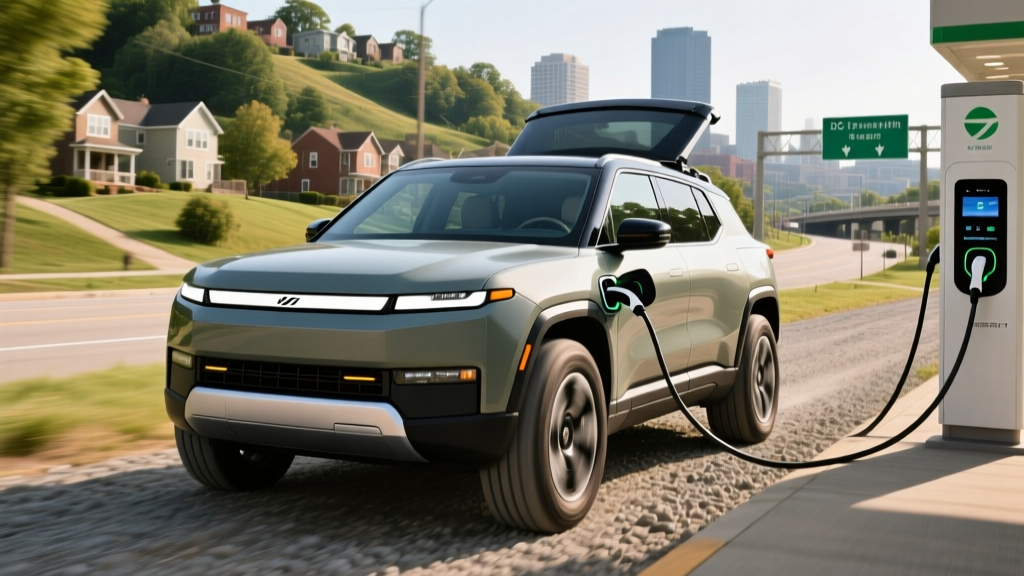
The R1S charges on the NACS (Tesla Supercharger) connector as of 2025, giving it access to the largest fast-charging network in North America. In the Pittsburgh area, Supercharger stations in Cranberry Township, Monroeville, and along the I-76 corridor provide reliable 150–250 kW charging.
For Electrify America and other CCS-based networks, Rivian provides a NACS-to-CCS adapter. Peak charging on a 220 kW-capable station takes the Large Battery from 10–80% in approximately 30 minutes. However, the charge curve tapers significantly above 80% — going from 80–100% can take an additional 20–25 minutes. For road trips, plan to charge to 80% and move on; it's far more time-efficient.
Pricing, Trims, and Federal Tax Credit Eligibility
The R1S positions itself as a premium electric SUV, and the pricing reflects that. Here's the current 2026 lineup:
| Configuration | Base MSRP | Destination | As-Tested Typical |
|---|---|---|---|
| AWD Standard Battery | $79,900 | $1,800 | $83,000–$86,000 |
| AWD Large Battery | $85,900 | $1,800 | $89,000–$95,000 |
| Tri-Motor Max Battery | $99,900 | $1,800 | $104,000–$112,000 |
Does the R1S Qualify for the §30D Federal Tax Credit?
- MSRP Cap for SUVs: $80,000 — the Standard Battery AWD at $79,900 qualifies; Large Battery and Tri-Motor trims exceed the cap.
- Buyer Income Cap: AGI must not exceed $150,000 (single) / $300,000 (joint filing).
- Battery Sourcing: Critical minerals and battery components must meet escalating domestic-content thresholds per IRS guidelines. Rivian has been working to qualify, but sourcing compliance varies by build date.
- Point-of-Sale Transfer: If eligible, you can apply the credit as an immediate price reduction at delivery rather than waiting for tax filing.
Practically speaking, only the Standard Battery AWD trim falls under the $80,000 SUV MSRP cap. If you want the 352-mile Large Battery (the sweet spot for Pittsburgh winters), you'll pay full price unless state-level incentives apply. Pennsylvania currently does not offer a state EV purchase rebate, though some utilities (Duquesne Light, for instance) offer modest rebates for home charger installation.
Cargo, Passenger Space, and Daily Practicality
The R1S is a genuine three-row SUV, though the third row is best suited for children or short-trip adults. Key dimensions:
- Cargo (behind 3rd row): ~20 cu ft
- Cargo (3rd row folded): ~58 cu ft
- Cargo (all rear rows folded): ~104 cu ft
- Front legroom: 41.3 inches
- Second-row legroom: 38.5 inches
- Third-row legroom: 32.1 inches
- Front trunk (frunk): ~11 cu ft — large enough for charging cables, a soft cooler, or groceries
For Pittsburgh families, the R1S handles two car seats in the second row comfortably, with usable third-row space for older kids on school carpools. The frunk is a daily win — wet gear, muddy boots from Frick Park, or charging equipment all stay separated from the cabin.
Technology, Driver Assists, and the Rivian OS
Rivian's in-house software stack runs on a 15.6-inch center touchscreen with a clean, responsive interface. Key tech highlights:
- Rivian Driver+ (Level 2 ADAS): Combines adaptive cruise control with lane-centering on highways. Competent on the Parkway and I-79, but requires hands-on-wheel supervision at all times — this is not self-driving.
- Highway Assist: Hands-on lane centering with automatic lane changes when confirmed by the driver.
- Over-the-air updates: Rivian regularly pushes feature improvements, including efficiency optimizations and UI refinements.
- Vehicle-to-Load (V2L): The R1S can power external devices (camping gear, power tools, even a sump pump during outages) through its built-in outlets.
- Adventure Network: Rivian's own charging network is expanding along popular outdoor corridors, though Pittsburgh-area coverage relies primarily on Superchargers and Electrify America.
Rivian Driver+ and Highway Assist are SAE Level 2 driver-assistance systems. The driver must remain fully attentive, keep hands on the steering wheel, and be prepared to take over at any moment. These systems do not make the R1S autonomous.
Pros, Cons, and How It Compares
- Class-leading off-road capability (air suspension, quad-motor torque vectoring available)
- 352-mile EPA range (Large Battery) is outstanding for a three-row SUV
- NACS connector = full Supercharger network access
- Excellent build quality and distinctive design
- Frunk + V2L capability add real utility
- 7,700-lb towing covers most boat and camper trailers
- MSRP exceeds §30D tax credit cap on most trims
- Third row is tight for adults on longer drives
- Cold-weather range loss is significant (~25–30%)
- Insurance premiums run 15–25% higher than comparable ICE SUVs
- Service center network still growing (Pittsburgh owners may travel to Columbus or Philadelphia for major warranty work)
- Efficiency (~73 MPGe) trails lighter, more aerodynamic EVs
R1S vs. Key Competitors for Pittsburgh Buyers
- vs. Tesla Model X: The Model X offers slightly more range and faster Supercharging, plus a Pittsburgh-area service center. But the R1S is more rugged, has a frunk, and offers a more conventional SUV interior layout. Model X starts around $79,990 but has its own tax-credit limitations.
- vs. Kia EV9: The EV9 is significantly cheaper (starting ~$54,900) and qualifies for the tax credit on certain trims. It sacrifices off-road capability, towing capacity, and ~60 miles of range compared to the Large Battery R1S.
- vs. Jeep Grand Cherokee 4xe (PHEV): For buyers not ready to go fully electric, the 4xe offers 25 miles of electric-only range with a gas backup. Lower upfront cost, but far higher fuel and maintenance costs long-term.
Who Should Buy the Rivian R1S in Pittsburgh?
- Choose the R1S if: You need three rows, tow occasionally, want serious off-road capability for Laurel Highlands weekends, have home Level 2 charging, and your budget accommodates an $85,000+ SUV.
- Look elsewhere if: You primarily commute solo (a smaller EV like the Hyundai Ioniq 5 or Tesla Model Y is far more efficient), you need the federal tax credit to make the math work, or you lack reliable home charging access.
The R1S makes the most sense for Pittsburgh households that use all three rows regularly, take weekend trips to Ohiopyle or Seven Springs, and can charge at home. If your daily drive is a 12-mile round trip from Point Breeze to Downtown and back, you're paying a premium for capability you rarely use — and a smaller EV will cost thousands less per year in electricity alone.
Frequently Asked Questions
What is the real-world range of the Rivian R1S in Pittsburgh winters?
Expect 230–260 miles from the Large Battery model in January/February conditions (20°F, hilly terrain, cabin heating). The heat pump helps, but physics is physics — cold batteries and dense air reduce efficiency by roughly 25–30%. Preconditioning while plugged in recovers some of that loss.
How fast does the R1S charge at home and on the road?
On a home Level 2 charger (11.5 kW), you'll add about 28 miles per hour — a 10-hour overnight session restores ~280 miles. On DC fast chargers, the Large Battery peaks at ~220 kW, reaching 10–80% in roughly 30 minutes. Charging slows dramatically above 80%, so plan road-trip stops to 80% for the best time efficiency.
Does the Rivian R1S qualify for the $7,500 federal tax credit?
Only the Standard Battery AWD trim (MSRP $79,900) falls under the §30D SUV price cap of $80,000. Even then, eligibility depends on your AGI (must be under $150K single / $300K joint), battery sourcing compliance, and current-year IRS rules. The more popular Large Battery and Tri-Motor trims exceed the MSRP cap and do not qualify. Consult a tax professional before relying on the credit.
Is the R1S worth it vs. the Tesla Model X?
It depends on priorities. The R1S offers superior off-road capability, a frunk, V2L, and a more traditional SUV layout. The Model X has a slight range advantage, faster Supercharging, and an established Pittsburgh-area service presence. If you value adventure capability and build distinctiveness, the R1S wins. If you prioritize charging speed and service convenience, the Model X is the safer bet.
Where can I get a Rivian serviced in Pittsburgh?
As of 2026, Rivian operates service centers in major metro areas, but Pittsburgh does not yet have a dedicated Rivian service facility. Mobile service handles many software and minor hardware issues at your home. For major warranty work, the nearest full service centers are typically in Columbus, OH, or the Philadelphia area — roughly 5–6 hours of driving. Rivian may cover a loaner or tow in some cases, but this is a real ownership consideration.
How much does it cost to charge an R1S vs. gas in Pennsylvania?
At Pennsylvania's average residential electricity rate (~$0.17/kWh), fully charging the 128 kWh Large Battery costs roughly $21.76 for ~352 miles — about $0.06 per mile. A comparable gas SUV getting 20 MPG at $3.50/gallon costs $0.175 per mile. Over 15,000 miles annually, that's roughly $2,625 in electricity vs. $7,500 in gas — a savings of nearly $4,900 per year before maintenance differences.