The 2026 Rivian R1S is the three-row electric SUV that tries to do everything: school runs, 5,000-pound towing, off-road trails, and 400-mile road trips — all while wrapping its occupants in what might be the most thoughtfully designed cabin in the EV space. If you've been searching for a deep dive on the Rivian R1S interior alongside the hard numbers on range, charging, and pricing, this review covers the full ownership picture.
Rivian updated the R1S substantially for the 2025 model year with its second-generation platform, and the 2026 carryover retains those upgrades: a new electrical architecture, faster charging, tri-motor and dual-motor powertrains, and a reworked interior with higher-quality materials and improved infotainment. Let's get into the specs, the real-world caveats, and whether this $80K+ SUV earns its price tag.
Rivian R1S Quick Specs at a Glance
| Spec | Dual-Motor (Standard Pack) | Tri-Motor (Max Pack) |
|---|---|---|
| EPA Range | ~270 mi | ~410 mi |
| Battery Capacity (usable) | ~95 kWh (LFP) | ~149 kWh (NMC) |
| Horsepower | 533 hp | 850 hp |
| 0–60 mph | ~4.5 sec | ~2.9 sec |
| Drivetrain | AWD (dual-motor) | AWD (tri-motor) |
| Max DC Fast Charge | ~200 kW | ~220 kW |
| 10–80% DC Charge Time | ~28 min | ~42 min |
| Level 2 Home Charging | 11.5 kW (~25 mi/hr) | 11.5 kW (~25 mi/hr) |
| MPGe (combined, est.) | ~73 MPGe | ~70 MPGe |
| Towing Capacity | 7,700 lb | 7,700 lb |
| Base MSRP | ~$79,900 | ~$99,900 |
Source: Rivian R1S official specs and EPA fueleconomy.gov. Tri-Motor Max Pack figures based on largest available battery configuration. Verify exact specs at point of order as Rivian adjusts configurations.
Range, Efficiency, and the Real-World Reality Check
Dual-Motor Standard: EPA ~270 mi → expect ~220–240 mi at sustained highway speeds (70–80 mph), and ~190–210 mi in sub-freezing winter conditions.
Tri-Motor Max Pack: EPA ~410 mi → expect ~340–360 mi highway, ~280–310 mi in cold weather with cabin heating demands.
The R1S is a large, heavy vehicle — over 6,900 lbs in Max Pack trim — and that mass shows up in efficiency. The Dual-Motor Standard Pack achieves roughly 73 MPGe combined (about 46 kWh/100 mi), while the Max Pack drops slightly to around 70 MPGe (48 kWh/100 mi) due to the heavier battery. For context, the Hyundai Ioniq 5 achieves 114 MPGe, but it's a 4,300-lb crossover, not a three-row SUV.
Cold weather hits the R1S harder than smaller EVs because there's simply more cabin volume to heat. Rivian includes a heat pump on 2025+ models, which mitigates some loss, but you should still budget 25–30% range reduction in sustained sub-30°F driving. On the plus side, the Max Pack's 410-mile EPA rating gives you enough buffer that even a 30% winter cut still leaves ~280 usable miles — enough for most single-day road trips without charging.
Charging Speed: DC Fast, Level 2, and the NACS Advantage
| Charging Level | Power / Rate | Miles Added per Hour |
|---|---|---|
| Level 1 (120V household) | ~1.4 kW | ~3 mi/hr |
| Level 2 (240V home, 48A) | 11.5 kW | ~25 mi/hr |
| DC Fast Charge (peak) | 200–220 kW | ~140 mi in 20 min |
The 2026 R1S comes equipped with the NACS (Tesla-style) charge port natively, meaning full access to the Tesla Supercharger network — now the largest and most reliable DC fast-charging network in the U.S. — without an adapter. This is a significant practical advantage over CCS-port vehicles that still rely on Electrify America or EVgo for comparable coverage.
On DC fast charging, the Standard Pack peaks around 200 kW and the Max Pack around 220 kW. However, as with all EVs, that peak rate is not sustained across the entire session. The charge curve tapers meaningfully above 60% state of charge (SoC), and substantially above 80%. A 10–80% session on the Max Pack takes roughly 42 minutes at a V3 or V4 Supercharger (250–350 kW capable), because the vehicle's peak acceptance rate is the limiting factor, not the charger.
Preconditioning matters. The R1S will precondition its battery when you navigate to a charger via the built-in navigation. This warms the pack to optimal temperature and can shave 5–10 minutes off your charging session in cold weather. Always navigate to your charging stop rather than just pulling up — the difference is measurable.
For home Level 2 charging, the onboard 11.5 kW charger replenishes the Standard Pack from empty in roughly 8–9 hours and the Max Pack in about 13–14 hours. Most owners will plug in nightly and wake up with a full battery. A 48-amp Level 2 home charger (hardwired, on a 60-amp circuit) is the recommended setup; expect $500–$1,500 for equipment plus $800–$2,500 for electrician installation depending on your panel capacity and run length.
The Rivian R1S Interior: Three Rows, Real Materials, Smart Design
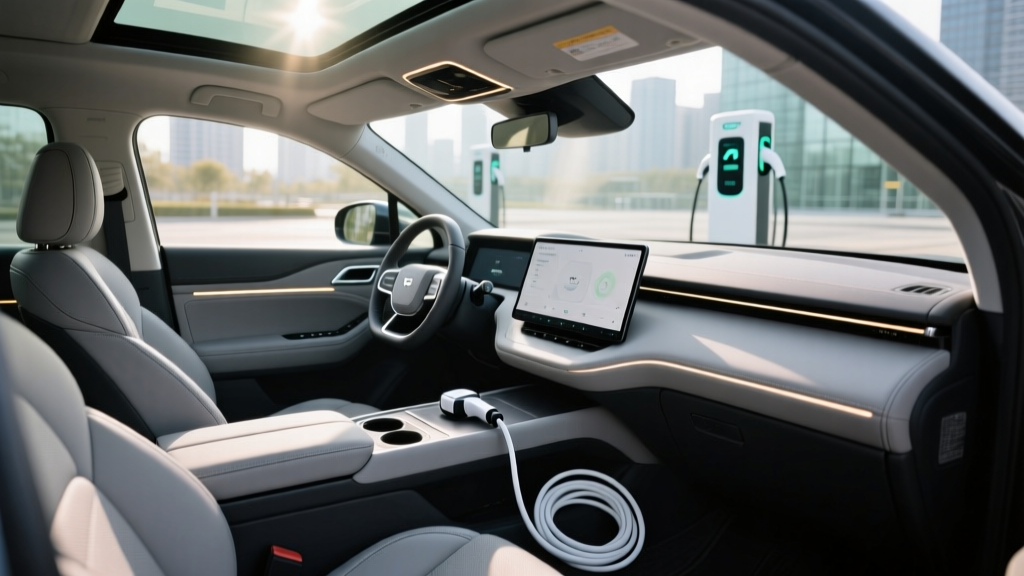
This is where the R1S separates itself from the Tesla Model X and most other electric SUVs. The cabin is genuinely premium — not in a "slap leather on the dash" way, but through thoughtful material choices and packaging.
Materials and build quality: The R1S uses vegan leatherette as standard, with an available upgrade to perforated Nappa-like synthetic with contrast stitching. Real wood accents (open-pore walnut or ash) appear on the dash and door panels, and the overall fit-and-finish on 2025+ models has improved noticeably over early-build 2022 examples. Panel gaps are tight, and the soft-touch surfaces extend to the lower doors and center console — areas where competitors like the Model X still use hard plastics.
Seating and passenger space:
- First row: 41.4 inches of legroom, heated and ventilated seats standard, 12-way power adjustment with memory.
- Second row: 38.2 inches of legroom, available captain's chairs or a three-across bench, heated seats standard, USB-C ports and dedicated climate vents.
- Third row: 30.4 inches of legroom — suitable for children or adults on short trips. This is comparable to the Kia EV9's third row (32.0 in) but tighter than a Toyota Grand Highlander Hybrid's (33.5 in).
Cargo volume:
- Behind third row: ~11.5 cu ft (enough for a few grocery bags or two carry-ons)
- Behind second row (third row folded): ~46.7 cu ft
- Behind first row (all rear rows folded): ~83.5 cu ft
- Front trunk (frunk): ~11.0 cu ft — a genuine differentiator; the frunk fits a large duffel or a week's worth of charging cables and gear.
Infotainment and tech: The R1S runs Rivian's in-house software on a 15.6-inch center touchscreen and a 12.3-inch digital instrument cluster. The UI is clean and responsive, with wireless Apple CarPlay and Android Auto, native navigation with integrated trip planning and charger routing, and over-the-air updates that have added meaningful features post-purchase (including improved route planning and camp mode enhancements). A 6.8-inch rear touchscreen controls second-row climate and media.
Notable interior drawbacks: There's no traditional glovebox (replaced by a center-console bin), which frustrates some owners. The panoramic glass roof lacks a physical shade — Rivian uses an electrochromic dimming panel, which reduces but doesn't fully eliminate solar heat gain in summer. And the third row, while usable, is best reserved for kids; adults will find it cramped on trips over an hour.
Performance and Drivetrain: Dual-Motor vs. Tri-Motor
The Dual-Motor R1S produces 533 hp and 610 lb-ft of torque via one motor per axle (AWD). The 0–60 mph sprint takes approximately 4.5 seconds — quick for a 6,700-lb SUV and more than adequate for merging, passing, and daily driving.
The Tri-Motor variant adds a second rear motor, pushing output to 850 hp and 900+ lb-ft. The 0–60 time drops to roughly 2.9 seconds, which is genuinely absurd for a vehicle that can carry seven people and tow 7,700 pounds. This is supercar acceleration in a family haulter, and while it's a fun party trick, the real benefit is the effortless highway passing power and the confidence of massive torque reserves when towing uphill.
Rivian's air suspension is standard across all trims, offering adjustable ride height with up to 14.9 inches of ground clearance in Off-Road mode. The system also enables a "kneel" function that lowers the rear for easier cargo loading and third-row access. Ride quality is firm but controlled — this is not a floaty luxury cruiser; it drives more like a sport-tuned SUV. Body roll is well-managed for the vehicle's height and weight.
Pricing, Trims, and Federal Tax Credit Eligibility
| Trim / Config | Base MSRP | As-Tested (typical) | §30D Federal Credit |
|---|---|---|---|
| Dual-Motor Standard Pack | ~$79,900 | $84,000–$88,000 | Up to $7,500 (if eligible) |
| Dual-Motor Large Pack | ~$84,900 | $89,000–$94,000 | Up to $7,500 (if eligible) |
| Tri-Motor Max Pack | ~$99,900 | $105,000–$112,000 | Up to $7,500 (if eligible) |
Federal tax credit (§30D) critical rules for 2026:
- MSRP cap: SUVs must have a base MSRP ≤ $80,000. The Dual-Motor Standard Pack qualifies; the Large Pack and Tri-Motor Max Pack exceed this cap and are not eligible for the federal credit.
- Buyer income cap: Modified adjusted gross income must not exceed $300,000 (joint), $225,000 (head of household), or $150,000 (single).
- Battery sourcing: The vehicle must meet critical-mineral and battery-component sourcing requirements that tighten annually. Rivian has worked to qualify its U.S.-built battery packs, but eligibility can change — always verify on the IRS clean vehicle credit page before purchasing.
- Point-of-sale transfer: As of 2024, buyers can transfer the credit to the dealer at purchase, reducing the upfront price by up to $7,500 instead of waiting for a tax refund.
In practice, this means only the base Dual-Motor Standard Pack R1S is likely eligible for the full $7,500 credit, bringing its effective starting price to roughly $72,400 for qualified buyers. Higher trims are ineligible due to the MSRP cap. Consult a tax professional for your specific situation.
Warranty and Long-Term Ownership
Rivian covers the R1S with the following warranty structure:
- Battery & drivetrain: 8 years / 120,000 miles (whichever comes first), with a capacity retention threshold of 70% — if the battery degrades below 70% of original capacity within the warranty period, Rivian will repair or replace it.
- Bumper-to-bumper: 5 years / 60,000 miles
- Roadside assistance: 5 years / 60,000 miles
The 70% degradation threshold is industry-standard, matching Tesla, Hyundai, and Ford. Real-world data on Rivian's second-gen batteries is still limited (the platform launched for 2025), but the LFP chemistry in the Standard Pack is known for excellent cycle life and lower degradation rates compared to NMC, albeit at the cost of lower energy density. The NMC Max Pack offers more range but may degrade slightly faster over 10+ years — though still well within the warranty buffer for most owners.
Driver Assistance and Safety
Rivian's Driver+ system is an SAE Level 2 driver-assistance feature. It combines adaptive cruise control and lane-centering for hands-on-wheel highway driving. The driver must remain fully attentive and engaged at all times. This is not autonomous driving (Level 4+). Rivian has not announced a hands-free highway system comparable to GM Super Cruise or Ford BlueCruise as of early 2026.
The R1S comes standard with a comprehensive ADAS suite: automatic emergency braking, blind-spot monitoring, rear cross-traffic alert, lane-keeping assist, and a 360-degree camera system. NHTSA has not yet published a full crash-test rating for the second-gen R1S as of this writing; the first-gen R1S earned a 5-star overall NHTSA rating. Check NHTSA.gov and IIHS.org for updates.
Who the Rivian R1S Is For (and Who Should Look Elsewhere)
- You need a genuine three-row electric SUV with usable cargo space and 7,700-lb towing.
- You want NACS-native access to the Supercharger network without adapters.
- You value interior material quality and design over minimalism-for-its-own-sake.
- You take road trips and need 300+ real-world miles of range (Max Pack).
- You want off-road capability (air suspension, 14.9 in clearance, tank turns on tri-motor).
- You're budget-conscious — the R1S starts near $80K and most trims exceed $90K.
- You need the absolute lowest cost-per-mile; the R1S's efficiency (46–48 kWh/100 mi) means higher electricity costs than a lighter EV.
- Third-row adult comfort is a priority — consider the Kia EV9 or a PHEV like the Grand Highlander Hybrid.
- You want hands-free highway driving (GM Super Cruise or Ford BlueCruise are further ahead here).
Key Competitors Compared
| Attribute | Rivian R1S (Tri-Motor Max) | Tesla Model X (Plaid) | Kia EV9 (GT-Line AWD) |
|---|---|---|---|
| EPA Range | ~410 mi | ~326 mi | ~270 mi |
| 0–60 mph | ~2.9 sec | ~2.5 sec | ~5.0 sec |
| Third-Row Legroom | 30.4 in | 37.1 in | 32.0 in |
| Towing | 7,700 lb | 5,000 lb | 5,000 lb |
| Base MSRP | ~$99,900 | ~$94,990 | ~$63,900 |
| Charge Port | NACS (native) | NACS (native) | CCS (NACS adapter avail.) |
| §30D Credit Eligible | No (MSRP cap) | No (MSRP cap) | Yes (select trims) |
The R1S occupies a unique niche: it's the only electric SUV that combines serious off-road capability, 7,700-lb towing, 400+ mile range, and a premium interior. The Model X is faster and has a more spacious third row, but it can't match the R1S's range or towing. The EV9 is far more affordable and qualifies for the tax credit, but sacrifices range, performance, and towing capacity.
Frequently Asked Questions
What is the real-world range of the Rivian R1S?
The EPA rates the Max Pack at ~410 miles and the Standard Pack at ~270 miles. In real-world highway driving at 70–80 mph, expect roughly 340–360 miles (Max) and 220–240 miles (Standard). In cold weather below 30°F, subtract another 15–20% due to cabin heating and battery resistance.
How fast does the R1S charge at home and on the road?
On DC fast charging (Supercharger or equivalent), the R1S peaks at 200–220 kW and charges from 10–80% in roughly 28 minutes (Standard Pack) or 42 minutes (Max Pack). At home on a Level 2 charger (11.5 kW / 48A), you'll add about 25 miles of range per hour, or a full charge overnight for the Standard Pack and about 13 hours for the Max Pack.
Does the 2026 Rivian R1S qualify for the $7,500 federal tax credit?
Only the base Dual-Motor Standard Pack (MSRP ~$79,900) potentially qualifies, because the §30D credit caps eligible SUVs at $80,000 MSRP. The Large Pack and Tri-Motor Max Pack exceed this threshold. Additionally, buyer income must fall below IRS limits ($300K joint / $150K single), and battery-sourcing requirements must be met. Verify current eligibility on IRS.gov before ordering.
Is the Rivian R1S interior better than the Tesla Model X?
Most reviewers and owners consider the R1S interior more thoughtfully designed, with higher-quality materials (real wood, better soft-touch surfaces), more physical storage solutions, and a more intuitive layout. The Model X offers more third-row legroom and a larger panoramic windshield, but its interior materials and panel-gap consistency lag behind the R1S at similar price points.
Can the Rivian R1S tow a camper or boat?
Yes. The R1S is rated to tow 7,700 pounds across all configurations, which covers most mid-size travel trailers, boat trailers, and utility trailers. Note that towing at or near max capacity will reduce range by approximately 40–50%, so plan charging stops accordingly on long hauls.
What's the biggest complaint about the R1S interior?
The most common criticisms are the lack of a traditional glovebox, the electrochromic glass roof that doesn't fully block summer heat, and the third row being tight for adults on longer trips. Some owners also note that the center console storage, while large, lacks organizational dividers found in competitors.