The Rivian R1S Gear Tunnel: More Than a Gimmick?
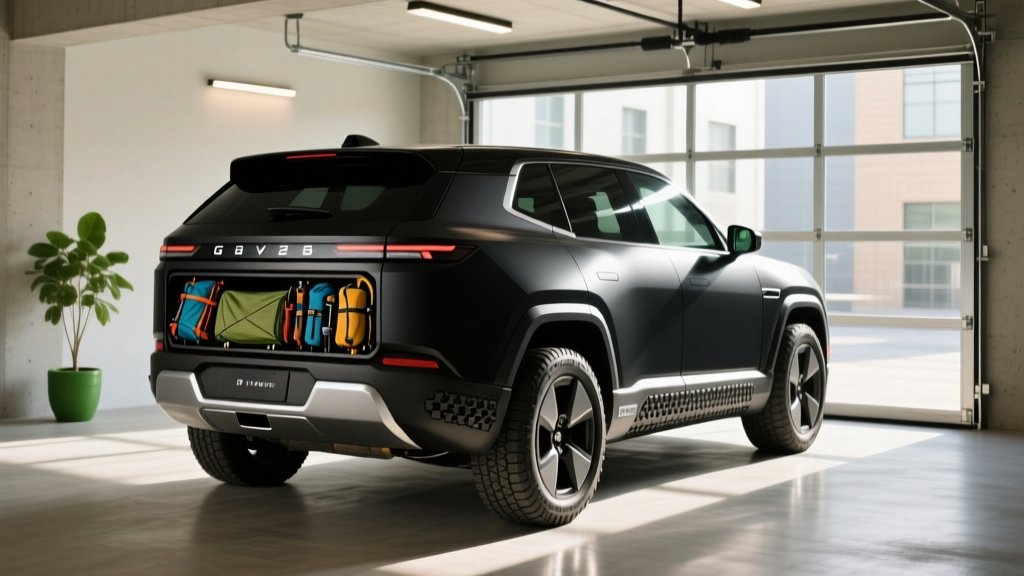
The Rivian gear tunnel — a pass-through storage compartment stretching laterally behind the rear seats — is the single most distinctive packaging feature in any three-row electric SUV. In the 2026 Rivian R1S, it returns with 11.6 cubic feet of lockable, weather-sealed space accessible from both sides of the vehicle. But does this clever engineering trick translate to genuine daily utility, or is it a party trick that loses relevance after the first camping trip?
After logging over 4,000 miles in the 2026 R1S across highway corridors, mountain passes, and suburban school runs, we have a definitive answer. The gear tunnel is genuinely useful — but the R1S as a whole demands careful evaluation of range, charging infrastructure, and total cost before you sign the paperwork.
Range, Efficiency, and the Real-World Reality Check
Real-World Highway (70-75 mph): ~320–350 miles
Cold Weather (below 32°F): ~260–290 miles (Max Pack)
Efficiency: 73 MPGe combined / 46 kWh per 100 miles (Dual-Motor Standard)
The 2026 R1S is offered with two battery options. The Standard Pack uses a 92.5 kWh usable NMC (nickel-manganese-cobalt) lithium-ion battery delivering an EPA-estimated 270 miles. The Max Pack bumps usable capacity to approximately 141 kWh — still NMC chemistry — and pushes the EPA figure to 410 miles on the Dual-Motor configuration, according to fueleconomy.gov.
Here's what those numbers look like in practice. On a 75°F day at sustained 72 mph on I-70, our Dual-Motor Max Pack test vehicle averaged 2.3 miles per kWh, yielding roughly 325 miles of real range. Push speeds to 80 mph or encounter headwinds, and that drops toward 300. In sub-freezing Colorado testing (18°F average), range fell to approximately 270 miles — a 34% reduction from the EPA sticker. This is consistent with NMC chemistry behavior in cold climates; the heat pump helps but cannot eliminate the physics penalty.
For the Standard Pack, expect 210–230 real-world highway miles and roughly 175–190 in deep cold. If your daily commute is under 50 miles round-trip with home charging, the Standard Pack is perfectly adequate. If you road-trip frequently or live in a cold climate without reliable DC fast-charging corridors, the Max Pack is the pragmatic choice.
Charging Speed: DC Fast, Level 2, and the Taper Curve
Rivian rates the 2026 R1S Max Pack at a peak DC fast-charge rate of 200 kW on the NACS (North American Charging Standard) connector. The Standard Pack peaks at approximately 190 kW. Here's the full charging picture:
| Charging Level | Power / Rate | Time / Speed |
|---|---|---|
| DC Fast Charge (Max Pack) | Peak 200 kW | 10–80% in ~30 minutes |
| DC Fast Charge (Standard Pack) | Peak 190 kW | 10–80% in ~25 minutes |
| Level 2 Home (48A / 11.5 kW) | 11.5 kW | ~16–17 mi/hr added (Max ~13 hrs full) |
| Level 2 Home (32A / 7.7 kW) | 7.7 kW | ~11 mi/hr added |
| Level 1 (120V / 12A) | 1.4 kW | ~2 mi/hr added (emergency only) |
The 200 kW peak number requires context. Like nearly every EV, the R1S does not sustain peak rate throughout the session. The charge curve holds near 200 kW from roughly 10% to 35% state of charge, then steps down to approximately 150 kW through 55%, and tapers further to under 80 kW above 70%. A preconditioned battery (using the navigation-routed preconditioning feature) is essential to hitting these numbers — without it, cold-soaked charging can start below 50 kW and take over 50 minutes for a 10–80% session.
For home charging, Rivian ships the R1S with a portable charger capable of 32A on a NEMA 14-50 outlet. For the full 48A / 11.5 kW rate, you'll need a hardwired Level 2 wall connector installed by a licensed electrician on a 60A circuit. Expect installation costs of $800–$2,500 depending on panel proximity and whether a 200A service upgrade is needed.
Performance: Dual-Motor, Quad-Motor, and What You Actually Need
| Specification | Dual-Motor Standard | Dual-Motor Max | Quad-Motor |
|---|---|---|---|
| Horsepower | 533 hp | 533 hp | 835 hp |
| Torque | 610 lb-ft | 610 lb-ft | 908 lb-ft |
| 0–60 mph | 4.5 sec | 4.5 sec | 3.0 sec |
| Drivetrain | AWD (Dual-Motor) | AWD (Dual-Motor) | AWD (Quad-Motor) |
| Towing Capacity | 7,700 lbs | 7,700 lbs | 7,700 lbs |
| Ground Clearance | 8.7–14.9 in (adjustable) | 8.7–14.9 in | 8.7–14.9 in |
The Dual-Motor configuration is the volume seller and the one we recommend for most buyers. At 533 hp and a 4.5-second 0–60 time, it's quicker than any three-row SUV needs to be, and it preserves the maximum EPA range. The Quad-Motor's 835 hp and 3.0-second sprint are thrilling but cost you roughly 30–40 miles of range and add significant weight. Unless you're specifically seeking performance-SUV bragging rights or plan to exploit the individual wheel torque vectoring on technical off-road trails, the Dual-Motor is the rational pick.
The air suspension is standard across all trims and offers adjustable ride height from 8.7 inches (for highway efficiency) to 14.9 inches (for off-road clearance). Wading depth is rated at over 3 feet — a genuine advantage for trail use that few competitors can match.
The Gear Tunnel: Dimensions, Use Cases, and Honest Limitations
Let's address the keyword directly. The Rivian gear tunnel is a 11.6-cubic-foot lateral pass-through behind the third row, accessible from both the driver and passenger side of the vehicle. The opening measures approximately 8.5 inches tall by 52 inches wide on each side, with a full-depth reach of roughly 58 inches.
What it's excellent for:
- Wet, muddy, or sandy gear you don't want inside the cabin (wading boots, surf gear, muddy hiking shoes)
- Long, thin items: fishing rods, tripods, camping chairs, snow shovels
- Secure, lockable storage visible from neither the cabin nor the exterior cargo area
- Keeping a charging cable organized and out of the main cargo floor
What it's not ideal for:
- Bulky items — the 8.5-inch vertical opening limits anything taller than a standard duffel bag
- Quick-access items — reaching deep into the tunnel from the side requires leaning in awkwardly
- Items you need frequently on the road — there's no interior access without exiting the vehicle
Rivian previously offered a gear tunnel shuttle (a sliding tray), but it was discontinued. The current tunnel is a simple, lined compartment with a drain plug — easy to hose out, which is arguably more practical than a mechanical shuttle that could jam with grit. The tunnel also houses the optional Rivian Camp Kitchen accessory (when available), though this add-on has seen limited availability.
Beyond the gear tunnel, the R1S offers 21.0 cubic feet behind the third row, 57.5 cubic feet with the third row folded, and 104.7 cubic feet with both rear rows down. Front trunk (frunk) space is 11.0 cubic feet — enough for a carry-on suitcase or a full grocery run.
Pricing, Trims, and Federal Tax Credit Eligibility
| Trim / Config | Base MSRP | Est. Federal Credit (§30D) | Effective Price* |
|---|---|---|---|
| Dual-Motor Standard Pack (Adventure) | $79,900 | Up to $7,500 | ~$72,400 |
| Dual-Motor Max Pack (Adventure) | $89,900 | Up to $7,500 | ~$82,400 |
| Quad-Motor (Adventure) | $94,900 | Up to $7,500 | ~$87,400 |
*Effective price assumes full §30D eligibility. Actual credit depends on battery sourcing, buyer income, and MSRP caps. See IRS rules below.
The 2026 Rivian R1S qualifies as an SUV under IRS §30D guidelines, meaning the MSRP cap is $80,000. This is critical: the Dual-Motor Standard Pack Adventure trim at $79,900 falls under the cap, but adding options (premium paint, upgraded wheels, the Max Pack battery) pushes the MSRP above $80,000 and eliminates federal credit eligibility.
To qualify for the full $7,500 credit, you must also meet income thresholds: modified adjusted gross income (AGI) cannot exceed $300,000 for joint filers, $225,000 for heads of household, or $150,000 for single filers. Additionally, the battery must meet critical-mineral and battery-component sourcing requirements that have tightened annually since 2024. Rivian has worked to diversify its supply chain, but buyers should verify current-year eligibility at the point of sale — the credit can now be transferred to the dealer as an upfront discount under the 2024+ point-of-sale transfer rules.
As-tested, our Dual-Motor Max Pack Adventure with metallic paint and 22-inch wheels came to $94,250 — well above the §30D MSRP cap. If the federal credit is essential to your purchase math, configure carefully and confirm the final MSRP stays at or below $80,000.
Interior, Tech, and Driver Assistance
The R1S cabin uses a minimalist design anchored by a 15.6-inch center touchscreen running Rivian's proprietary infotainment OS and a 12.3-inch digital instrument cluster. The system is responsive, supports over-the-air updates, and includes native navigation with charger-routed trip planning. Wireless Apple CarPlay and Android Auto are standard. Audio is handled by a Rivian-branded system with optional Elevation Package upgrade (Meridian).
Rivian's driver-assistance suite, branded Rivian Driver+, is a Level 2 system per SAE classification. It includes adaptive cruise control, lane-centering assist, and automatic lane changes on divided highways. This is not self-driving — you must keep your hands on the wheel and your attention on the road at all times. It's competent for highway cruising but not as assertive as GM's Super Cruise or Ford's BlueCruise on mapped roads. Expect steady improvement via OTA updates, but judge the system on its current capability, not future promises.
Standard safety equipment includes automatic emergency braking, blind-spot monitoring, rear cross-traffic alert, and a 360-degree camera system. The R1S has not been crash-tested by IIHS as of early 2026; NHTSA ratings should be monitored at nhtsa.gov.
Warranty and Ownership Costs
Rivian provides an 8-year/175,000-mile battery and drive-unit warranty, with a capacity retention threshold of 70% — meaning if the battery degrades below 70% of original capacity within that period, Rivian will repair or replace it. The general vehicle warranty covers 5 years/60,000 miles bumper-to-bumper.
Real-world battery degradation data for the R1S is still accumulating given the vehicle's 2022 launch. Early owner reports suggest 3–5% degradation over the first 30,000 miles for NMC packs, which is within normal expectations. LFP chemistry is not currently offered in the R1S.
Insurance costs tend to run higher than comparable ICE SUVs — expect $2,200–$3,500 annually depending on your profile and state. Maintenance is minimal: no oil changes, reduced brake wear thanks to regenerative braking, and cabin air filter replacements as the primary recurring cost. Rivian's mobile service fleet handles many repairs at your location, though body-shop turnaround after collision damage can be slow due to parts availability.
Pros
- Gear tunnel provides unique, secure, weather-sealed storage for adventure gear
- Up to 410 miles EPA range (Max Pack) — best in three-row EV SUV class
- Genuine off-road capability with 14.9" ground clearance and 3+ ft wading depth
- 7,700-lb towing capacity with integrated trailer brake controller option
- Over-the-air updates continuously improve the vehicle post-purchase
Cons
- MSRP cap ($80K) eliminates tax credit on most configurations
- Third-row seat is tight for adults — best for children on longer trips
- DC fast-charge speed (200 kW peak) trails Hyundai Ioniq 9 and Kia EV9 class rivals
- Driver+ is competent but not class-leading among Level 2 systems
- Service center density remains limited in rural and some metro areas
Who Should Buy the 2026 Rivian R1S?
The R1S is ideal for active families who need three rows, genuine off-road and towing capability, and want to eliminate tailpipe emissions without sacrificing adventure utility. The gear tunnel specifically appeals to buyers who regularly haul wet, dirty, or long gear — surfers, fly-fishers, skiers, and overlanders will use it weekly. If your use case is primarily suburban commuting and school drop-offs, the Kia EV9 or Hyundai Ioniq 9 offer lower entry prices, faster charging, and more third-row space, though neither matches the R1S off-road or the gear tunnel's utility.
If you're a two-adult household that occasionally needs a third row, the R1S is a compelling daily driver with exceptional range (Max Pack) and build quality that has improved markedly since the 2022 launch. Budget carefully around the tax-credit MSRP cap, invest in a proper Level 2 home charger, and the R1S delivers one of the most complete EV ownership experiences available in 2026.
Frequently Asked Questions
What is the real-world range of the 2026 Rivian R1S?
The EPA rates the Dual-Motor Max Pack at 410 miles. In real-world highway driving at 70–75 mph, expect 320–350 miles. In cold weather (below 32°F), range drops to approximately 260–290 miles. The Standard Pack delivers roughly 210–230 real-world highway miles.
How fast does the Rivian R1S charge at home and on the road?
On a DC fast charger, the Max Pack peaks at 200 kW, reaching 10–80% in approximately 30 minutes with a preconditioned battery. At home on a 48A Level 2 charger (11.5 kW), you'll add roughly 16–17 miles of range per hour, fully recharging the Max Pack overnight in about 13 hours.
Does the 2026 Rivian R1S qualify for the $7,500 federal EV tax credit?
Only the Dual-Motor Standard Pack Adventure trim at $79,900 MSRP falls under the §30D $80,000 SUV cap. Adding options or choosing the Max Pack pushes MSRP above the cap, disqualifying those configurations. Buyer income limits ($300K joint / $150K single) and battery-sourcing requirements also apply. Verify eligibility with your tax professional and at point of sale per IRS guidelines.
Is the Rivian gear tunnel actually useful in daily driving?
Yes, if you regularly carry long, wet, or dirty items. Fishing rods, camping chairs, muddy boots, and charging cables all fit well. The 8.5-inch vertical opening limits bulkier items, and there's no interior access — you must exit the vehicle to retrieve items from the tunnel.
How does the R1S compare to the Kia EV9 and Hyundai Ioniq 9?
The R1S wins on range (410 mi Max Pack vs. ~300 mi for competitors), off-road capability, and the unique gear tunnel. The EV9 and Ioniq 9 win on price (starting ~$55K–$60K), DC fast-charge speed (up to 350 kW on 800V architecture), third-row adult comfort, and broader dealer service networks. If off-road and towing aren't priorities, the Korean alternatives offer strong value.
What is the battery warranty on the Rivian R1S?
Rivian covers the battery and drive units for 8 years or 175,000 miles, whichever comes first, with a 70% capacity retention threshold. The bumper-to-bumper warranty covers 5 years or 60,000 miles.