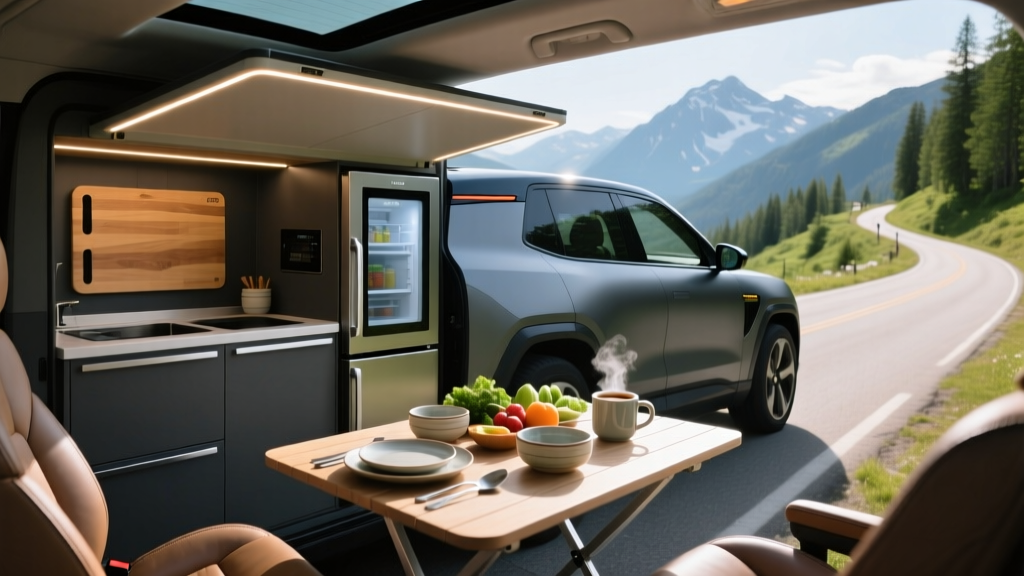
Rivian's Gear Tunnel has always been the R1S's secret weapon — a 10.8-cubic-foot pass-through compartment behind the third row that swallows duffel bags, camping gear, and groceries with ease. But the aftermarket and Rivian's own accessory ecosystem have transformed this space into something far more ambitious: a fully functional mobile kitchen. In this review, we evaluate the 2026 Rivian R1S with a Gear Tunnel Kitchen configuration — examining whether the SUV's core EV specs (range, charging, price) justify the adventure-vehicle build-out, and who should consider this setup over competing electric SUVs.
The Rivian R1S at a Glance: 2026 Specs
| Specification | 2026 Rivian R1S Dual-Motor AWD (Max Pack) |
|---|---|
| EPA Range | 352 miles |
| Battery Capacity | 149 kWh usable (NMC) |
| Drivetrain | Dual-Motor AWD |
| Horsepower | 533 hp |
| 0–60 mph | 5.0 seconds |
| Max DC Fast Charge | 200 kW (peak) |
| 10–80% DC Charge Time | ~38 minutes |
| Level 2 Home Charging | 11.5 kW (~25 mi/hr) |
| Efficiency | 73 MPGe combined / 46 kWh/100mi |
| Cargo (behind 3rd row) | 10.8 cu ft (plus Gear Tunnel) |
| Cargo (max, seats folded) | 104.7 cu ft |
| Towing Capacity | 7,700 lbs |
| Base MSRP (Dual-Motor Max) | $99,900 |
| Battery Warranty | 8 years / 175,000 miles |
| Vehicle Warranty | 5 years / 60,000 miles |
Rivian offers the R1S across several battery and motor configurations for 2026. The Standard Pack (106 kWh) delivers 270 miles EPA, the Large Pack (128 kWh) pushes 340 miles, and the Max Pack (149 kWh NMC) tops the lineup at 352 miles. The Gear Tunnel Kitchen build we're profiling here pairs best with the Max Pack, since loading the tunnel with kitchen gear, water tanks, and slide-out stoves adds 150–300 lbs that can shave range — making every extra mile of battery capacity worthwhile.
Real-World Range: What the EPA Number Doesn't Tell You
Real-World Highway (70 mph, 65°F): ~295–315 miles
Real-World Highway + Full Gear Tunnel Load: ~275–295 miles
Cold Weather (20°F, highway): ~230–260 miles
Note: Towing at max capacity drops range to roughly 160–190 miles.
The R1S's boxy aerodynamics (a drag coefficient around 0.30) and 6,000+ lb curb weight mean highway efficiency suffers compared to sleeker crossovers. On fueleconomy.gov, the R1S Max Pack posts 73 MPGe combined — respectable for its size, but you'll see closer to 2.1–2.3 kWh/mile at sustained 75 mph speeds.
For Gear Tunnel Kitchen builds specifically, expect a 5–8% range penalty when the tunnel is fully loaded with a kitchen slide-out, cast-iron cookware, water jugs, and provisions. Rivian's regenerative braking system (adjustable from mild to aggressive one-pedal mode) helps recoup energy on mountain descents — a scenario where the R1S genuinely shines on overlanding routes.
Charging Speed: Home Base and DC Fast Charging
| Charging Level | Power | Rate | Time / Notes |
|---|---|---|---|
| Level 1 (120V) | ~1.4 kW | ~3 mi/hr | Emergency/trickle only |
| Level 2 (240V, Rivian Wall Connector) | 11.5 kW | ~25 mi/hr | Full charge in ~13 hrs (Max Pack) |
| DC Fast Charge (CCS/NACS) | 200 kW peak | Varies by SoC | 10–80% in ~38 min |
| DC Fast Charge (sustained avg) | ~145 kW | — | Typical sustained rate 20–80% |
Rivian transitioned the R1S to the NACS (Tesla-style) charge port for 2025+, giving owners native access to the Tesla Supercharger network — now the most reliable DC fast-charging infrastructure in the U.S. The R1S peaks at 200 kW but, like most large-battery EVs, the charge curve tapers meaningfully above 60% state of charge. Expect the 10–80% session to average around 145 kW, which translates to roughly 38 minutes at a capable 250+ kW station.
For home charging, Rivian's Wall Connector at 11.5 kW adds about 25 miles of range per hour. A full Max Pack charge from 10% takes approximately 13 hours — plan overnight sessions accordingly. Most Gear Tunnel Kitchen owners we've spoken with charge nightly to 80% (a practice that preserves NMC battery health long-term) and top up to 100% only before long trips.
Installation note: A 60-amp circuit (48-amp continuous) is recommended for 11.5 kW Level 2 charging. Budget $800–$2,200 for professional installation depending on your electrical panel's proximity to the garage and whether a panel upgrade (to 200A service) is needed. Always get a quote from a licensed electrician.
Gear Tunnel Kitchen: Setup, Weight, and Practicality
The Gear Tunnel itself measures roughly 47 inches wide, 14 inches tall, and 20 inches deep — a pass-through space accessible from both sides of the vehicle via flip-up doors. Rivian sells the Gear Tunnel Shuttle ($750) as a slide-out cargo tray, which serves as the foundation for most kitchen builds.
Typical Gear Tunnel Kitchen configurations include:
- Slide-out stove platform: Single or dual-burner camp stove (e.g., Coleman or Jetboil) mounted to the shuttle
- Water system: 5–7 gallon freshwater jug with a 12V electric pump, routed through the tunnel
- Cooler integration: Dometic or Yeti fridge (12V compressor models draw ~45W, powered via the R1S's 12V cargo outlet or a portable power station)
- Cookware and utensil bins: Stackable totes secured with cargo nets or custom dividers
- Lighting: LED strip lights mounted inside the tunnel doors
The R1S's 12V outlet in the cargo area (rated at 15A/180W) can run a small compressor fridge but won't sustain high-draw appliances simultaneously. For more ambitious setups, owners pair a portable power station (EcoFlow Delta Pro or Bluetti AC200) stored in the tunnel. The R1S does not currently offer V2L (vehicle-to-load) AC power output from the traction battery — a notable omission versus the Hyundai Ioniq 5 or Ford F-150 Lightning, which can power appliances directly.
Weight impact: A full kitchen build adds 200–350 lbs. The R1S's 1,760-lb payload capacity absorbs this easily, but you'll notice a slight efficiency hit and marginally softer handling in corners. Air suspension self-levels automatically.
Pricing, Tax Credits, and Total Cost
| Trim / Configuration | 2026 MSRP | Federal §30D Credit | Effective Price |
|---|---|---|---|
| Dual-Motor Standard Pack | $79,900 | $0 (over MSRP cap) | $79,900 |
| Dual-Motor Large Pack | $89,900 | $0 (over MSRP cap) | $89,900 |
| Dual-Motor Max Pack | $99,900 | $0 (over MSRP cap) | $99,900 |
| Quad-Motor Max Pack | $109,900 | $0 (over MSRP cap) | $109,900 |
Here's the hard truth for R1S buyers: no current R1S configuration qualifies for the federal §30D new EV tax credit. The IRS §30D rules cap the credit at vehicles with an MSRP of $80,000 or less for SUVs/pickups. Even the base Dual-Motor Standard Pack R1S at $79,900 technically sits right at the threshold, but once any destination fee or mandatory option pushes the transaction above $80,000, eligibility is lost.
Additionally, §30D imposes buyer income caps ($300,000 joint / $150,000 single modified AGI) and battery critical-mineral sourcing requirements that shift annually. The R1S's battery cells (sourced from Samsung SDI) have faced sourcing-compliance challenges under the evolving rules.
Cost-saving alternatives: Some buyers opt for the Rivian R1T (truck) platform, where certain configurations may approach credit eligibility, or explore the used EV credit (§25E) — up to $4,000 on qualifying pre-owned R1S models priced under $25,000 (rare in the current market). State-level incentives (California's CVRP, Colorado's $5,000 credit, etc.) may partially offset the cost — check your state's energy office for current programs.
How It Compares: R1S vs. Key Competitors
If the Gear Tunnel Kitchen concept is central to your purchase, here's how the R1S stacks up against the three closest electric SUV alternatives:
- Kia EV9 (3-row, 304 mi EPA, ~$54,900–$73,900): More affordable, qualifies for §30D on select trims, but has no Gear Tunnel equivalent. Cargo space is conventional. Better for families who don't need the adventure build-out.
- Tesla Model X (335 mi EPA, ~$79,990–$94,990): Supercharger-native, Falcon Wing doors, but no dedicated pass-through storage. Superiorefficiency (102 MPGe) and faster charging (250 kW peak). The FSD (Supervised) system is SAE Level 2 — not autonomous. Less rugged for overlanding.
- BMW iX xDrive50 (324 mi EPA, ~$87,250): Premium interior, 150 kW DC charging, but cargo space is limited and no adventure-oriented storage solutions exist. Better for luxury commuters than campers.
The R1S's Gear Tunnel is genuinely unique in the market. No competitor offers a dedicated, weather-sealed pass-through compartment integrated into the vehicle's structure. If mobile kitchen capability and overlanding storage are non-negotiable, the R1S has no direct rival.
✓ Pros
- Gear Tunnel is a one-of-a-kind adventure storage solution
- 352-mile Max Pack range handles long overlanding routes
- NACS port = full Supercharger network access
- Air suspension self-levels with heavy tunnel loads
- 7,700-lb towing capacity for trailers and boats
- Over-the-air updates continuously add features
- Strong off-road capability (8.9" ground clearance, tank turns on Quad-Motor)
✗ Cons
- No federal tax credit — all trims exceed §30D MSRP cap
- No V2L (vehicle-to-load) AC power from traction battery
- 200 kW peak DC charging is slower than rivals (Hyundai at 350 kW)
- High base price — $79,900+ before any kitchen accessories
- Real-world highway range drops ~15% below EPA
- Gear Tunnel kitchen accessories add $1,500–$4,000+
- Third-row seat is tight for adults on long trips
Who Should Buy the R1S with a Gear Tunnel Kitchen?
- Regularly car-camp, overland, or tailgate and need integrated kitchen/storage
- Want 350+ miles of range without towing
- Need 3 rows of seating plus dedicated gear storage
- Value Supercharger network access for road-trip charging reliability
- Can absorb a $85,000–$110,000 purchase without relying on federal credits
- Prioritize the $7,500 federal tax credit (consider Kia EV9 or base Ford Mustang Mach-E)
- Need V2L to power kitchen appliances directly from the vehicle battery
- Mostly commute and rarely adventure — the Gear Tunnel adds cost you won't use
- Want the fastest possible DC charging (Hyundai Ioniq 5 or Kia EV6 at 350 kW)
Frequently Asked Questions
What is the real-world range of the Rivian R1S with a loaded Gear Tunnel?
With a full kitchen setup (250–350 lbs in the tunnel), expect approximately 275–295 miles of real-world highway range from the Max Pack's 352-mile EPA rating. City driving with regenerative braking recovers more energy, pushing real-world city range closer to 310–325 miles.
How fast does the R1S charge at home and on the road?
At home on a Level 2 Rivian Wall Connector (11.5 kW), you gain roughly 25 miles of range per hour — a full overnight session replenishes the Max Pack. On DC fast chargers, the R1S peaks at 200 kW and charges from 10–80% in approximately 38 minutes, with sustained rates averaging around 145 kW.
Does the 2026 Rivian R1S qualify for the federal EV tax credit?
No. All current R1S configurations exceed the IRS §30D MSRP cap of $80,000 for SUVs. The base Dual-Motor Standard Pack starts at $79,900, but destination fees and mandatory options push it over the threshold. Buyer income limits and battery-sourcing rules add further restrictions. Consult a tax professional and check IRS.gov for the latest eligibility details.
Can I power kitchen appliances directly from the R1S battery?
Not currently. The R1S lacks V2L (vehicle-to-load) capability — unlike the Ford F-150 Lightning or Hyundai Ioniq 5, you cannot plug AC appliances directly into the vehicle. The 12V cargo outlet (180W max) can run a small compressor fridge, but larger appliances require a separate portable power station.
Is the R1S Gear Tunnel Kitchen worth it versus a roof-top tent or trailer setup?
The Gear Tunnel Kitchen excels for travelers who want quick-deploy cooking without towing a trailer or climbing onto a roof. It keeps gear secure, weather-protected, and at waist height. However, if you need full stand-up kitchen space or plan extended off-grid stays, a small teardrop trailer (the R1S tows 7,700 lbs) paired with a simpler tunnel storage setup may offer more versatility.
What's the battery warranty on the R1S?
Rivian covers the Max Pack battery for 8 years or 175,000 miles, whichever comes first, with a capacity retention threshold of 70%. The general vehicle warranty is 5 years / 60,000 miles. These terms are competitive with the industry standard (most manufacturers offer 8 yr/100,000 mi), and Rivian's higher mileage threshold on the battery is a plus for high-mileage adventure drivers.