Quick Verdict: The Rivian R1S Dune Edition at a Glance
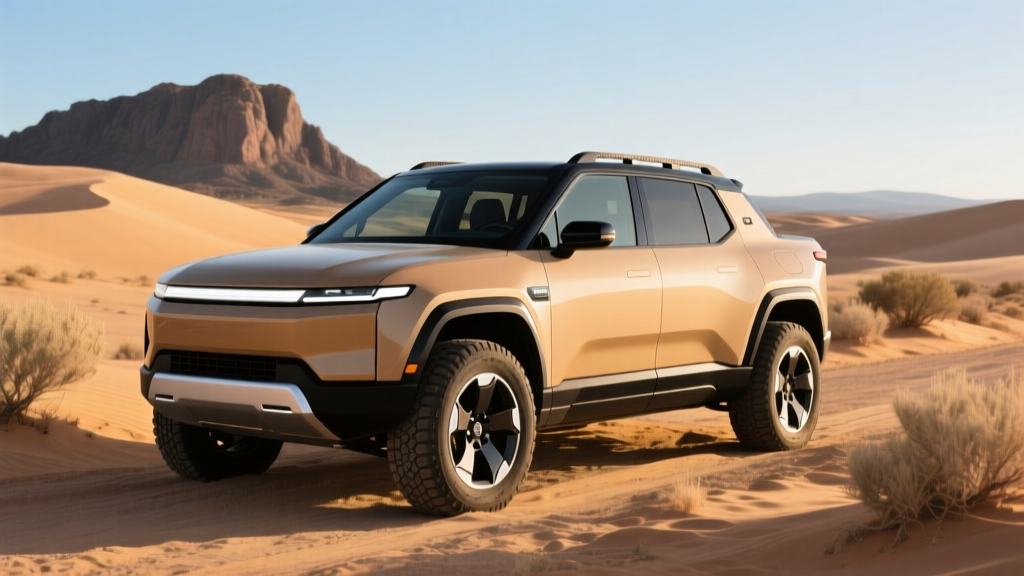
The 2026 Rivian R1S Dune Edition slots into the R1S lineup as an off-road-focused, adventure-ready three-row electric SUV. Built on Rivian's updated Gen 2 platform with dual-motor AWD, it pairs serious trail capability with daily-driver practicality. If you want a family-hauling EV that can also tackle sand washes and forest roads without flinching, the Dune Edition is the most compelling package Rivian currently offers — but it comes at a premium, and real-world range falls meaningfully short of the EPA sticker when you push it hard off-pavement or drive into cold weather.
Below, we break down every spec that matters: range, battery chemistry, charging curve realities, performance numbers, cargo dimensions, pricing after the federal tax credit, and how it stacks up against the Tesla Model X, Jeep Wagoneer S, and Cadillac Escalade IQ.
Range, Battery, and Real-World Efficiency
The 2026 R1S Dune Edition is equipped with Rivian's Large battery pack, which provides approximately 128.9 kWh of usable capacity using NMC (nickel manganese cobalt) lithium-ion cells supplied in a 2170 cylindrical format. Rivian moved to its in-house-developed drive units and battery management for Gen 2, improving energy density and thermal management over the original Gen 1 R1S.
| Specification | Value |
|---|---|
| EPA Estimated Range | ~352 miles (Dual-Motor, Large Pack) |
| Usable Battery Capacity | ~128.9 kWh (NMC) |
| Drivetrain | Dual-Motor AWD |
| Horsepower | ~533 hp |
| 0–60 mph | ~4.5 seconds |
| EPA Efficiency | ~73 MPGe / 46 kWh/100 mi |
| Max DC Fast Charge | ~220 kW peak |
| 10–80% DC Charge Time | ~30 minutes |
| Level 2 Home Charging | ~11.5 kW (~25 mi/hr) |
| Towing Capacity | 7,700 lbs |
| Ground Clearance | Up to 14.9 in (max air suspension) |
| Base MSRP | ~$99,900 (est. Dune Edition trim) |
| Battery/Powertrain Warranty | 8 years / 175,000 miles |
EPA 352 miles is the sticker number — but plan for less in actual use. In mixed highway driving at 70–75 mph, expect roughly 290–310 miles. In cold weather (below 32°F), range can drop to 240–270 miles due to cabin heating demands and reduced battery efficiency. Off-road use with aggressive terrain modes and low-speed crawling further reduces efficiency to as low as 2.0–2.5 mi/kWh, meaning a full charge might yield under 200 miles on a trail-heavy day. Always precondition the battery before DC fast charging to hit peak charge rates.
For efficiency context, the R1S Dune Edition's ~46 kWh/100 mi is typical for a 6,000+ lb electric SUV. The Tesla Model X achieves slightly better efficiency at ~39 kWh/100 mi thanks to lower weight and more aerodynamic shaping, but sacrifices the off-road hardware the Rivian provides.
Charging Speed: DC Fast, Level 2, and What to Expect
Rivian's Gen 2 platform supports a peak DC fast-charge rate of approximately 220 kW on compatible CCS or NACS chargers (Rivian has transitioned to NACS ports for 2025+ models, with CCS adapter support for legacy networks). However, as with all EVs, peak rate is not sustained rate.
| Charging Level | Power / Rate | Estimated Speed |
|---|---|---|
| Level 1 (120V) | ~1.4 kW | ~3 mi/hr |
| Level 2 (240V, 48A) | ~11.5 kW | ~25 mi/hr |
| DC Fast (peak) | ~220 kW | 10–80% in ~30 min |
| DC Fast (sustained avg 10–80%) | ~150–170 kW avg | ~200 mi added in 30 min |
The charge curve on the Large Pack NMC battery is relatively aggressive: you'll see peak rates (200–220 kW) between roughly 10–35% State of Charge (SoC), then a taper to ~150 kW through 60%, and a further taper above 80% where charging slows dramatically to protect cell longevity. If you're road-tripping, plan your stops to charge from 15–75% rather than waiting to hit 5% or pushing to 95% — the taper above 80% can add 20+ minutes for just a few extra miles of range.
For home charging, a 48-amp Level 2 wall connector on a 60-amp circuit delivers the full 11.5 kW, adding roughly 25 miles of range per hour. A full overnight charge (10 hours) restores approximately 250 miles — enough to replenish most daily driving and moderate road-trip segments. Rivian's Wall Connector is NACS-native and integrates with the Rivian app for scheduling and preconditioning.
Performance, Drivetrain, and Off-Road Capability
The Dune Edition's dual-motor AWD system produces an estimated 533 horsepower and launches the R1S to 60 mph in approximately 4.5 seconds. That's quick for a three-row SUV weighing over 6,800 pounds, though it trails the quad-motor R1T/R1S variants (which hit 60 in the ~3.0-second range). For most buyers, the dual-motor setup is the right balance of performance, range, and cost.
Where the Dune Edition separates itself from a standard R1S is the off-road hardware package:
- Reinforced underbody protection — full-length skid plates covering battery, motors, and differentials
- Upgraded air suspension with up to 14.9 inches of ground clearance in max-lift mode
- All-terrain tires (34-inch, typically General Grabber A/Tx or equivalent from the factory)
- Dune-specific drive modes — Sand, Rock Crawl, and Snow with recalibrated torque vectoring
- Approach/departure/breakover angles optimized for trail use (est. 34°/33°/25° in max-lift)
The 7,700-lb towing capacity is best-in-class for electric SUVs, though expect range to drop by 40–50% when towing near max capacity at highway speeds — a physics reality no current EV avoids.
Interior, Cargo, and Technology
The R1S is a genuine three-row SUV, though the third row is best suited for children or short trips. Cargo volume breaks down as follows:
- Behind third row: ~10.6 cu ft
- Behind second row (third row folded): ~46.7 cu ft
- Behind first row (all rear seats folded): ~88.2 cu ft
- Front trunk (frunk): ~11.0 cu ft — lockable, weather-sealed, with a drain plug for use as a cooler
The Dune Edition adds sand-colored Napa leather or vegan upholstery, unique wood trim, and all-weather floor liners as standard. Rivian's 15.6-inch center touchscreen runs the in-house Rivian OS, which has matured significantly since launch. Over-the-air updates continue to add features — recent updates improved route planning with elevation-aware range estimation and better DC charger preconditioning logic.
Driver assistance is handled by Rivian's Driver+ system, a SAE Level 2 feature combining adaptive cruise control and lane centering on divided highways. It is not autonomous driving — the driver must remain attentive with hands on or near the wheel at all times. The system is competent for highway cruising but does not match the hands-free capability of GM's Super Cruise or Ford's BlueCruise on mapped roads.
Rivian Driver+ is a Level 2 driver-assistance system. It requires continuous driver supervision. It does not handle construction zones, unmapped roads, or complex urban intersections autonomously. You are the driver — the system assists.
Pricing, Trims, and Federal Tax Credit Eligibility
The 2026 R1S Dune Edition is positioned near the top of the R1S lineup. Pricing is estimated as follows based on Rivian's current configuration options and the Dune Edition package premium:
| Item | Amount |
|---|---|
| Base MSRP (Dune Edition, Dual-Motor, Large Pack) | ~$99,900 |
| Destination Fee | ~$1,800 |
| Typical As-Tested (with premium paint, spare tire) | ~$104,000–$107,000 |
| Federal §30D Tax Credit (if eligible) | Up to $7,500 |
| Estimated Net Price After Max Credit | ~$92,400–$99,500 |
Federal tax credit eligibility for the R1S is not automatic. Under current IRS §30D rules, the following constraints apply:
- MSRP cap: SUVs must be at or below $80,000 MSRP — the R1S Dune Edition at ~$99,900 exceeds this cap and is not eligible for the new-vehicle §30D credit.
- Buyer income limits: AGI must not exceed $300,000 (married filing jointly), $225,000 (head of household), or $150,000 (single).
- Battery sourcing: Critical minerals and battery component requirements phase in annually; consult IRS guidance for current-year thresholds.
- Point-of-sale transfer: If eligible, the credit can be transferred to the dealer at purchase, reducing your out-of-pocket cost immediately.
The hard truth: at a ~$99,900 base MSRP, the R1S Dune Edition does not qualify for the federal new-vehicle tax credit due to the $80,000 SUV cap. Buyers should consult a tax professional for personal eligibility, and check fueleconomy.gov for the latest credit-eligible vehicle list. Some state-level incentives (California, Colorado, and others) may still apply regardless of MSRP caps — check your state's energy office.
How It Compares: Rivals and Alternatives
The Dune Edition occupies a niche — off-road-capable, three-row electric SUV — with few direct competitors. Here's how it measures up:
| Spec | Rivian R1S Dune | Tesla Model X | Jeep Wagoneer S | Cadillac Escalade IQ |
|---|---|---|---|---|
| EPA Range | ~352 mi | ~326 mi | ~300 mi (est.) | ~300 mi (est.) |
| 0–60 mph | ~4.5 sec | ~3.8 sec (Plaid) | ~5.5 sec (est.) | ~5.0 sec (est.) |
| Off-Road Hardware | Excellent | Minimal | Good | Limited |
| 3rd Row | Yes (compact) | Yes (compact) | No (2-row) | Yes (full-size) |
| Towing | 7,700 lbs | 5,000 lbs | ~5,000 lbs (est.) | ~8,000 lbs |
| Base MSRP | ~$99,900 | ~$79,990 | ~$72,000 (est.) | ~$130,000 (est.) |
| §30D Credit Eligible | No (MSRP cap) | Yes (under cap) | Yes (under cap) | No (MSRP cap) |
The Model X wins on efficiency, Supercharger network access, and performance (in Plaid trim), but offers essentially no off-road capability. The Wagoneer S is more affordable and credit-eligible but lacks a third row and has an unproven platform. The Escalade IQ is larger and more luxurious but significantly more expensive and less trail-focused. The R1S Dune Edition's combination of range, genuine off-road hardware, and three rows remains unique in the market.
Pros, Cons, and Who Should Buy
Pros
- Class-leading off-road capability with skid plates, air suspension, and all-terrain tires
- 352-mile EPA range is among the best for any three-row electric SUV
- 7,700-lb towing capacity
- Useful frunk with drain plug
- Strong OTA update cadence improving the vehicle over time
- 8-year/175,000-mile battery warranty exceeds the industry standard 8/100,000
Cons
- MSRP exceeds $80K cap — no federal §30D tax credit
- Third row is tight for adults on longer trips
- DC fast charging peaks at 220 kW — slower than Hyundai/Kia's 800V platforms at 350 kW
- Driver+ is competent but behind Super Cruise/BlueCruise in hands-free capability
- Real-world highway and cold-weather range drops significantly below EPA estimate
- Service center network still growing — may require mobile service or long drives for repairs
Choose the R1S Dune Edition if: You need a three-row EV with genuine off-road capability, regularly drive on unpaved roads or trails, value a large frunk and strong towing capacity, and can accept the ~$100K price without a federal credit.
Look elsewhere if: You prioritize tax-credit eligibility (consider the Model X or a dual-motor R1S in a lower trim under $80K), need a full-size third row for adults (Escalade IQ or a PHEV like the Grand Cherokee 4xe), or want the fastest DC charging speeds available (Hyundai Ioniq 9 or Kia EV9 on 800V architecture).
Frequently Asked Questions
What is the real-world range of the Rivian R1S Dune Edition?
The EPA estimates ~352 miles, but real-world highway driving at 70+ mph typically yields 290–310 miles. In cold weather (below freezing), expect 240–270 miles. Off-road use with aggressive terrain modes can reduce range further, sometimes below 200 miles on a full charge depending on terrain and speed.
How fast does the R1S Dune Edition charge at home and on the road?
On a 48-amp Level 2 home charger, the R1S adds roughly 25 miles of range per hour (11.5 kW). On a DC fast charger, it peaks at ~220 kW and charges from 10–80% in approximately 30 minutes, though sustained average power is closer to 150–170 kW. Preconditioning the battery via the navigation system is essential to hit peak rates.
Does the Rivian R1S Dune Edition qualify for the $7,500 federal EV tax credit?
No. Under current IRS §30D rules, the R1S Dune Edition's ~$99,900 MSRP exceeds the $80,000 cap for SUVs. Lower-trim R1S configurations priced at or below $80,000 may qualify if the buyer meets income limits and battery-sourcing requirements. Always verify on fueleconomy.gov and consult a tax professional.
Is the R1S Dune Edition worth buying over the Tesla Model X?
It depends on your priorities. The Model X is more efficient, faster in Plaid trim, and has access to the Supercharger network. The R1S Dune Edition offers far superior off-road capability, more ground clearance, higher towing capacity, and a more adventure-oriented design. If you never leave pavement, the Model X is the better EV. If you regularly hit trails, sand, or snow, the Rivian is the clear choice.
What is the battery warranty on the R1S?
Rivian covers the battery pack and drive units for 8 years or 175,000 miles, whichever comes first. The warranty guarantees the battery will retain a specified percentage of its original capacity (typically 70%+), though exact retention thresholds should be confirmed in your purchase agreement. This exceeds the industry-standard 8-year/100,000-mile coverage most competitors offer.
Can the R1S Dune Edition tow a camper or boat?
Yes — the 7,700-lb towing capacity handles most travel trailers, boat trailers, and car-hauler loads. However, towing near max capacity at highway speeds will cut range by 40–50%, reducing effective range to roughly 150–180 miles between charges. Plan your charging stops accordingly and use Rivian's built-in trailer mode for optimized range estimation.