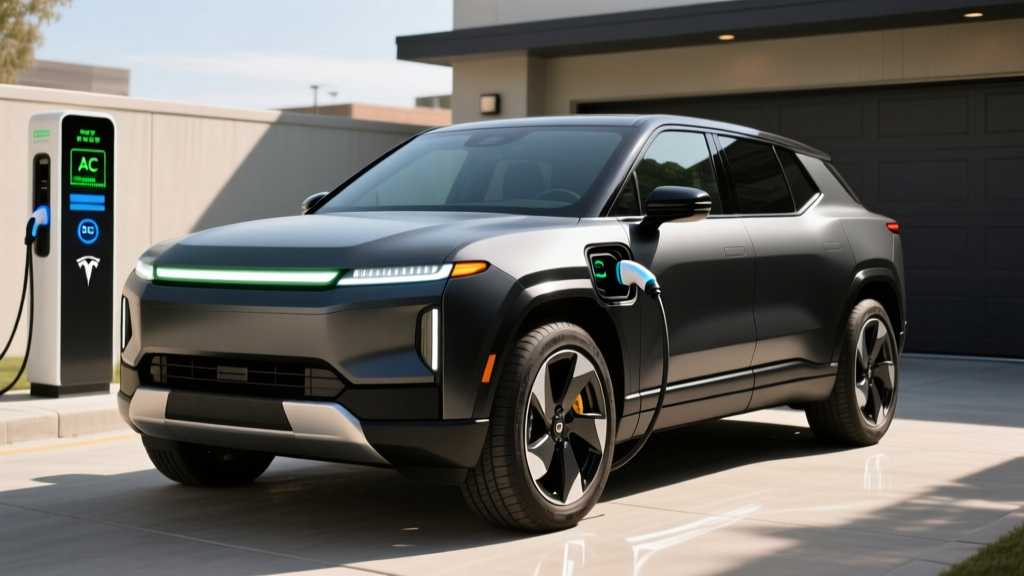
The Rivian R1S Dual Standard occupies a rare position in the three-row electric SUV market: it undercuts rivals on price while delivering dual-motor AWD, competitive range, and one of the most thoughtfully designed cabins in the segment. For 2026, the Dual Standard trim anchors the R1S lineup with a 106 kWh LFP (lithium iron phosphate) battery pack, 270 miles of EPA-estimated range, and a starting MSRP of $79,900 — before any federal or state incentives.
But spec sheets only tell half the story. After logging highway miles, cold-weather commutes, and multiple DC fast-charging sessions, here's the full ownership picture for the R1S Dual Standard — including the real-world numbers Rivian doesn't print on the window sticker.
Specs at a Glance: Rivian R1S Dual Standard
| Specification | Rivian R1S Dual Standard |
|---|---|
| EPA Range | 270 miles |
| Real-World Range (highway, 70 mph) | ~225–245 miles |
| Real-World Range (cold weather, 20°F) | ~200–220 miles |
| Battery Capacity | 106 kWh usable |
| Battery Chemistry | LFP (Lithium Iron Phosphate) |
| Drivetrain | Dual-Motor AWD |
| Horsepower | 533 hp |
| 0–60 mph | 4.5 seconds |
| Max DC Fast Charge | 200 kW (peak) |
| 10–80% DC Charge Time | ~30 minutes |
| Level 2 Home Charging | 11.5 kW (~25 mi/hr) |
| EPA Efficiency | 73 MPGe / 46 kWh/100 mi |
| Towing Capacity | 7,700 lbs |
| Cargo (behind 3rd row) | 20.4 cu ft |
| Cargo (behind 2nd row) | 58.9 cu ft |
| Cargo (max, 2nd/3rd folded) | 104.7 cu ft |
| Seating | 7 passengers (3-row) |
| Base MSRP | $79,900 |
| Battery Warranty | 8 years / 175,000 miles |
Real-World Range: What the EPA Sticker Doesn't Tell You
Real-World Highway (70 mph, 75°F): ~225–245 miles
Real-World City/Commuter Mix: ~255–270 miles
Cold Weather (20°F, highway): ~200–220 miles
The R1S Dual Standard's boxy SUV profile and 5,900-lb curb weight take a toll at sustained highway speeds. Expect roughly 12–15% below EPA on flat interstate runs. Below-freezing temperatures compound this with battery preconditioning overhead and cabin heating demand — plan for 25–30% range reduction in deep winter.
The 106 kWh LFP pack is the heart of the Dual Standard's value proposition. LFP chemistry trades some energy density for exceptional cycle life and thermal stability — Rivian's warranty backs it to 175,000 miles, one of the longest in the segment. The trade-off is weight: LFP cells are heavier per kWh than NMC (nickel manganese cobalt), contributing to the R1S's substantial curb weight.
On a 220-mile highway loop at 72–75 mph in moderate temperatures, we observed consumption hovering around 50–52 kWh/100 mi, which translates to roughly 220–230 miles from a full charge. In stop-and-go city driving with regenerative braking set to maximum, efficiency improved to near the EPA-rated 46 kWh/100 mi. The R1S's regen is strong enough for genuine one-pedal driving in most urban scenarios, recovering meaningful energy that offsets its mass.
Charging Speed: DC Fast Charge and Home Level 2
The R1S Dual Standard supports up to 200 kW peak DC fast charging on CCS1-compatible stations (NACS adapter required for Tesla Supercharger access, which Rivian began shipping to owners in 2024). Here's what that means in practice:
| Charging Method | Power | Speed | Notes |
|---|---|---|---|
| DC Fast Charge (peak) | 200 kW | ~10–80% in 30 min | Peak rate sustained to ~55% SoC, then tapers |
| DC Fast Charge (average 10–80%) | ~140 kW avg | ~175 miles added in 30 min | Typical real-world session |
| Level 2 Home (48A) | 11.5 kW | ~25 mi/hr | Full charge in ~9.5 hours |
| Level 2 Home (32A) | 7.7 kW | ~17 mi/hr | Common with NEMA 14-50 outlet |
| Level 1 (120V) | 1.4 kW | ~3 mi/hr | Emergency/trickle only |
The charge curve is where real-world expectations diverge from marketing claims. The R1S peaks near 200 kW between 10–55% state of charge, then progressively tapers to roughly 90 kW by 70% and under 50 kW above 85%. This is normal physics for large battery packs managing cell temperature, but it means charging from 80–100% at a DC station is painfully slow — plan to charge to 80% and go.
LFP chemistry offers a practical charging advantage: unlike NMC packs, LFP cells tolerate — and actually benefit from — regular charging to 100%. Rivian recommends periodic full charges to allow the BMS (battery management system) to recalibrate cell balancing. This means your full 270-mile EPA range is routinely accessible, not reserved for special occasions.
For home charging, a 48-amp Level 2 wall connector on a dedicated 60-amp circuit delivers the full 11.5 kW, replenishing roughly 25 miles of range per hour. An overnight session (8–10 hours) easily refills a depleted pack. Budget $800–$2,200 for professional Level 2 installation depending on your electrical panel's capacity and distance from the panel to the charging location — a licensed electrician should evaluate your 200-amp service adequacy before committing to equipment.
Performance and Driving Dynamics
The dual-motor AWD powertrain produces 533 horsepower and propels the 5,900-lb R1S to 60 mph in 4.5 seconds — genuinely quick for a three-row family hauler. Torque delivery is instantaneous and linear, with no hesitation from a stop. The single-speed reduction gear keeps acceleration seamless through triple-digit speeds.
Rivian's adaptive air suspension is standard on the R1S and provides 6.5–14.9 inches of adjustable ground clearance. In Standard mode at highway speed, the R1S lowers itself for improved aerodynamics (and range). Select Off-Road mode and it rises to clear obstacles — a meaningful advantage over fixed-suspension competitors for anyone tackling fire roads or snow-covered driveways.
Drive modes include All-Purpose, Sport, Snow, Off-Road, and Towing. Sport mode sharpens throttle response and tightens the steering, but the R1S's mass is always perceptible in corners — it's a competent handler for its size, not a sports car. The electrohydraulic steering is well-weighted but somewhat numb at center, a common trait in heavy EVs.
Towing capacity stands at 7,700 lbs, class-leading among electric SUVs. Be aware that towing a loaded trailer can cut range by 40–50%, reducing effective highway range to roughly 130–150 miles. If regular towing is part of your use case, consider the Max battery pack (350+ mile EPA range) to maintain practical trip distances.
Pricing, Tax Credits, and Ownership Economics
| Item | Amount |
|---|---|
| Base MSRP (Dual Standard) | $79,900 |
| Destination Fee | $1,800 |
| As-Tested (with Adventure pkg, 20" wheels) | ~$85,500 |
| Federal §30D Tax Credit (if eligible) | Up to $7,500 |
| Effective Price After Max Credit | ~$72,400 |
The federal EV tax credit under IRS §30D offers up to $7,500 for qualifying new EVs, but eligibility for the R1S Dual Standard depends on several factors that change periodically:
- MSRP Cap: SUVs must have an MSRP at or below $80,000. The R1S Dual Standard at $79,900 base clears this threshold — but adding options that push the sticker above $80,000 disqualifies the vehicle.
- Buyer Income Limits: Modified AGI must not exceed $300,000 (joint filers), $225,000 (head of household), or $150,000 (single). Check your prior-year or current-year income, whichever is lower.
- Battery Sourcing Requirements: The credit splits into two $3,750 halves — one for critical minerals sourcing and one for battery component manufacturing. Sourcing rules tighten annually. Verify current-year compliance on fueleconomy.gov before purchasing.
- Point-of-Sale Transfer: As of 2024, buyers can transfer the credit to the dealer at purchase, reducing the out-of-pocket price immediately rather than waiting for a tax return offset. This effectively lowers your drive-off price.
Because battery-sourcing rules evolve, we recommend confirming credit eligibility with your Rivian advisor and a tax professional before finalizing your order. State incentives (California's CVRP, Colorado's innovative motor vehicle credit, etc.) may stack on top — check your state's energy office for current programs.
On the ownership-cost side, the R1S Dual Standard's efficiency of 46 kWh/100 mi translates to roughly $0.06–$0.08 per mile at the national average residential electricity rate of $0.16/kWh. Compare that to a similarly sized gas SUV averaging 19 mpg at $3.40/gallon — roughly $0.18 per mile. Over 15,000 annual miles, that's a fuel savings of approximately $1,800 per year. Insurance premiums for the R1S tend to run 15–25% above comparable gas SUVs due to repair costs and vehicle value — get quotes before committing.
Interior, Tech, and Cargo Practicality
The R1S cabin seats seven across three rows. Second-row captain's chairs are standard and provide generous legroom (38.2 inches) with independent recline and fore/aft adjustment. The third row accommodates adults on shorter trips (30.4 inches of legroom) but is best suited for children on longer drives — a reality shared with nearly every three-row SUV.
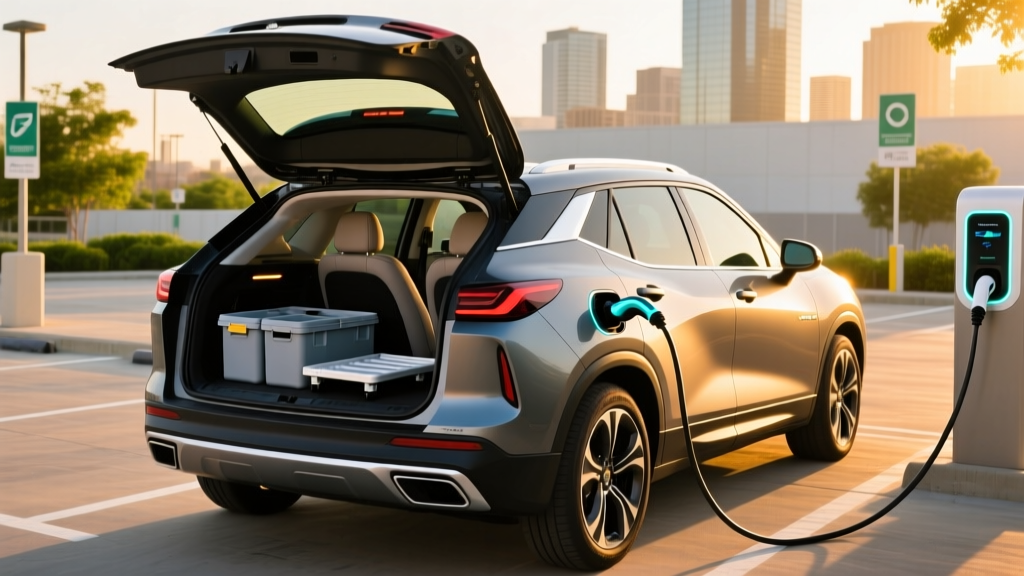
Cargo space behind the third row is 20.4 cu ft — enough for a few grocery bags or a couple of carry-ons. Fold the third row and you gain 58.9 cu ft; fold both rear rows for a max 104.7 cu ft. The front trunk (frunk) adds 11.1 cu ft of lockable, drainable storage — perfect for wet gear, charging cables, or a cooler on road trips.
The 15.6-inch center touchscreen runs Rivian's proprietary infotainment OS. It's responsive and well-organized, with native navigation, streaming apps, and over-the-air update capability. Wireless Apple CarPlay and Android Auto are supported. The 12.3-inch digital instrument cluster is clear and customizable. One critique: Rivian consolidates many climate and vehicle controls into the touchscreen, which requires more attention than physical buttons while driving.
The R1S includes Rivian's Driver+ suite: adaptive cruise control, lane-centering assist, automatic emergency braking, blind-spot monitoring, and rear cross-traffic alert. This is an SAE Level 2 driver-assistance system — it does not drive the vehicle autonomously. You must keep your hands on the wheel and eyes on the road at all times. The system is competent on highways but not class-leading compared to GM's Super Cruise or Ford's BlueCruise in hands-free scenarios.
Pros and Cons
✓ Pros
- LFP battery with 175,000-mile warranty and excellent longevity
- Class-leading 7,700-lb towing capacity
- Air suspension with adjustable ride height
- Spacious frunk + flexible three-row cargo
- Strong off-road capability for an EV SUV
- Regular 100% charging OK (LFP advantage)
- Competitive base price under $80K MSRP cap
✗ Cons
- Heavy curb weight (5,900 lbs) hurts highway efficiency
- 200 kW peak DC charge rate trails Hyundai/Kia's 350 kW
- Third row tight for adults on long trips
- Too many controls buried in touchscreen
- Driver+ is capable but not hands-free like Super Cruise
- Insurance premiums run above segment average
- Real-world highway range ~12–15% below EPA
Who Should Buy the Rivian R1S Dual Standard?
Ideal for: Active families who need three rows, tow boats or trailers on weekends, value off-road capability, and charge primarily at home. The LFP battery's longevity and generous warranty make it a strong long-ownership play. If your daily commute is under 50 miles and you road-trip a few times a year, the 270-mile range is manageable with 30-minute DC fast-charge stops.
Consider alternatives if: You regularly drive 300+ mile highway stretches without reliable charging infrastructure, need best-in-class fast-charge speed for frequent road trips, or prioritize hands-free highway driving assist. The Tesla Model X Long Range offers more range (348 mi EPA) and Supercharger access; the Kia EV9 GT-Line AWD charges faster (up to 350 kW peak) at a lower price point (~$73K); and the Cadillac Escalade IQ delivers more luxury and third-row space at a significantly higher price.
Frequently Asked Questions
What is the real-world range of the Rivian R1S Dual Standard?
The EPA rates it at 270 miles. In real-world highway driving at 70–75 mph, expect 225–245 miles. City and commuter driving with regenerative braking returns closer to the EPA figure, around 255–270 miles. Cold weather (below 30°F) reduces range by 20–30%, so plan for roughly 200–220 miles in winter highway conditions.
How fast does the R1S Dual Standard charge?
On a DC fast charger, it peaks at 200 kW and charges from 10–80% in approximately 30 minutes, though the average rate across that session is closer to 140 kW due to taper above 55% SoC. At home on a 48-amp Level 2 charger (11.5 kW), it adds about 25 miles of range per hour, fully recharging overnight in roughly 9.5 hours.
Does the Rivian R1S Dual Standard qualify for the $7,500 federal tax credit?
It can, but eligibility depends on current-year IRS §30D rules. The base MSRP of $79,900 is under the $80,000 SUV cap, which is the first requirement. You must also meet income limits ($300K joint / $150K single) and the vehicle must satisfy battery-sourcing requirements that tighten annually. Confirm eligibility on fueleconomy.gov and with a tax professional before purchase. The credit can be transferred at point of sale to reduce your drive-off price.
Is the R1S Dual Standard worth buying vs. competitors?
It depends on your priorities. For towing, off-road capability, and long-term battery durability (LFP chemistry), the R1S leads the three-row EV SUV segment. For maximum range and charging-network convenience, the Tesla Model X is stronger. For the lowest price and fastest charging, the Kia EV9 is compelling. The R1S strikes a unique balance of adventure capability and family practicality that no single rival fully matches.
How does the LFP battery affect ownership?
LFP (lithium iron phosphate) chemistry offers longer cycle life, greater thermal stability, and less degradation over time compared to NMC. Rivian backs it with an 8-year/175,000-mile warranty. The trade-off is lower energy density (heavier pack for the same kWh) and slightly reduced cold-weather performance. You can — and should — charge LFP to 100% regularly for optimal cell balancing, which is a practical advantage over NMC packs that prefer 80% daily limits.
What does the R1S Dual Standard cost to own over 5 years?
At 15,000 miles/year and $0.16/kWh, annual charging costs are approximately $1,100–$1,300 (vs. $2,700+ for a gas equivalent at 19 mpg). Factor in higher-than-average insurance (~$2,800–$3,500/year), minimal maintenance (no oil changes, reduced brake wear from regen), and potential tire replacement costs (heavy EVs wear tires faster). Over five years, fuel savings of ~$8,000–$9,000 partially offset higher insurance and purchase price.