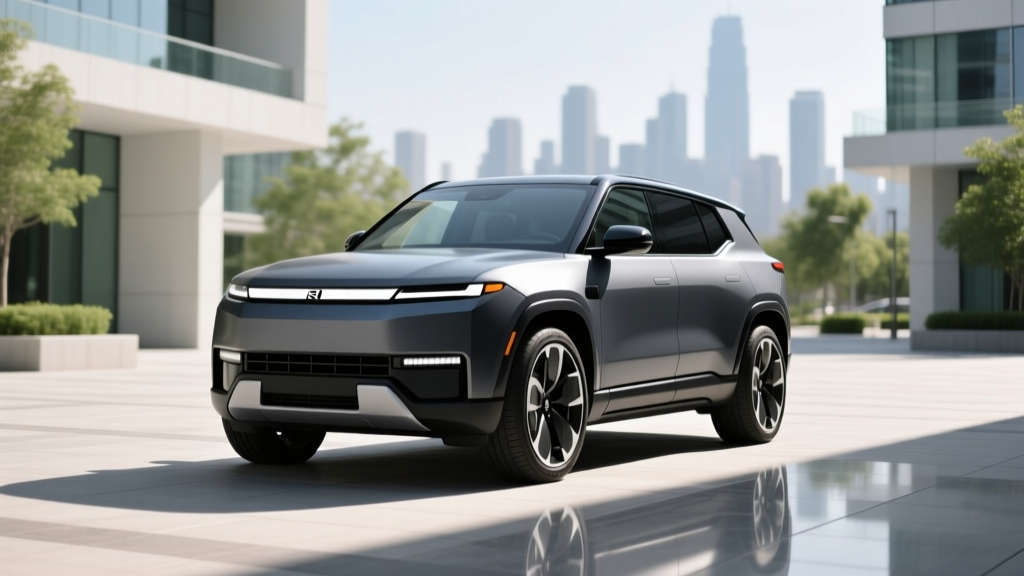
The Rivian R1S occupies a rare position in the EV market: a three-row, body-on-frame electric SUV that actually delivers off-road capability without sacrificing on-road composure. For buyers evaluating this vehicle, physical size is a primary concern — garage fitment, third-row usability, and cargo capacity all hinge on the R1S dimensions. This profile breaks down every measurement that matters, alongside the powertrain, charging, and pricing data you need to make a purchase decision in 2026.
Exterior Dimensions: Will It Fit Your Garage?
The R1S is a full-size SUV, but it rides on a shorter wheelbase than competitors like the Chevrolet Tahoe or Ford Expedition. That makes it more maneuverable in parking lots while still offering three rows of seating. Here are the exact exterior measurements for the current-generation R1S:
| Measurement | Specification |
|---|---|
| Overall Length | 200.8 inches |
| Wheelbase | 121.1 inches |
| Width (without mirrors) | 81.8 inches |
| Width (mirrors extended) | 91.2 inches |
| Height (standard suspension) | 73.0 inches |
| Ground Clearance (standard) | 9.2 inches |
| Ground Clearance (max off-road) | 14.9 inches |
| Curb Weight (Dual-Motor) | ~6,800 lbs |
| Curb Weight (Quad-Motor) | ~7,100 lbs |
| Approach Angle | 32.5° |
| Departure Angle | 33.7° |
| Turning Circle | 39.4 feet |
Garage fitment note: At just under 201 inches long and roughly 73 inches tall in standard mode, the R1S fits in most standard US residential garages (typically 220+ inches deep, 84+ inches tall). However, if you have a low-clearance garage door or a compact single-bay garage, measure carefully — especially if you plan to install a roof rack or use the Max suspension lift mode, which raises the vehicle beyond 77 inches.
The air suspension system offers multiple ride-height settings, dropping about an inch at highway speeds for efficiency and lifting up to 14.9 inches of ground clearance for trail use. That adjustability is a key differentiator versus fixed-suspension competitors.
Interior Space and Cargo Capacity
Three-row EV SUVs are judged heavily on whether the third row is usable for adults or strictly for children. The R1S third row is best suited for children or shorter adults on trips under an hour. Here are the interior dimension specifics:
| Measurement | Specification |
|---|---|
| Front Headroom | 40.9 inches |
| Front Legroom | 41.3 inches |
| Second-Row Headroom | 39.5 inches |
| Second-Row Legroom | 38.2 inches |
| Third-Row Headroom | 37.3 inches |
| Third-Row Legroom | 30.4 inches |
| Cargo (behind 3rd row) | 10.4 cu ft |
| Cargo (3rd row folded) | 46.7 cu ft |
| Cargo (all rear rows folded) | 83.5 cu ft |
| Front Trunk (Frunk) | 11.0 cu ft |
The 10.4 cubic feet behind the third row is tight — enough for a few grocery bags or a couple of carry-on suitcases, but not a full family road trip's worth of luggage with all seats occupied. Folding the third row opens up a practical 46.7 cu ft, and the flat-load floor with both rear rows down yields 83.5 cu ft, competitive with midsize SUVs.
The 11.0-cu-ft frunk is one of the largest in the segment and includes a drain plug, making it usable as a cooler for tailgating. This is a genuine utility advantage over the Tesla Model X, which has a smaller front trunk.
Range, Battery, and Efficiency
Rivian offers the R1S with multiple battery configurations for the 2025–2026 model years, following its Gen 2 platform update. The chemistry and capacity you get depend on the trim and pack you select:
| Battery Pack | Chemistry | Usable Capacity | EPA Range (Dual-Motor) | EPA Range (Quad-Motor/Performance) |
|---|---|---|---|---|
| Standard | LFP (Lithium Iron Phosphate) | ~92 kWh | 270 miles | 250 miles |
| Large | NMC (Nickel Manganese Cobalt) | ~113 kWh | 340 miles | 320 miles |
| Max | NMC | ~141 kWh | 410 miles | 385 miles |
The EPA estimates above assume mixed driving. In real-world highway testing at 70–75 mph, expect roughly 10–15% less range than the EPA sticker. The Large Pack Dual-Motor, rated at 340 miles EPA, typically delivers 290–310 miles on the highway in moderate temperatures. In cold weather (below 32°F), range can drop an additional 15–25% due to battery heating demands and cabin climate load — putting the Large Pack at roughly 250–270 miles in winter conditions. The Max Pack's 410-mile EPA rating provides a meaningful buffer, making it the strongest choice for road-trippers and cold-climate owners.
Efficiency varies by configuration. The Dual-Motor with the Large Pack achieves approximately 73 MPGe combined (per fueleconomy.gov), translating to roughly 46 kWh per 100 miles. The Quad-Motor variants are less efficient due to the additional weight and power of four independent motors, running closer to 49–52 kWh/100mi.
LFP vs. NMC — what it means for you: The Standard pack uses LFP chemistry, which offers slower degradation over time and can be charged to 100% daily without concern. The trade-off is lower energy density (less range) and reduced cold-weather performance. The Large and Max packs use NMC chemistry, which provides higher energy density and better cold-weather output, but Rivian recommends charging to 80–90% for daily use to preserve long-term battery health.
Charging Speeds: DC Fast Charging and Home Level 2
Charging speed is where the R1S's Gen 2 architecture made meaningful gains. Here are the specific numbers for each charging scenario:
| Charging Type | Power / Rate | Speed |
|---|---|---|
| DC Fast Charge (peak) | 200 kW (Max Pack: up to 220 kW) | 10–80% in ~30 min (Large), ~35 min (Max) |
| DC Fast Charge (sustained avg) | ~140–160 kW | Varies by SoC and temperature |
| Level 2 Home (11.5 kW onboard charger) | 11.5 kW | ~25 miles of range per hour |
| Level 2 Home (19.2 kW capable) | 19.2 kW (requires 100A circuit) | ~42 miles of range per hour |
| Level 1 (120V household) | ~1.4 kW | ~3 miles of range per hour |
Charging curve reality: The 200–220 kW peak rate is only sustained up to roughly 40–50% state of charge. Beyond 80%, charging slows significantly — a 80–100% top-off can add 20–30 minutes. This is standard for NMC batteries with large capacities. Rivian's navigation system includes battery preconditioning: when you route to a DC fast charger, the vehicle warms the battery to optimize charge speed on arrival. Always use this feature — arriving at a charger with a cold battery can cut your peak charge rate in half.
Home charging setup: The R1S ships with a portable charger that handles Level 1 (120V) and Level 2 (240V, up to 32A / 7.7 kW). For the full 11.5 kW Level 2 rate, you'll need a Rivian Wall Charger or equivalent 48A Level 2 station on a 60-amp dedicated circuit. The 19.2 kW option requires a 100-amp circuit and compatible hardware — feasible for homes with 200A electrical service, but likely requiring a panel upgrade for older homes. Budget $800–$2,500 for a professional Level 2 installation depending on your electrical panel's capacity and the run distance to your garage or driveway.
Performance and Drivetrain
The R1S is not a slow, lumbering family hauler. Even the base Dual-Motor configuration is genuinely quick, and the Quad-Motor variant is supercar-fast for a vehicle of its mass:
| Configuration | Horsepower | Torque (lb-ft) | 0–60 mph | Drivetrain |
|---|---|---|---|---|
| Dual-Motor (Standard/Large) | 533 hp | 610 | 4.5 sec | AWD (2 motors) |
| Performance Dual-Motor | 665 hp | 828 | 3.5 sec | AWD (2 motors) |
| Quad-Motor | 835 hp | 908 | 3.0 sec | AWD (4 independent motors) |
| Tri-Motor (Performance) | 850 hp | 1,103 | 2.9 sec | AWD (3 motors) |
The Quad-Motor and Tri-Motor setups offer genuine torque vectoring — each wheel can be independently controlled, giving the R1S a level of off-road traction and on-road cornering precision that single- or dual-motor competitors can't match. The Quad-Motor also enables "tank turns" (low-speed 360° rotations), though this is more a demonstration feature than a daily-use capability.
Towing: The R1S is rated to tow up to 7,700 lbs when properly equipped. That's competitive with the BMW X5 and Audi Q7, though below the Ford Expedition's 9,300-lb rating. Note that towing significantly impacts range — expect a 30–45% reduction when pulling a loaded trailer.
Pricing, Trims, and Federal Tax Credit Eligibility
The R1S is positioned as a premium electric SUV. Pricing reflects that positioning, though it undercuts luxury-brand rivals like the BMW iX and Mercedes EQS SUV in many configurations:
| Configuration | Base MSRP | Est. As-Tested (w/ common options) |
|---|---|---|
| Dual-Motor Standard Pack | $79,900 | $83,000–$86,000 |
| Dual-Motor Large Pack | $86,900 | $90,000–$95,000 |
| Dual-Motor Max Pack | $96,900 | $100,000–$106,000 |
| Performance Dual-Motor Large | $92,900 | $97,000–$102,000 |
| Tri-Motor Max Pack | $104,900 | $110,000–$118,000 |
Destination charges, premium paint colors ($2,000–$3,000), the Adventure package, and upgraded wheels can add $5,000–$12,000 to the sticker price.
The Rivian R1S may qualify for the federal clean vehicle credit of up to $7,500, but eligibility is not guaranteed for every buyer or every configuration. Key requirements:
- MSRP Cap: SUVs must have an MSRP at or below $80,000. Only the base Dual-Motor Standard Pack at $79,900 potentially meets this threshold — once options push it above $80,000, it becomes ineligible.
- Buyer Income Cap: Modified AGI must not exceed $300,000 (joint), $225,000 (head of household), or $150,000 (single).
- Battery Sourcing: The credit is split into two halves ($3,750 each) — one for critical minerals and one for battery component manufacturing. Sourcing requirements tighten annually. Check fueleconomy.gov for the latest eligible VIN list.
- Point-of-Sale Transfer: Eligible buyers can transfer the credit to the dealer at purchase, reducing the out-of-pocket price directly rather than waiting for a tax refund.
Technology, Driver Assistance, and Notable Features
The R1S runs Rivian's proprietary software stack on a 15.6-inch center touchscreen and a 12.3-inch digital instrument cluster. Key technology highlights include:
- Rivian Driver+: A Level 2 driver-assistance system with adaptive cruise control, lane-centering, and hands-on-wheel monitoring. This is a supervised system — not self-driving. It competes with Ford BlueCruise and GM Super Cruise in capability, though Rivian does not currently offer a hands-free highway mode like those competitors.
- Over-the-air (OTA) updates: Rivian regularly pushes software updates that add features, improve efficiency, and refine the UI — similar to Tesla's update cadence.
- Vehicle-to-Load (V2L): The R1S can power external devices through its frunk and bed outlets, delivering up to 3.5 kW — enough to run camping appliances, power tools, or provide emergency home backup during outages.
- Drive modes: All-Purpose, Sport, Snow, Off-Road, and Tow modes adjust suspension height, throttle response, and traction control mapping.
- Powered tonneau-style cargo cover and a gear tunnel (on the R1T truck, not R1S) — though the R1S frunk and configurable roof rail system provide similar utility for adventure gear.
Notable drawbacks: The R1S lacks Apple CarPlay and Android Auto — Rivian uses its own infotainment system exclusively, which some buyers find limiting. Third-row access is tighter than the Kia EV9. The R1S does not currently support NACS natively (as of the 2025 model year, it uses CCS1), though adapters and future NACS-native vehicles are expected. Charging on the Tesla Supercharger network requires a CCS-to-NACS adapter.
Pros, Cons, and Who Should Buy the R1S
Pros
- Genuine off-road capability with 14.9" ground clearance and quad-motor torque vectoring
- Up to 410 miles EPA range (Max Pack)
- 11-cu-ft frunk with drain — best in class
- Strong towing capacity (7,700 lbs)
- Distinctive design — stands out in a sea of crossover clones
- OTA updates continuously improve the vehicle
- V2L capability for camping and emergency backup
Cons
- Third row is tight for adults (30.4" legroom)
- Cargo behind 3rd row is only 10.4 cu ft
- No Apple CarPlay / Android Auto
- Most trims exceed the $80K federal tax credit MSRP cap
- CCS1 port requires adapter for Tesla Superchargers
- Premium pricing — base starts at $79,900
- Driver+ is capable but lacks hands-free mode
Who the R1S Is For
- Adventure families: If you need three rows for school runs but also want to hit trails, camp, and tow a small trailer on weekends, the R1S is uniquely capable.
- Outdoor enthusiasts: The frunk, V2L, air suspension, and off-road modes make it a genuine overlanding platform.
- Performance-minded SUV buyers: The Quad/Tri-Motor variants deliver acceleration that embarrasses sports cars while carrying seven passengers.
Consider alternatives if: You need a genuinely comfortable third row for adults (look at the Kia EV9 at ~$55K), want hands-free highway driving (Ford Expedition with BlueCruise), or need maximum cargo space (Chevrolet Tahoe EV when available).
Warranty Coverage
| Coverage | Term |
|---|---|
| Basic Vehicle Warranty | 5 years / 60,000 miles |
| Battery & Powertrain | 8 years / 175,000 miles |
| Battery Capacity Retention | Minimum 70% over 8 yr / 175,000 mi |
| Roadside Assistance | 5 years / 60,000 miles |
| Corrosion Perforation | 12 years (unlimited miles) |
Rivian's 8-year/175,000-mile battery and powertrain warranty exceeds the federal minimum (8 years/100,000 miles) and is competitive with Tesla's 8-year/120,000–150,000-mile coverage. The 70% capacity retention threshold is standard for the industry — if your battery drops below 70% of original capacity within the warranty period, Rivian will repair or replace it.
Frequently Asked Questions
What is the real-world range of the Rivian R1S?
The EPA-rated range spans from 250 miles (Quad-Motor Standard) to 410 miles (Dual-Motor Max). Real-world highway driving at 70–75 mph typically yields 10–15% less than the EPA figure. Cold weather (below freezing) can reduce range an additional 15–25%. For the popular Large Pack Dual-Motor (340 mi EPA), expect roughly 290–310 miles highway in summer and 250–270 miles in winter.
How fast does the R1S charge?
DC fast charging peaks at 200–220 kW depending on the pack, achieving a 10–80% charge in approximately 30–35 minutes. At home on a 48A Level 2 charger (11.5 kW), you'll add about 25 miles of range per hour, fully replenishing the Large Pack in roughly 10–11 hours. A 19.2 kW Level 2 setup cuts that to about 6 hours but requires a 100A circuit.
Does the Rivian R1S qualify for the federal EV tax credit?
Possibly, but only in limited configurations. The §30D credit requires an SUV MSRP at or below $80,000 — only the base Dual-Motor Standard Pack at $79,900 potentially qualifies, and options can push it over the cap. Buyer income caps ($300K joint / $150K single) and battery sourcing rules also apply. Verify eligibility at irs.gov and with a tax professional before purchasing.
Is the R1S worth buying vs. the Kia EV9 or Tesla Model X?
It depends on your priorities. The Kia EV9 starts around $55,000, offers a roomier third row, and qualifies more easily for the tax credit — making it the value pick for families who don't need off-road capability. The Tesla Model X offers more range, access to the Supercharger network natively, and a hands-free-capable FSD (Supervised) option, but starts above $80,000 and has a less practical interior layout. The R1S wins on off-road capability, adventure features (frunk, V2L, air suspension), and distinctive design — but it costs more and has a tighter third row than the EV9.
What are the R1S dimensions for garage fitment?
The R1S measures 200.8 inches long, 81.8 inches wide (without mirrors), and 73.0 inches tall at standard ride height. It fits most standard US residential garages, but verify your garage door height if you plan to use elevated suspension modes or install a roof rack. The 39.4-foot turning circle is reasonable for its size but tighter spaces will require care.
Can the R1S use Tesla Superchargers?
As of the current model year, the R1S uses a CCS1 charge port. Accessing Tesla Superchargers requires a CCS-to-NACS adapter. Rivian has indicated future vehicles will adopt the NACS connector natively, but current-production R1S vehicles require the adapter for Supercharger access.