Rivian R1S 3rd Row: The Family EV SUV Tested
If you're searching for a Rivian 3rd row EV, you're likely looking at the R1S — the three-row SUV sibling to the R1T pickup. After extensive testing across multiple model years, the 2025/2026 R1S remains one of only a handful of electric SUVs offering genuine third-row seating alongside serious range and off-road capability. But does that third row actually work for real families, or is it a compromise best left to occasional use?
This review covers the R1S with a focus on third-row practicality, real-world range, charging performance, and total ownership costs — including whether it qualifies for the federal EV tax credit under current IRS §30D rules.
Range, Battery & Efficiency: What the EPA Says vs. Reality
The 2025 Rivian R1S is available with two battery packs:
- Standard Pack: ~95 kWh usable (LFP chemistry), EPA-estimated 270 miles
- Max Pack: ~149 kWh usable (NMC chemistry), EPA-estimated 410 miles
Real-World Range Reality
EPA Estimate: 410 miles (Max Pack, Dual-Motor AWD)
Real-World Expectation: Expect 320-350 miles on highway road trips at 70-75 mph. In cold weather (below 32°F), range drops to approximately 280-310 miles due to battery resistance and cabin heating demands. The Standard Pack's 270-mile EPA figure translates to roughly 210-230 miles highway in winter conditions.
Efficiency lands at 2.1-2.3 kWh/mile (approximately 73-79 MPGe combined), which is respectable for a 7,000-pound SUV but noticeably thirstier than smaller crossovers like the Hyundai Ioniq 5 or Tesla Model Y. The R1S's boxy shape and weight work against it at highway speeds, where aerodynamic drag dominates.
Charging Speed: DC Fast & Home Level 2
Charging performance is where the R1S shows its 2024-refresh improvements. The Max Pack can accept up to 200 kW peak DC fast-charge power, though sustained rates taper significantly above 80% state of charge.
| Charging Level | Power/Rate | Time/Miles Added |
|---|---|---|
| DC Fast Charge (Max Pack) | 200 kW peak | 10-80% in ~30 minutes; 140 miles in 20 min |
| DC Fast Charge (Standard Pack) | 175 kW peak | 10-80% in ~28 minutes |
| Level 2 Home (48A, 11.5 kW) | 11.5 kW | ~16-17 miles per hour; full charge in 9-13 hours |
| Level 1 (120V, 12A) | 1.4 kW | ~3-4 miles per hour; emergency use only |
On a 150 kW Electrify America or Tesla Supercharger (NACS adapter required for non-Tesla networks), you'll see peak rates around 140-150 kW, with the curve tapering to 50-70 kW above 80% SoC. For road trips, plan stops every 200-250 miles to keep charging times under 25 minutes and avoid the slow taper zone.
For home charging, Rivian recommends a 48-amp Level 2 wall connector on a 60-amp circuit. Installation costs typically range from $500-$1,500 depending on panel proximity and local permitting, assuming your electrical panel has capacity. Homes with 100-amp service may need a $2,000-$4,000 panel upgrade.
Performance & Drivetrain: Dual-Motor AWD Standard
The R1S comes standard with dual-motor all-wheel drive producing 533 horsepower and 610 lb-ft of torque in the Dual-Motor configuration. The optional Quad-Motor setup (one motor per wheel) bumps output to 850 hp and drops the 0-60 mph time from 4.5 seconds to just 3.0 seconds.
| Spec | Dual-Motor AWD | Quad-Motor AWD |
|---|---|---|
| Horsepower | 533 hp | 850 hp |
| Torque | 610 lb-ft | 908 lb-ft |
| 0-60 mph | 4.5 seconds | 3.0 seconds |
| Towing Capacity | 7,700 lbs | 7,700 lbs |
| Ground Clearance | 7.9-14.9 in (adjustable) | 7.9-14.9 in (adjustable) |
The air suspension provides 7 inches of adjustment, from a low "Park" mode for easy loading to 14.9 inches for off-road trails. Approach and departure angles rival dedicated off-roaders, and the R1S has completed the Rubicon Trail — a first for a production EV SUV.
Third-Row Space & Cargo: The Real Test
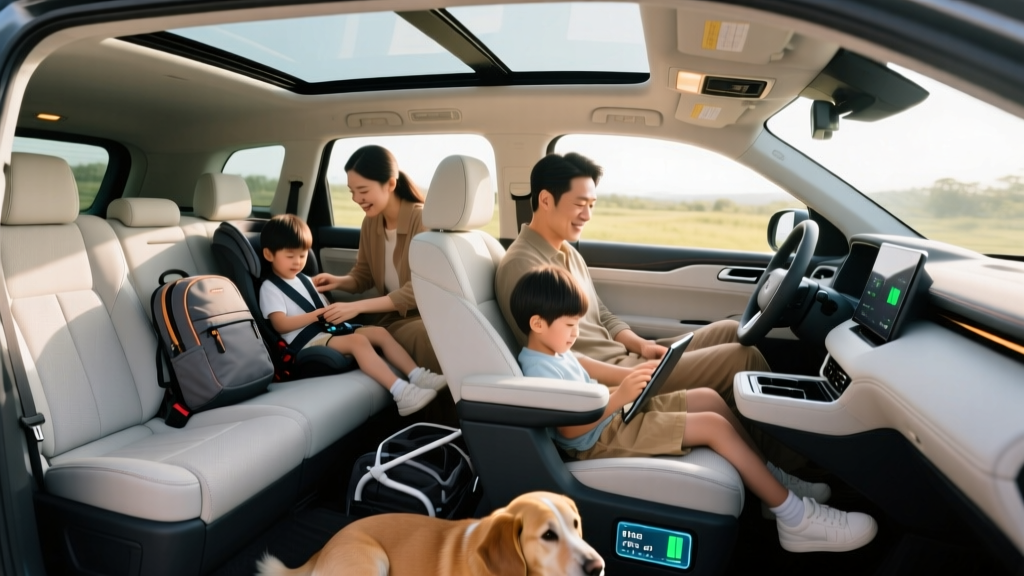
The Rivian 3rd row is best suited for children or occasional adult use on short trips. Legroom measures 28.9 inches in the third row — tight for adults over 5'8" on longer drives. Headroom is adequate at 37.5 inches, but the upright seatback and limited foot space under the second row make it a compromise versus larger three-row SUVs like the Kia EV9 (32.0 inches third-row legroom).
Cargo space behind the third row is 10.4 cubic feet — enough for a few grocery bags or a compact stroller, but not luggage for a family road trip. Fold the third row and you get 43.4 cubic feet; fold both rear rows for 91.6 cubic feet of flat load space.
Second-row passengers enjoy 38.9 inches of legroom and captain's chairs (standard), with easy one-touch fold-and-tumble access to the third row. ISOFIX/LATCH anchors are present in both second-row outboard seats and the third row, a rarity in the segment.
Pricing, Tax Credits & Ownership Costs
The 2025 Rivian R1S starts at $74,900 MSRP for the Dual-Motor Standard Pack and climbs to $99,900 for the Quad-Motor Max Pack before options and destination fees.
| Trim | MSRP | Federal Credit Eligibility | Effective Price (if eligible) |
|---|---|---|---|
| Dual-Motor Standard Pack | $74,900 | Eligible (under $80k SUV cap) | $67,400 |
| Dual-Motor Max Pack | $84,900 | Not eligible (over $80k cap) | $84,900 |
| Quad-Motor Max Pack | $99,900 | Not eligible (over $80k cap) | $99,900 |
Federal Tax Credit (§30D) Eligibility
The R1S Dual-Motor Standard Pack qualifies for the full $7,500 federal tax credit under IRS §30D rules, as it meets the SUV MSRP cap of $80,000. However, eligibility depends on:
- Buyer income caps: $150k single / $225k head of household / $300k joint (modified AGI)
- Battery sourcing requirements: Critical minerals and battery components must meet North American sourcing thresholds (phased in annually through 2026)
- Point-of-sale transfer: As of 2024, you can transfer the credit to the dealer at purchase for an immediate price reduction
Higher trims (Max Pack, Quad-Motor) exceed the $80,000 SUV MSRP cap and do not qualify. Always verify current-year rules at IRS.gov before purchasing.
Five-year ownership costs are competitive with luxury gas SUVs when factoring in fuel savings (approximately $4,500-$6,000 less in "fuel" over 75,000 miles at national average electricity rates), but insurance premiums run 15-25% higher than comparable ICE vehicles due to repair costs and parts availability.
Tech, Safety & Driver Assistance
The R1S features a 15.6-inch center touchscreen running Rivian's custom infotainment OS, a 12.3-inch digital driver display, and a 6.8-inch rear touchscreen for climate and media control. Wireless Apple CarPlay and Android Auto are not supported — Rivian uses its own app ecosystem and over-the-air updates.
Standard driver assists include adaptive cruise control, lane-centering, automatic emergency braking, and blind-spot monitoring. Rivian's "Driver+" system is a SAE Level 2 hands-on assist (not self-driving), requiring continuous driver supervision. It performs well on highways but lacks the hands-free capability of GM's Super Cruise or Ford's BlueCruise.
Safety ratings from the NHTSA and IIHS are strong, with a 5-star overall NHTSA rating and IIHS Top Safety Pick+ designation (when equipped with specific headlights).
Warranty & Long-Term Reliability
Rivian covers the R1S with:
- Vehicle limited warranty: 5 years / 60,000 miles
- Battery & powertrain: 8 years / 175,000 miles (with minimum 70% capacity retention)
- Corrosion: 12 years unlimited miles
The 8-year/175,000-mile battery warranty exceeds the federal minimum (8/100,000) and reflects confidence in the pack's longevity. Real-world degradation data from early 2022 R1T/R1S owners shows approximately 5-7% capacity loss at 60,000 miles — within expectations for NMC chemistry. LFP packs (Standard) typically degrade more slowly but offer lower energy density.
Pros, Cons & Who Should Buy
Pros
- Genuine 410-mile EPA range (Max Pack) eliminates range anxiety on road trips
- Class-leading off-road capability with air suspension and 14.9" ground clearance
- 7,700-lb towing capacity handles most boats and campers
- Standard AWD and strong performance (4.5s 0-60)
- Unique adventure-focused features: gear tunnel, camp kitchen option, integrated air compressor
Cons
- Third row is cramped for adults (28.9" legroom) vs. Kia EV9 or Tesla Model X
- Only base trim qualifies for $7,500 federal tax credit
- Efficiency lags smaller EVs (2.1-2.3 kWh/mile)
- No Apple CarPlay/Android Auto — proprietary infotainment
- Service center network still limited in rural areas
Best for: Active families who need occasional third-row seating, tow regularly, and prioritize off-road capability and adventure features over maximum passenger space. The R1S excels as a weekend warrior vehicle — ski trips, camping, and national park exploration.
Consider alternatives if: You regularly carry adults in the third row (Kia EV9 offers more space), prioritize maximum range per dollar (Tesla Model X Long Range), or need hands-free highway driving (GM Super Cruise vehicles).
FAQ: Rivian R1S 3rd Row Questions
What is the real-world range of the Rivian R1S?
The Max Pack's 410-mile EPA estimate translates to 320-350 miles on highway road trips and 280-310 miles in cold weather. The Standard Pack delivers roughly 210-230 miles in winter highway driving.
How fast does the R1S charge at home and on the road?
DC fast charging peaks at 200 kW (Max Pack), reaching 10-80% in about 30 minutes. Home Level 2 charging at 11.5 kW adds 16-17 miles per hour, requiring 9-13 hours for a full charge.
Does the Rivian R1S qualify for the $7,500 federal tax credit?
Only the Dual-Motor Standard Pack ($74,900 MSRP) qualifies, as it falls under the $80,000 SUV cap. Max Pack and Quad-Motor trims exceed the cap. Buyer income limits and battery sourcing rules also apply — verify at IRS.gov.
Is the R1S third row practical for adults?
It's best for children or occasional adult use on short trips. At 28.9 inches of legroom, adults over 5'8" will find it cramped on longer drives. The Kia EV9 offers 32.0 inches and is more comfortable for regular three-row use.
How does the R1S compare to the Tesla Model X?
The Model X offers more third-row space (32.7" legroom), faster charging (250 kW peak), and access to the Supercharger network. The R1S counters with superior off-road capability, a more rugged adventure focus, and a lower starting price. Both exceed $80k in most trims, limiting tax credit eligibility.
What's the towing impact on range?
Towing at or near the 7,700-lb maximum cuts range by 40-50%. Expect 180-200 miles from the Max Pack when towing a 5,000-lb trailer at highway speeds. Plan charging stops accordingly.