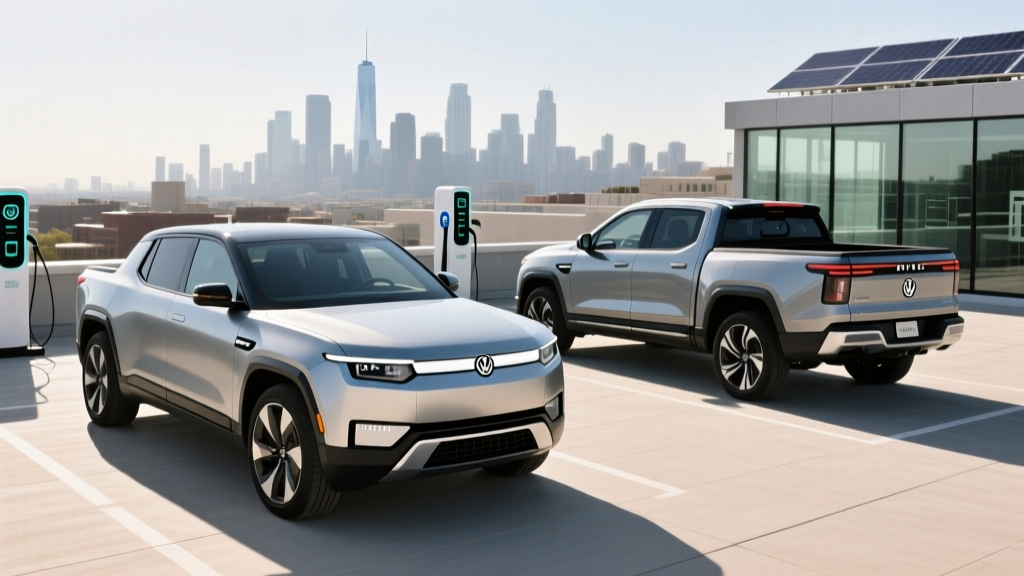
Rivian shares surged following third-quarter gross profit and Volkswagen funding news late in 2024, and the ripple effects are reshaping what buyers can expect from the 2026 Rivian R1S SUV and R1T pickup. The VW investment — part of a joint venture worth up to $5 billion — gave Rivian the capital runway to accelerate its second-generation R1 platform, slash production costs, and push toward sustained profitability. For shoppers, the real question isn't the stock ticker. It's whether the 2026 R1S and R1T justify their premium pricing against an increasingly crowded field of electric SUVs and trucks.
This review breaks down everything that matters for buyers: EPA range versus real-world results, charging speeds on the NACS port, battery chemistry, tax credit eligibility under current IRS §30D rules, and how Rivian stacks up against the Tesla Model X, Ford F-150 Lightning, and GMC Hummer EV.
2026 Rivian R1S and R1T: The Core Specs at a Glance
| Spec | R1S Dual-Motor (Standard) | R1S Max Pack (Tri-Motor) | R1T Dual-Motor (Standard) | R1T Max Pack (Tri-Motor) |
|---|---|---|---|---|
| EPA Range | ~330 mi | ~410 mi | ~330 mi | ~415 mi |
| Battery Capacity (usable) | ~106 kWh (NMC) | ~141 kWh (NMC) | ~106 kWh (NMC) | ~141 kWh (NMC) |
| Horsepower | 533 hp | 850 hp | 533 hp | 850 hp |
| 0–60 mph | 4.5 sec | ~2.9 sec | 4.5 sec | ~3.0 sec |
| Drivetrain | Dual-Motor AWD | Tri-Motor AWD | Dual-Motor AWD | Tri-Motor AWD |
| Max DC Fast Charge | ~200 kW | ~220 kW | ~200 kW | ~220 kW |
| 10–80% DC Time | ~28 min | ~36 min | ~28 min | ~36 min |
| Level 2 Home Charge | 11.5 kW (~25 mi/hr) | 11.5 kW (~25 mi/hr) | 11.5 kW (~25 mi/hr) | 11.5 kW (~25 mi/hr) |
| Towing Capacity | 7,700 lb | 7,700 lb | 11,000 lb | 11,000 lb |
| Base MSRP (est.) | $75,900 | $99,900 | $69,900 | $93,900 |
Note: Specs reflect second-generation R1 platform updates. Final 2026 EPA certifications may vary slightly by trim and wheel size. Always confirm at fueleconomy.gov before purchasing.
Real-World Range: What the EPA Number Doesn't Tell You
EPA Estimate: 330 mi (Dual-Motor Standard) / 410 mi (Max Pack)
Real-World Highway (70 mph, mild weather): ~280–300 mi (Standard) / ~350–370 mi (Max Pack)
Cold Weather (below 32°F, highway): ~230–260 mi (Standard) / ~290–320 mi (Max Pack)
Heavy Towing (5,000+ lb trailer): ~160–200 mi (Standard) / ~210–250 mi (Max Pack)
Rivian's EPA range figures are competitive, but the boxy aerodynamics of both the R1S and R1T exact a toll at highway speeds. In real-world testing, expect to lose roughly 10–15% versus the sticker at sustained 70–75 mph driving. Cold weather compounds this — battery heating and cabin climate draw can push total range loss to 25–30% in sub-freezing conditions.
The Max Pack's 141 kWh NMC battery is one of the largest in any consumer EV, and that raw capacity provides a meaningful buffer. Even at 70% of rated range in winter, 290+ miles is enough for most road-trip legs between DC fast-charger stops. For R1T owners planning to tow, however, range planning becomes critical — a 7,000-pound boat or camper will cut range nearly in half.
Efficiency for the Dual-Motor R1S lands around 48–52 kWh/100mi (roughly 70–72 MPGe combined), which trails sleeker crossovers like the Hyundai Ioniq 5 or Tesla Model Y but is expected for a body-on-frame adventure vehicle with all-terrain tires.
Charging Speed: NACS, DC Fast Charging, and Home Setup
Starting with the second-generation platform, Rivian transitioned to the NACS (North American Charging Standard) connector, giving R1S and R1T owners native access to the Tesla Supercharger network — currently the most reliable and expansive DC fast-charging infrastructure in North America.
| Charging Level | Power / Rate | Miles Added per Hour | Notes |
|---|---|---|---|
| Level 1 (120V household) | ~1.4 kW | ~3–4 mi/hr | Emergency/trickle only |
| Level 2 (240V home, 48A) | 11.5 kW | ~25 mi/hr | Full charge overnight (~12–14 hrs for Max Pack) |
| DC Fast Charge (Standard Pack) | Peak ~200 kW | ~140 mi in 20 min | 10–80% in ~28 min; tapers sharply above 85% |
| DC Fast Charge (Max Pack) | Peak ~220 kW | ~150 mi in 20 min | 10–80% in ~36 min; larger battery = longer session |
A critical nuance buyers often miss: peak kW is not sustained kW. The R1's charge curve holds near its peak rate between roughly 15–55% State of Charge (SoC), then progressively tapers. From 80–100%, charging slows dramatically to protect the NMC cells — adding that final 20% can take as long as the first 70%. For road trips, plan stops around the 10–80% window to minimize time at the charger.
At home, a 48-amp Level 2 wall connector on a 60-amp circuit delivers the full 11.5 kW. Most owners will need a 240V outlet (NEMA 14-50) or hardwired installation. Budget $800–$2,500 for a quality Level 2 charger and electrician installation, depending on whether your electrical panel needs an upgrade to 200A service. Rivian's Wall Connector retails around $700 and integrates with the vehicle's scheduled charging and preconditioning features.
Preconditioning matters: When you navigate to a DC fast charger using the Rivian's built-in routing, the battery thermal management system pre-warms or pre-cools the pack to optimize charge acceptance. Skipping this (e.g., arriving at a charger without navigation routing) can add 5–10 minutes to your session in cold weather.
Performance and Drivetrain: Adventure Meets Acceleration
Rivian's dual-motor and tri-motor powertrains deliver performance that belies the R1's rugged exterior. The Dual-Motor AWD setup produces 533 hp and rockets either vehicle to 60 mph in approximately 4.5 seconds — quick for a 6,000+ pound SUV or truck. The Tri-Motor configuration pushes output to an estimated 850 hp, dropping 0–60 times into supercar territory at under 3.0 seconds for the R1S.
Beyond straight-line speed, Rivian's quad-corner air suspension provides up to 14.9 inches of ground clearance in Off-Road mode, a wading depth of over 3 feet, and a compliant highway ride in Standard mode. The R1T's unique Gear Tunnel (a pass-through storage compartment behind the cab) and integrated camp kitchen option remain standout features that no competitor matches.
For towing, the R1T is rated at 11,000 pounds — besting the Ford F-150 Lightning's 10,000-pound max. The R1S tows up to 7,700 pounds. Both include an integrated trailer brake controller and a towing-specific drive mode that adjusts regen, throttle mapping, and stability control.
Interior, Cargo, and Technology
The second-generation R1 interior received significant upgrades in material quality, processing power, and display responsiveness. The 15.6-inch center touchscreen runs Rivian's latest software, with over-the-air (OTA) update capability that has consistently added features post-purchase — from improved regen profiles to enhanced camp mode functionality.
R1S Cargo Space:
- Behind third row: ~10.5 cu ft
- Behind second row (third row folded): ~46.7 cu ft
- Max (all rear seats folded): ~91.6 cu ft
- Front trunk (frunk): ~11.0 cu ft
R1T Cargo Space:
- Bed length: 54.0 inches (4.5 ft) with standard bed; extendable with midgate
- Gear Tunnel: ~11.7 cu ft of sealed, lockable storage
- Frunk: ~11.0 cu ft
Driver Assistance: Rivian's Driver+ system is a SAE Level 2 driver-assist suite — it provides adaptive cruise control and lane-centering on highways but requires continuous driver supervision. It is not autonomous driving. The system is competent for long highway stretches but does not yet match the hands-off-on-certain-highways experience of GM's Super Cruise or Ford's BlueCruise on mapped roads. Expect continued OTA improvements as Rivian invests in its ADAS stack.
Rivian Driver+ is a Level 2 system per SAE classification. The driver must remain alert, keep hands on or near the wheel, and be prepared to take over at any moment. This is not Level 4 autonomous driving (which is currently only available in limited robotaxi services like Waymo in select cities).
Pricing, Trims, and Federal Tax Credit Eligibility
| Trim / Config | Base MSRP (est.) | §30D Federal Credit | Est. After-Credit Price |
|---|---|---|---|
| R1T Dual-Motor Standard | $69,900 | Up to $7,500* | ~$62,400 |
| R1T Tri-Motor Max Pack | $93,900 | $0 (MSRP cap) | $93,900 |
| R1S Dual-Motor Standard | $75,900 | $0 (MSRP cap) | $75,900 |
| R1S Tri-Motor Max Pack | $99,900 | $0 (MSRP cap) | $99,900 |
*Federal EV tax credit eligibility is subject to multiple IRS §30D requirements. See checklist below.
The critical tax-credit issue for Rivian buyers: the §30D MSRP cap for SUVs and pickups is $80,000. This means the Dual-Motor R1T (starting under $70K) can qualify, but most R1S configurations and all Max Pack / Tri-Motor models exceed the cap and are ineligible. Additionally, the credit is subject to:
- Buyer income limits: Modified AGI ≤ $150,000 (single) / $300,000 (joint filers)
- Battery sourcing requirements: Critical minerals and battery components must meet phased-in thresholds from US or FTA-partner countries — Rivian's supply chain compliance varies by build date
- Point-of-sale transfer: As of 2024, eligible buyers can transfer the credit to the dealer at purchase, reducing the upfront price rather than waiting for tax filing
Always verify current eligibility on IRS.gov and confirm with your tax professional before relying on the credit in your purchase decision. Rules have shifted annually and are subject to legislative changes.
Rivian vs. the Competition: Who Wins Where?
| Category | Rivian R1T (Dual-Motor) | Ford F-150 Lightning | Tesla Model X | GMC Hummer EV |
|---|---|---|---|---|
| Max EPA Range | ~330 mi (415 Max) | ~320 mi (Ext. Range) | ~335 mi | ~381 mi |
| Starting MSRP | ~$69,900 | ~$57,000 | ~$82,000 | ~$99,000 |
| Max Tow Rating | 11,000 lb | 10,000 lb | 5,000 lb | 7,500 lb |
| DC Fast Charge Peak | ~200 kW | ~150 kW | ~250 kW | ~350 kW |
| Off-Road Capability | Excellent | Good | Limited | Excellent |
| §30D Credit Eligible | Yes (base R1T) | Yes (most trims) | No (MSRP cap) | No (MSRP cap) |
- You want best-in-class off-road capability with genuine adventure DNA
- You need the R1T's unique Gear Tunnel and camp-kitchen ecosystem
- You value OTA software updates and a direct-to-consumer sales model
- You want NACS Supercharger access in a non-Tesle EV
- Budget is the top priority (F-150 Lightning undercuts by $12K+)
- You need maximum DC fast-charge speed (Tesla/Hummer charge faster)
- You want hands-free highway driving (GM Super Cruise is more mature)
- You need a third row with generous space (consider the Kia EV9)
Battery, Warranty, and Long-Term Ownership
Rivian uses NMC (nickel manganese cobalt) chemistry across all R1 battery packs. NMC offers higher energy density than LFP (lithium iron phosphate), which is essential for fitting 141 kWh into the Max Pack — but it comes with a trade-off. NMC cells benefit from avoiding prolonged 100% SoC storage; Rivian recommends daily charging to 85–90% for battery longevity and reserving 100% for road trips.
Warranty Coverage:
- Battery & Drive Units: 8 years / 175,000 miles (whichever comes first), with a minimum 70% capacity retention guarantee
- Limited Vehicle Warranty: 5 years / 60,000 miles
- Roadside Assistance: 5 years / 60,000 miles
Rivian's 175,000-mile battery warranty is competitive and signals confidence in its pack engineering. The 70% retention threshold is industry-standard — if your Max Pack drops below ~99 kWh usable capacity within the warranty window, Rivian will repair or replace modules to restore it above that threshold.
Long-term ownership costs to consider: insurance premiums for the R1S/R1T tend to run 15–25% above comparable gas vehicles, reflecting high repair costs for aluminum body panels and specialized ADAS sensors. Tire replacement for the factory all-terrain rubber averages $1,200–$1,800 per set. On the positive side, there are no oil changes, transmission fluid, or spark plugs — and brake pad life is significantly extended by regenerative braking.
What Rivian's Q3 Profit and VW Funding Mean for Buyers
The financial headline — Rivian shares surged following third-quarter gross profit and Volkswagen funding — isn't just investor news. It directly impacts buyers in three ways:
- Production stability: Gross profit achievement signals that Rivian's per-unit manufacturing costs have dropped below revenue, reducing the risk of production cuts or plant slowdowns that plagued 2022–2023.
- Software investment: The VW joint venture funds next-generation electrical architecture and ADAS development, meaning buyers can expect more rapid feature additions via OTA updates.
- Service network growth: Improved financials support Rivian's expansion of service centers and mobile service vans — historically a pain point for owners in rural areas.
For buyers who hesitated on Rivian due to startup risk, the VW partnership and path to profitability significantly de-risk the purchase. This is no longer a company fighting for survival — it's a maturing automaker with a credible long-term roadmap, including the more affordable R2 platform expected in 2026–2027.
Frequently Asked Questions
What is the real-world range of the 2026 Rivian R1S and R1T?
Expect approximately 280–300 miles on the highway in mild weather with the Dual-Motor Standard pack (EPA 330 mi), and 350–370 miles with the Max Pack (EPA 410 mi). Cold weather reduces these figures by 20–30%, and towing cuts range roughly in half. The Max Pack's enormous 141 kWh battery provides a real-world safety margin that few EVs can match.
How fast does the Rivian R1 charge at home and on the road?
At home on a 240V Level 2 charger (48 amps), the R1 adds roughly 25 miles of range per hour — enough to fully recharge a Standard pack overnight. On DC fast chargers, the Dual-Motor peaks at ~200 kW (10–80% in ~28 minutes) and the Max Pack at ~220 kW (10–80% in ~36 minutes). The NACS connector provides native Tesla Supercharger access.
How much does the Rivian R1 cost after the federal tax credit?
The base R1T Dual-Motor starts around $69,900 and may qualify for the full $7,500 §30D credit (subject to income limits, MSRP caps, and battery-sourcing rules), bringing the effective price to approximately $62,400. Most R1S configurations and all Max Pack / Tri-Motor trims exceed the $80,000 SUV MSRP cap and do not qualify. Verify eligibility at IRS.gov.
Is the Rivian R1 worth buying versus the Ford F-150 Lightning or Tesla Model X?
If off-road capability, adventure features (Gear Tunnel, camp kitchen, air suspension), and build quality are priorities, the Rivian justifies its premium. The F-150 Lightning is the value pick — significantly cheaper with strong utility — but lacks the R1T's sophistication and range. The Model X offers faster charging and access to Tesla's ecosystem but can't match the Rivian's ruggedness or truck utility.
Does the Rivian R1 qualify for the federal EV tax credit?
The base R1T Dual-Motor (under $70K MSRP) can qualify for up to $7,500 under IRS §30D, provided the buyer meets income thresholds ($150K single / $300K joint MAGI) and the specific vehicle's battery sourcing meets current-year critical-mineral and component requirements. Most R1S and all Tri-Motor/Max Pack configurations exceed the $80,000 MSRP cap and are ineligible. Always confirm with the IRS and your tax advisor before purchase.
What are the biggest pros and cons of owning a Rivian R1?
- Class-leading off-road capability and ground clearance
- Unique Gear Tunnel and adventure accessories
- Strong OTA update track record adding real features
- NACS Supercharger access
- 11,000-lb towing (R1T)
- 175,000-mile battery warranty
- Premium pricing; most trims ineligible for §30D credit
- Highway efficiency trails sleeker EVs (48–52 kWh/100mi)
- Driver+ ADAS lags behind Super Cruise / BlueCruise
- Insurance costs 15–25% above gas equivalents
- Third-row space in R1S is tight for adults
- Max Pack adds significant weight, increasing tire wear
Sources: EPA / fueleconomy.gov, IRS §30D Clean Vehicle Credit, Rivian official specifications. Pricing and credit eligibility reflect estimates based on available data and are subject to change. Confirm all figures with Rivian and a qualified tax professional before purchasing.