Rivian's Q3 2025 production and delivery figures marked a pivotal moment for the automaker. Between July and September 2025, Rivian produced 11,618 vehicles and delivered 10,482 units across the R1S SUV and R1T pickup — numbers that signaled both growing manufacturing maturity at its Normal, Illinois facility and the beginning of the Gen 2 platform transition. For buyers researching a Rivian purchase in 2026, understanding that Q3 milestone provides critical context for current build quality, delivery timelines, and the updated specs now rolling off the line.
This profile covers what those Q3 2025 numbers mean for today's shoppers, along with a full spec breakdown of the Gen 2 R1S and R1T as they stand for the 2026 model year — including real-world range, charging curves, pricing after federal tax credits, and how Rivian stacks up against Tesla, Ford, and Hyundai in the electric adventure segment.
Rivian Q3 2025 Production and Delivery by the Numbers
Rivian reported Q3 2025 results that landed squarely within the company's full-year guidance of 40,000 to 46,000 vehicles produced. The breakdown:
| Metric | Q3 2025 | YTD Through Q3 2025 |
|---|---|---|
| Vehicles Produced | 11,618 | ~33,500 |
| Vehicles Delivered | 10,482 | ~31,200 |
| Production-to-Delivery Gap | ~1,136 units | — |
The gap between production and delivery narrowed compared to prior quarters, suggesting improved logistics and fewer vehicles sitting in transit or awaiting final prep. This matters for 2026 buyers because it indicates Rivian's supply chain has matured — delivery estimates quoted at order time are now more reliable than the 2022-2023 era of multi-month delays.
Critically, Q3 2025 was the last full quarter dominated by Gen 1 vehicles before the Gen 2 R1 platform began reaching customers in volume. If you're ordering today, you're almost certainly getting a Gen 2 build, which brings meaningful hardware and software upgrades.
Gen 2 R1S and R1T: Full Spec Breakdown
The Gen 2 platform (introduced mid-2024, now in full production for 2026) brought a redesigned electrical architecture, new battery pack options, improved thermal management, and the in-house-developed Rivian Autonomy Platform. Here are the numbers that matter:
| Spec | R1S Dual-Motor (Standard) | R1S Dual-Motor (Max Pack) | R1T Dual-Motor (Max Pack) |
|---|---|---|---|
| Battery Capacity (usable) | ~92 kWh (LFP) | ~141 kWh (NMC) | ~141 kWh (NMC) |
| EPA Range | 270 mi | 410 mi | 420 mi |
| Horsepower | 533 hp | 533 hp | 533 hp |
| 0-60 mph | 4.5 sec | 4.5 sec | 4.5 sec |
| Drivetrain | AWD (dual-motor) | AWD (dual-motor) | AWD (dual-motor) |
| Max DC Fast Charge | 200 kW | 220 kW | 220 kW |
| 10-80% DC Charge | ~30 min | ~42 min | ~42 min |
| Level 2 Home Charge | 11.5 kW (~25 mi/hr) | 11.5 kW (~25 mi/hr) | 11.5 kW (~25 mi/hr) |
| MPGe (combined) | 73 MPGe | 70 MPGe | 72 MPGe |
| Towing Capacity | 7,700 lbs | 7,700 lbs | 11,000 lbs |
kW vs kWh refresher: kW (kilowatts) measures the rate of power flow — how fast you charge. kWh (kilowatt-hours) measures total energy stored — your battery's "tank size." A 141 kWh battery charged at 220 kW peak will still take over 40 minutes from 10-80% because the charge rate tapers as the battery fills.
Real-World Range: What the EPA Sticker Doesn't Tell You
R1S Max Pack: EPA 410 mi → Expect ~330-350 mi on highway road trips at 70-75 mph. In freezing temperatures (below 32°F), plan for 270-310 mi.
R1S Standard Pack (LFP): EPA 270 mi → Expect ~220-235 mi highway, dropping to ~185-200 mi in deep cold.
R1T Max Pack: EPA 420 mi → Expect ~340-360 mi highway unloaded; towing a 5,000-lb trailer cuts range to roughly 180-210 mi.
The R1S and R1T are large, heavy, boxy vehicles with the aerodynamics of adventure rigs, not teardrop sedans. Highway efficiency suffers accordingly. According to fueleconomy.gov, the R1S Max Pack achieves roughly 70 MPGe combined, which translates to about 48 kWh per 100 miles — thirsty by EV standards but expected for a 6,900-lb three-row SUV.
The Standard Pack's LFP (lithium iron phosphate) chemistry offers a trade-off: less energy density and lower range, but better long-term cycle life, faster charging at low states of charge, and the ability to routinely charge to 100% without accelerating degradation. For daily commuters with home charging, the LFP pack is arguably the more practical and durable choice.
Charging Speed and Infrastructure
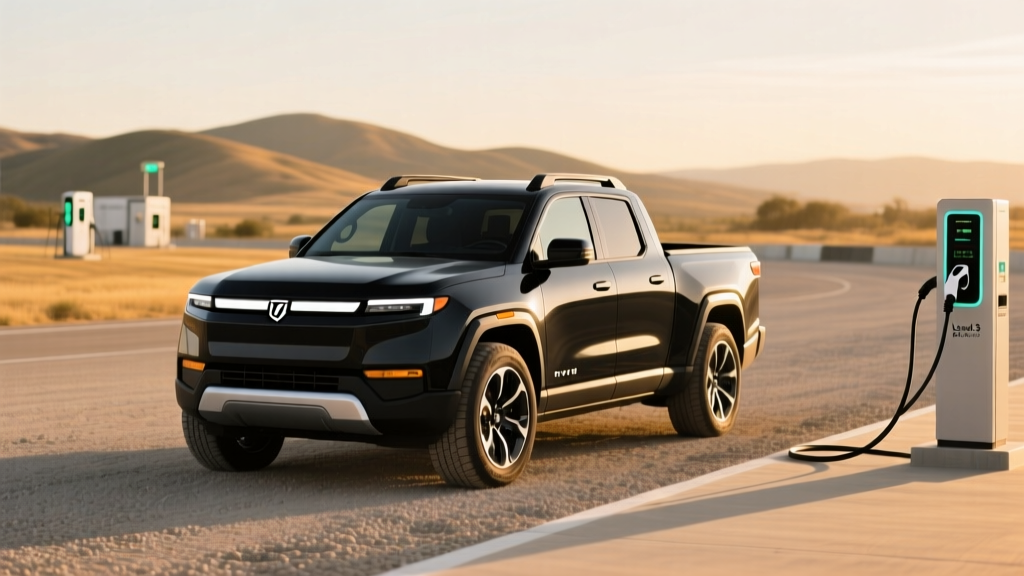
Rivian uses the NACS (North American Charging Standard) connector on all Gen 2 vehicles, giving native access to the Tesla Supercharger network — the largest and most reliable DC fast-charging network in North America. This was a major competitive advantage that took effect for 2025+ models.
| Charging Level | Power | Speed | Use Case |
|---|---|---|---|
| Level 1 (120V) | ~1.4 kW | ~3 mi/hr | Emergency/trickle only |
| Level 2 (240V home) | 11.5 kW | ~25 mi/hr | Daily overnight charging |
| DC Fast Charge | Up to 220 kW peak | 10-80% in ~42 min (Max) | Road trips |
Charging curve reality: The 220 kW peak on the Max Pack is sustained roughly from 10% to 35% state of charge. From 50-80%, expect the rate to taper to 80-120 kW. This is normal lithium-ion behavior — no EV sustains peak rate to 80%. The Standard LFP pack holds its charge rate more consistently across the curve, making its 200 kW peak arguably more usable in practice.
At home, an 11.5 kW Level 2 wall connector on a 60-amp circuit adds roughly 25 miles of range per hour. A full overnight charge (8 hours) replenishes about 200 miles — more than enough for most daily needs. Installation costs typically run $800-$2,000 depending on panel capacity and conduit distance. Homes with 100-amp electrical panels may need a $1,500-$3,000 panel upgrade to support a dedicated 60-amp circuit.
Pricing, Trims, and Federal Tax Credit Eligibility
| Model / Trim | Base MSRP | As-Tested Typical | §30D Credit Eligible? |
|---|---|---|---|
| R1S Dual-Motor Standard | $75,900 | $79,000-$84,000 | Check sourcing rules |
| R1S Dual-Motor Max Pack | $89,900 | $94,000-$102,000 | Exceeds MSRP cap |
| R1T Dual-Motor Standard | $69,900 | $73,000-$78,000 | Check sourcing rules |
| R1T Dual-Motor Max Pack | $83,900 | $88,000-$95,000 | Exceeds MSRP cap |
Federal tax credit rules (IRS §30D, 2026): The $7,500 credit has three gates you must clear simultaneously:
- MSRP cap: SUVs and pickups must be at or below $80,000 MSRP. This means the R1S Standard and R1T Standard potentially qualify; Max Pack trims exceed the cap.
- Buyer income cap: Modified AGI must not exceed $150,000 (single), $225,000 (head of household), or $300,000 (joint).
- Battery sourcing: Critical minerals and battery components must meet escalating domestic-content thresholds. Rivian has been working to source LFP cells domestically, but NMC Max Pack cells still rely heavily on overseas supply chains.
The credit can now be transferred to the dealer at point of sale, effectively reducing your purchase price by $7,500 upfront rather than waiting for a tax refund. Always verify current eligibility on irs.gov before committing, as battery-sourcing compliance lists update periodically. Consult a tax professional for your specific situation.
Cargo, Passenger Space, and Practicality
The R1S is a genuine three-row SUV, though the third row is best suited for children or short trips. The R1T is a crew-cab pickup with a unique gear tunnel.
| Dimension | R1S SUV | R1T Pickup |
|---|---|---|
| Cargo (behind 3rd row) | 20.5 cu ft | — |
| Cargo (behind 2nd row) | 57.7 cu ft | — |
| Cargo (max, seats folded) | 104.7 cu ft | — |
| Bed length | — | 54.2 in (4.5 ft) |
| Gear Tunnel | — | 11.7 cu ft |
| Front legroom | 41.3 in | 41.3 in |
| 2nd-row legroom | 38.2 in | 38.2 in |
| 3rd-row legroom | 30.4 in | — |
| Frunk | 11.1 cu ft | 11.1 cu ft |
The R1T's gear tunnel — a pass-through compartment behind the rear seats — is a genuinely clever feature for storing long items like skis, fishing rods, or camping gear. Combined with the frunk and the bed, the R1T offers more usable storage volume than most midsize pickups despite its shorter bed.
Technology, Driver Assists, and the Rivian Autonomy Platform
Gen 2 Rivians ship with the company's in-house Autonomy Platform, replacing the earlier reliance on third-party hardware. The system uses 11 cameras, 5 radar units, and a custom autonomy computer.
Rivian's Highway Assist and Enhanced Adaptive Cruise are Level 2 driver-assistance systems. They provide steering, acceleration, and braking support on highways, but the driver must remain fully engaged, hands on or near the wheel, and eyes on the road at all times. This is not self-driving. Only Level 4 robotaxi services like Waymo operate without a human driver.
Key tech features include a 15.6-inch center touchscreen running Rivian's custom OS, over-the-air software updates, a built-in camp kitchen option (R1T), pet mode, and a gear guard with cable lock for securing items in the bed. The infotainment system supports wireless Apple CarPlay and Android Auto, though some owners note the native navigation is more tightly integrated with the vehicle's range and charging planner.
Notable drawbacks: The R1 platform's ride quality on rough pavement can be firm, especially with the 22-inch wheel option. Wind noise at highway speeds is more noticeable than in the Tesla Model X or Mercedes EQS SUV. And Rivian's service center network, while expanding, remains thin in rural areas — a consideration if you live far from a metro market.
Who Should Buy a Rivian — and Who Shouldn't
- You need genuine off-road capability (8.9-14.9 in ground clearance, quad-motor tank turns available)
- You tow regularly (up to 11,000 lbs for R1T)
- You want a three-row electric SUV that isn't a minivan (R1S)
- You value build quality, outdoor-oriented design, and NACS Supercharger access
- You can charge at home and your daily driving is under 200 miles
- Maximum efficiency and range-per-dollar are your top priorities (Hyundai Ioniq 5, Tesla Model Y are more efficient)
- You live in a rural area with no nearby Rivian service center
- You want Level 4 autonomous driving (not available on any consumer vehicle)
- Budget is tight — even after the tax credit, a well-equipped R1 exceeds $75,000
Warranty and Long-Term Ownership
Rivian provides an 8-year/175,000-mile battery and drive unit warranty — one of the most generous mileage thresholds in the industry. The bumper-to-bumper warranty covers 5 years or 60,000 miles. The battery warranty guarantees that the pack will retain at least 70% of its original capacity over the warranty period; falling below that threshold triggers a repair or replacement at Rivian's expense.
For context, Tesla's battery warranty is 8 years/120,000 miles (Model S/X) or 8 years/100,000 miles (Model 3/Y). Ford's is 8 years/100,000 miles. Rivian's 175,000-mile threshold reflects confidence in the Gen 2 pack's durability, particularly the LFP Standard Pack, which is known for slower degradation over thousands of charge cycles.
Frequently Asked Questions
What was Rivian's Q3 2025 production total, and why does it matter now?
Rivian produced 11,618 vehicles and delivered 10,482 in Q3 2025. This confirmed the company's manufacturing cadence heading into the Gen 2 transition. For 2026 buyers, it signals that delivery timelines have stabilized and the Normal, Illinois factory is operating at a sustainable rate.
What is the real-world range of the Rivian R1S?
The EPA rates the R1S Max Pack at 410 miles and the Standard LFP pack at 270 miles. In real-world highway driving at 70-75 mph, expect roughly 330-350 miles (Max) or 220-235 miles (Standard). Cold weather below freezing reduces those figures by 15-25%.
How fast does the Rivian charge at home and on the road?
At home on a 240V Level 2 charger (11.5 kW), the R1 adds about 25 miles of range per hour. On a DC fast charger, the Max Pack peaks at 220 kW and charges from 10-80% in approximately 42 minutes. The Standard LFP pack peaks at 200 kW with a 10-80% time around 30 minutes.
Does the Rivian R1S qualify for the $7,500 federal tax credit?
Possibly — it depends on trim and your income. The R1S Standard ($75,900 MSRP) falls under the $80,000 SUV cap. The R1S Max Pack ($89,900) exceeds it and is ineligible regardless of income. All trims require the buyer to meet IRS income caps and the vehicle must satisfy battery critical-mineral and component sourcing requirements, which change periodically. Verify at irs.gov.
Is the Rivian R1 worth buying over a Tesla Model X or Ford F-150 Lightning?
The R1S offers better off-road capability and build quality than the Model X, with a more adventure-focused design. The R1T competes with the F-150 Lightning on towing but offers the unique gear tunnel and more premium interior. If you prioritize efficiency and Supercharger ubiquity, Tesla still leads. If you want a rugged, well-built electric adventure vehicle with NACS Supercharger access already baked in, Rivian is the strongest option in its class.