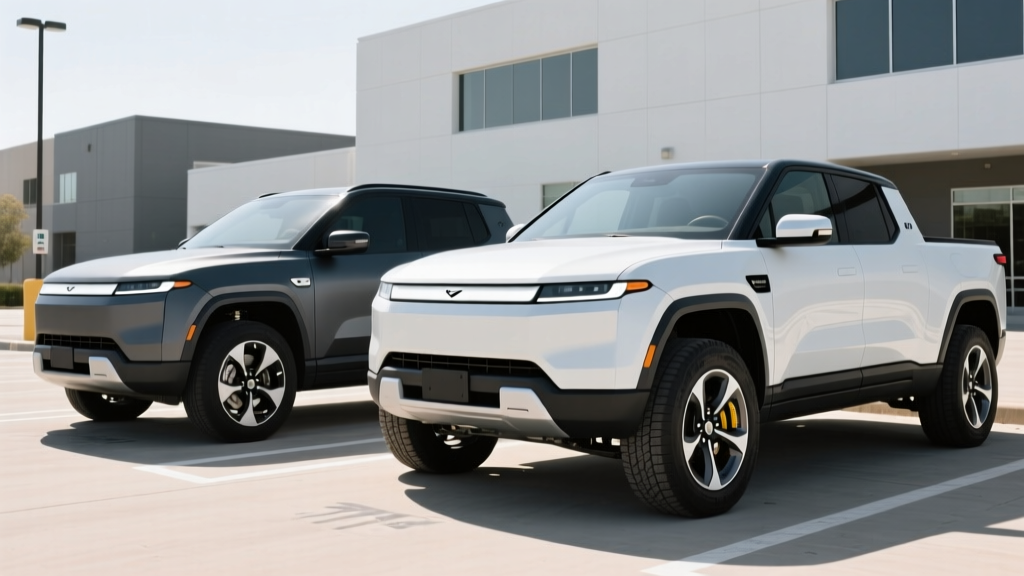
Rivian's Q1 2025 earnings call wasn't just a financial report—it was a roadmap for anyone considering an R1T pickup or R1S SUV over the next 18 months. Between production milestones, the rollout of the Tri-Motor powertrain, and updated guidance on its next-generation battery pack, the earnings release contained critical buying signals that spec sheets alone don't capture.
As of early 2026, Rivian has delivered over 100,000 vehicles cumulatively, narrowed its per-vehicle loss significantly, and confirmed that the R1 Gen 2 refresh (introduced mid-2025) is now the sole production configuration. Here's what the financial data means for your purchase decision—and the full spec breakdown you need.
Rivian Q1 2025 Earnings: Key Takeaways for Buyers
Rivian reported Q1 2025 revenue of $1.2 billion with gross margin turning positive for the first time on a per-vehicle basis (excluding regulatory credits). The company produced approximately 9,500 vehicles and delivered roughly 8,400 in the quarter. More importantly for buyers:
- Gen 2 R1 production fully ramped — the updated R1T and R1S with Tri-Motor option, new electrical architecture, and revised interior are now the only configurations being built.
- Gen 2 battery pack timeline confirmed — Rivian's in-house designed LFP-based pack is expected for the R2 platform (late 2026) but may trickle into R1 fleet orders by late 2026 or early 2027.
- Service network expansion — 45+ service centers and growing mobile service fleet, addressing a top owner complaint from 2022-2023.
- Software-defined vehicle progress — over-the-air updates now cover chassis, ADAS, and infotainment with faster deployment cycles.
The financial picture matters because it signals whether Rivian will be around to honor your 8-year battery warranty. Positive per-vehicle gross margin and the confirmed R2 production timeline at the new Georgia plant suggest the company has moved past its most precarious cash-burn phase.
2026 R1T & R1S: Full Spec Breakdown
The current R1 lineup uses Samsung SDI-sourced NMC (nickel manganese cobalt) cylindrical cells in two pack sizes. The Gen 2 refresh added a Tri-Motor configuration and revised thermal management for improved sustained charging performance.
| Spec | R1T Dual-Motor (Standard) | R1T Dual-Motor (Max Pack) | R1T Tri-Motor (Max Pack) |
|---|---|---|---|
| EPA Range | 270 mi | 420 mi | 380 mi |
| Battery (usable) | ~92 kWh (NMC) | ~141 kWh (NMC) | ~141 kWh (NMC) |
| Horsepower | 533 hp | 533 hp | 850 hp |
| Torque | 610 lb-ft | 610 lb-ft | 1,103 lb-ft |
| 0-60 mph | 4.5 sec | 4.5 sec | 2.9 sec |
| Drivetrain | AWD (dual-motor) | AWD (dual-motor) | AWD (tri-motor) |
| Max DC Fast Charge | 200 kW | 220 kW | 220 kW |
| 10-80% DCFC Time | ~30 min | ~42 min | ~42 min |
| Level 2 Home Charge | 11.5 kW (~25 mi/hr) | 11.5 kW (~25 mi/hr) | 11.5 kW (~25 mi/hr) |
| Towing Capacity | 11,000 lbs | 11,000 lbs | 11,000 lbs |
| MPGe (combined) | 73 MPGe | 70 MPGe | 65 MPGe |
| Base MSRP (R1T) | $69,900 | $83,900 | $99,900 |
Source: Rivian R1T specifications, fueleconomy.gov. R1S pricing starts ~$1,000 higher than equivalent R1T trims.
Real-World Range: What the EPA Number Doesn't Tell You
EPA Sticker: 270 mi (Standard) / 420 mi (Max) / 380 mi (Tri-Motor)
Highway (70-75 mph, moderate temps): Expect ~230 mi / ~360 mi / ~320 mi
Cold Weather (below 32°F, highway): Expect ~185 mi / ~290 mi / ~260 mi
Towing (5,000+ lb trailer): Range drops 40-50% — plan for ~140-160 mi (Standard pack)
The R1 platform's boxy shape and 6,000+ lb curb weight work against highway efficiency. In real-world testing, the Max Pack R1T averages around 2.0-2.2 kWh/mile at highway speeds, which translates to roughly 350-370 miles from the ~141 kWh usable battery in ideal conditions. Cold weather hits the large pack harder in absolute terms—expect to lose 100+ miles of range in sub-freezing road trips unless you precondition at a charger.
The Gen 2 thermal management system improves cold-weather preconditioning speed, but physics is physics: a 6,800-lb truck with the aerodynamic profile of a brick will consume more energy at 75 mph than a sleek sedan. Plan charging stops accordingly.
Charging Speed: DC Fast & Home Level 2
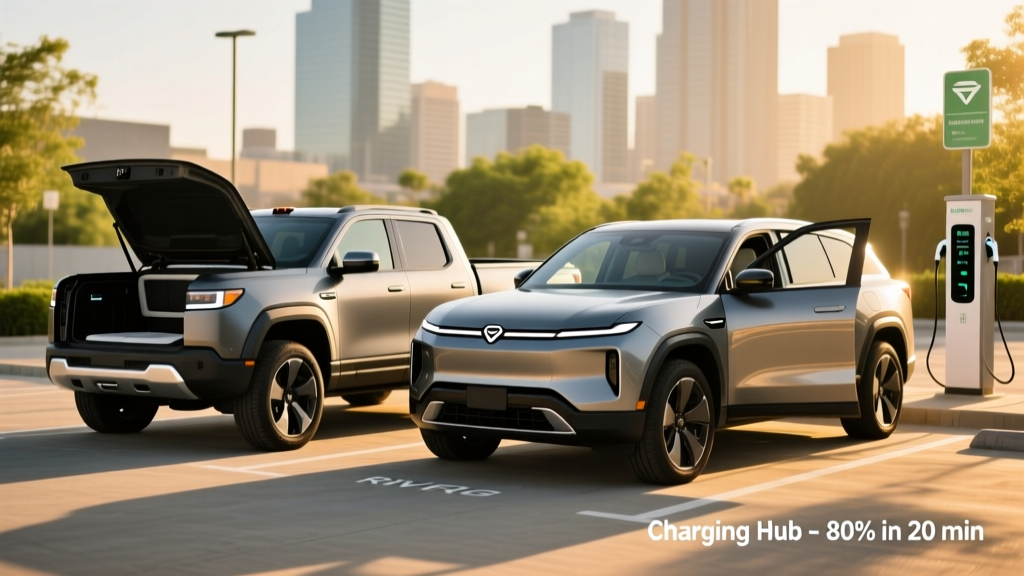
Rivian uses the NACS (Tesla-style) connector on all Gen 2 vehicles, granting native access to the Tesla Supercharger network (15,000+ stalls in North America) without an adapter. This was a major competitive advantage confirmed during the Q1 2025 earnings discussion of charging infrastructure partnerships.
| Charging Level | Power (kW) | Miles Added per Hour | Notes |
|---|---|---|---|
| Level 1 (120V outlet) | ~1.4 kW | ~3 mi/hr | Emergency/trickle only |
| Level 2 (240V, 48A) | 11.5 kW | ~25 mi/hr | Full charge overnight (~10-14 hrs for Max) |
| DC Fast Charge (Standard) | Peak 200 kW | ~200 mi in 20 min | Tapers significantly above 80% |
| DC Fast Charge (Max/Tri) | Peak 220 kW | ~220 mi in 20 min | 10-80% in ~42 min; 80-100% adds 30+ min |
Charging curve reality check: The R1 Max Pack peaks at 220 kW only between roughly 15-40% State of Charge. By 60% SoC, it drops to ~150 kW, and above 80% it falls below 50 kW. On a road trip, plan to charge from 10-80% and skip the slow top-off unless you're at your overnight destination. The larger battery's higher absolute charge times are the trade-off for its exceptional range.
At home, a 48-amp Level 2 charger on a 60-amp circuit adds roughly 25 miles of range per hour. For daily commuters who use 40-60 miles round-trip, a standard overnight charge easily replenishes daily use. Max Pack owners who deplete the battery on a road trip should expect a full Level 2 charge to take 12-14 hours.
Pricing, Tax Credits, and Total Cost
| Configuration | Base MSRP | Federal §30D Credit | Effective Price (if eligible) |
|---|---|---|---|
| R1T Dual-Motor Standard | $69,900 | $7,500 (point-of-sale) | ~$62,400 |
| R1T Dual-Motor Max Pack | $83,900 | $7,500 (point-of-sale) | ~$76,400 |
| R1T Tri-Motor Max Pack | $99,900 | $7,500 (point-of-sale) | ~$92,400 |
| R1S Dual-Motor Standard | $74,900 | $7,500 (point-of-sale) | ~$67,400 |
| R1S Dual-Motor Max Pack | $89,900 | $7,500 (point-of-sale) | ~$82,400 |
Critical §30D eligibility requirements (per IRS guidelines):
- MSRP cap: Trucks/SUVs must have an MSRP at or below $80,000. The R1T Dual-Motor Standard and R1S Dual-Motor Standard qualify. The Max Pack and Tri-Motor trims exceed the cap and are not eligible for the new-vehicle §30D credit.
- Buyer income cap: Modified AGI must not exceed $150,000 (single), $225,000 (head of household), or $300,000 (joint filers).
- Battery sourcing: A percentage of critical minerals must be sourced from the U.S. or FTA partners (threshold increases annually). Rivian's Samsung SDI cells have partially qualified in prior years, but annual threshold increases may affect eligibility. Confirm current-year status with your dealer and tax professional.
- Point-of-sale transfer: Eligible buyers can transfer the credit to the dealer for an immediate price reduction at purchase.
The MSRP cap is the dealbreaker for most R1 buyers. If you want the Max Pack or Tri-Motor, you're paying full MSRP for the new-vehicle credit. However, used R1 vehicles (model year 2022+) may qualify for the separate §25E used clean vehicle credit of up to $4,000 (30% of sale price, capped), with lower income thresholds ($75,000 single / $150,000 joint).
Performance, Cargo, and Daily Livability
The R1T's party trick remains its quad-motor torque vectoring (on Tri-Motor, effectively tri-motor with the rear axle handling torque distribution). The 2.9-second 0-60 time in the Tri-Motor puts it in supercar territory, but the real-world value is in low-speed off-road precision and confident highway merging with a loaded bed.
R1T cargo dimensions:
- Bed length: 54.0 inches (4.5 ft)
- Bed width (between wheel wells): 50.0 inches
- Gear Tunnel (R1T exclusive): 11.7 cu ft, lockable, pass-through — fits golf bags, ski gear, or a week of camping supplies
- Frunk (front trunk): 11.0 cu ft
- Total enclosed storage: ~76 cu ft (bed + tunnel + frunk with tonneau cover)
R1S passenger space:
- Seating: 7-passenger (3 rows)
- Front legroom: 41.3 inches
- Second-row legroom: 38.6 inches
- Third-row legroom: 30.1 inches (tight for adults on long trips)
- Cargo behind 3rd row: 10.6 cu ft
- Cargo behind 2nd row (3rd folded): 46.7 cu ft
- Max cargo (all rear seats folded): 91.6 cu ft
Standout tech features:
- Rivian Driver+ (Level 2 ADAS): Adaptive cruise + lane centering on mapped highways. Competent but not class-leading vs. GM Super Cruise or Ford BlueCruise.
- 15.6-inch center touchscreen with custom Rivian OS — responsive, OTA-updatable, but no Apple CarPlay/Android Auto (Rivian's native system replaces them).
- Camp Kitchen accessory (R1T): Slide-out induction cooktop and sink from the Gear Tunnel.
- Powered tonneau cover, air suspension with 6.5 inches of travel adjustment, wading mode for water crossings up to 36 inches.
- Vehicle-to-load (V2L): Power devices or a campsite from the bed outlets (up to 2.4 kW continuous).
Notable drawbacks:
- No native Apple CarPlay or Android Auto — a dealbreaker for some buyers accustomed to phone projection.
- Third row in the R1S is tight; best suited for children or short trips.
- Service center density still lags legacy OEMs in rural areas, though mobile service coverage has expanded.
- Efficiency (kWh/100mi) trails lighter, more aerodynamic EVs — you pay for the truck's capability at every charging stop.
R1 vs. Competitors: Is Rivian Worth It in 2026?
- You need genuine truck capability (11,000-lb tow, off-road, Gear Tunnel) with EV power
- NACS + Supercharger access is a priority for road trips
- You value OTA software updates and a tech-forward ownership experience
- You want a distinctive, non-legacy-OEV design with strong community/owner culture
- Budget is under $60K — consider the Ford F-150 Lightning XLT or Chevy Silverado EV
- You need a full-size crew-cab bed (R1T bed is midsize at 4.5 ft)
- Apple CarPlay/Android Auto is non-negotiable (most competitors offer it)
- You want a proven dealer/service network in rural areas (Ford/Chevy advantage)
Against the Ford F-150 Lightning, the R1T sacrifices bed length and rear-seat space for superior off-road capability, the Gear Tunnel, and a more car-like driving experience. The Lightning is the pragmatic work truck; the R1T is the adventure-lifestyle truck.
Against the Tesla Cybertruck, the R1T offers a more conventional (and repairable) body, real NACS Supercharger access without caveats, and a proven build quality track record. The Cybertruck edges on efficiency and stainless-steel durability claims, but Rivian's fit-and-finish has been consistently rated higher by owners.
Warranty and Long-Term Ownership
Rivian's warranty package for the 2026 R1 lineup:
- Battery & Drive Unit: 8 years / 175,000 miles (whichever comes first), with a capacity retention threshold of 70% — if your battery degrades below 70% of original capacity within the warranty period, Rivian will repair or replace it.
- Limited Vehicle Warranty: 5 years / 60,000 miles bumper-to-bumper.
- Corrosion Perforation: 5 years / unlimited miles.
- Roadside Assistance: 5 years / 60,000 miles.
The 175,000-mile battery warranty is generous—above the industry-standard 100,000 miles. Given that the Samsung SDI NMC cells in the R1 have shown minimal degradation in 2022-2024 owner reports (typically 3-5% over 50,000 miles), long-term battery health appears solid. However, Rivian is still a young company; long-term data beyond 100,000 miles is still accumulating.
Insurance costs are a real consideration: R1T/R1S premiums typically run 25-40% higher than comparable ICE trucks due to repair costs, aluminum body panels, and limited aftermarket parts. Get quotes before purchasing—this can add $800-$1,500/year depending on your profile.
Frequently Asked Questions
What is the real-world range of the Rivian R1T?
The EPA rates the R1T Dual-Motor Standard at 270 miles and the Max Pack at 420 miles. In real-world highway driving at 70-75 mph in moderate temperatures, expect roughly 230 miles (Standard) or 350-370 miles (Max). Cold weather below freezing can reduce range by 25-35%. Towing cuts range roughly in half.
How fast does the R1 charge at home and on the road?
At home on a 240V/48A Level 2 charger, the R1 adds about 25 miles of range per hour (11.5 kW). On a DC fast charger, it peaks at 200-220 kW depending on pack size, achieving a 10-80% charge in approximately 30 minutes (Standard) or 42 minutes (Max). Charging slows significantly above 80% SoC.
Does the Rivian R1 qualify for the $7,500 federal tax credit?
Only the Standard Pack trims (R1T at $69,900 and R1S at $74,900) fall under the §30D MSRP cap of $80,000 for trucks/SUVs. Max Pack and Tri-Motor trims exceed the cap and are ineligible for the new-vehicle credit. All buyers must also meet IRS income caps ($150K single / $300K joint) and battery sourcing requirements. Confirm eligibility with your tax professional and check IRS.gov for current-year rules.
Is the Rivian R1T worth buying over the Ford F-150 Lightning?
It depends on your use case. The R1T excels at off-road adventure, offers the unique Gear Tunnel, and provides a more refined driving experience with native NACS/Supercharger access. The F-150 Lightning wins on bed size (5.5-6.5 ft), rear-seat room, dealer/service network depth, and lower starting price (~$55,000). If you need a work truck, go Lightning. If you want a lifestyle adventure truck, the R1T is the stronger choice.
What are the biggest pros and cons of owning a Rivian?
Pros: Exceptional off-road capability, Gear Tunnel storage, NACS Supercharger access, strong OTA update cadence, premium interior, 11,000-lb towing, active owner community. Cons: No Apple CarPlay/Android Auto, midsize bed limits work-truck utility, higher insurance premiums, service center availability in rural areas, Max/Tri-Motor trims ineligible for federal tax credit, efficiency trails lighter EVs.
Will Rivian's financial health affect my ownership experience?
Rivian's Q1 2025 earnings showed the first positive per-vehicle gross margin and confirmed the R2 production timeline. While no startup is risk-free, the company's cash runway, Volkswagen's $5.8 billion investment (confirmed through 2024-2025), and the Georgia R2 plant construction suggest medium-term stability. The 8-year/175,000-mile battery warranty is backed by the company, so monitoring quarterly earnings is prudent for any buyer committing to a long-term vehicle purchase.