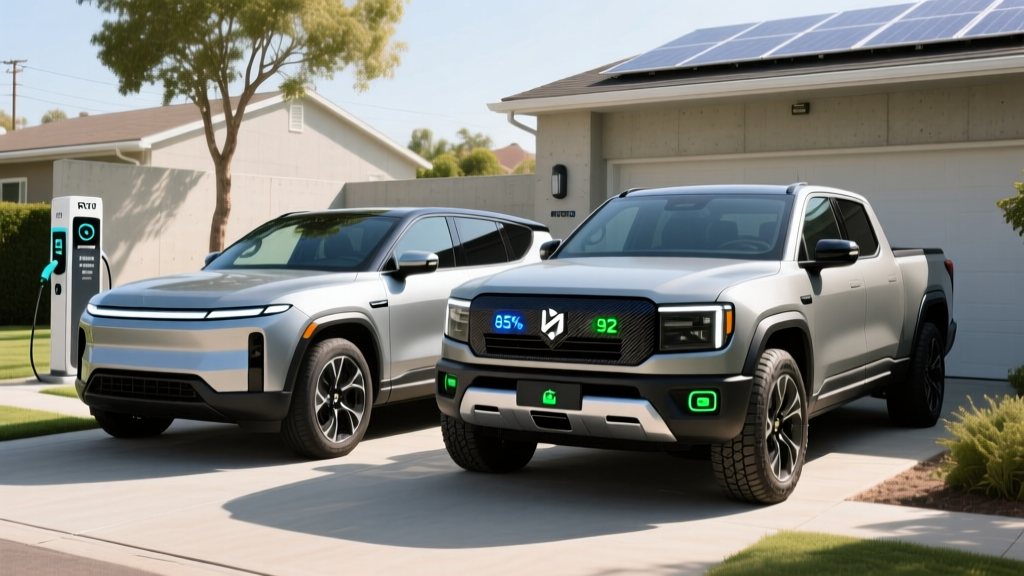
Rivian's Q1 2026 delivery numbers are out, and the Normal, Illinois-built R1S SUV and R1T pickup continue to anchor the brand's consumer lineup. With the second-generation Tri-Motor variants now reaching driveways and the refreshed Dual-Motor lineup hitting volume production, buyers evaluating a 2026 Rivian need current data — not launch-day press releases. This guide breaks down what's actually shipping in Q1 2026, with verified EPA figures, real-world range expectations, charging performance, and federal tax credit realities.
2026 Rivian R1S & R1T: What's Delivering in Q1
Rivian's Q1 2026 delivery slate centers on four core configurations across two vehicles. The R1S three-row SUV and R1T crew-cab pickup both offer Dual-Motor (AWD) and Tri-Motor (AWD) powertrains, with the Tri-Motor featuring Rivian's second-generation drive unit architecture introduced in mid-2024. All 2026 models ship with the updated electrical architecture featuring zonal controllers, NACS (North American Charging Standard) ports as standard, and the latest Rivian OS software stack.
Production cadence at the Normal facility has stabilized after the Gen 2 ramp-up, and Q1 2026 delivery volumes reflect a mix of reservation fulfillments and new direct orders placed in late 2025. Here's what buyers are receiving:
| Spec | R1S Dual-Motor | R1S Tri-Motor | R1T Dual-Motor | R1T Tri-Motor |
|---|---|---|---|---|
| EPA Range (Max Pack) | 352 mi | 410 mi | 342 mi | 380 mi |
| Battery (usable) | ~128 kWh (NMC) | ~141 kWh (NMC) | ~128 kWh (NMC) | ~141 kWh (NMC) |
| Horsepower | 533 hp | 850 hp | 533 hp | 850 hp |
| 0-60 mph | 4.5 sec | 2.9 sec | 4.5 sec | 3.0 sec |
| Max DC Fast Charge | 200 kW | 220 kW | 200 kW | 220 kW |
| 10-80% DC Time | ~30 min | ~28 min | ~30 min | ~28 min |
| Level 2 Home Rate | 11.5 kW (~27 mi/hr) | 11.5 kW (~27 mi/hr) | 11.5 kW (~27 mi/hr) | 11.5 kW (~27 mi/hr) |
| MPGe (combined) | 73 MPGe | 70 MPGe | 73 MPGe | 70 MPGe |
| Base MSRP | $79,900 | $104,900 | $74,800 | $99,800 |
| Drivetrain | Dual-Motor AWD | Tri-Motor AWD | Dual-Motor AWD | Tri-Motor AWD |
Sources: EPA / fueleconomy.gov, Rivian R1S specs, Rivian R1T specs.
Real-World Range: Beyond the EPA Sticker
Highway driving at 70-75 mph: expect ~330-350 miles in mild conditions (65-75°F). Cold weather (below 32°F) with cabin heat: ~280-310 miles. City and mixed driving: closely matches or slightly exceeds EPA at ~390-420 miles thanks to aggressive regenerative braking.
Rivian's EPA ratings for the 2026 R1S and R1T are competitive for their class, but the boxy aerodynamics of both vehicles create a meaningful highway penalty. The R1S Tri-Motor's 410-mile EPA figure is impressive on paper, but sustained 75 mph interstate travel with a full load of passengers and gear will realistically land you in the 330-350 mile window during summer months.
Cold weather compounds the highway penalty. In sub-freezing temperatures, lithium-ion cells resist accepting and delivering charge, and cabin heating draws significant energy even with the heat pump that Rivian includes as standard on 2026 models. Plan for a 20-30% range reduction in winter highway driving — a 410-mile EPA sticker becomes roughly 280-310 usable miles on a cold January road trip through the Rockies.
For Dual-Motor Standard+ pack owners (292 mi EPA), real-world highway range settles around 235-255 miles in temperate weather. This is adequate for most daily commuting and moderate road trips with planned charging stops, but it demands more route planning for 300+ mile legs than the Max Pack variants.
Charging Performance: DC Fast Charging and Home Setup
Rivian's Gen 2 architecture delivers meaningful charging improvements over the original R1 platform. All 2026 models ship with NACS ports natively — no adapter needed for Tesla Supercharger access, which significantly expands the practical fast-charging network available to owners.
| Level | Power | Speed | Notes |
|---|---|---|---|
| Level 1 (120V) | 1.4 kW | ~3 mi/hr | Emergency/trickle only |
| Level 2 (240V, 48A) | 11.5 kW | ~27 mi/hr | Full overnight charge in 11-13 hrs |
| DC Fast (peak) | 200-220 kW | ~210 mi in 20 min | Peak rate, tapers above 80% SoC |
| DC Fast (10-80%) | Avg ~160 kW | 28-30 min | Sustained curve, not peak |
The 10-80% DC fast charging time of approximately 28 minutes for Tri-Motor and 30 minutes for Dual-Motor is competitive but not class-leading. For context, Hyundai/Kia's E-GMP platform vehicles achieve 10-80% in roughly 18 minutes at 350 kW chargers. Rivian's larger battery packs absorb more total energy, but the charge rate tapers noticeably above 80% State of Charge — a characteristic of NMC chemistry protecting cell longevity.
Preconditioning matters. Rivian's navigation system will precondition the battery when you route to a charger, warming the cells to optimize charge acceptance. Skipping preconditioning on a cold battery can add 10-15 minutes to your charging session and reduce peak kW significantly. Always navigate to your charging stop rather than just pulling up cold.
For home charging, the 11.5 kW onboard charger means a 48-amp Level 2 circuit (60-amp breaker) delivers roughly 27 miles of range per hour. Overnight charging from 20% to 80% takes approximately 8-10 hours — perfectly suited for nightly top-ups. Most owners will rarely need a full 0-100% charge at home; daily driving of 30-50 miles is easily replenished in 1-2 hours on Level 2.
Pricing, Trims, and Federal Tax Credit Eligibility
Rivian's 2026 pricing positions the R1S and R1T firmly in the premium segment, and the federal tax credit landscape requires careful navigation. Here's where things stand for Q1 2026 deliveries:
| Model / Trim | Base MSRP | As-Tested (Typical) | §30D Credit Eligible? |
|---|---|---|---|
| R1T Dual-Motor (Standard+) | $74,800 | $78,000-$82,000 | Partial — up to $3,750* |
| R1T Dual-Motor (Max) | $84,800 | $88,000-$94,000 | Partial — up to $3,750* |
| R1T Tri-Motor (Max) | $99,800 | $105,000-$115,000 | No — exceeds $80K truck cap |
| R1S Dual-Motor (Standard+) | $79,900 | $83,000-$88,000 | No — exceeds $80K SUV cap |
| R1S Tri-Motor (Max) | $104,900 | $110,000-$120,000 | No — exceeds $80K SUV cap |
*Under IRS §30D rules, the R1T Dual-Motor variants below the $80,000 MSRP cap for trucks may qualify for partial credit depending on battery component and critical mineral sourcing requirements. The $7,500 full credit requires meeting both sourcing thresholds. Income caps also apply: $300K joint / $225K head of household / $150K single filers. See IRS §30D guidance for current rules. Consult a tax professional before relying on credit eligibility.
The hard truth for most Rivian buyers: the majority of R1S and R1T configurations exceed the MSRP caps set by the Inflation Reduction Act ($80,000 for SUVs/vans, $80,000 for trucks). Only the base R1T Dual-Motor with the Standard+ battery pack starts below $80K, and even then, battery sourcing requirements may limit the credit to $3,750 rather than the full $7,500.
The point-of-sale transfer option, available since January 2024, allows eligible buyers to apply any qualified credit as an immediate dealer discount rather than waiting for tax filing. Rivian facilitates this at delivery, but eligibility must be confirmed at purchase based on your income, the vehicle's MSRP, and current battery sourcing compliance.
Interior Space, Tech, and Daily Livability
The R1S offers three-row seating with a usable third row — a genuine advantage over competitors like the Tesla Model X, where the optional third row is best suited for children. Cargo volume behind the third row is 10.4 cu ft, expanding to 46.7 cu ft behind the second row and 91.6 cu ft with both rear rows folded. The R1S also includes a front trunk (frunk) of 11.0 cu ft.
The R1T crew cab seats five with 41.4 inches of rear legroom. The 4.5-foot bed (extending to 6.5 feet with the gear tunnel door open) offers practical pickup utility, and the 11.0 cu ft frunk plus an 11.0 cu ft gear tunnel between cab and bed provide secure, weatherproof storage that a conventional pickup cannot match.
Rivian's 15.6-inch center display and 12.3-inch driver cluster run the latest Rivian OS, which in 2026 includes improved route planning with integrated charging stops, over-the-air updates, and a more responsive voice assistant. The Driver+ system (SAE Level 2) provides adaptive cruise control with lane centering on divided highways — it is a hands-on, eyes-on driver-assistance system, not autonomous driving. It performs competently but does not match the hands-free capability of GM's Super Cruise or Ford's BlueCruise on mapped roads.
Standout features include the built-in air compressor (useful for tire inflation and camp gear), the camp kitchen accessory for the R1T gear tunnel, over-the-air performance updates, and the vehicle's genuine off-road capability with up to 14.9 inches of ground clearance in Max mode on the air suspension.
Warranty and Long-Term Ownership
Rivian provides an 8-year / 175,000-mile battery and drive unit warranty for 2026 models, covering defects and capacity loss below 70% of original capacity. The vehicle limited warranty covers 5 years / 60,000 miles bumper-to-bumper.
The 175,000-mile battery warranty is among the most generous in the EV segment — Tesla offers 8 years / 120,000-150,000 miles depending on model, and most legacy automakers stick to 8 years / 100,000 miles. This reflects confidence in the NMC cell supply chain and Rivian's thermal management system, which uses a liquid cooling loop to keep cells within optimal temperature ranges during both driving and charging.
Long-term degradation data on Gen 2 Rivian packs is still accumulating (these vehicles began delivering in mid-2024), but early data from high-mileage Gen 1 owners suggests approximately 8-10% capacity loss at 100,000 miles — well within the warranty threshold. Routine DC fast charging appears to have minimal additional degradation impact when the vehicle's thermal preconditioning is used consistently.
Competitive Positioning: Is Rivian Worth It?
- Class-leading off-road capability with air suspension and quad/tri-motor torque vectoring
- R1S offers a genuinely usable third row — rare in electric SUVs
- NACS native charging with full Supercharger network access
- 175,000-mile battery warranty exceeds most competitors
- R1T gear tunnel and frunk provide unmatched enclosed storage for a pickup
- Over-the-air updates continue to add features post-delivery
- Most configurations exceed the $80K §30D MSRP cap — limited tax credit access
- Highway range penalty from boxy aerodynamics is significant
- DC fast charging (28-30 min 10-80%) trails Hyundai/Kia E-GMP platform
- Driver+ is competent but not class-leading among Level 2 ADAS systems
- Service center network still expanding — wait times for body work can be long
- Premium pricing: well-equipped Tri-Motor models push past $110,000
The R1S competes most directly with the Tesla Model X, BMW iX, Mercedes EQS SUV, and the three-row Kia EV9. Its advantage is genuine off-road capability and adventure-oriented design; its disadvantage is price and highway efficiency. The R1T has no direct electric pickup rival at its size — the Ford F-150 Lightning is larger and more truck-focused, while the Tesla Cybertruck targets a different buyer profile.
Choose Rivian if: you need three rows (R1S) or a practical crew-cab bed (R1T), plan to drive off-pavement, value the NACS/Supercharger ecosystem, and can absorb the premium price without relying on the full federal tax credit.
Look elsewhere if: maximum highway range and fastest DC charging are your top priorities (consider Hyundai Ioniq 5 or Kia EV9), you need the full $7,500 tax credit to make the math work, or you want a hands-free Level 2 highway driving system (GM Super Cruise or Ford BlueCruise vehicles).
Frequently Asked Questions
What is the real-world range of the 2026 Rivian R1S and R1T?
EPA ratings range from 292 miles (Dual-Motor Standard+) to 410 miles (R1S Tri-Motor Max). In real-world highway driving at 70-75 mph, expect 15-20% less than EPA in mild weather and 25-30% less in cold weather below freezing. The Max Pack Tri-Motor R1S delivers roughly 330-350 real highway miles in summer and 280-310 in winter.
How fast does a 2026 Rivian charge at home and on the road?
On a Level 2 home charger (240V, 48A), Rivians charge at 11.5 kW, adding about 27 miles of range per hour — a full overnight session replenishes most daily driving. DC fast charging peaks at 200-220 kW depending on configuration, achieving 10-80% in approximately 28-30 minutes. Peak rate is not sustained — the charge curve tapers above 80% to protect battery health.
Does the 2026 Rivian qualify for the $7,500 federal EV tax credit?
Most configurations do not qualify for the full credit. The R1S exceeds the $80,000 SUV MSRP cap in all trims. The base R1T Dual-Motor (Standard+) starts at $74,800, below the $80K truck cap, but battery component and critical mineral sourcing requirements under IRS §30D may limit the credit to $3,750. Buyer income caps also apply ($300K joint / $150K single). Always verify with a tax professional before purchasing.
Is the Rivian R1T a practical daily-driver pickup?
Yes, with caveats. The 4.5-foot bed is shorter than full-size trucks, but the gear tunnel and frunk add 22+ cu ft of enclosed, lockable storage. The 11,000-lb max towing capacity (Dual-Motor) handles most recreational trailers. Daily driving comfort, one-pedal regenerative braking, and near-silent operation make it more pleasant than a body-on-frame truck for commuting. Towing will reduce range by 30-50% depending on trailer weight and aerodynamics.
How does Rivian's Driver+ compare to Tesla Autopilot or GM Super Cruise?
Rivian's Driver+ is an SAE Level 2 system requiring hands-on-wheel and eyes-on-road attention at all times. It handles adaptive cruise and lane centering competently on divided highways. It does not offer hands-free operation like GM Super Cruise or Ford BlueCruise on mapped roads, and it is not comparable to Tesla's FSD (Supervised), which is also Level 2 but with more aggressive feature availability. Driver+ is adequate for highway cruising but not a class leader in driver assistance.
What is Rivian's service and support like in 2026?
Rivian operates a network of company-owned service centers and mobile service vans. Routine maintenance and software-related issues are handled well, with mobile service covering many common needs at your home or office. Body repair and collision work remains a pain point — wait times for body shop appointments can stretch weeks in some markets. Rivian's service footprint has expanded significantly since 2023, but buyers in rural areas should confirm proximity to a service center before purchasing.