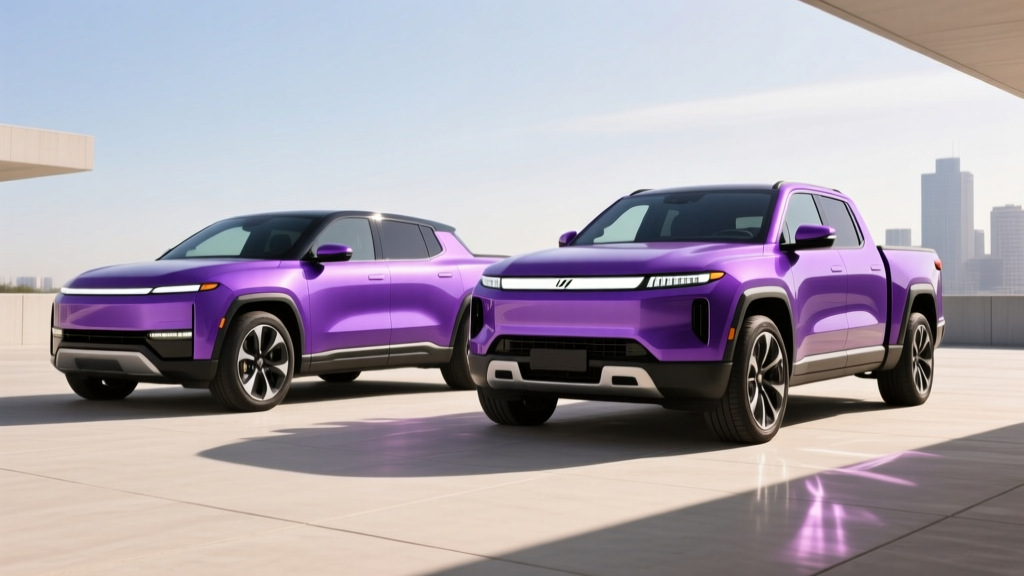
If you've been scrolling through Rivian owner forums or configurator screenshots, you've likely searched for the elusive Rivian purple color — a deep, shifting hue that has become one of the most talked-about paint options in the electric truck and SUV segment. For 2026, Rivian continues to offer its signature purple-inspired tones alongside a refreshed palette across the R1S SUV and R1T pickup. But paint is only part of the story. This guide covers everything you need to know about ordering a purple-hued Rivian in 2026, including the full spec breakdown: EPA range, battery chemistry, charging speeds, real-world efficiency, pricing, and federal tax credit eligibility.
Rivian's Purple Paint Options for 2026: What's Available
Rivian does not currently offer a single paint labeled simply "purple" in its 2026 configurator. Instead, the automaker provides colors that read as purple under certain lighting conditions — most notably Midnight (a deep blue-violet that shifts between navy and plum depending on the angle) and the limited-run Electro Violet (a more overtly purple tone offered through Rivian's special-edition programs). Earlier production years also saw Forest Green and El Cap Granite take on purplish undertones in shade.
Rivian's paint strategy mirrors its overall brand approach: understated, nature-inspired tones rather than flashy dealer-lot colors. If you're set on a true purple Rivian, your best path in 2026 is:
- Midnight — Standard availability across R1S and R1T trims; reads dark blue-purple in direct sunlight
- Electro Violet — Limited availability; check with your local Rivian Space or service center for current inventory
- Aftermarket vinyl wrap — A popular route among owners who want a true, saturated purple (costs roughly $3,000–$5,000 installed, and is removable without voiding the body warranty)
All Rivian paints are water-based and applied at the company's Normal, Illinois factory. The premium paint option (currently $2,500 above standard colors) adds a multi-coat depth that enhances the color-shift effect on Midnight especially.
2026 Rivian R1S & R1T: Full Spec Breakdown
Whether you choose Dual-Motor, Performance Dual-Motor, or the Tri-Motor configuration, the 2026 R1S and R1T share a core architecture built on Rivian's updated Gen 2 platform. Below is the comprehensive spec table covering the most popular configurations.
| Specification | Dual-Motor (Standard Battery) | Dual-Motor (Large Battery) | Tri-Motor (Max Battery) |
|---|---|---|---|
| EPA Range (R1S) | 270 mi | 352 mi | 420 mi |
| EPA Range (R1T) | 270 mi | 342 mi | 415 mi |
| Battery Capacity (usable) | 92 kWh (LFP) | 113 kWh (NMC) | 141 kWh (NMC) |
| Battery Chemistry | LFP (lithium iron phosphate) | NMC (nickel manganese cobalt) | NMC |
| Horsepower | 533 hp | 533 hp | 850 hp |
| 0–60 mph | 4.5 sec | 4.5 sec | 2.9 sec |
| Drivetrain | AWD (dual-motor) | AWD (dual-motor) | AWD (tri-motor) |
| Max DC Fast Charge | 190 kW | 220 kW | 220 kW |
| 10–80% DC Charge Time | ~28 min | ~21 min | ~26 min |
| Level 2 Home Charge Rate | 11.5 kW (~25 mi/hr) | 11.5 kW (~25 mi/hr) | 11.5 kW (~25 mi/hr) |
| Efficiency (R1S, MPGe) | 73 MPGe | 70 MPGe | 65 MPGe |
| Efficiency (kWh/100 mi) | 46 | 48 | 52 |
| Towing Capacity | 7,700 lb | 7,700 lb | 7,700 lb (R1T) / 7,700 lb (R1S) |
| Base MSRP (R1S) | $74,800 | $82,300 | $99,900 |
| Base MSRP (R1T) | $69,900 | $77,400 | $94,500 |
Charging Speed and Infrastructure: What Owners Need to Know
Rivian's 2026 models support the NACS (North American Charging Standard) connector natively, meaning direct access to the Tesla Supercharger network — a significant advantage over CCS-only competitors. Here's how charging breaks down across all three levels:
| Level | Power | Miles Added per Hour | Best Use Case |
|---|---|---|---|
| Level 1 (120V household) | ~1.4 kW | ~3 mi/hr | Overnight top-up, emergencies |
| Level 2 (240V home/public) | Up to 11.5 kW | ~25 mi/hr | Daily home charging, full overnight refill |
| DC Fast Charge | Up to 220 kW (peak) | ~140 mi in 20 min | Road trips, highway corridor charging |
Charging curve reality: The 220 kW peak rate on Large and Max Battery models is not sustained across the full session. Rivian's charge curve is aggressive from 10–50% SoC (state of charge), where you'll see the full 200–220 kW. From 50–80%, the rate tapers to roughly 120–150 kW, and above 80% it drops sharply to protect battery longevity. This is why the 10–80% metric matters more than peak kW alone. For the Max Battery pack, the larger capacity means the 10–80% session takes a few minutes longer despite the same peak rate — roughly 26 minutes versus 21 for the Large Battery.
At home, a full Level 2 install on a 60-amp circuit (48-amp continuous) will refill the Large Battery from empty in approximately 11 hours. Budget $800–$2,000 for a quality Level 2 wall connector and professional installation, potentially more if your home's electrical panel needs a service upgrade to 200 amps.
Pricing, Trims, and Federal Tax Credit Eligibility
Rivian's 2026 lineup spans three primary configurations (Standard, Large, and Max battery) across Adventure and Ascend trim levels. The Ascend trim adds premium interior materials, an upgraded audio system, and additional driver-assist features for roughly $5,000–$8,000 above the Adventure equivalent.
| Model / Trim | Base MSRP | §30D Credit Eligibility | Effective Price (if eligible) |
|---|---|---|---|
| R1T Dual-Motor Standard | $69,900 | Up to $7,500 | ~$62,400 |
| R1T Dual-Motor Large | $77,400 | Up to $7,500 | ~$69,900 |
| R1S Dual-Motor Standard | $74,800 | Up to $7,500 | ~$67,300 |
| R1S Dual-Motor Large | $82,300 | Up to $7,500 | ~$74,800 |
| R1S Tri-Motor Max | $99,900 | Check MSRP cap | Varies — SUV cap is $80,000 |
| R1T Tri-Motor Max | $94,500 | Eligible (truck cap $80k+) | ~$87,000 |
Critical tax credit details: Under the IRS §30D Clean Vehicle Credit, eligibility depends on several factors that change annually:
- MSRP caps: SUVs (R1S) must have an MSRP at or below $80,000; pickups (R1T) must be at or below $80,000. This means the R1S Tri-Motor Max at $99,900 does not qualify, while most R1T configurations do.
- Buyer income limits: Modified adjusted gross income must not exceed $300,000 (joint filers), $225,000 (head of household), or $150,000 (single filers).
- Battery sourcing requirements: A percentage of critical minerals and battery components must be sourced from the U.S. or free-trade-agreement partners. Rivian has been progressively shifting its supply chain, but eligibility can change — always verify current-year compliance on the IRS website or with a tax professional.
- Point-of-sale transfer: As of 2024, buyers can transfer the credit to the dealer at purchase, reducing the upfront cost rather than waiting to claim it on their tax return.
Interior, Cargo, and Technology
The 2026 R1S and R1T share Rivian's minimalist, adventure-oriented cabin. Both seat up to seven (R1S, with an optional third row) or five (R1T). Cargo capacity is generous:
- R1S cargo: 46.7 cu ft behind the second row; 104.7 cu ft with both rear rows folded
- R1T bed: 4.5-ft bed with 26.4 cu ft of volume, plus a 10.6 cu ft front trunk (frunk) and the signature Gear Tunnel (11.7 cu ft, available on certain configurations)
- Legroom (front/rear): 41.3 in / 38.2 in (R1S)
On the technology front, the 15.6-inch center touchscreen runs Rivian's proprietary infotainment system — no Apple CarPlay or Android Auto, which remains a sticking point for some buyers. Instead, Rivian offers native navigation, streaming apps, and over-the-air (OTA) updates that regularly add features. The Rivian Driver+ system provides Level 2 driver assistance (adaptive cruise, lane centering, automatic emergency braking) but requires continuous driver attention — this is not a hands-free system like GM's Super Cruise or Ford's BlueCruise.
Unique Rivian features include the built-in air compressor (for tires and gear), a camp kitchen option that slides from the Gear Tunnel, integrated Bluetooth camp speakers, and a flashlight that docks in the driver's door panel — all designed around the overlanding and outdoor-lifestyle use case.
Pros and Cons: The Honest Assessment
Pros
- Class-leading combination of off-road capability and on-road refinement
- NACS connector provides direct Tesla Supercharger access
- Up to 420 miles EPA range (Max Battery R1S)
- Tri-Motor performance variant hits 0–60 in 2.9 seconds — supercar territory
- Thoughtful adventure features (Gear Tunnel, built-in compressor, camp kitchen)
- OTA updates continuously improve the vehicle post-purchase
- LFP option on Standard Battery provides excellent cycle life and can be charged to 100% daily
Cons
- No Apple CarPlay or Android Auto — Rivian's native system only
- Higher trims exceed the $80,000 MSRP cap for the federal tax credit (R1S)
- LFP Standard Battery suffers notable cold-weather range loss
- Third-row seat in R1S is tight for adults on longer trips
- Premium paint and option packages push as-tested prices well above base MSRP
- Driver+ is capable but not hands-free — competitors offer eyes-off highway assist
- Insurance costs tend to run 15–25% higher than comparable ICE trucks/SUVs
Who Should Buy a Rivian (and Who Shouldn't)
Choose Rivian if:
- You need a capable electric truck or 3-row SUV with genuine off-road chops and 7,700-lb towing
- You value NACS/Supercharger access for road-trip charging reliability
- You want an adventure-oriented vehicle with integrated camping and utility features
- You can charge at home with Level 2 and mostly drive within the Large Battery's real-world range
Look elsewhere if:
- You prioritize hands-free highway driving (consider GM Super Cruise or Ford BlueCruise vehicles)
- Apple CarPlay/Android Auto is non-negotiable for your daily commute
- You need a budget EV under $50,000 — Rivian's entry point is $69,900
- You live in an extreme cold-weather region and want to avoid range loss — consider a larger NMC battery or a different platform
Warranty and Long-Term Ownership
Rivian backs the 2026 R1S and R1T with the following coverage:
- Basic vehicle warranty: 5 years / 60,000 miles
- Battery and powertrain warranty: 8 years / 175,000 miles (with a minimum 70% capacity retention threshold)
- Roadside assistance: 5 years / 60,000 miles
The 175,000-mile battery warranty is competitive within the segment. Rivian's vertical integration — the company designs and manufactures its own battery packs and drive units at its Normal, Illinois facility — gives it control over replacement part availability, though service center capacity has been a growing pain as the fleet expands. Rivian has been adding mobile service vans and expanding its Space+Service network to address this.
For battery longevity, owners of the LFP-equipped Standard Battery should note that this chemistry tolerates regular 100% charging better than NMC — in fact, Rivian recommends periodic full charges for LFP to maintain accurate state-of-charge calibration. NMC owners should target 80–90% daily and reserve 100% for road trips.
Frequently Asked Questions
What is the real-world range of a 2026 Rivian?
For the most popular Large Battery Dual-Motor R1S, the EPA rates it at 352 miles. In real-world highway driving at 70–75 mph, expect approximately 300–315 miles. In cold weather (below freezing), that drops to roughly 260–280 miles. The Standard Battery (LFP) sees more significant cold-weather loss — plan for 200–220 highway miles in winter conditions.
How fast does a Rivian charge at home and on the road?
At home on a 240V Level 2 charger (11.5 kW), you'll add about 25 miles of range per hour — a full overnight charge from near-empty takes 10–14 hours depending on battery size. On DC fast chargers, the Large Battery peaks at 220 kW and charges from 10–80% in approximately 21 minutes. The Max Battery takes about 26 minutes due to its larger capacity.
Does the 2026 Rivian qualify for the $7,500 federal EV tax credit?
It depends on the specific configuration and your income. Most R1T pickups and R1S SUVs priced at or below $80,000 MSRP qualify, assuming the buyer meets income thresholds ($300k joint, $150k single) and the vehicle meets current-year battery sourcing requirements. Higher-priced Tri-Motor and Max Battery R1S models exceed the $80,000 SUV MSRP cap and are ineligible. Always verify on IRS.gov before purchasing.
Is the Rivian R1T worth buying over the Ford F-150 Lightning or Tesla Cybertruck?
The R1T excels in build quality, off-road capability (with its quad-motor tank turns on certain trims), and adventure-specific features. The F-150 Lightning offers a lower starting price and more traditional truck utility. The Cybertruck provides NACS-native charging (though Rivian now also has NACS) and polarizing design. For buyers prioritizing refinement and genuine trail capability, the R1T holds a strong position — but at a higher price point.
Can I get a true purple Rivian from the factory?
The closest factory option in 2026 is the Midnight color, which shifts between deep navy and dark purple-violet depending on lighting. A true, saturated purple is not currently a standard configurator option. Many owners opt for a professional vinyl wrap in their desired purple shade, which costs $3,000–$5,000 and can be removed without affecting the factory paint warranty.
What are the biggest drawbacks of owning a Rivian?
The most cited owner complaints are the lack of Apple CarPlay/Android Auto, higher-than-average insurance costs, and the fact that premium configurations push well past the tax credit MSRP cap. Service center availability has improved but still lags behind legacy automakers in some regions. The LFP Standard Battery's cold-weather range loss is also a consideration for northern-climate buyers.
Sources: EPA Fuel Economy, IRS Clean Vehicle Credits, Rivian Official Specifications. All specifications reflect 2026 model-year data available at time of publication. Tax credit rules are subject to change — consult a tax professional for personal eligibility.