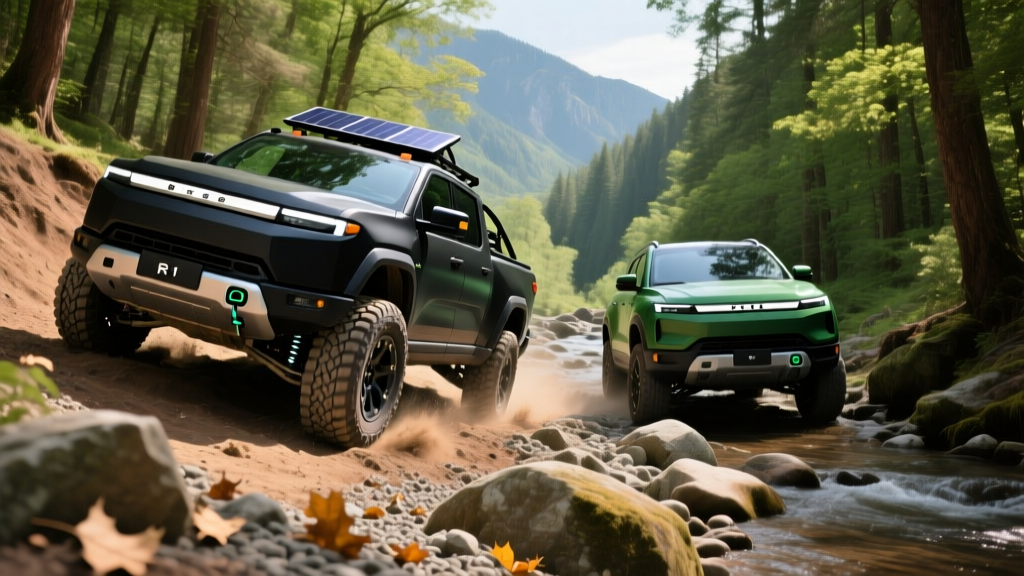
Rivian's R1T pickup and R1S SUV remain the only purpose-built electric adventure vehicles on the market that can tow 11,000 pounds, ford 3+ feet of water, and still deliver over 300 miles of EPA range. As we move through the 2026 model year, Rivian has introduced the Gen 2 architecture with in-house drive units, a new Standard battery pack, and an upgraded Max pack that pushes range past 400 miles. But how do these trucks actually perform when the pavement ends?
This guide breaks down the 2026 Rivian lineup for off-road use — covering real-world range expectations on trails, DC fast charging speed, tax credit eligibility, and whether the R1T or R1S makes more sense for your next backcountry adventure.
2026 Rivian Lineup at a Glance
Rivian offers both the R1T (crew-cab pickup) and R1S (three-row SUV) in three battery configurations and two motor setups for the 2026 model year. The Gen 2 platform, introduced in mid-2024, carries forward with refinements to thermal management and software-defined suspension tuning.
| Spec | R1T Dual-Motor (Standard) | R1T Dual-Motor (Large) | R1T Tri-Motor (Max) | R1S Dual-Motor (Large) | R1S Tri-Motor (Max) |
|---|---|---|---|---|---|
| EPA Range | 270 mi | 352 mi | 420 mi | 341 mi | 410 mi |
| Battery (usable kWh) | 92 kWh (LFP) | 128 kWh (NMC) | 149 kWh (NMC) | 128 kWh (NMC) | 149 kWh (NMC) |
| Drivetrain | Dual-Motor AWD | Dual-Motor AWD | Tri-Motor AWD | Dual-Motor AWD | Tri-Motor AWD |
| Horsepower | 533 hp | 533 hp | 850 hp | 533 hp | 850 hp |
| 0-60 mph | 4.5 sec | 4.5 sec | 2.9 sec | 4.6 sec | 3.0 sec |
| Max Tow Capacity | 11,000 lb | 11,000 lb | 11,000 lb | 7,700 lb | 7,700 lb |
| Ground Clearance (max) | 14.9 in | 14.9 in | 14.9 in | 14.9 in | 14.9 in |
| Water Fording | 36.2 in | 36.2 in | 36.2 in | 36.2 in | 36.2 in |
| Base MSRP | $69,900 | $75,900 | $99,900 | $75,900 | $99,900 |
All 2026 Rivians come with an air suspension system capable of adjusting ride height across multiple settings, including an off-road mode that raises the vehicle to maximum ground clearance. The approach, departure, and breakover angles rival dedicated off-road SUVs like the Jeep Wrangler Rubicon and Land Rover Defender.
Real-World Range: Trails, Towing, and Cold Weather
EPA estimates are measured under controlled lab conditions. In real-world off-road and adventure use, expect the following from the R1T Dual-Motor Large (352 mi EPA):
• Highway driving (70-75 mph): ~280-300 miles
• Mixed city/highway: ~310-330 miles
• Trail/off-road use (low-speed, high-torque): ~220-260 miles (varies heavily by terrain)
• Towing a 5,000-lb trailer: ~170-200 miles
• Cold weather (below 32°F): ~240-280 miles (20-30% reduction)
The Max pack (420 mi EPA R1T) extends these figures proportionally but adds ~400 lbs of battery weight, slightly reducing efficiency.
Off-road driving is inherently energy-intensive. Low-speed rock crawling demands high torque output with minimal regenerative braking opportunity, and soft surfaces like sand dramatically increase rolling resistance. On a full day of moderate trail use — say 40 miles of forest service roads with 3,000 feet of elevation gain — expect to consume roughly 30-40% of the Large pack's capacity.
The LFP chemistry in the Standard battery pack has a key advantage for off-roaders: it tolerates repeated 100% charges better than NMC. You can charge to full the night before a trail day without the same long-term degradation concerns. However, LFP batteries are heavier per kWh and lose more range in extreme cold compared to NMC.
For reference, the EPA's fueleconomy.gov database provides official efficiency ratings, but real-world off-road consumption falls outside standardized testing. Rivian's trip planner in the vehicle software accounts for elevation, temperature, and terrain when estimating remaining range.
Charging Speed: DC Fast Charge and Home Level 2
Rivian's Gen 2 architecture supports DC fast charging at up to 220 kW peak for the Large and Max packs, and approximately 175 kW for the Standard (LFP) pack. The charge curve tapers significantly above 80% state of charge — a physical reality of lithium-ion charging, not a Rivian limitation.
| Charging Method | Standard (LFP 92 kWh) | Large (NMC 128 kWh) | Max (NMC 149 kWh) |
|---|---|---|---|
| Max DC Fast Charge | 175 kW peak | 220 kW peak | 220 kW peak |
| 10-80% DCFC Time | ~30 min | ~25 min | ~30 min |
| Level 2 (240V / 48A) | 11.5 kW (~25 mi/hr) | 11.5 kW (~25 mi/hr) | 11.5 kW (~25 mi/hr) |
| Level 1 (120V / 12A) | ~1.4 kW (~3 mi/hr) | ~1.4 kW (~3 mi/hr) | ~1.4 kW (~3 mi/hr) |
| Connector | NACS (native) | NACS (native) | NACS (native) |
All 2026 Rivians ship with the NACS (North American Charging Standard) connector natively, giving access to Tesla Supercharger stalls, Rivian Adventure Network chargers, and third-party networks using NACS. The Rivian Adventure Network continues to expand along popular overland routes, with chargers placed at trailheads and near national parks.
For home charging, a 48-amp Level 2 wall connector on a 60-amp circuit adds roughly 25 miles of range per hour. A full charge from 10% to 100% on the Large pack takes about 11-12 hours — practical for overnight charging. Home installation typically requires a 240V dedicated circuit; budget $800-$2,500 for professional installation depending on panel proximity, as confirmed by licensed electricians in most markets.
One important note on charging curves: peak kW is sustained only between roughly 15-50% state of charge. From 50-80%, the rate tapers to approximately 100-120 kW. Above 80%, charging slows dramatically to protect battery health. For road trips, plan your stops around 10-80% sessions — pushing to 100% at a DC fast charger wastes time.
Off-Road Hardware and Trail Technology
What separates Rivian from other electric SUVs and trucks is the depth of its off-road engineering. This isn't a lifted crossover with all-terrain tires bolted on — the R1 platform was designed from day one for serious trail use.
Suspension and geometry: The air suspension provides up to 14.9 inches of ground clearance in Off-Road mode, with approach angles of 35.5 degrees, departure angles of 33.6 degrees, and a breakover angle of 26.4 degrees (R1T). The system automatically adjusts damping based on terrain, and the driver can select modes for Sand, Rock Crawl, Mud, and Snow.
Tank turns: The Tri-Motor configuration enables Rivian's Tank Turn feature, which spins the vehicle in place by driving left and right wheels in opposite directions. This is genuinely useful on tight switchback trails where a three-point turn isn't possible. It works at low speed on loose surfaces and requires the All-Terrain or Max pack.
Drivetrain control: Each axle has its own motor (Dual-Motor) or the rear axle gets two motors (Tri-Motor), enabling true torque vectoring without mechanical lockers. The system can send 100% of available torque to any single wheel within milliseconds — faster than any mechanical differential. This gives Rivian a traction advantage that rivals traditional off-roaders with locking diffs.
Underbody protection: A full-length structural battery enclosure doubles as a skid plate, with additional armor plating protecting the motors and differentials. Rivian rates the underbody for significant rock-strike resistance.
Driver assistance on trails: Rivian's Highway Assist is an SAE Level 2 driver-assistance system — it handles steering, acceleration, and braking on paved roads but requires the driver to remain fully engaged. It does not function on off-road terrain. There is no hands-off or self-driving capability on trails or highways.
Cargo, Passenger Space, and Practicality
The R1T crew cab offers a 4.5-foot bed with a unique Gear Tunnel — a lockable, pass-through storage compartment behind the rear seats that spans the full width of the vehicle. This adds 11.7 cubic feet of enclosed storage accessible from either side. The R1T also includes a front trunk (frunk) with 11.1 cubic feet of space.
| Dimension | R1T (Pickup) | R1S (SUV) |
|---|---|---|
| Frunk Volume | 11.1 cu ft | 11.1 cu ft |
| Bed / Rear Cargo | 54.0 cu ft (bed) | 46.7 cu ft (behind 2nd row) 104.7 cu ft (behind 1st row) |
| Gear Tunnel (R1T only) | 11.7 cu ft | N/A |
| Front Legroom | 41.3 in | 41.3 in |
| Rear Legroom | 38.2 in | 36.5 in (2nd row) 30.4 in (3rd row) |
| Seating Capacity | 5 | 7 |
The R1S gains a third row (total 7 seats) but sacrifices some second-row legroom compared to the R1T. For families with young children, the R1S works well. For taller teens or adults in the second row, the R1T is noticeably more comfortable.
Towing is a standout capability: the R1T can tow up to 11,000 pounds, and the R1S up to 7,700 pounds. However, towing significantly reduces range — plan for roughly 1.5-2.0 kWh per mile when towing a loaded 5,000-7,000 lb trailer, which cuts the Large pack's effective range to approximately 170-200 miles.
Pricing, Trims, and Federal Tax Credit Eligibility
The 2026 Rivian lineup starts at $69,900 for the R1T Dual-Motor Standard and climbs to over $110,000 for a fully optioned R1S Tri-Motor Max. Here's how the pricing breaks down and where the federal tax credit applies:
| Model / Configuration | Base MSRP | §30D Credit Eligible? | Effective Price (with credit) |
|---|---|---|---|
| R1T Dual-Motor Standard | $69,900 | Yes (if income/sourcing qualify) | ~$62,400 |
| R1T Dual-Motor Large | $75,900 | Yes (if income/sourcing qualify) | ~$68,400 |
| R1T Tri-Motor Max | $99,900 | No (exceeds $80K truck cap) | $99,900 |
| R1S Dual-Motor Large | $75,900 | Yes (if income/sourcing qualify) | ~$68,400 |
| R1S Tri-Motor Max | $99,900 | No (exceeds $80K SUV cap) | $99,900 |
The federal EV tax credit under IRS §30D provides up to $7,500, but eligibility depends on multiple factors:
• MSRP cap: Trucks (R1T) must be under $80,000; SUVs/vans (R1S) must be under $80,000. This eliminates all Tri-Motor Max configurations.
• Buyer income cap: Modified AGI must not exceed $150,000 (single), $225,000 (head of household), or $300,000 (married filing jointly).
• Battery sourcing: A percentage of critical minerals and battery components must meet US/free-trade-agreement sourcing requirements. This percentage threshold increases annually. Verify current-year compliance on the IRS Clean Vehicle Credit page before purchasing.
• Point-of-sale transfer: Eligible buyers can transfer the credit to the dealer at purchase, reducing the upfront cost rather than waiting for a tax refund.
Consult a tax professional for your specific situation. Credit rules are subject to change.
Efficiency and Operating Costs
The 2026 R1T Dual-Motor Large achieves an EPA-rated 73 MPGe combined (approximately 46 kWh per 100 miles). The R1S Dual-Motor Large is rated at 72 MPGe combined. The Tri-Motor configurations, with their additional weight and power, drop to approximately 65 MPGe combined.
At a national average electricity rate of $0.16/kWh (per the EIA), charging the R1T Large pack from 10% to 90% at home costs roughly $18-20. That same energy in gasoline for a comparable truck (say, a Ford F-150 at 20 MPG combined and $3.50/gallon) would cost approximately $50-55. Over 15,000 miles annually, the R1T saves roughly $1,800-$2,500 in fuel costs versus a gas truck, depending on local electricity rates.
Off-road efficiency is inherently lower. Expect consumption of 55-70 kWh/100mi during active trail driving, which is comparable to the fuel consumption of a gas off-roader running low range in technical terrain.
Warranty, Reliability, and Ownership
Rivian provides the following warranty coverage for the 2026 model year:
- Battery pack: 8 years / 175,000 miles (whichever comes first), with a minimum 70% capacity retention guarantee
- Powertrain (motors, inverters): 8 years / 175,000 miles
- Vehicle limited warranty: 5 years / 60,000 miles bumper-to-bumper
- Corrosion perforation: 12 years / unlimited miles
The 175,000-mile battery warranty is among the most generous in the EV industry, exceeding the federal minimum of 8 years/100,000 miles. Rivian's 70% capacity retention threshold is standard — it means the warranty covers replacement if your battery drops below 70% of original capacity within the warranty period.
As a newer automaker, Rivian's long-term reliability data is still maturing. The Gen 2 platform (introduced mid-2024) addressed several first-generation complaints including panel gaps, software glitches, and drive unit noise. Owner forums and NHTSA complaint databases show improving build quality, but buyers should be aware that Rivian's service center network, while growing, is still smaller than legacy automaker dealer networks — particularly in rural areas near popular off-road destinations.
Rivian vs. the Off-Road Competition
- Class-leading off-road capability with air suspension and torque vectoring
- Up to 420 miles EPA range (Max pack)
- 11,000-lb towing (R1T) — best in electric truck segment
- Tank Turns (Tri-Motor) for tight trail maneuvering
- NACS connector — full Tesla Supercharger access
- Over-the-air software updates add new features regularly
- Gear Tunnel provides unique lockable storage
- Strong battery warranty at 8yr/175,000mi
- Starting price above $69,900 — premium positioning
- Tri-Motor Max configurations exceed $80K tax credit cap
- Towing cuts range by 40-50%
- Service center network still limited in rural/off-road regions
- Cold-weather range loss of 20-30% (all EVs, but notable for adventure use)
- No Apple CarPlay / Android Auto — Rivian's native system only
- Third row in R1S is tight for adults
- Off-road energy consumption difficult to predict — range planning requires caution
The closest competitors to the Rivian off-road formula include:
- Ford F-150 Lightning: Lower starting price (~$55K), but 8.7 inches less ground clearance and no air suspension. Better value for light-duty use, but not a serious off-roader.
- Chevrolet Silverado EV: Competitive towing, but larger footprint and limited off-road geometry. No air suspension option.
- Jeep Wrangler 4xe (PHEV): Superior breakover angles and aftermarket support, but only 22 miles of electric range and far less total powertrain efficiency.
- Mercedes G580 EQ: Comparable luxury and off-road ability, but starts above $150,000.
Who Should Buy the Rivian for Off-Road Use?
Choose the R1T Dual-Motor Standard if: You want the most affordable entry into the Rivian platform, primarily drive in moderate climates, and don't need maximum range. The LFP battery is ideal if you plan to charge to 100% regularly before trail days.
Choose the R1T Dual-Motor Large if: You want the best balance of range (352 mi), price ($75,900), and tax credit eligibility. This is the sweet-spot configuration for most adventure-oriented buyers.
Choose the R1T/R1S Tri-Motor Max if: You need Tank Turns for extreme terrain, want the 420-mile Max range, and budget is not a primary concern. Accept that you will not qualify for the $7,500 federal credit.
Choose the R1S over the R1T if: You need three rows of seating for family or group adventures and don't need a pickup bed.
Look elsewhere if: Your budget is under $60K, you need a mature dealer/service network in a rural area, or you primarily tow heavy trailers over long distances (the range penalty is significant).
Frequently Asked Questions
What is the real-world off-road range of the Rivian R1T?
On moderate trails with mixed elevation, expect roughly 220-260 miles from the Large pack (352 mi EPA). Technical rock crawling and sand driving reduce this further. The Max pack extends trail range to approximately 280-320 miles. Always plan off-road routes with charging access in mind — range prediction on trails is inherently less precise than on highways.
How fast does the Rivian charge on a road trip to the trailhead?
The Large and Max packs peak at 220 kW on DC fast chargers, achieving a 10-80% charge in approximately 25-30 minutes. On a road trip, plan 20-25 minute stops every 200-250 miles. The Rivian navigation system preconditions the battery when you route to a charger, which optimizes charging speed upon arrival.
Does the Rivian qualify for the $7,500 federal EV tax credit?
The R1T Dual-Motor Standard ($69,900) and R1T/R1S Dual-Motor Large ($75,900) fall under the IRS §30D MSRP cap of $80,000 for trucks and SUVs, making them potentially eligible for up to $7,500. However, you must also meet income caps ($150K single / $300K married filing jointly) and the battery must meet current-year critical mineral and component sourcing thresholds. The Tri-Motor Max configurations ($99,900) exceed the MSRP cap and do not qualify. Always verify current rules at IRS.gov before purchasing.
Is the Rivian better off-road than a Jeep Wrangler?
They excel in different ways. The Rivian offers more power, vastly more range on pavement, superior on-road comfort, and instant torque vectoring. The Wrangler (especially the Rubicon) has better aftermarket support, lighter weight for soft terrain, a solid front axle for extreme articulation, and a far more established service network in remote areas. For mixed on-road/off-road adventure use, the Rivian is the more versatile daily driver. For dedicated hardcore trail use, the Wrangler still has advantages.
Can I charge my Rivian at Tesla Superchargers?
Yes. All 2026 Rivians come with the NACS connector natively, providing direct access to Tesla's Supercharger network without an adapter. You can also use Rivian's Adventure Network and third-party NACS chargers from Electrify America and others.
What does Rivian's battery warranty actually cover?
Rivian warrants the battery pack for 8 years or 175,000 miles, guaranteeing a minimum of 70% capacity retention. If your battery degrades below 70% of its original capacity within that period, Rivian will repair or replace it. This is a capacity-based warranty — it covers degradation, not just catastrophic failure.