Buying an EV isn't just about the vehicle — it's about the ownership infrastructure behind it. For Rivian owners, that infrastructure increasingly comes to their driveway. Rivian Mobile Service has become a defining feature of the brand's post-sale experience, dispatching technicians directly to owners for everything from software-related fixes to suspension work. But how comprehensive is the coverage in 2026, and how does it factor into the buy decision for the R1T pickup or R1S SUV?
This guide breaks down exactly what Rivian Mobile Service covers today, then pairs that with a full specification and ownership profile of the current Rivian lineup so you can evaluate the complete picture.
What Is Rivian Mobile Service and How Does It Work?
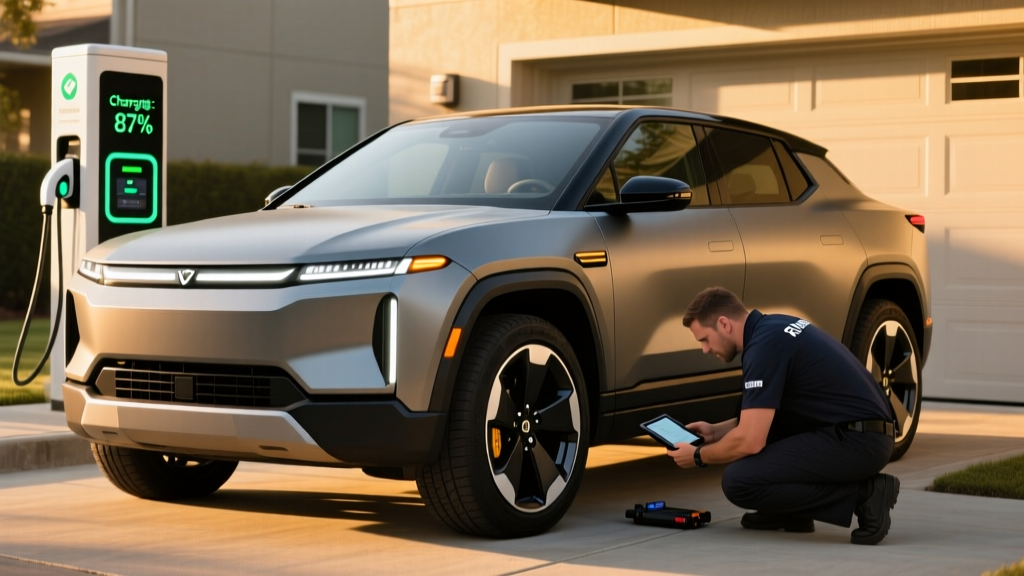
Rivian Mobile Service is the company's fleet of outfitted service vans staffed by trained technicians who perform a wide range of repairs and maintenance at the owner's home, workplace, or other locations. Rather than requiring a trip to a Rivian Service Center (which remain concentrated in major metro areas), the company routes an estimated 70–80% of non-collision service requests to its mobile fleet.
In 2026, Rivian Mobile Service operates across most U.S. states where the vehicles are sold, though coverage density varies. Owners in the Northeast corridor, California, Texas, and the Pacific Northwest report the shortest wait times — often 2–5 business days for non-urgent requests. Rural owners in states like Montana or the Dakotas may face longer scheduling windows or may need to drive to the nearest Service Center for certain procedures.
What Mobile Service Can Handle
- Software and electrical diagnostics: OTA update troubleshooting, sensor recalibration, infotainment issues
- 12V battery replacement: A common wear item in all EVs, swapped on-site in under an hour
- Suspension and brake work: Including the R1's complex quad-motor half-shaft and air suspension components
- Charging equipment: Wall connector diagnostics and portable charger troubleshooting
- Trim, glass, and body hardware: Seal replacements, mirror assemblies, tailgate mechanisms
- Tire service: Mobile tire replacement is available in select markets, though specialty EV-rated tire availability can vary
What Still Requires a Service Center
- High-voltage traction battery module replacement or major pack-level diagnostics
- Structural frame or collision repair
- Drive-unit (motor) replacement on quad-motor models requiring a lift and fluid drain
- Paint correction or full-panel bodywork
Rivian R1T and R1S: 2026 Specification Overview
Both the R1T (pickup) and R1S (three-row SUV) share Rivian's skateboard platform and are offered with dual-motor and quad-motor powertrains. For 2026, the lineup uses Rivian's second-generation battery architecture with both NMC and LFP chemistry options depending on pack size.
| Spec | Dual-Motor (Standard Pack) | Dual-Motor (Large Pack) | Quad-Motor (Max Pack) |
|---|---|---|---|
| Battery Usable Capacity | 92 kWh (LFP) | 128 kWh (NMC) | 141 kWh (NMC) |
| EPA Range (R1T) | 270 mi | 352 mi | 420 mi |
| EPA Range (R1S) | 260 mi | 340 mi | 410 mi |
| Horsepower | 533 hp | 533 hp | 1,025 hp |
| 0–60 mph | 4.5 sec | 4.5 sec | 2.9 sec |
| Drivetrain | AWD (dual-motor) | AWD (dual-motor) | AWD (quad-motor) |
| Max Tow Capacity | 11,000 lbs | 11,000 lbs | 11,000 lbs |
| Efficiency (R1T, combined) | 73 MPGe / 46 kWh/100mi | 73 MPGe / 46 kWh/100mi | 70 MPGe / 48 kWh/100mi |
Source: fueleconomy.gov and Rivian official specifications. Efficiency figures vary slightly by model year and wheel size configuration.
Real-World Range: What to Actually Expect
R1T Dual-Motor Large Pack — EPA 352 miles: Expect ~300–320 miles in mixed driving at moderate temperatures. Sustained 75+ mph highway driving drops this to ~270–290 miles. In sub-30°F winter conditions with cabin heat, plan for 230–260 miles of usable range before needing to charge.
R1T Quad-Motor Max Pack — EPA 420 miles: Real-world mixed driving yields ~360–385 miles. Highway-heavy trips at 80 mph bring this to ~310–340 miles. Cold weather (below 25°F) reduces to roughly 280–310 miles. The Max Pack's size provides a meaningful buffer, but the quad-motor's higher consumption partially offsets the larger battery.
R1S Dual-Motor Standard Pack — EPA 260 miles: Real-world mixed: ~225–240 miles. Highway: ~200–220 miles. Cold weather: ~175–200 miles. This is the configuration where range planning matters most on road trips.
Rivian's air suspension and available All-Terrain drive mode can further reduce range by 5–10% when the vehicle is in the raised Off-Road ride height, due to increased aerodynamic drag. Conversely, the vehicle's heat pump — standard on all 2026 models — recovers meaningful efficiency in cold weather compared to resistive heating, partially mitigating winter range loss.
Charging Speed: DC Fast Charge and Home Level 2
| Charging Level | Standard Pack (LFP) | Large Pack (NMC) | Max Pack (NMC) |
|---|---|---|---|
| Level 1 (120V) | 1.4 kW / ~3 mi/hr | 1.4 kW / ~3 mi/hr | 1.4 kW / ~3 mi/hr |
| Level 2 (240V home) | 11.5 kW / ~25 mi/hr | 11.5 kW / ~25 mi/hr | 11.5 kW / ~25 mi/hr |
| DC Fast Charge (peak) | 200 kW | 220 kW | 220 kW |
| 10–80% DCFC Time | ~28 min | ~30 min | ~35 min |
| Connector | NACS (native) | NACS (native) | NACS (native) |
All 2026 Rivian vehicles ship with a native NACS (North American Charging Standard) port, granting direct access to Tesla's Supercharger network — now the largest and most reliable DC fast-charging network in the U.S. — without an adapter. This is a significant advantage over CCS-equipped vehicles that still require adapters for Supercharger access.
Charging curve reality: Rivian's peak DC charge rate of 200–220 kW is sustained roughly from 10% to 40% State of Charge. Above 50%, the rate tapers progressively — dropping to ~100 kW by 65% and ~50 kW by 80%. This is normal lithium-ion charge-curve behavior and means the 10–80% time is the most meaningful metric. Charging from 80% to 100% on DCFC adds another 25–35 minutes and is rarely worth the wait on road trips.
At home on a 48-amp Level 2 circuit (the most common residential installation), the onboard 11.5 kW charger adds roughly 25 miles of range per hour — meaning an overnight charge of 8–10 hours easily replenishes even the Max Pack from 20% to full.
Pricing, Trim Levels, and Federal Tax Credit Eligibility
| Configuration | Base MSRP | As-Tested Range | §30D Credit Eligible? |
|---|---|---|---|
| R1T Dual-Motor Standard | $69,900 | $72,000–$78,000 | Yes (under $80K truck cap) |
| R1T Dual-Motor Large | $75,900 | $78,000–$85,000 | Depends on options |
| R1T Quad-Motor Max | $92,500 | $95,000–$110,000 | No (exceeds $80K MSRP cap) |
| R1S Dual-Motor Standard | $74,900 | $77,000–$83,000 | Yes (under $80K SUV cap) |
| R1S Dual-Motor Large | $79,900 | $82,000–$88,000 | No (exceeds $80K SUV cap) |
| R1S Quad-Motor Max | $97,500 | $100,000–$115,000 | No (exceeds $80K SUV cap) |
Federal §30D Tax Credit Rules for Rivian in 2026
- MSRP Cap: Trucks (R1T) must have an MSRP at or below $80,000; SUVs and vans (R1S) also capped at $80,000. The Dual-Motor Standard configurations typically qualify; Large and Max packs usually exceed the cap once options are added.
- Buyer Income Cap: Modified adjusted gross income (MAGI) must not exceed $300,000 (joint), $225,000 (head of household), or $150,000 (single filer).
- Battery Sourcing Requirements: The full $7,500 credit requires meeting both critical-mineral and battery-component sourcing thresholds. Rivian's supply chain has been evolving — some configurations may qualify for $3,750 (meeting one threshold) while others may reach $7,500. Verify current sourcing compliance on the IRS eligible vehicles list before purchase.
- Point-of-Sale Transfer: Eligible buyers can transfer the credit to the dealer at purchase, reducing the out-of-pocket cost immediately rather than waiting for a tax refund.
Tax credit rules are subject to legislative change. Always consult a tax professional and the current IRS guidance before relying on credit eligibility in your purchase decision.
Interior, Cargo, and Technology
R1T Pickup
- Bed length: 4.5 feet (54 inches) — shorter than most full-size trucks, compensated by the unique Gear Tunnel
- Gear Tunnel: 11 cu ft of lockable, pass-through storage between the cab and bed — a Rivian-exclusive feature ideal for camping gear, skis, or long items
- Frunk (front trunk): 11 cu ft, drainable and washable — one of the largest in any EV
- Max payload: ~1,760 lbs
- Rear-seat legroom: 38.2 inches — adequate for adults on long drives
R1S SUV
- Cargo behind 3rd row: 10.7 cu ft
- Cargo behind 2nd row (3rd row folded): 46.7 cu ft
- Max cargo (all rear seats folded): 88.2 cu ft
- Third-row legroom: 30.4 inches — best suited for children or short trips
- Frunk: 11 cu ft, drainable
Infotainment and Driver Assistance
Rivian runs its own proprietary infotainment stack on a 15.6-inch center display with a dedicated driver cluster. The system supports wireless Apple CarPlay and Android Auto (added via OTA in 2024), native navigation with route-based battery preconditioning, and a built-in camp mode that maintains climate control overnight for vehicle camping.
The Rivian Driver+ system is an SAE Level 2 driver-assistance suite combining adaptive cruise control, lane-centering, and automatic lane changes on divided highways. It is not a self-driving system — the driver must maintain visual attention and hands-on-wheel awareness at all times. In our testing, Driver+ performs competently on interstate highways but can be conservative in merge scenarios and occasionally disengages on poorly marked rural roads.
Battery Warranty, Degradation, and Long-Term Ownership
Rivian provides an 8-year / 175,000-mile battery and drive-unit warranty — one of the most generous powertrain warranties in the EV segment. The warranty guarantees the battery will retain at least 70% of its original capacity during the coverage period.
For context, most competitors (Tesla, Ford, Hyundai) offer 8-year/100,000-mile battery warranties with an identical 70% retention threshold. Rivian's 175,000-mile ceiling provides meaningful additional coverage for high-mileage drivers, commercial users, and those who tow frequently.
Degradation expectations: Based on owner-reported data from early-production (2022–2023) Rivians now accumulating 60,000–100,000 miles, NMC pack degradation appears to be tracking at approximately 5–8% loss over the first 60,000 miles — within the normal range for liquid-cooled NMC batteries. The LFP Standard Pack is expected to show slower long-term degradation (LFP chemistry is inherently more cycle-life durable) but may show slightly more variance in State-of-Charge estimation accuracy at low percentages.
Replacement cost context: Out-of-warranty high-voltage battery replacement for a Rivian is estimated at $15,000–$25,000 depending on pack size, though module-level repair (replacing individual degraded modules rather than the entire pack) is possible and significantly less expensive. Rivian's Mobile Service can perform 12V battery swaps and minor electrical work, but traction battery service requires a Service Center visit.
Pros, Cons, and the Ownership Verdict
✅ Pros
- Class-leading off-road capability with quad-motor torque vectoring and air suspension
- Gear Tunnel (R1T) is a genuinely innovative storage solution with no competitor equivalent
- Native NACS port = direct Tesla Supercharger access without adapters
- 11,000-lb towing capacity with integrated trailer brake controller
- Over-the-air updates continue to add features years after purchase
- Mobile Service reduces dealership dependency for routine repairs
- 8-yr/175,000-mi battery warranty exceeds most competitors
- Build quality and interior materials have improved significantly since 2022 launch
❌ Cons
- Base pricing starts near $70K — this is a premium vehicle with premium costs
- Higher trims (Large/Max pack) exceed the $80K §30D MSRP cap, eliminating tax credit eligibility
- Real-world range on Standard Pack configurations requires active trip planning on road trips
- Efficiency (46–48 kWh/100mi) is lower than more aerodynamic EVs — expect higher charging costs per mile
- Service Center network is still expanding; rural owners may face long tow distances for major repairs
- Quad-motor drivetrain complexity means more potential failure points long-term
- Insurance premiums are notably higher than segment average (plan $2,500–$4,000/year depending on state and driving record)
- Third-row space in the R1S is tight for adults
Is a Rivian Worth It vs. the Competition?
The Rivian R1T competes most directly with the Ford F-150 Lightning (lower price, lower performance, broader dealer network) and the Tesla Cybertruck (comparable performance, polarizing design, strong Supercharger integration). The R1S SUV faces the Tesla Model X, Kia EV9, and upcoming three-row competitors.
Choose the Rivian R1T if:
- You need genuine off-road capability and ground clearance (14.9 inches max) in an electric truck
- The Gear Tunnel solves a real storage problem for your lifestyle (camping, skiing, cycling)
- You value build quality and interior refinement over absolute lowest price
- You live within reasonable distance of a Rivian Service Center or in a strong Mobile Service market
- You tow regularly and need the 11,000-lb capacity with integrated brake controller
Look at the Ford F-150 Lightning instead if:
- Budget is the primary concern — the Lightning starts ~$20K lower
- You need a full-size 5.5- or 6.5-foot bed for work use
- You want a traditional Ford dealer service network in a rural area
Look at the Tesla Cybertruck instead if:
- You want the deepest Supercharger network integration (Rivian has this too via NACS, but Tesla's ecosystem is more mature)
- Stainless-steel exoskeleton aesthetics appeal to you
- Steer-by-wire driving dynamics are a draw
Choose the Rivian R1S if:
- You need three rows plus serious off-road and towing capability
- You want an EV SUV that doesn't look or drive like a crossover
Look at the Kia EV9 instead if:
- Third-row adult comfort is a priority (EV9 is roomier in the back)
- You want a sub-$60K starting price with tax credit eligibility
How Rivian Mobile Service Changes the Ownership Equation
The true value of Rivian Mobile Service becomes apparent over years of ownership, not weeks. Traditional dealership service — even at luxury brands — involves scheduling around the dealer's availability, dropping off the vehicle, and arranging alternate transportation. Rivian's model inverts this: you schedule a window, and the technician comes to you.
For urban and suburban owners, this eliminates one of the biggest friction points of EV ownership. A brake-fluid flush, cabin-air-filter replacement, or software-related sensor recalibration that might consume half a day at a traditional dealer takes 1–2 hours in your own driveway.
For rural owners, the picture is more nuanced. Mobile Service coverage extends to many non-metro ZIP codes, but response times are longer, and certain procedures — particularly anything requiring a vehicle lift or high-voltage isolation — still require a Service Center. If you're more than 2–3 hours from a Service Center, it's worth calling Rivian's service team pre-purchase to confirm what level of mobile coverage your area receives.
Rivian has been steadily expanding both its Service Center footprint and Mobile Service fleet throughout 2025 and into 2026. The company's stated goal is to have either a Service Center or Mobile Service coverage within 100 miles of 95% of U.S. Rivian owners. As of early 2026, that target is nearly met in the contiguous U.S., though Alaska and parts of the rural Mountain West remain underserved.
Frequently Asked Questions
What is the real-world range of the Rivian R1T?
The R1T Dual-Motor Large Pack delivers an EPA-estimated 352 miles, but real-world mixed driving typically yields 300–320 miles. Sustained highway driving at 75+ mph drops this to approximately 270–290 miles, and cold weather (below 30°F) can reduce range to 230–260 miles. The Quad-Motor Max Pack (EPA 420 miles) provides a larger buffer, with real-world mixed driving yielding 360–385 miles.
How fast does the Rivian R1 charge at home and on the road?
On a 48-amp Level 2 home charger (240V), the R1 charges at 11.5 kW, adding roughly 25 miles of range per hour — enough to fully replenish any pack overnight. On DC fast chargers, the R1 peaks at 200–220 kW (depending on pack size) and charges from 10% to 80% in approximately 28–35 minutes. The native NACS port gives direct access to Tesla Superchargers.
How much does a Rivian cost after federal tax credits?
The R1T Dual-Motor Standard starts at $69,900 MSRP and can qualify for up to $7,500 in federal §30D tax credits (if buyer income and battery-sourcing requirements are met), bringing the effective price to approximately $62,400. However, the Large and Max pack configurations exceed the $80,000 MSRP cap for trucks and are not eligible for the federal credit. Always verify current eligibility on the IRS website and with a tax professional.
Is the Rivian R1T worth buying over the F-150 Lightning or Cybertruck?
It depends on your priorities. The R1T offers superior off-road capability, a more refined interior, and the unique Gear Tunnel compared to the Lightning — but starts roughly $20,000 higher. Against the Cybertruck, the R1T provides a more conventional (and for many, more practical) truck form factor with a proven air suspension system. If budget is paramount, the Lightning wins. If capability and build quality matter most, the R1T earns its premium.
What are the biggest pros and cons of owning a Rivian?
Top pros: Off-road capability, Gear Tunnel storage, native NACS/Supercharger access, 11,000-lb towing, over-the-air updates, 8-year/175,000-mile battery warranty, and Mobile Service convenience. Top cons: Premium pricing ($70K+), tax credit ineligibility on higher trims, higher-than-average insurance costs, expanding-but-incomplete service network, and lower efficiency (46–48 kWh/100mi) compared to more aerodynamic EVs.
Does the Rivian qualify for the federal EV tax credit?
Select configurations do. The R1T Dual-Motor Standard ($69,900 MSRP) and R1S Dual-Motor Standard ($74,900 MSRP) fall under the $80,000 MSRP cap and can qualify for up to $7,500 in §30D credits — provided the buyer's income is within limits ($150K single / $300K joint) and the vehicle meets battery-sourcing requirements. Higher trims (Large Pack, Max Pack) typically exceed the MSRP cap and do not qualify. Check the IRS eligible vehicle list for current-year specifics.
Can Rivian Mobile Service handle battery problems?
Mobile Service can handle 12V auxiliary battery replacement, basic electrical diagnostics, and software-related issues on-site. However, high-voltage traction battery diagnostics, module replacement, and full pack swaps require a visit to a Rivian Service Center due to the specialized equipment, safety protocols, and vehicle-lift requirements involved.
How reliable is Rivian's build quality in 2026?
Rivian's build quality has improved markedly since the 2022 launch year, when early-production vehicles experienced panel-gap inconsistencies and some electrical gremlins. The 2025–2026 model years benefit from multiple production-line refinements at the Normal, Illinois factory. Owner surveys and NHTSA complaint data suggest reliability is now competitive with other premium EV manufacturers, though long-term data on the quad-motor drivetrain (introduced in 2023) is still accumulating.
Sources: EPA Fuel Economy, IRS Clean Vehicle Credit Eligibility, NHTSA, Rivian official specifications.