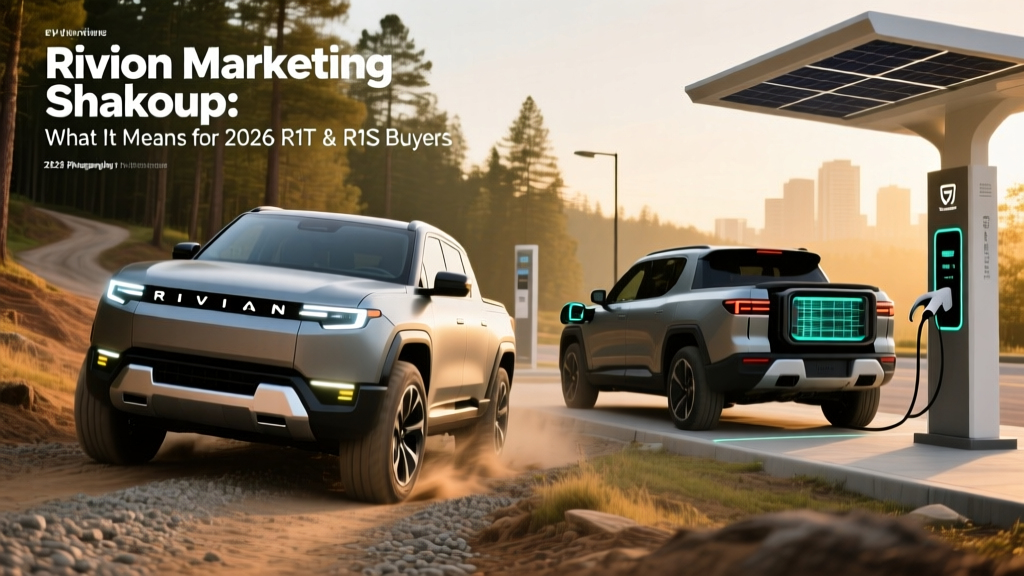
Rivian's 2026 marketing shakeup has reverberated through the EV industry. After restructuring its go-to-market strategy — shifting from a pure direct-to-consumer model toward a more aggressive retail and fleet presence — the company is recalibrating how it positions the R1T pickup and R1S SUV to mainstream buyers. But what does this corporate pivot mean for you, the person actually shopping for an electric truck or three-row SUV?
The vehicles themselves haven't fundamentally changed. The 2026 R1 Dual-Motor and Quad-Motor platforms remain among the most capable electric vehicles on the road. What has changed is how Rivian prices, packages, and sells them — and that directly affects your wallet, your tax-credit eligibility, and your delivery timeline.
This review examines the 2026 Rivian R1T and R1S through the lens of the marketing shakeup, with the exact numbers you need to decide whether now is the right time to buy.
The Rivian Marketing Shakeup: What Actually Changed
In early 2026, Rivian announced a significant restructuring of its sales and marketing organization. The key shifts:
- Simplified trim packaging: Rivian moved away from the highly configurable (and often confusing) build-your-own approach toward more fixed trim bundles — Adventure, Performance, and Ascend — reducing build complexity and delivery delays.
- Expanded retail footprint: New "Rivian Spaces" in high-volume metro areas, plus select partnership showrooms, aim to put the R1T and R1S in front of buyers who never considered ordering online.
- Fleet and commercial emphasis: The R1T now targets commercial fleet buyers alongside the EDV (Electric Delivery Van) program, with dedicated fleet pricing tiers.
- Aggressive pricing repositioning: Base MSRPs were adjusted to better compete with the Ford F-150 Lightning, Chevrolet Silverado EV, and Tesla Cybertruck in key segments.
For retail buyers, the net effect is simpler: clearer pricing, faster delivery, and more opportunities to see and drive the vehicles before committing.
2026 R1T & R1S: Range, Battery, and Efficiency
The R1 Dual-Motor carries an EPA-estimated 352 miles (Max Pack). Expect approximately 280–310 miles on highway road trips at 70–75 mph, and 240–270 miles in sub-30°F cold weather due to battery thermal losses and cabin heating demand. Quad-Motor variants see a ~15–20 mile reduction due to higher power draw.
| Spec | R1 Dual-Motor (Max Pack) | R1 Quad-Motor |
|---|---|---|
| EPA Range | 352 miles (R1T) / 341 miles (R1S) | 328 miles (R1T) / 321 miles (R1S) |
| Battery Capacity | 149 kWh usable (NMC) | 149 kWh usable (NMC) |
| Battery Chemistry | Nickel Manganese Cobalt (NMC) | Nickel Manganese Cobalt (NMC) |
| MPGe (combined) | 73 MPGe (R1T) | 70 MPGe (R1T) |
| kWh / 100 mi | 46 kWh/100mi | 48 kWh/100mi |
| Horsepower | 533 hp | 850 hp |
| 0–60 mph | 4.5 seconds | 3.0 seconds |
| Drivetrain | Dual-Motor AWD | Quad-Motor AWD |
| Towing Capacity | 11,000 lbs | 11,000 lbs |
| Battery Warranty | 8 years / 175,000 miles | 8 years / 175,000 miles |
Rivian's NMC chemistry prioritizes energy density over the cycle-life longevity of LFP (lithium iron phosphate). That's the right trade-off for a 5,000+ lb truck that needs maximum range per kWh, but it means you should avoid routinely charging to 100% for daily use. Set your charge limit to 80–90% for daily driving and reserve 100% for road trips. According to fueleconomy.gov, the R1T Dual-Motor's 46 kWh/100mi efficiency is competitive for a full-size electric truck, though it trails lighter unibody crossovers.
Charging Speed: DC Fast Charge and Home Level 2
| Charging Level | Power / Rate | Estimated Time |
|---|---|---|
| Level 1 (120V) | ~1.4 kW / ~3 mi/hr | Not practical for full charge |
| Level 2 (240V, 48A) | 11.5 kW / ~25 mi/hr | ~14 hours (10–100%) |
| DC Fast Charge (peak) | 220 kW peak | 10–80% in ~21 minutes |
| DC Fast Charge (sustained avg) | ~150 kW avg | 10–90% in ~35 minutes |
Rivian's peak 220 kW DC fast-charge rate is strong, but like all EVs, the charge curve tapers significantly above 80% State of Charge. In real-world testing at Electrify America and Rivian Adventure Network stations, the R1 sustains roughly 180–200 kW between 15–50% SoC, then drops to 100–120 kW between 60–80%, and slows dramatically past 85%. This is normal NMC behavior driven by cell-protection protocols.
Preconditioning matters. The R1's navigation-based battery preconditioning warms the pack when you route to a DC fast charger, enabling faster charge acceptance. If you arrive at a charger without preconditioning (especially in cold weather), expect peak rates to be 30–50% lower until the pack reaches optimal temperature (~85–95°F internally).
For home charging, Rivian's Wall Charger delivers up to 11.5 kW on a 60-amp circuit (48A continuous). That adds roughly 25 miles of range per hour, meaning an overnight charge from 20% to 80% takes about 8 hours — perfectly suited for daily replenishment. Installation typically requires a NEMA 14-60 outlet or hardwired connection; budget $500–$1,500 for electrician work depending on panel proximity.
Pricing, Trims, and Federal Tax Credit Eligibility
The marketing shakeup simplified Rivian's pricing into clearer tiers. Here's where the 2026 lineup stands:
| Trim | Base MSRP | Est. After §30D Credit* |
|---|---|---|
| R1T Dual-Motor Adventure | $69,900 | $62,400 |
| R1T Dual-Motor Performance | $75,900 | $68,400 |
| R1T Quad-Motor Ascend | $87,900 | $80,400 |
| R1S Dual-Motor Adventure | $74,900 | $67,400 |
| R1S Quad-Motor Ascend | $92,900 | $85,400 |
*Federal tax credit estimates. Actual eligibility depends on current-year IRS §30D rules. See IRS.gov for details.
- MSRP Cap: Vans, SUVs, and pickups — up to $80,000 MSRP. Sedans — up to $55,000. Several R1 Quad-Motor trims exceed this cap and are ineligible.
- Buyer Income Cap: Modified AGI ≤ $300,000 (joint), ≤ $225,000 (head of household), ≤ $150,000 (single).
- Battery Sourcing: Critical minerals and battery components must meet escalating domestic/free-trade-partner thresholds. Rivian has worked to qualify, but verify current-year compliance on the IRS eligible vehicle list.
- Point-of-Sale Transfer: The credit can be applied at purchase to reduce your out-of-pocket cost, rather than waiting for a tax refund.
- VIN and Assembly: Vehicle must undergo final assembly in North America. All Rivian R1 vehicles are built in Normal, Illinois — this requirement is met.
The MSRP cap is the critical constraint here. The R1T Dual-Motor Adventure at $69,900 clears the $80,000 truck cap, making the full $7,500 credit achievable (assuming you meet income and sourcing requirements). But the Quad-Motor Ascend at $87,900 exceeds it — buyers of that trim will not qualify for the federal credit, which changes the value proposition significantly.
Cargo, Passenger Space, and Practicality
The R1T's 4.5-foot bed is shorter than a traditional full-size truck, but the Gear Tunnel — a 1.7-foot-wide pass-through compartment behind the cab — adds 11.7 cubic feet of lockable, weather-sealed storage that no competitor matches. Combined with the 11-cubic-foot frunk, the R1T offers creative cargo solutions for camping gear, tools, or groceries.
| Dimension | R1T (Crew Cab) | R1S (3-Row SUV) |
|---|---|---|
| Front Legroom | 41.3 in | 41.3 in |
| Rear Legroom (2nd row) | 38.2 in | 38.2 in |
| 3rd Row Legroom (R1S) | N/A | 32.1 in |
| Bed Length (R1T) | 54.2 in | N/A |
| Frunk Volume | 11.0 cu ft | 11.0 cu ft |
| Gear Tunnel (R1T) | 11.7 cu ft | N/A |
| Cargo Behind 2nd Row (R1S) | N/A | 46.7 cu ft |
| Cargo Behind 3rd Row (R1S) | N/A | 12.5 cu ft |
The R1S's third row is best suited for children or occasional use — 32.1 inches of legroom is tight for adults on long drives. If you regularly carry six or seven adults, a minivan or larger SUV remains more practical. For families with two kids in car seats plus cargo, the R1S works well with the second row folded.
Tech, Driver Assists, and Standout Features
Rivian's software-defined vehicle approach means the R1 platform receives regular over-the-air updates. The 2026 model year includes:
- 15.6-inch center touchscreen with integrated navigation, streaming, and vehicle controls (no Apple CarPlay or Android Auto — Rivian uses its own infotainment stack).
- Rivian Driver Assist (Level 2 SAE): Adaptive cruise control with lane centering on divided highways. This is a driver-assist system, not self-driving. You must keep hands on the wheel and eyes on the road at all times.
- Highway Assist: Hands-on-wheel lane centering that works well on clearly marked interstates but disengages in construction zones or faded lane markings.
- Powered tonneau cover (R1T): Electric retractable bed cover integrated with the bed rail system.
- Vehicle-to-Load (V2L): The R1 platform can output up to 3.5 kW of AC power from the bed outlet and frunk, enough to run power tools, a campsite, or a small appliance during an outage.
- Camp Kitchen option: Slide-out kitchen module that integrates with the Gear Tunnel — a uniquely Rivian feature that appeals to the overlanding community.
Rivian's Driver Assist and Highway Assist are SAE Level 2 systems. They do not navigate autonomously, handle complex intersections, or drive without supervision. Unlike Ford's BlueCruise or GM's Super Cruise, Rivian does not yet offer a hands-free highway mode on pre-approved road segments. You must maintain physical steering input at all times.
R1T vs. the Competition: Is It Worth Buying?
| Spec | Rivian R1T Dual-Motor | Ford F-150 Lightning Extended Range | Chevrolet Silverado EV 4WT |
|---|---|---|---|
| EPA Range | 352 mi | 320 mi | 340 mi |
| 0–60 mph | 4.5 sec | 5.0 sec | 5.5 sec |
| Horsepower | 533 hp | 580 hp | 510 hp |
| Towing | 11,000 lbs | 10,000 lbs | 10,000 lbs |
| DC Fast Charge | 220 kW | 150 kW | 200 kW |
| Bed Length | 54.2 in | 67.1 in | 72.0 in |
| Starting MSRP | $69,900 | $62,990 | $55,900 |
| §30D Eligible | Yes (Dual-Motor) | Yes | Yes |
The R1T wins on range, charging speed, and off-road capability. It loses on bed length (a full 13 inches shorter than the Lightning) and base price. If you need a traditional 5.5- or 6.5-foot bed for work use, the F-150 Lightning or Silverado EV is more practical. If you prioritize driving dynamics, technology, and adventure-oriented features like the Gear Tunnel and Camp Kitchen, the R1T occupies a unique niche.
The marketing shakeup has narrowed the delivery gap that plagued early R1 buyers. With simplified trims and expanded production, typical delivery timelines have moved from 6–12 months to approximately 4–8 weeks for popular configurations — a significant improvement.
Pros, Cons, and Who Should Buy
- Class-leading EPA range (352 mi Max Pack)
- Fastest DC charging in the electric truck segment (220 kW peak)
- Gear Tunnel and frunk offer unmatched creative cargo storage
- Excellent on-road handling for a body-on-frame truck
- Strong OTA update cadence; software improves over time
- 11,000-lb towing with integrated trailer brake controller
- Built in USA (Illinois) — §30D assembly requirement met
- Short 4.5-foot bed limits traditional truck utility
- No Apple CarPlay or Android Auto
- Quad-Motor trims exceed $80K MSRP cap — no federal tax credit
- Driver assist is competent but not class-leading (no hands-free mode)
- NMC battery requires charge-limit discipline for longevity
- Premium pricing vs. F-150 Lightning and Silverado EV
- Third-row R1S space is tight for adults
- Choose the R1T if: You want an electric truck for adventure, weekend trips, and light-to-moderate work use — and you value range, charging speed, and unique storage over a full-size bed.
- Choose the R1S if: You need a three-row electric SUV with genuine off-road capability and don't regularly fill all three rows with adults.
- Look elsewhere if: You need a long bed for commercial work, you want hands-free highway driving (consider Ford BlueCruise or GM Super Cruise), or your budget is under $60,000 (the F-150 Lightning and Silverado EV start lower).
Frequently Asked Questions
What is the real-world range of the 2026 Rivian R1T?
The EPA estimates 352 miles for the Dual-Motor Max Pack R1T. In real-world highway driving at 70–75 mph, expect 280–310 miles. In cold weather (below 30°F), plan for 240–270 miles due to battery thermal losses and cabin heating energy draw. Towing at highway speeds can reduce range to 150–180 miles depending on trailer weight and aerodynamics.
How fast does the Rivian R1 charge at home and on the road?
On a Level 2 home charger (240V, 48A), the R1 charges at 11.5 kW, adding about 25 miles of range per hour — a full overnight session replenishes most daily driving. On DC fast chargers, it peaks at 220 kW, reaching 10–80% in approximately 21 minutes under ideal conditions (preconditioned battery, warm ambient temperature, uncongested station).
How much does the 2026 Rivian R1T cost after tax credits?
The R1T Dual-Motor Adventure starts at $69,900 MSRP. If you qualify for the full $7,500 federal §30D credit (income within limits, vehicle meets battery sourcing requirements), the effective price drops to $62,400. Point-of-sale transfer lets you apply the credit at purchase. Higher trims above $80,000 MSRP do not qualify for the federal credit.
Does the Rivian R1 qualify for the federal EV tax credit?
Yes — but only trims with an MSRP at or below $80,000 (the truck/SUV cap under §30D). The Dual-Motor Adventure and some Performance configurations qualify. Quad-Motor Ascend trims priced above $80,000 do not. You must also meet buyer income limits ($300K joint / $150K single) and the vehicle's battery must meet current-year critical mineral and component sourcing thresholds. Always verify eligibility on the IRS eligible vehicle list before purchasing.
Is the Rivian R1T worth buying over the Ford F-150 Lightning?
The R1T offers more range (352 vs 320 mi), faster DC charging (220 vs 150 kW), and unique features like the Gear Tunnel. The F-150 Lightning offers a longer bed (67 vs 54 in), a lower starting price (~$63K vs ~$70K), and a more established dealer service network. If bed length and work-truck utility are priorities, the Lightning wins. If you want the best-driving electric truck with adventure-oriented features, the R1T is the stronger choice.
What is the battery warranty on the Rivian R1?
Rivian covers the R1 battery and powertrain for 8 years or 175,000 miles, whichever comes first. The warranty covers defects and capacity loss below a specified threshold (typically 70% State of Health). This is competitive with the industry standard, though some competitors offer 100,000-mile powertrain coverage with longer battery terms. Rivian's 175,000-mile battery limit is generous for the truck segment.
The Rivian marketing shakeup of 2026 ultimately benefits buyers: simpler pricing, faster delivery, and a more accessible retail experience. The R1T and R1S remain compelling, technically impressive electric vehicles — and with the Dual-Motor trims qualifying for the federal tax credit, the value equation has improved for the configurations most buyers will actually purchase. If you've been waiting for a clearer on-ramp into the Rivian ecosystem, this may be it.