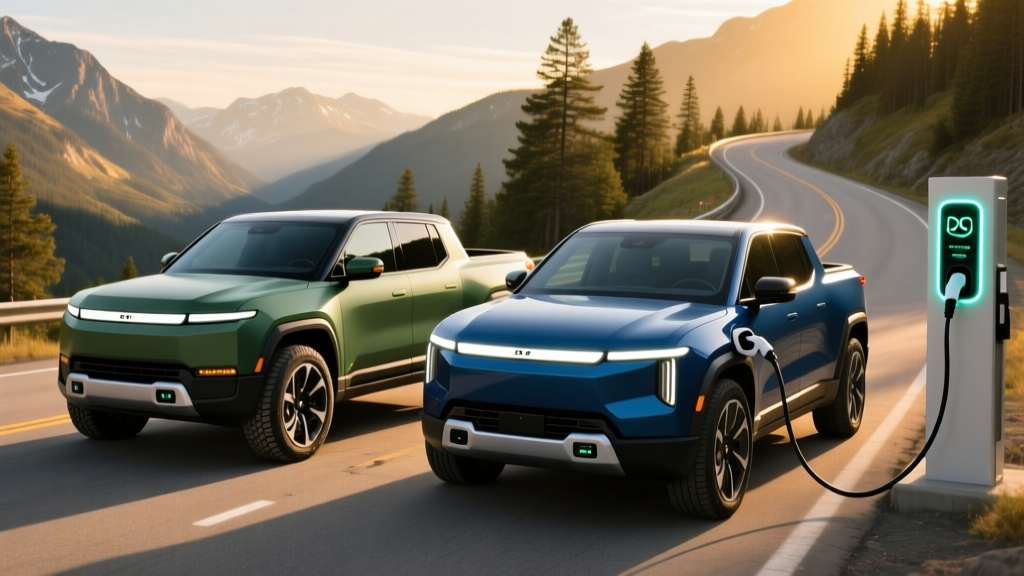
If you've searched for "Rivian map" you're likely trying to understand how Rivian's built-in navigation plans routes, factors in battery state of charge, and locates chargers on the road. The Rivian map is more than a GPS — it's an EV-specific route planner that integrates real-time battery data, terrain, weather, and the Rivian Adventure Network to predict whether you'll make it to your destination (or your next charger) with juice to spare.
But a smart map is only as useful as the vehicle it's guiding. Below, we break down how the Rivian map and route-planning system works in the 2026 R1T (truck) and R1S (SUV), then dive into the hard numbers that determine whether that map is plotting realistic trips: EPA range, real-world range loss, DC fast-charge curves, home charging speeds, pricing, and federal tax-credit eligibility.
How the Rivian Map Plans EV Routes
The Rivian navigation system — accessible on the 15.6-inch center touchscreen and the companion app — does several things that generic map apps like Google Maps or Apple Maps don't:
- State-of-charge-aware routing: The Rivian map continuously monitors your battery's State of Charge (SoC) and calculates whether your current charge is sufficient to reach the destination. If not, it automatically inserts charging stops.
- Arrival SoC prediction: For every route, the system displays your estimated SoC on arrival — a critical data point for trip planning in remote areas.
- Elevation and terrain modeling: Climbing a mountain pass consumes significantly more energy than driving flat interstate. The Rivian map factors in topography, regaining some energy on descents via regenerative braking.
- Weather and temperature integration: Cold air increases battery internal resistance and cabin heating loads. The map adjusts range estimates downward in cold conditions.
- Rivian Adventure Network and third-party charger integration: The map displays Rivian's proprietary Adventure Network chargers (often near trailheads and outdoor destinations) alongside Electrify America, EVgo, and other networks.
- Battery preconditioning: When you navigate to a DC fast charger, the vehicle preconditions the battery pack to an optimal temperature, reducing charge time on arrival.
The result is a navigation experience closer to Tesla's trip planner than to a conventional car's GPS. You tell the Rivian map where you're going; it tells you whether you can make it, where to stop, and how long each stop will take.
2026 Rivian R1T and R1S: Core Specifications
Before trusting any route planner, you need to know the vehicle's actual capabilities. Here are the key specs for the 2026 Rivian R1T (Dual-Motor and Quad-Motor configurations with the Standard and Max battery packs) and the R1S SUV equivalents.
| Spec | R1T Dual-Motor Standard | R1T Dual-Motor Max | R1T Quad-Motor Max |
|---|---|---|---|
| EPA Range | ~270 mi | ~352 mi | ~328 mi |
| Battery (usable) | ~92 kWh (NMC) | ~128 kWh (NMC) | ~128 kWh (NMC) |
| Horsepower | 533 hp | 533 hp | 1,025 hp |
| 0–60 mph | ~4.5 sec | ~4.5 sec | ~3.0 sec |
| Drivetrain | AWD (dual-motor) | AWD (dual-motor) | AWD (quad-motor) |
| Max DC Fast Charge | ~200 kW peak | ~220 kW peak | ~220 kW peak |
| 10–80% DCFC Time | ~28 min | ~38 min | ~38 min |
| Level 2 Home Charge | 11.5 kW (~25 mi/hr) | 11.5 kW (~30 mi/hr) | 11.5 kW (~30 mi/hr) |
| Efficiency (MPGe) | ~73 MPGe combined | ~70 MPGe combined | ~65 MPGe combined |
| Towing Capacity | 11,000 lbs | 11,000 lbs | 11,000 lbs |
| Base MSRP (R1T) | $69,900 | $82,400 | $99,900 |
Sources: fueleconomy.gov, Rivian R1T specs. EPA figures are estimates; real-world results vary. R1S SUV figures are closely aligned with R1T but typically 5–10 miles less range due to aerodynamics.
Real-World Range: What the Rivian Map Won't Hide
EPA sticker: 352 miles (R1T Dual-Motor Max)
Real-world highway (70–75 mph, 65°F): ~280–310 miles
Cold weather (30°F, cabin heat on): ~230–260 miles
Towing (5,000 lb trailer): ~160–190 miles
The Rivian map adjusts its range prediction dynamically based on driving style, temperature, and terrain — so the number you see on-screen is usually more conservative (and more accurate) than the EPA sticker.
Rivian's large, boxy trucks and SUVs are not efficiency champions. The Dual-Motor Max at ~70 MPGe combined consumes roughly 43 kWh per 100 miles. That's significantly more than a Tesla Model Y (~28 kWh/100 mi) or Hyundai Ioniq 5 (~30 kWh/100 mi). The tradeoff is capability: ground clearance, approach/departure angles, wading depth, and 11,000-lb towing.
The Rivian map accounts for this. If you're driving 80 mph on I-70 in January, the system will predict lower range than a 55-mph summer cruise — and it will insert additional charging stops accordingly. In our experience, the Rivian map's arrival-SoC predictions tend to be conservative by 3–5%, which is preferable to the alternative.
Charging Speed: DC Fast Charging and Home Level 2
Rivian vehicles use the NACS (North American Charging Standard) connector as of the 2025 model year, granting access to Tesla Superchargers via native port (no adapter required for 2025+ models; earlier CCS-equipped Rivians use a NACS adapter for Supercharger access).
| Charging Level | Power | Miles of Range Added | Notes |
|---|---|---|---|
| Level 1 (120V household) | ~1.4 kW | ~3 mi/hr | Emergency/trickle only |
| Level 2 (240V home, 48A) | 11.5 kW | ~25–30 mi/hr | Full charge in ~10–13 hours (Max pack) |
| DC Fast Charge (peak) | 200–220 kW | ~140 mi in 20 min (ideal) | Curve tapers significantly above 80% SoC |
Understanding the charge curve: Rivian's Max pack peaks around 220 kW between roughly 10–35% SoC, then steps down progressively. By 60% SoC, you're typically seeing ~140–160 kW. By 80%, the rate drops to ~70–90 kW. This is why the 10–80% time of ~38 minutes (Max pack) is longer than the peak kW figure might suggest — peak power is not sustained power.
Battery preconditioning matters: If you navigate to a DC fast charger using the Rivian map, the vehicle begins heating or cooling the battery en route. Arriving at a charger without preconditioning — especially in cold weather — can cut your peak charge rate in half. Always let the Rivian map route you to the charger rather than just driving there.
Rivian Adventure Network: Rivian has been building its own charging stations near outdoor recreation areas (national parks, trailheads, ski areas). These chargers are integrated into the Rivian map and typically offer 200+ kW DCFC. The network is smaller than Tesla's Supercharger network but strategically placed for the adventure-oriented buyer.
Pricing, Trims, and Federal Tax Credit Eligibility
Rivian's pricing places it firmly in the premium segment. Here's where the 2026 lineup stands, and how the federal §30D tax credit applies.
| Trim / Configuration | Base MSRP | §30D Credit Eligible? | Effective Price (if eligible) |
|---|---|---|---|
| R1T Dual-Motor Standard | $69,900 | Likely no (MSRP cap: $80K for trucks ✓, but battery sourcing rules may limit) | $69,900–$62,400 |
| R1T Dual-Motor Max | $82,400 | No (exceeds $80K truck MSRP cap) | $82,400 |
| R1T Quad-Motor Max | $99,900 | No (exceeds MSRP cap) | $99,900 |
| R1S Dual-Motor Standard | $74,900 | Likely no (MSRP cap: $80K for SUVs ✓, sourcing rules apply) | $74,900–$67,400 |
| R1S Dual-Motor Max | $87,400 | No (exceeds $80K SUV cap) | $87,400 |
§30D credit rules (2026): Under the IRS clean vehicle credit, the full $7,500 credit requires the vehicle to meet all of the following:
- MSRP cap: ≤$80,000 for trucks/SUVs/vans; ≤$55,000 for sedans
- Buyer income cap: AGI ≤$300K (married filing jointly), ≤$225K (head of household), ≤$150K (single)
- Battery critical minerals: A percentage of critical minerals must be sourced from the US or FTA partners (threshold increases annually)
- Battery components: A percentage of battery components must be manufactured or assembled in North America (threshold increases annually)
- Point-of-sale transfer: Eligible buyers can transfer the credit to the dealer at purchase, reducing the out-of-pocket price immediately
For Rivian, the Standard pack Dual-Motor R1T ($69,900) and R1S ($74,900) clear the MSRP cap. However, battery sourcing requirements have tightened each year, and Rivian's large NMC cells — while assembled in Normal, Illinois — may not meet the escalating critical-minerals thresholds for the full $7,500 in 2026. Check the fueleconomy.gov credit lookup for the specific VIN's eligibility before purchasing. Never assume the full credit applies.
Cargo, Passenger Space, and Practicality
Rivian's skateboard architecture — with the battery pack low in the chassis — frees up significant interior and cargo space.
R1T (Truck)
- Bed length: ~54 inches (4.5 ft) — shorter than a full-size F-150 bed but compensated by the gear tunnel
- Gear Tunnel: ~11 cu ft lockable, climate-optional cross-vehicle storage behind the rear seats — a Rivian-exclusive feature ideal for skis, tools, or camping gear
- Frunk (front trunk): ~11 cu ft, drainable — usable as a cooler
- Rear-seat legroom: ~37 inches
- Cab seats: 5 passengers
R1S (SUV, 3-row)
- Cargo behind 3rd row: ~10 cu ft
- Cargo behind 2nd row (3rd row folded): ~47 cu ft
- Max cargo (all rear rows folded): ~83 cu ft
- 3rd-row legroom: ~30 inches (best for children or short trips)
- Seating: Up to 7 passengers
The R1T's gear tunnel and frunk give it a versatility advantage over conventional trucks for adventure use. The R1S's third row is tight for adults but functional for families with younger children.
Technology, Driver Assistance, and Standout Features
Rivian's tech stack is proprietary and vertically integrated — similar in philosophy to Tesla, but with a more adventure-focused execution.
Infotainment and Connectivity
- 15.6-inch center touchscreen with Rivian OS
- 12.3-inch digital instrument cluster
- Over-the-air (OTA) software updates — regularly adding features and refining the Rivian map
- Native Spotify, TuneIn, and Bluetooth audio
- No Apple CarPlay or Android Auto (a common complaint — Rivian relies on its native system)
- Wi-Fi hotspot via embedded LTE
Driver Assistance (Rivian Driver+)
Rivian Driver+ is an SAE Level 2 driver-assistance system. It provides adaptive cruise control and lane-centering on highways, but the driver must remain fully engaged with hands on the wheel and eyes on the road at all times. This is not an autonomous or "self-driving" system. Only Level 4 services like Waymo operate without a human driver.
- Adaptive cruise control with stop-and-go
- Lane-centering assist (highway-capable)
- Automatic emergency braking, blind-spot monitoring, rear cross-traffic alert
- Highway Assist combines ACC + lane centering but does not auto-change lanes or navigate off-ramps autonomously
Adventure-Specific Tech
- Drive modes: All-Purpose, Sport, Snow, Off-Road, Towing — each adjusts suspension height, throttle mapping, and regen
- Air suspension: Adjustable ride height with up to ~14.4 inches of ground clearance (max off-road mode)
- Water wading: Rated to ~3+ feet
- Camp Kitchen: Optional slide-out kitchen that mounts in the gear tunnel (R1T)
- Vehicle-to-everything potential: Rivian has signaled V2L (vehicle-to-load) capability for powering campsite equipment, though availability and wattage vary by model year
Notable Drawbacks
- No CarPlay/Android Auto: A dealbreaker for some buyers accustomed to phone-mirroring
- Efficiency: At 65–73 MPGe, the R1T/R1S is thirstier than unibody crossovers — expect higher electricity costs per mile
- Charging speed vs. competitors: Peak ~220 kW is respectable but trails Hyundai/Kia's 800V architecture (~350 kW peak, 10–80% in ~18 min)
- Service center availability: Rivian's service network is growing but still sparse in many regions compared to legacy automakers
- Premium pricing: Even the base R1T starts near $70K before options
Pros, Cons, and Who Should Buy
- Best-in-class adventure capability (ground clearance, wading, gear tunnel)
- Max pack delivers 352 mi EPA — genuine road-trip range
- Rivian map with SoC-aware routing and preconditioning
- Quad-Motor offers supercar-level acceleration (3.0 sec 0–60) in a truck
- OTA updates continuously improve the vehicle
- 11,000-lb towing capacity
- NACS port for native Supercharger access (2025+)
- Base price near $70K; Max/Quad configs push past $90K
- Most trims exceed §30D MSRP cap — no $7,500 federal credit
- Efficiency lags unibody EVs (higher per-mile electricity cost)
- DCFC speed (~220 kW peak) slower than 800V competitors
- No Apple CarPlay or Android Auto
- Service centers still limited in many markets
- Third row (R1S) is tight for adults
Who the Rivian R1T/R1S Is For
- Outdoor enthusiasts: If you regularly drive to trailheads, campgrounds, or ski areas — especially on rough roads — the R1T's ground clearance, gear tunnel, and Adventure Network chargers are purpose-built for you.
- Families needing truck capability + SUV space: The R1S offers 3 rows and EV running costs, with genuine off-road ability that a Tesla Model X can't match.
- Towing users (short-to-medium distances): 11,000-lb capacity is real, but plan for range cuts of 40–50% when towing.
Who Should Look Elsewhere
- Budget-conscious buyers: At $70K+, Rivian is not an entry-level EV. Consider the Ford F-150 Lightning or Chevy Silverado EV for more affordable electric truck options.
- Commuters prioritizing efficiency: A Tesla Model Y, Hyundai Ioniq 5, or Kia EV6 will cost far less per mile and charge faster.
- CarPlay loyalists: If phone-mirroring is non-negotiable, Rivian's native system won't satisfy you.
Warranty and Battery Longevity
Rivian's warranty coverage is competitive with the EV segment:
- Battery pack: 8 years / 175,000 miles (whichever comes first), with a capacity retention threshold of 70% — meaning Rivian warrants that the battery will retain at least 70% of its original capacity during the warranty period.
- Powertrain (motors, reducers): 8 years / 175,000 miles
- Vehicle (bumper-to-bumper): 5 years / 60,000 miles
- Roadside assistance: 5 years / 60,000 miles
Rivian uses NMC (nickel manganese cobalt) chemistry in both the Standard and Max packs. NMC offers higher energy density than LFP (lithium iron phosphate) — which is why the Max pack can fit 128 kWh into the skateboard platform — but NMC typically shows slightly more degradation over time than LFP. Based on early owner data and industry norms, expect ~5–8% capacity loss over the first 100,000 miles, with the curve flattening afterward. The 70% retention warranty threshold at 175,000 miles is generous and should provide adequate protection.
Longevity tips: Avoid routinely charging to 100% on NMC packs — set your daily charge limit to 80–90% via the app, and save 100% for road trips. The Rivian map's preconditioning feature also helps longevity by keeping the battery in its thermal sweet spot during fast charging.
Frequently Asked Questions
What is the real-world range of the Rivian R1T and R1S?
The EPA rates the R1T Dual-Motor Max at ~352 miles. In real-world highway driving at 70–75 mph in moderate temperatures, expect ~280–310 miles. In cold weather (below freezing), plan for ~230–260 miles. When towing, range drops to roughly 160–190 miles depending on trailer weight and aerodynamics. The Rivian map adjusts predictions in real time based on these factors, giving you a more accurate number than the EPA sticker alone.
How fast does a Rivian charge at home and on the road?
At home on a 240V Level 2 charger (48 amps, 11.5 kW), the R1T/R1S adds roughly 25–30 miles of range per hour. A full charge of the Max pack takes ~10–13 hours. On DC fast chargers, the Max pack peaks at ~220 kW, achieving a 10–80% charge in approximately 38 minutes. The Standard pack peaks at ~200 kW with a 10–80% time of ~28 minutes. Charging slows significantly above 80% SoC to protect battery health.
How much does a Rivian cost after tax credits?
The 2026 R1T starts at $69,900 (Dual-Motor Standard). The R1S starts at $74,900. Most Max and Quad-Motor configurations exceed the §30D MSRP cap ($80,000 for trucks/SUVs) and are ineligible for the federal credit. Even for Standard-pack models that clear the MSRP cap, the escalating battery-sourcing and critical-minerals requirements may reduce or eliminate the credit. Check fueleconomy.gov and consult a tax professional before relying on the $7,500 credit.
Does the Rivian qualify for the federal EV tax credit?
Possibly, but only the Standard-pack Dual-Motor R1T ($69,900) and R1S ($74,900) fall under the §80,000 MSRP cap for trucks and SUVs. Even then, you must meet income limits (≤$300K married filing jointly) and the vehicle must satisfy 2026 critical-minerals and battery-component sourcing thresholds. The Max and Quad-Motor trims are not eligible due to MSRP. Verify per-VIN eligibility on fueleconomy.gov and review IRS §30D guidance.
Is the Rivian worth buying vs. the Ford F-150 Lightning, Tesla Cybertruck, or Chevy Silverado EV?
It depends on your use case. The F-150 Lightning starts significantly lower (~$55K) and offers more conventional truck ergonomics, but lacks Rivian's off-road capability and gear tunnel. The Tesla Cybertruck offers comparable performance and stainless-steel construction, but its polarizing design and limited service infrastructure are drawbacks. The Chevy Silverado EV offers a longer bed and Ultium platform efficiency, but its availability and real-world charging remain less proven. The Rivian wins for adventure-oriented buyers who value ground clearance, the gear tunnel, the Rivian map's route planning, and a premium interior — and who can absorb the $70K+ entry price.
Does the Rivian map work without cell service?
Yes. The Rivian map stores map data locally and uses GPS for positioning. Route planning and SoC predictions function offline. However, real-time charger availability, traffic data, and weather integration require a cellular connection. When planning trips into remote areas, download your route while you still have service and note alternative charging locations.
Can I use Apple CarPlay or Android Auto with the Rivian map?
No. Rivian does not support Apple CarPlay or Android Auto as of the 2026 model year. The company relies entirely on its proprietary Rivian OS and integrated map system. For most EV-specific functions (charger routing, SoC prediction, preconditioning), the native system is superior to phone-mirroring. But for music, podcasts, and messaging, you'll use Rivian's built-in apps or Bluetooth audio.