If you've been searching for answers to "Rivian made by" — as in, who actually builds these electric trucks and SUVs, where they come from, and whether the company is a credible long-term bet — you're not alone. Rivian remains one of the most scrutinized automakers in the EV space, partly because it arrived with a fully realized product lineup and a massive Amazon backing, and partly because its vehicles tackle segments (electric pickups, three-row electric SUVs) that legacy brands have struggled to crack.
This guide answers the ownership and manufacturing questions behind the badge, then pivots into a full spec-driven review of the current 2026 Rivian R1S (SUV) and R1T (pickup) — covering real-world range, charging curves, pricing after federal tax credits, and how they stack up against Tesla, Ford, and Hyundai's electrified competition.
Who Makes Rivian? Company Origins and Backers
Rivian Automotive, Inc. is an American electric-vehicle manufacturer founded in 2009 by RJ Scaringe, an MIT-trained mechanical engineer. Originally incorporated as Mainstream Motors, then briefly Avera Motors, the company settled on the name Rivian in 2011. Scaringe remains CEO and has steered the company from a skunkworks R&D lab to a publicly traded automaker (NASDAQ: RIVN) with a production facility, a growing service network, and an expanding charging footprint.
Key backers and partners define Rivian's financial and industrial backbone:
- Amazon — The e-commerce giant holds a significant equity stake and contracted Rivian to build 100,000 electric delivery vans (EDVs). Amazon's involvement provides both capital and a guaranteed production volume anchor.
- Ford Motor Company — Ford invested $500 million in Rivian in 2019, though the planned joint Lincoln EV project was later canceled. Ford retains a stake.
- Public markets — Rivian went public in November 2021 in one of the largest IPOs of that year, raising approximately $13.7 billion.
- Volkswagen Group — In mid-2024, VW announced a joint venture with Rivian valued at up to $5 billion, focused on co-developing electrical architecture and software platforms. This deal provides Rivian with a critical cash runway and validates its software stack for legacy OEM licensing.
Unlike many EV startups that have folded before delivering a single customer vehicle (Lordstown, Fisker, Nikola's consumer ambitions), Rivian has delivered tens of thousands of R1 vehicles and commercial vans, placing it firmly in the "real automaker" category alongside Tesla and legacy OEMs.
Where Are Rivian Vehicles Built?
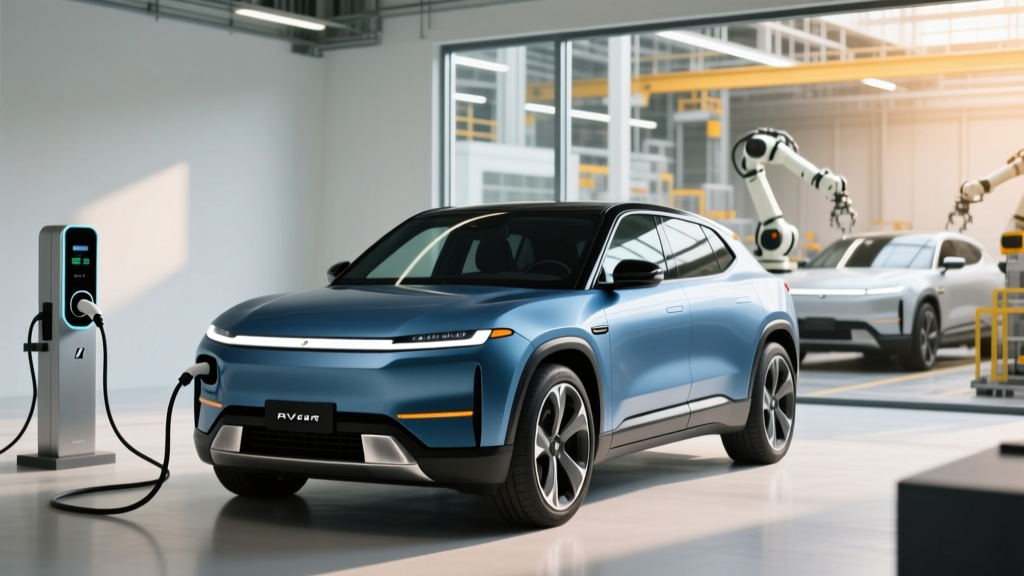
All consumer Rivian vehicles — the R1S SUV and R1T pickup — are manufactured at the company's Normal, Illinois assembly plant. This facility was originally a Mitsubishi/Diamond-Star Motors factory that Rivian purchased in 2017 and extensively retooled for EV production.
The Normal plant handles stamping, body-in-white, paint, battery pack assembly, and final vehicle assembly under one roof. Rivian has incrementally expanded capacity through process improvements and shift additions, reaching production rates that support both consumer demand and the Amazon EDV contract.
A second facility in Stanton, Georgia has been announced for future production, primarily to support the upcoming R2 midsize platform (expected 2026-2027 timeframe). Until R2 production begins, Normal remains the sole source of Rivian vehicles.
2026 Rivian R1S and R1T: Quick Verdict
The second-generation R1S and R1T (introduced for the 2025 model year and continuing into 2026) represent a substantial mid-cycle refresh. Rivian overhauled the electrical architecture, reduced wiring harness complexity, improved thermal management, upgraded the infotainment processor, and introduced new tri-motor performance variants alongside the carryover dual-motor and quad-motor options.
The verdict: Rivian's R1 platform remains the most capable electric adventure vehicle on the market — combining genuine off-road hardware, best-in-class towing for the R1T, and a tech stack that has improved dramatically through over-the-air updates. The trade-offs are pricing (these are premium vehicles, even before options), a charging curve that peaks lower than Hyundai/Kia's E-GMP platform, and a service network still maturing compared to Tesla's.
| Spec | R1S Dual-Motor (Standard) | R1S Dual-Motor (Max) | R1T Dual-Motor (Max) | R1T Tri-Motor (Performance) |
|---|---|---|---|---|
| Drivetrain | AWD (Dual-Motor) | AWD (Dual-Motor) | AWD (Dual-Motor) | AWD (Tri-Motor) |
| Horsepower | 533 hp | 533 hp | 533 hp | 850 hp |
| 0-60 mph | 4.5 sec | 4.5 sec | 4.5 sec | ~3.0 sec (est.) |
| Battery (usable) | ~92 kWh (LFP) | ~128 kWh (NMC) | ~128 kWh (NMC) | ~128 kWh (NMC) |
| EPA Range | ~270 mi | ~352 mi (R1S Max) | ~352 mi (R1T Max) | ~320 mi (est.) |
| Max DC Charge Rate | ~200 kW | ~220 kW | ~220 kW | ~220 kW |
| 10-80% DCFC Time | ~30 min | ~35 min | ~35 min | ~35 min |
| Level 2 (11.5 kW) | ~25 mi/hr | ~25 mi/hr | ~25 mi/hr | ~25 mi/hr |
| Towing Capacity | 7,700 lbs | 7,700 lbs | 11,000 lbs | 11,000 lbs |
| Base MSRP | $75,900 | $89,900 | $79,900 | $99,900 (est.) |
Source: Rivian R1S specs, fueleconomy.gov. Tri-motor figures are preliminary estimates pending final EPA certification.
Real-World Range: What the EPA Sticker Doesn't Tell You
The Standard Pack with LFP chemistry (EPA ~270 miles) is more resilient to daily deep-cycling — LFP cells tolerate 100% state-of-charge storage better than NMC — but the smaller battery means highway road trips require more frequent stops. For the R1T pickup, aerodynamic drag from the open bed and any cargo reduces efficiency further; expect roughly 5-10% less real-world range in the R1T versus the R1S at equivalent battery sizes.
Efficiency ratings hover around 73-79 MPGe combined (roughly 42-46 kWh/100 miles) depending on configuration, per fueleconomy.gov. That's thirstier than a Tesla Model Y or Hyundai Ioniq 5, but expected for a 6,000+ lb body-on-frame vehicle with genuine off-road capability.
Charging Speed and Infrastructure
Rivian's charging performance is adequate but not class-leading. The Max Pack (NMC, ~128 kWh usable) peaks at approximately 220 kW on a DC fast charger, but the large battery means the 10-80% session still takes roughly 35 minutes — longer than a Hyundai Ioniq 5's 18-minute 10-80% sprint, though the Ioniq 5 carries a much smaller 77.4 kWh battery.
| Charging Level | Power / Voltage | Miles of Range Added Per Hour | Notes |
|---|---|---|---|
| Level 1 (120V household) | ~1.4 kW | ~3-4 mi/hr | Emergency/trickle only |
| Level 2 (240V, 48A home charger) | 11.5 kW | ~25 mi/hr | Full overnight charge (~10-12 hrs for Max Pack) |
| DC Fast Charge (Max Pack) | Up to 220 kW peak | ~600+ mi/hr (at peak) | 10-80% in ~35 min; tapers above 80% |
| DC Fast Charge (Standard LFP) | Up to 200 kW peak | ~550+ mi/hr (at peak) | 10-80% in ~30 min; LFP charges more linearly |
Charge curve reality: Rivian's NMC Max Pack sustains its peak rate through roughly 30-40% state of charge, then tapers progressively. If you arrive at a 350 kW Electrify America or Tesla Supercharger (via the NACS adapter) at 10% SoC, you'll see the highest speeds early, dropping below 100 kW after ~70% SoC. Preconditioning the battery via the navigation system's automatic preconditioning feature is essential for achieving advertised speeds — arriving cold can add 10+ minutes to your session.
Rivian uses the NACS (Tesla-style) connector on current R1 vehicles and has access to the Tesla Supercharger network (over 25,000 stalls in North America) as well as CCS networks via adapter. The Rivian Adventure Network — the company's own DC fast-charging corridor buildout — continues to expand along popular adventure and road-trip routes.
Performance, Drivetrain, and Off-Road Capability
Every R1S and R1T is all-wheel drive. The Dual-Motor setup uses one motor per axle, delivering 533 hp and a 0-60 mph time of approximately 4.5 seconds — quick for a vehicle this size, though not supercar-quick like the original Quad-Motor's 3.0-second claim.
The new Tri-Motor configuration (one front, two rear) targets buyers who want the performance envelope of the original Quad-Motor with reduced complexity and weight. Rivian quotes approximately 850 hp and a 0-60 time near 3.0 seconds, making the R1T Tri-Motor one of the fastest production pickups ever built.
Off-road credentials are genuine, not cosmetic:
- Air suspension with up to 14.9 inches of ground clearance (max ride height)
- Approach/departure/breakover angles competitive with body-on-frame off-roaders
- Water fording rated at over 3 feet for the R1T
- Dedicated off-road drive modes (All-Purpose, Off-Road, Snow, Sport, Towing)
- Available all-terrain and mud-terrain tire packages from the factory
The R1T's gear tunnel — a full-width pass-through storage compartment between the cab and bed — remains a unique differentiator in the pickup segment, adding approximately 11 cubic feet of lockable, weather-sealed cargo space that no competitor offers.
Interior, Tech, and Cargo Space
The R1S seats up to seven passengers across three rows, though the third row is best suited for children or short trips. The R1T seats five. Interior materials lean premium — vegan leather, real wood trim, aluminum accents — with build quality that has improved noticeably in the Gen 2 refresh.
Cargo volume for the R1S:
- Behind third row: ~10.5 cu ft
- Behind second row (third row folded): ~46 cu ft
- Behind front row (all rear rows folded): ~88 cu ft
- Front trunk (frunk): ~11 cu ft
The R1T offers a 54-inch bed (shorter than a traditional full-size truck) with a powered tonneau cover, plus the aforementioned gear tunnel and a ~11 cu ft frunk. Towing capacity reaches 11,000 lbs on Max Pack and Tri-Motor configurations — but be aware that towing at or near max capacity can cut range by 40-50%, making long-distance towing trips a careful planning exercise.
The Gen 2 infotainment system runs on a faster processor with a responsive 15.6-inch center touchscreen, wireless Apple CarPlay/Android Auto, and an improved navigation system that integrates charging stops and battery preconditioning automatically. Rivian's Driver+ ADAS suite provides highway lane-centering and adaptive cruise control — this is an SAE Level 2 driver-assist system, meaning you must keep your hands on the wheel and eyes on the road at all times. It is not autonomous driving.
Pricing, Trim Levels, and Federal Tax Credit Eligibility
| Configuration | Base MSRP | Federal §30D Credit Eligible? | Effective Price (if eligible) |
|---|---|---|---|
| R1S Dual-Motor Standard | $75,900 | Yes (under $80K SUV cap) | ~$68,400 |
| R1S Dual-Motor Max | $89,900 | No (exceeds $80K SUV MSRP cap) | $89,900 |
| R1T Dual-Motor Standard | $69,900 | Yes (under $80K truck cap) | ~$62,400 |
| R1T Dual-Motor Max | $79,900 | Yes (under $80K truck cap) | ~$72,400 |
| R1T Tri-Motor | ~$99,900 | No (exceeds $80K truck MSRP cap) | ~$99,900 |
Critical tax credit caveats per IRS §30D rules:
- Income caps: Modified AGI must not exceed $300,000 (married filing jointly), $225,000 (head of household), or $150,000 (single).
- MSRP caps: SUVs, vans, and pickups must have an MSRP at or below $80,000; sedans at or below $55,000.
- Battery sourcing: A percentage of critical minerals and battery components must be sourced from the US or free-trade-agreement partners. These thresholds tighten annually. Verify current-year compliance on the IRS qualified vehicles list before purchasing.
- Point-of-sale transfer: As of 2024, buyers can transfer the credit to the dealer for an immediate price reduction at purchase rather than claiming it on their tax return.
Options and packages (premium interior colors, 22-inch wheels, camp kitchen, forest edge or ocean coast interior themes) can push a Standard-pack vehicle above the MSRP cap, eliminating credit eligibility. Always confirm the final sticker price and IRS listing before signing.
Rivian R1 vs. the Competition
- Genuine off-road capability with air suspension and high ground clearance
- R1T's gear tunnel and 11,000-lb towing are class-unique
- Over-the-air updates continuously add features and improve performance
- Strong build quality improvement in Gen 2 vehicles
- Access to Tesla Supercharger network via NACS
- VW partnership provides long-term financial stability
- Premium pricing — even base trims are expensive
- Max Pack and Tri-Motor trims exceed $80K tax credit MSRP cap
- Charging speed (220 kW peak) trails Hyundai/Kia's 800V architecture
- Service center network still expanding — wait times in some regions
- Third-row space in R1S is tight for adults
- Efficiency (MPGe) trails crossover-based EVs significantly
Choose the Rivian R1S if: You need a three-row electric SUV with genuine off-road chops, value OTA-driven feature improvements, and want a vehicle that can handle ski trips, camping, and daily school runs without compromise.
Choose the Rivian R1T if: You want an electric pickup that doesn't feel like a compromise — the gear tunnel, strong towing, and adventure-focused design make it ideal for active lifestyles where a Cybertruck's polarizing style or a Ford F-150 Lightning's fleet-truck DNA don't appeal.
Look elsewhere if: Maximum range-per-dollar or fastest charging speed is your priority. The Hyundai Ioniq 5, Kia EV9, or Tesla Model X may better serve pure efficiency or charging-speed-focused buyers. For luxury three-row SUV needs without off-road requirements, the BMW iX or Mercedes EQS SUV are worth cross-shopping.
Frequently Asked Questions
Is Rivian made by Ford or Amazon?
No. Rivian is an independent, publicly traded company (NASDAQ: RIVN) founded by RJ Scaringe. Amazon and Ford are investors and partners — Amazon has a large equity stake and a commercial van contract, while Ford made an early financial investment — but neither company manufactures or controls Rivian. The Volkswagen Group joint venture involves shared technology development, not manufacturing control.
What is the real-world range of the Rivian R1S and R1T?
With the Max Pack (~128 kWh NMC), the R1S achieves an EPA-estimated 352 miles. Real-world highway driving in moderate temperatures yields approximately 290-320 miles. Cold weather (below 30°F) can reduce that to 240-270 miles. The Standard Pack (LFP, ~92 kWh) delivers an EPA-estimated ~270 miles, with real-world highway figures around 220-250 miles.
How fast does a Rivian charge at home and on the road?
At home on a 240V Level 2 charger (11.5 kW / 48 amps), you'll add roughly 25 miles of range per hour — meaning a full Max Pack charge takes about 10-12 hours overnight. On a DC fast charger, the Max Pack peaks at ~220 kW, reaching 10-80% in approximately 35 minutes. The Standard LFP pack peaks at ~200 kW with a 10-80% time of roughly 30 minutes.
Does the Rivian R1 qualify for the $7,500 federal EV tax credit?
It depends on the configuration and your income. The R1S Dual-Motor Standard ($75,900 MSRP) and R1T Dual-Motor Standard/Max (at or below $80,000) qualify, provided your modified AGI is under IRS limits and battery-sourcing requirements are met. Max Pack R1S and Tri-Motor R1T configurations exceed the $80,000 MSRP cap and do not qualify. Always verify on the IRS qualified vehicle list before purchasing.
Is Rivian's Driver+ system self-driving?
No. Rivian's Driver+ is an SAE Level 2 driver-assistance system. It provides adaptive cruise control and lane-centering on highways, but you must remain fully engaged — hands on the wheel, eyes on the road. It does not navigate autonomously, handle all road types, or replace an attentive driver.
How does Rivian's service network compare to Tesla's?
Rivian operates a growing network of service centers and mobile service vans, but coverage is less dense than Tesla's. In major metro areas, service turnaround is generally reasonable. In rural or less-populated regions, you may face longer wait times or need to travel to a service center. Rivian's mobile service handles many software-related and minor hardware repairs at your home or office.