Quick Verdict: Where Can You Actually Lease a Rivian?
Rivian's direct-to-consumer model means you can order an R1T pickup or R1S SUV from anywhere in the United States — but leasing availability depends on where Rivian has established leasing operations and where state regulations permit direct manufacturer leasing. As of early 2026, Rivian offers lease options in all 50 states through its online ordering system, though the experience, delivery logistics, and local incentive stacking vary considerably by region.
The more relevant question for EV shoppers isn't just whether you can lease — it's whether leasing a Rivian makes financial sense compared to buying, especially given the shifting federal tax credit landscape under IRS §30D. This guide breaks down Rivian's 2026 lineup specs, real-world range and charging data, pricing with and without the federal credit, and the practical realities of leasing versus purchasing an R1T or R1S.
Rivian R1T and R1S: 2026 Specs at a Glance
Rivian refreshed both the R1T (truck) and R1S (three-row SUV) for the 2025 model year with a new electrical architecture, improved battery packs, and faster charging. Those updates carry into 2026 with minor trim adjustments. Here's what you're working with across the current lineup:
| Spec | Standard Battery (AWD) | Large Battery (AWD) | Max Battery (Tri-Motor) |
|---|---|---|---|
| Usable Battery Capacity | ~95 kWh (LFP) | ~129 kWh (NMC) | ~149 kWh (NMC) |
| EPA Est. Range (R1T) | 270 mi | 352 mi | 420 mi |
| EPA Est. Range (R1S) | 261 mi | 341 mi | 410 mi |
| Drivetrain | Dual-Motor AWD | Dual-Motor AWD | Tri-Motor AWD |
| Horsepower | 533 hp | 533 hp | 850 hp |
| 0–60 mph | 4.5 sec | 4.5 sec | 2.9 sec |
| Max DC Fast Charge | 200 kW | 220 kW | 220 kW |
| 10–80% DC Charge Time | ~27 min | ~24 min | ~30 min |
| Level 2 Home Charging | 11.5 kW (~25 mi/hr) | 11.5 kW (~25 mi/hr) | 11.5 kW (~25 mi/hr) |
| Efficiency (R1T, combined) | ~68 MPGe / 42 kWh/100mi | ~73 MPGe / 40 kWh/100mi | ~70 MPGe / 41 kWh/100mi |
| Towing Capacity | 11,000 lbs | 11,000 lbs | 11,000 lbs |
Chemistry note: The Standard pack uses lithium iron phosphate (LFP), which is heavier but offers longer cycle life, better thermal stability, and can be charged to 100% daily without degradation concerns. The Large and Max packs use nickel-manganese-cobalt (NMC) chemistry for higher energy density — better for range but best kept between 20–80% for daily use.
Real-World Range: What the EPA Sticker Doesn't Tell You
EPA Sticker (R1T Large Battery): 352 miles
Real-World Highway (70–75 mph, 70°F): ~290–310 miles
Real-World Highway (30°F, winter): ~240–270 miles
City/Commuting (mixed, moderate climate): ~320–340 miles
Rivian's boxy, truck-shaped aerodynamics penalize highway efficiency more than a sleek sedan or crossover. In EPA testing, the R1T Large Battery achieves 352 miles — a strong number. But sustained highway driving at 75 mph in the R1T typically yields 290–310 miles in temperate conditions, based on owner-reported data and independent testing.
Cold weather compounds the loss. Below freezing, expect a 20–30% range reduction due to battery heating demands, denser air, and cabin climate load. Rivian's heat pump (standard on 2025+ models) mitigates this compared to older resistive-heating EVs, but physics is physics. If your commute or road trip involves sub-30°F temperatures, plan around 250 miles of usable range on the Large pack.
The Max Battery pack's 420-mile EPA figure is genuinely useful for road trips, but the $10,000+ premium over the Large pack only makes sense if you regularly drive 300+ miles between charging stops. For most lessees, the Large Battery hits the sweet spot.
Charging Speed: Home and DC Fast Charging Breakdown
| Charging Level | Power (kW) | Speed (Miles/Hour) | Typical Use Case |
|---|---|---|---|
| Level 1 (120V outlet) | 1.4 kW | ~3 mi/hr | Emergency/top-up only |
| Level 2 (240V, 48A) | 11.5 kW | ~25 mi/hr | Home overnight charging |
| DC Fast (peak) | 200–220 kW | ~500+ mi/hr (peak) | Road trip charging |
DC fast charging reality: Rivian's peak charge rate of 200–220 kW (depending on pack) is respectable but not class-leading. The charge curve holds near peak from roughly 10–40% state of charge, then tapers progressively. A 10–80% session takes approximately 24 minutes on the Large Battery at a capable 350 kW station — but you'll only see those speeds on networks like Electrify America or Tesla Superchargers (via the included NACS adapter on 2025+ models).
Rivian adopted the NACS (Tesla) connector starting with 2025 models, giving you native access to the Tesla Supercharger network — the most reliable and widespread DC fast-charging network in the US. This is a significant practical advantage for lessees planning road trips.
Home charging: At 11.5 kW on a Level 2 wall connector (requires a 60A circuit), you'll add roughly 25 miles of range per hour. A full overnight session (8–10 hours) replenishes 200–250 miles — more than enough for daily driving. Installation costs for a Level 2 home setup typically run $800–$2,500 depending on panel capacity and conduit distance. Budget for a potential panel upgrade if your home has a 100A service.
Pricing, Lease Deals, and Federal Tax Credit Eligibility
Rivian pricing has shifted multiple times since launch, but the 2026 lineup stabilizes around these MSRPs:
| Model / Trim | Base MSRP | Federal Credit (§30D) | Effective Price |
|---|---|---|---|
| R1T Dual-Motor Standard | $69,900 | Up to $7,500* | ~$62,400 |
| R1T Dual-Motor Large | $75,900 | Up to $7,500* | ~$68,400 |
| R1T Tri-Motor Max | $89,900 | Up to $7,500* | ~$82,400 |
| R1S Dual-Motor Standard | $74,900 | Up to $7,500* | ~$67,400 |
| R1S Dual-Motor Large | $79,900 | Up to $7,500* | ~$72,400 |
| R1S Tri-Motor Max | $94,900 | Up to $7,500* | ~$87,400 |
*Federal tax credit caveats (§30D, per IRS guidelines): The $7,500 credit is not automatic. Eligibility requires:
- MSRP cap: Vans/pickups (R1T) must be under $80,000; SUVs (R1S) under $80,000. The R1T Tri-Motor Max at $89,900 exceeds the cap and does NOT qualify.
- Income cap: Modified AGI ≤ $300,000 (joint), $225,000 (head of household), $150,000 (single).
- Battery sourcing: Critical minerals and battery components must meet phased domestic-content thresholds that tighten annually through 2029.
- Point-of-sale transfer: As of 2024+, you can transfer the credit to the dealer at purchase for an immediate price reduction — or apply it at tax time.
Leasing and the tax credit: Here's where it gets nuanced. When you lease a Rivian, the §30D credit technically goes to the lessor (Rivian's financing arm), not you. However, most EV manufacturers — Rivian included — typically pass the credit's value through as a lease cash incentive (sometimes called "lease cash" or a capitalized cost reduction). This means your monthly lease payment should reflect the $7,500 benefit, but confirm the specific lease offer details before signing. Rivian's website and sales advisors should clearly state whether lease cash is included in advertised monthly payments.
State incentives vary: Beyond the federal credit, states like California, Colorado, Massachusetts, and New York offer additional rebates ($1,500–$7,500) that may stack. Check your state's energy office or AFDC state incentive database for current programs.
Rivian Lease Availability by State
Rivian operates as a direct-to-consumer manufacturer, meaning there are no franchised dealers. You order online, configure your vehicle, and take delivery at a Rivian Service Center, Space (showroom), or via mobile delivery in select markets. As of 2026, Rivian has physical locations in roughly 30 states, but leasing is available nationwide through their online platform.
The practical difference between states comes down to:
- Delivery logistics: If you live near a Rivian hub (California, Illinois, New York, Texas, Florida, Washington, Colorado, Georgia), delivery is faster and you can pick up in person. Remote states may involve shipped delivery with longer lead times (4–8 weeks after build).
- Service access: Rivian's mobile service fleet covers most metro areas, but rural lessees in states like Montana, Wyoming, or the Dakotas may face longer wait times for repairs.
- State registration and tax: Some states charge EV registration surfees ($50–$200/year) to offset lost gas tax revenue. A few states (Washington, for example) exempt EVs from sales tax up to a price cap.
- Direct-sales legality: A handful of states have franchise laws that complicate direct manufacturer sales. Rivian has navigated these through various legal structures, but if you're in a state with restrictive franchise laws, confirm current ordering availability directly with Rivian.
Who Should Lease a Rivian — And Who Shouldn't?
- Want an electric adventure truck/SUV without committing to long-term battery ownership
- Drive 10,000–15,000 miles/year (standard lease terms) and have home charging
- Value access to the Tesla Supercharger network via native NACS
- Want to upgrade every 36 months as EV tech evolves rapidly
- Tow a boat, trailer, or camper under 11,000 lbs on weekends
- Drive 20,000+ miles/year — lease overage penalties ($0.20–$0.30/mile) add up fast
- Want to keep the vehicle 7–10 years and benefit from full depreciation
- Don't have reliable home charging access — public-only charging gets expensive and inconvenient
- Need a three-row SUV but don't want the R1S's $75K+ price — consider the Kia EV9 or VW ID.Buzz instead
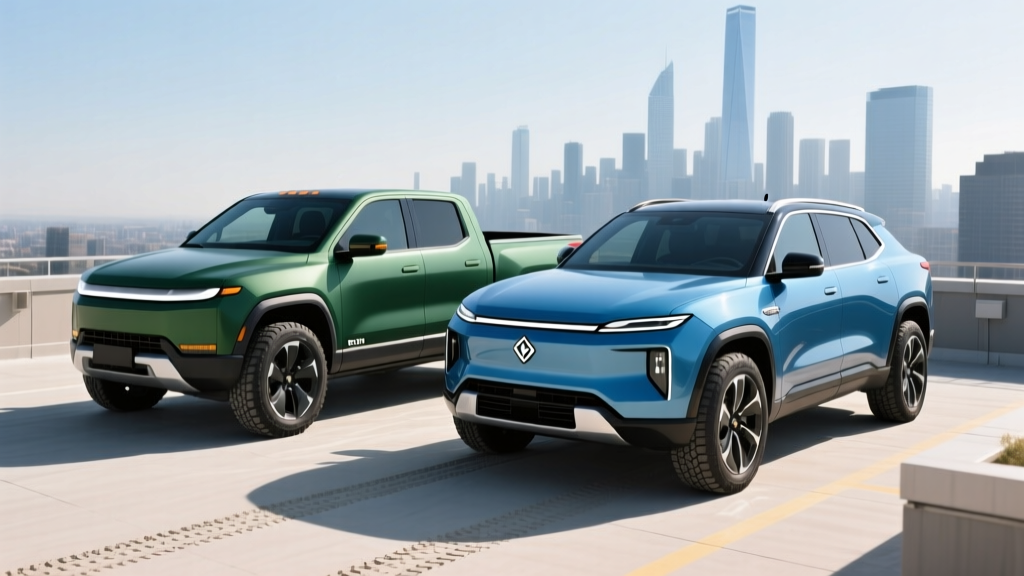
The R1T occupies a unique niche: it's the only fully electric mid-size pickup with a usable 4.5-foot bed, a gear tunnel (lockable cross-body storage), and genuine off-road capability. The R1S is one of few electric three-row SUVs with real third-row space for adults. If your use case matches these strengths, Rivian has no direct equivalent.
How the Rivian R1T and R1S Compare to Key Competitors
| Attribute | Rivian R1T (Large) | Tesla Cybertruck (AWD) | Ford F-150 Lightning (Ext. Range) | Kia EV9 (GT-Line AWD) |
|---|---|---|---|---|
| Type | Mid-size Pickup | Full-size Pickup | Full-size Pickup | 3-Row SUV |
| EPA Range | 352 mi | 340 mi | 320 mi | 270 mi |
| 0–60 mph | 4.5 sec | 4.1 sec | 5.0 sec | 5.0 sec |
| Max DC Charge | 220 kW | 250 kW | 150 kW | 239 kW |
| Base MSRP | $75,900 | $79,990 | $69,995 | $63,900 |
| Towing | 11,000 lbs | 11,000 lbs | 10,000 lbs | 5,000 lbs |
| NACS Native | Yes | Yes | No (CCS) | No (CCS) |
The R1T's main advantage over the Cybertruck and F-150 Lightning is its more manageable size (mid-size footprint), premium interior quality, and standard NACS access. The Lightning is cheaper and larger but charges slower. The Cybertruck polarizes on design and has faced build-quality criticism. Against the EV9 (an SUV, not a truck), the R1S trades range and price for superior off-road capability and towing.
Pros, Cons, and the Bottom Line on Leasing a Rivian
- Best-in-class adventure and off-road capability
- Native NACS / Tesla Supercharger access
- Premium interior with thoughtful storage (gear tunnel on R1T)
- Over-the-air updates continuously improve the vehicle
- Strong LFP option for worry-free daily charging
- 11,000-lb towing across all trims
- High base price — no trim under $69,900
- Highway range falls notably short of EPA due to aerodynamics
- Service center footprint still limited in rural areas
- Insurance premiums run 15–25% higher than comparable gas trucks
- Tri-Motor Max trims exceed the $80K MSRP cap for the federal credit
- No Apple CarPlay / Android Auto (proprietary infotainment)
Bottom line: Leasing a Rivian in 2026 is a smart move if you want an electric truck or three-row SUV without locking into long-term ownership of rapidly evolving EV technology. The lease cash pass-through of the federal credit keeps monthly payments competitive, and the NACS connector ensures the best public charging experience available. Just be honest about your annual mileage, your home charging situation, and whether you'll actually use the off-road and towing capabilities you're paying for.
Frequently Asked Questions
Can I lease a Rivian in any US state?
Yes — as of 2026, Rivian offers leasing nationwide through its online ordering platform. However, delivery timelines and service access vary by proximity to Rivian's physical locations. Remote states may experience longer delivery windows and limited mobile service coverage.
Does a Rivian lease include the $7,500 federal tax credit?
The §30D credit technically belongs to the lessor in a lease arrangement, but Rivian generally passes the value through as lease cash (a capitalized cost reduction). Always confirm with your Rivian advisor that the advertised lease payment reflects any applicable incentives.
What's the real-world highway range of the R1T Large Battery?
Expect approximately 290–310 miles at 70–75 mph in moderate temperatures. In winter conditions below 30°F, plan for 240–270 miles. The EPA's 352-mile estimate reflects mixed driving; highway-only use is less efficient due to the truck's aerodynamic profile.
How long does it take to charge a Rivian at home overnight?
On a Level 2 (240V, 48A) home charger delivering 11.5 kW, you'll gain about 25 miles of range per hour. An 8-hour overnight session adds roughly 200 miles — sufficient for most daily driving needs. A full 0–100% charge takes about 12–14 hours on the Large Battery pack.
Is Rivian's driver-assist system self-driving?
No. Rivian's Driver+ system is an SAE Level 2 driver-assistance feature — it combines adaptive cruise control and lane centering but requires you to keep your hands on the wheel and eyes on the road at all times. It is not autonomous driving.
What is Rivian's battery warranty?
Rivian covers the battery pack and drive system for 8 years or 175,000 miles (whichever comes first), with a capacity retention threshold of 70%. The vehicle limited warranty is 5 years / 60,000 miles. This is competitive with or exceeds most EV competitors.
Should I lease or buy a Rivian?
Lease if you drive under 15,000 miles/year, want to upgrade as EV tech advances, and prefer predictable monthly payments without long-term battery risk. Buy if you drive high mileage, plan to keep the vehicle 7+ years, or want to fully capture depreciation and the tax credit on your own return.