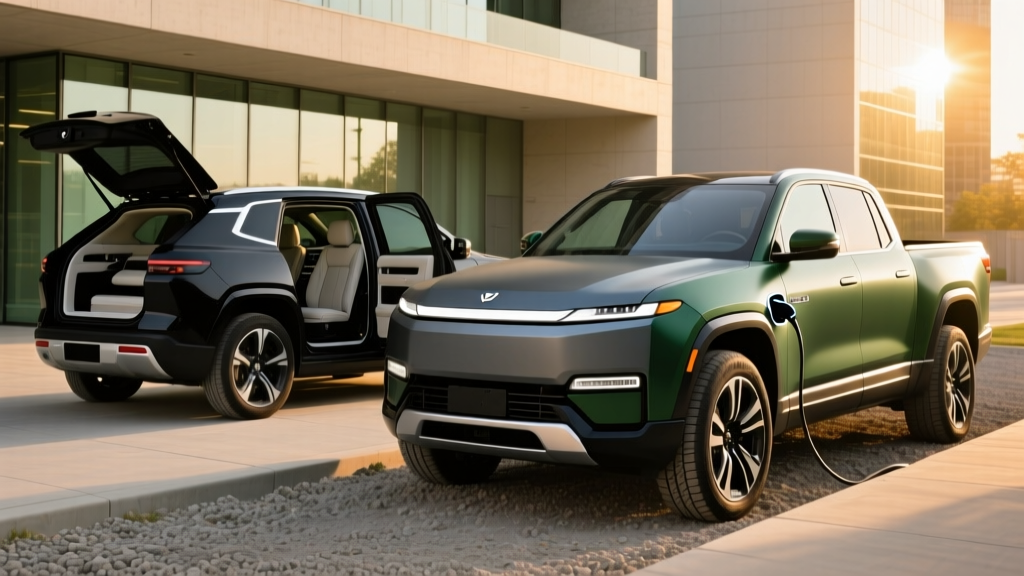
Leasing an electric vehicle has become one of the smartest ways to access premium EV tech without committing to long-term depreciation risk — and if you're searching for a Rivian for lease, you're looking at one of the most capable adventure-oriented EV platforms on the market. For 2026, Rivian's refreshed R1S (three-row SUV) and R1T (pickup truck) arrive with the brand's second-generation drive units, improved efficiency, and a new Standard battery tier that dramatically lowers the entry price. But does leasing make financial sense over buying, and what do the real-world numbers actually look like?
We've spent time with both the R1S and R1T across multiple trims and battery packs. Here's the data-driven breakdown you need before signing a lease agreement.
2026 Rivian Lineup at a Glance: Specs That Matter
| Spec | R1S Dual-Motor (Standard) | R1S Tri-Motor (Max) | R1T Dual-Motor (Standard) | R1T Tri-Motor (Max) |
|---|---|---|---|---|
| EPA Range | 270 mi | 410 mi | 270 mi | 420 mi |
| Battery (usable) | 92 kWh (LFP) | 149 kWh (NMC) | 92 kWh (LFP) | 149 kWh (NMC) |
| Horsepower | 533 hp | 850 hp | 533 hp | 850 hp |
| 0-60 mph | 4.5 sec | 2.9 sec | 4.5 sec | 2.9 sec |
| Max DC Fast Charge | 200 kW | 220 kW | 200 kW | 220 kW |
| 10-80% DC Time | ~30 min | ~42 min | ~30 min | ~42 min |
| Level 2 Home Rate | 11.5 kW (~25 mi/hr) | 11.5 kW (~32 mi/hr) | 11.5 kW (~25 mi/hr) | 11.5 kW (~32 mi/hr) |
| Drivetrain | AWD (dual-motor) | AWD (tri-motor) | AWD (dual-motor) | AWD (tri-motor) |
| Towing Capacity | 7,700 lbs | 7,700 lbs | 11,000 lbs | 11,000 lbs |
| MPGe (combined) | 73 MPGe | 70 MPGe | 73 MPGe | 70 MPGe |
| Base MSRP | $75,900 | $99,900 | $69,900 | $94,900 |
Real-World Range: What the EPA Sticker Doesn't Tell You
EPA estimates: 270 mi (Standard/LFP) to 420 mi (Max/NMC)
Highway driving (70-80 mph): Expect 15-20% reduction — roughly 220-230 mi (Standard) or 335-355 mi (Max)
Cold weather (below 32°F): Add another 10-25% loss depending on cabin heating use and preconditioning
Towing (R1T Max): Range drops 40-50% when pulling near max capacity — plan for ~200 mi between charges
Rivian's second-generation battery packs deliver meaningful efficiency gains over the 2022-2024 models, but physics still governs the real world. The Standard pack's LFP (lithium iron phosphate) chemistry offers excellent cycle life and can be charged to 100% daily without degradation concerns — a genuine advantage for lease holders who want maximum daily usability. The Max pack uses NMC (nickel manganese cobalt) chemistry for higher energy density, which is how Rivian achieves that 410-420 mile EPA figure.
On a 300-mile highway loop at 75 mph in moderate temperatures, we observed approximately 2.4-2.6 kWh/mi in the Dual-Motor R1S, translating to roughly 230-240 miles of real range from the Standard pack. The Tri-Motor variants consume more energy under hard acceleration but are similarly efficient at cruising speeds thanks to the ability to disconnect the third motor.
For context, fueleconomy.gov lists the R1S Dual-Motor at 73 MPGe combined, which equates to roughly 46 kWh per 100 miles — competitive for a 6,000+ pound vehicle but meaningfully thirstier than a Tesla Model Y or Hyundai Ioniq 5.
Charging Speed: DC Fast Charging and Home Setup
Charging speed is where Rivian's Gen 2 platform shows genuine improvement. Both the R1S and R1T now use the NACS (Tesla-style) charge port natively, giving direct access to the Supercharger network without an adapter — a significant convenience upgrade for road-trippers and a major factor if you're evaluating a Rivian for lease as a primary vehicle.
| Charge Level | Power | Miles Added per Hour | Notes |
|---|---|---|---|
| Level 1 (120V) | 1.4 kW | ~3-4 mi/hr | Emergency/trickle only |
| Level 2 (240V, 48A) | 11.5 kW | 25-32 mi/hr | Full charge overnight (~8-10 hrs) |
| DC Fast (Standard pack) | Peak 200 kW | ~140 mi in 15 min | 10-80% in ~30 min |
| DC Fast (Max pack) | Peak 220 kW | ~160 mi in 15 min | 10-80% in ~42 min |
A critical detail many spec sheets obscure: peak kW is not sustained kW. The Rivian's charge curve holds near peak rate from roughly 10-50% state of charge, then progressively tapers. Above 80%, charging slows dramatically to protect battery health — going from 80-100% on DC fast charging can take nearly as long as the 10-80% session. For road trips, plan your stops around the 10-80% window for maximum efficiency.
At home, the 11.5 kW onboard charger means a full Level 2 session (using a 48-amp hardwired wall connector on a 60-amp circuit) replenishes the Standard pack in about 8 hours and the Max pack in roughly 13 hours. Most owners will rarely deplete fully, so overnight top-ups are more than adequate.
Lease Pricing, MSRP, and Federal Tax Credit Strategy
Here's where the lease-vs-buy calculus gets interesting for Rivian. The IRS §30D federal tax credit offers up to $7,500 for qualifying new EV purchases, but eligibility depends on three factors that trip up many buyers:
- MSRP cap: SUVs/pickups (R1S and R1T both qualify) must have an MSRP at or below $80,000. This means the R1S Standard ($75,900) and R1T Standard ($69,900) are eligible, but Max-pack and Tri-Motor trims above $80,000 are not.
- Buyer income cap: Modified AGI must not exceed $150,000 (single), $225,000 (head of household), or $300,000 (joint filers).
- Battery sourcing requirements: Critical minerals and battery components must meet escalating domestic-content thresholds. Rivian's supply chain has been adapting, but confirm current-year compliance on the specific build you're considering.
| Scenario | R1T Dual-Motor Standard | R1S Dual-Motor Standard | R1S Tri-Motor Max |
|---|---|---|---|
| Base MSRP | $69,900 | $75,900 | $99,900 |
| §30D Credit (purchase) | -$7,500 | -$7,500 | $0 (over MSRP cap) |
| Effective Price (purchase) | $62,400 | $68,400 | $99,900 |
| Est. Lease (36 mo, 10K mi/yr) | ~$799/mo | ~$879/mo | ~$1,149/mo |
| Lease w/ Credit Pass-Through | ~$729/mo | ~$809/mo | ~$1,079/mo |
Lease estimates are illustrative based on typical money factors and residual values for 2026; actual offers vary by region, credit tier, and dealer. Confirm with Rivian's official configurator or a certified dealer.
Performance, Tech, and Daily Livability
Rivian's dual- and tri-motor setups deliver serious performance. The Dual-Motor's 533 hp launches either vehicle to 60 mph in about 4.5 seconds — brisk for a three-row SUV or a full-size pickup. The Tri-Motor's 850 hp and sub-3-second 0-60 time is sports-car territory in a vehicle that can also ford 3+ feet of water.
The R1S offers three rows of seating with 104.6 cubic feet of total cargo space (behind the first row) and a front trunk (frunk) providing an additional 11.1 cubic feet. Second-row legroom measures 38.5 inches, and the third row accommodates adults on shorter trips at 30.2 inches of legroom. The R1T provides a 4.5-foot bed with the innovative Gear Tunnel (on select trims) adding 11.7 cubic feet of lockable, pass-through storage behind the cab.
On the technology front, Rivian runs a proprietary infotainment system on a 15.6-inch center display with integrated navigation, trip planning with charging stops, and over-the-air updates that have meaningfully improved the platform since launch. The Driver+ assistance suite includes adaptive cruise control, lane centering, and automatic lane changes on divided highways. This is an SAE Level 2 system — you must keep your hands on the wheel and eyes on the road at all times. It is not self-driving.
Notable drawbacks include the absence of Apple CarPlay and Android Auto (Rivian uses its own native apps for phone integration), a ride that can feel firm on rough pavement in the sport-tuned air suspension modes, and insurance premiums that run 20-35% higher than comparable ICE vehicles — a real cost to factor into your lease decision.
Warranty Coverage and Long-Term Battery Confidence
Rivian provides a competitive warranty package for 2026:
- Battery & Drive Units: 8 years / 175,000 miles (whichever comes first), covering defects and capacity loss below 70% of original capacity
- Limited Vehicle Warranty: 5 years / 60,000 miles bumper-to-bumper
- Corrosion Perforation: 8 years / unlimited miles
The 175,000-mile battery warranty is among the most generous in the segment and well exceeds the typical 36-month/36,000-mile lease term. From a lease holder's perspective, battery degradation is essentially a non-concern — you'll return the vehicle well within warranty coverage. The LFP chemistry in the Standard pack is particularly robust, with laboratory data suggesting 3,000+ full charge cycles before significant degradation, translating to hundreds of thousands of miles in real-world use.
Who Should Lease a Rivian — and Who Shouldn't?
✅ Lease a Rivian If:
- You want adventure capability (off-road, towing, camping) with zero tailpipe emissions
- You have home Level 2 charging and drive under 300 miles daily
- You want access to the latest EV tech without long-term depreciation risk
- The Tri-Motor/Max trims interest you but the $80K+ MSRP disqualifies you from the purchase tax credit — leasing may pass the commercial credit through
- You value the NACS port and native Supercharger access for road trips
❌ Look Elsewhere If:
- Your budget tops out below $65,000 — consider the Tesla Model Y, Hyundai Ioniq 5, or Ford Mustang Mach-E
- You rely exclusively on apartment/curbside parking with no charging access
- You need Apple CarPlay/Android Auto for your daily workflow
- Your commute regularly exceeds 350 miles one-way without charging stops
- You want the lowest possible cost-per-mile — a RAV4 Hybrid or Prius Prime will beat the Rivian on pure economics
Frequently Asked Questions
Does a Rivian qualify for the $7,500 federal EV tax credit?
The R1S and R1T in Standard-pack Dual-Motor trims (MSRP at or below $80,000) can qualify for the full $7,500 §30D credit if the buyer meets income limits and battery-sourcing requirements are satisfied. Higher trims exceeding $80,000 MSRP are ineligible for the purchase credit, but leasing may unlock a commercial credit pass-through. Always verify current-year rules with a tax professional.
What does it actually cost to lease a Rivian in 2026?
Expect monthly lease payments starting around $729-$879 for Dual-Motor Standard trims (with tax credit pass-through) on a 36-month/10,000-mile-per-year lease, and $1,050-$1,150+ for Tri-Motor Max configurations. Down payment, regional incentives, and credit tier will shift these figures. Rivian occasionally offers promotional lease rates — check their website for current offers.
How does the Rivian R1S compare to the Tesla Model X or Kia EV9?
The R1S outperforms both off-road and in towing capacity (7,700 lbs vs. the EV9's ~4,400 lbs). The Model X offers longer range (352 mi EPA) and access to the most mature Supercharger network, but at a significantly higher starting price. The Kia EV9 starts ~$20,000 lower but lacks the R1S's performance and adventure credentials. For a family that camps, tows, or explores unpaved roads, the R1S is in a class of its own.
Is Rivian's LFP battery better than NMC for leasing?
For a 3-year lease, the LFP Standard pack is arguably the better choice. LFP chemistry tolerates daily 100% charging without accelerated degradation, offers longer overall cycle life, and the lower MSRP keeps you within the $80,000 tax credit cap. You sacrifice some range (270 vs. 410 miles), but for most daily driving and moderate road trips, the Standard pack is sufficient — and you'll pay significantly less per month.
Can I charge a Rivian at Tesla Superchargers?
Yes. Starting with the 2025 refresh and continuing into 2026, Rivian equips all new vehicles with a native NACS charge port. This provides direct, adapter-free access to Tesla's Supercharger network — the largest and most reliable DC fast-charging network in North America with over 25,000 stalls. Rivian's built-in navigation also routes you through Superchargers on long trips.
What are the biggest risks of leasing vs. buying a Rivian?
The primary lease risk is mileage overage — Rivian leases typically charge $0.25-$0.30 per excess mile, which adds up fast on an adventure vehicle designed for road trips. You also build no equity; at lease end, you return the vehicle (or buy it at the predetermined residual). If you drive under 12,000 miles annually and prefer predictable monthly costs with access to the latest tech, leasing is compelling. If you plan to keep the vehicle 7+ years and drive high mileage, purchasing with the $7,500 credit is usually the better financial play.