Why a Rivian Lease in Minnesota Demands Cold-Weather Scrutiny
Minnesota's brutal winters — where temperatures routinely plunge below zero and highway speeds combine with sub-freezing air to sap battery efficiency — make EV selection a high-stakes decision. If you're researching a Rivian lease in Minnesota, you're likely weighing the R1S SUV and R1T pickup against their ability to handle 300-mile highway trips to the North Shore or a daily commute through a Fargo wind chill. Both vehicles are engineered for adventure, but leasing one in the Upper Midwest requires understanding exactly how cold weather reshapes range, charging behavior, and total monthly cost.
This review covers the current 2026 Rivian R1S and R1T lineup with hard data: EPA range figures adjusted for real-world Minnesota conditions, DC fast-charge curves, home Level 2 speeds, pricing across trims, and federal tax credit eligibility under current IRS §30D rules. Whether you're comparing a lease against purchase or shopping against the Tesla Model X, Ford F-150 Lightning, or Rivian's own dual-motor vs. tri-motor configurations, the numbers below will ground your decision.
Rivian R1S and R1T: 2026 Spec Overview
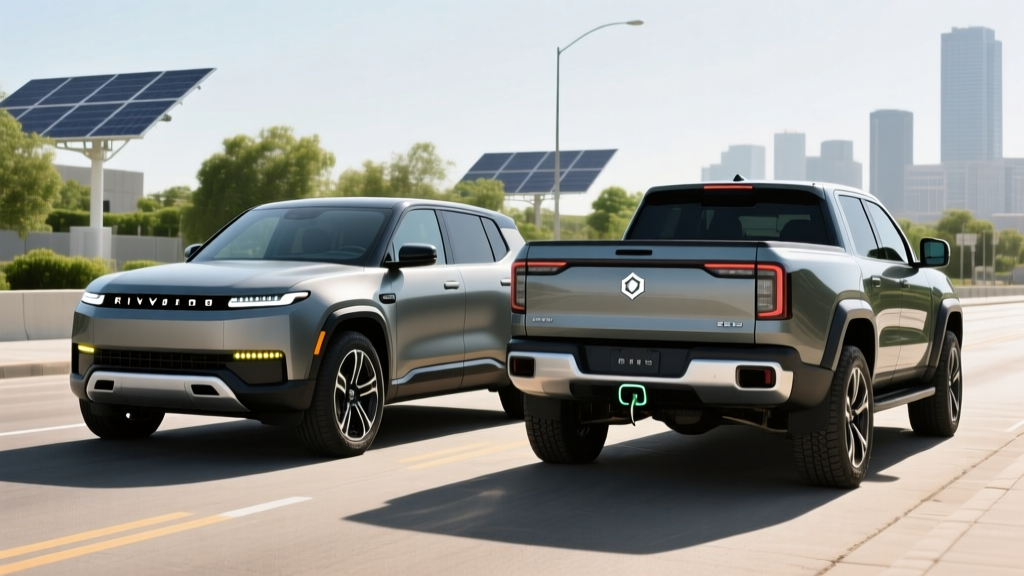
Rivian offers both the R1S (three-row SUV) and R1T (crew-cab pickup) in multiple battery and drivetrain configurations for 2026. The current lineup uses a Dual-Motor AWD (two independent motors, one per axle) and a performance-oriented Tri-Motor AWD setup. Battery options include the Standard pack, the Large pack, and the Max pack. Rivian uses NMC (nickel manganese cobalt) chemistry across its current battery lineup — chosen for higher energy density, which is critical for a large SUV/pickup platform. LFP (lithium iron phosphate) is not currently offered in Rivian vehicles.
| Spec | R1S Dual-Motor (Large) | R1S Tri-Motor (Max) | R1T Dual-Motor (Large) | R1T Tri-Motor (Max) |
|---|---|---|---|---|
| Battery (usable) | ~109 kWh (NMC) | ~141 kWh (NMC) | ~109 kWh (NMC) | ~141 kWh (NMC) |
| EPA Range | ~352 mi | ~410 mi | ~352 mi | ~420 mi |
| Drivetrain | Dual-Motor AWD | Tri-Motor AWD | Dual-Motor AWD | Tri-Motor AWD |
| Horsepower | ~533 hp | ~850 hp | ~533 hp | ~850 hp |
| 0–60 mph | ~4.5 sec | ~3.0 sec | ~4.5 sec | ~3.0 sec |
| Max DC Fast Charge | ~220 kW peak | ~220 kW peak | ~220 kW peak | ~220 kW peak |
| 10–80% DC Time | ~30 min | ~42 min | ~30 min | ~42 min |
| Level 2 Home Rate | 11.5 kW (~25 mi/hr) | 11.5 kW (~25 mi/hr) | 11.5 kW (~25 mi/hr) | 11.5 kW (~25 mi/hr) |
| MPGe (combined) | ~73 MPGe | ~70 MPGe | ~73 MPGe | ~70 MPGe |
| Efficiency | ~46 kWh/100 mi | ~48 kWh/100 mi | ~46 kWh/100 mi | ~48 kWh/100 mi |
| Base MSRP (approx.) | $79,900 | $99,900 | $73,000 | $93,000 |
| Battery Warranty | 8 yr / 175,000 mi | 8 yr / 175,000 mi | 8 yr / 175,000 mi | 8 yr / 175,000 mi |
Source: fueleconomy.gov and Rivian official specs. Figures reflect 2026 model year estimates and may vary by configuration.
Real-World Range: What Minnesota Winters Actually Do
R1S/R1T Dual-Motor Large (EPA 352 mi): Expect ~280–310 mi in mild conditions; ~230–265 mi in sustained sub-20°F highway driving.
R1S/R1T Tri-Motor Max (EPA 410–420 mi): Expect ~330–370 mi in mild conditions; ~275–310 mi in deep-winter highway use.
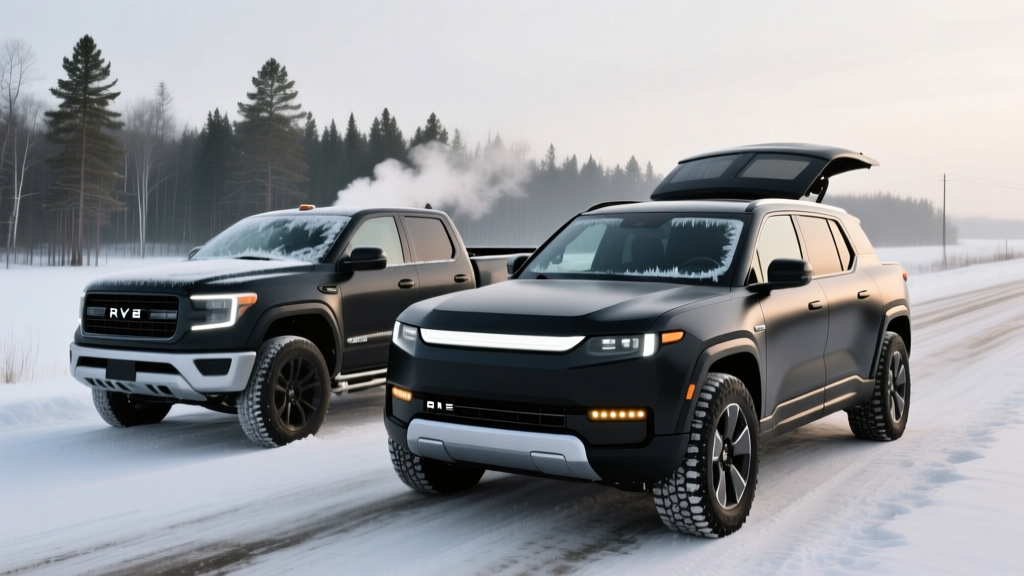
Cold-weather range loss of 20–35% is typical for NMC batteries in large, heavy EVs. Rivian's heat pump and battery preconditioning help mitigate this, but physics wins at -10°F with a roof rack.
Minnesota's average January temperature hovers around 10°F in the Twin Cities and drops well below zero in the Iron Range. For EV batteries, this means the electrolyte thickens, internal resistance increases, and energy is diverted to cabin and battery heating. In AAA and independent cold-weather testing, EVs with NMC chemistry and heat pumps — like Rivian's platform — typically lose 20–30% of their EPA-rated range at temperatures below 20°F when driven at highway speeds.
Rivian includes a heat pump across the R1 lineup, which is significantly more efficient than resistive heating for cabin warmth. The vehicle also offers battery preconditioning — when you navigate to a DC fast charger, the thermal management system warms the pack to an optimal temperature for charging. This matters enormously in Minnesota: arriving at a charger with a cold-soaked battery can cut your peak charge rate in half.
For a Minneapolis-to-Duluth run (roughly 155 miles each way), even the Dual-Motor Large pack can complete the trip round-trip in summer with margin to spare. In January, plan a 15–20 minute DC fast-charge stop in Hinckley or Moose Lake — both have Electrify America and Tesla Supercharger (with NACS adapter) stations along I-35.
Charging Speed: DC Fast and Home Level 2 Breakdown
Rivian's 2026 R1 vehicles accept up to ~220 kW peak on DC fast chargers using the NACS (North American Charging Standard) connector, which Rivian adopted starting with 2025 models. This gives access to the Tesla Supercharger network — a major advantage for Minnesota road trips, where Supercharger stations outnumber other networks along corridors like I-90 and I-94.
| Charging Level | Power | Miles Added per Hour | Notes |
|---|---|---|---|
| Level 1 (120V outlet) | ~1.4 kW | ~3 mi/hr | Emergency/trickle only; impractical for daily use |
| Level 2 (240V, 48A home) | 11.5 kW | ~25 mi/hr | Full charge overnight (~14 hrs for Max pack) |
| DC Fast (peak) | ~220 kW | N/A | Peak rate sustained only to ~40% SoC |
| DC Fast (10–80%) | Variable | N/A | ~30 min (Large), ~42 min (Max) |
Charge curve reality: The ~220 kW peak rate is not sustained across the entire session. Rivian's charge curve tapers progressively — you'll see peak speeds between 10–40% State of Charge, after which the rate steps down to protect battery health. By 70%, expect roughly 80–100 kW, and above 80%, speeds drop sharply to ~40–50 kW. This is why the 10–80% metric matters more than peak kW: it reflects the usable fast-charging window you'll actually rely on during road trips.
For home charging in Minnesota, a Level 2 wall connector rated at 48 amps (11.5 kW) on a 60-amp circuit is the practical standard. This adds roughly 25 miles of range per hour, meaning the Large pack charges from near-empty to full in about 11 hours — easily overnight. The Max pack requires roughly 14 hours, which still fits within an overnight window if you plug in by early evening. Most Minnesota homes with a 200-amp electrical panel can accommodate a 60-amp EV circuit; older homes may need a panel upgrade ($1,500–$3,000 via a licensed electrician).
Minnesota Lease Pricing and Federal Tax Credit Eligibility
Leasing a Rivian in Minnesota involves understanding how the federal EV tax credit interacts with lease structures. Under current IRS §30D rules and the commercial clean vehicle credit (§45W), the leasing company (lessor) is technically the entity that claims the credit — and may or may not pass savings to you as a reduced monthly payment or capitalized cost reduction. This is commonly called the "lease loophole" and it has been a significant factor in EV leasing decisions.
| Configuration | Base MSRP | Est. Monthly Lease (36 mo, 10k mi/yr) | Federal Credit Pass-Through |
|---|---|---|---|
| R1T Dual-Motor Large | $73,000 | ~$850–$950 | Varies by lessor; ask explicitly |
| R1S Dual-Motor Large | $79,900 | ~$900–$1,050 | Varies by lessor; ask explicitly |
| R1T Tri-Motor Max | $93,000 | ~$1,100–$1,250 | Varies by lessor; ask explicitly |
| R1S Tri-Motor Max | $99,900 | ~$1,200–$1,400 | Varies by lessor; ask explicitly |
Lease estimates are approximate and depend on money factor, residual value, down payment, and dealer/lender terms. Always confirm whether the lessor applies the federal credit to your lease.
- MSRP Cap (purchase, §30D): SUVs/pickups must be ≤$80,000 MSRP. This eliminates the Tri-Motor Max trims from the purchase credit but may not apply to leases under §45W.
- Buyer Income Cap (purchase, §30D): AGI ≤$300,000 (joint), ≤$225,000 (head of household), ≤$150,000 (single). Lease structures under §45W may bypass this cap.
- Battery Sourcing: Critical minerals and battery component requirements phase in annually. Confirm current-year compliance on irs.gov.
- Point-of-Sale Transfer: For purchases, the credit can be transferred to the dealer at sale. For leases, the lessor claims the commercial credit.
- Minnesota State Incentives: Check the Minnesota Department of Commerce for any current state rebates, which vary by legislative session.
For Minnesota buyers, the Dual-Motor Large configurations at ~$73,000–$79,900 MSRP fall under the §30D purchase cap for SUVs and trucks, making them eligible for up to $7,500 in federal credit if you meet income and sourcing requirements — assuming you buy rather than lease. If you lease, the commercial credit pathway may still reduce your cost, but it depends entirely on the lessor's policy. Always ask the leasing company directly whether the federal credit is applied to your capitalized cost.
Cargo, Passenger Space, and Daily Practicality
The R1S and R1T serve very different use cases, and Minnesota lifestyles often dictate which one fits:
R1S (SUV): Three rows of seating for up to seven passengers. Cargo volume behind the third row is approximately ~10 cu ft, expanding to ~47 cu ft with the third row folded and ~83 cu ft with both rear rows down. The front trunk (frunk) adds ~11 cu ft — useful for groceries or a charging cable kit. Third-row legroom is tight for adults (~32 inches) but works well for children on school runs or short trips to the cabin up north.
R1T (Pickup): A crew cab with seating for five. The 4.5-foot bed is shorter than a full-size truck but includes the innovative Gear Tunnel — a lockable, pass-through storage compartment spanning the width of the vehicle between the cab and bed, offering ~11 cu ft of secure, weatherproof storage. This is ideal for hockey bags, ski gear, or tools. The bed itself handles ~1,760 lbs of payload and the R1T can tow up to 11,000 lbs (properly equipped), though towing at max capacity will cut range roughly in half.
Both vehicles feature Rivian's 15.6-inch center touchscreen running a custom operating system with over-the-air updates, integrated navigation with charger routing, and a camp mode that maintains climate control for overnight use — a genuine asset for Boundary Waters camping trips. The Rivian Driver+ system provides adaptive cruise control and lane-centering on highways, but it is a Level 2 driver-assist system — the driver must remain fully engaged at all times. It is not autonomous or self-driving.
Pros, Cons, and How It Compares
Pros
- Class-leading NACS access to Tesla Supercharger network for road trips
- Excellent build quality, thoughtful storage (Gear Tunnel, frunk)
- Strong off-road capability with quad-motor option and air suspension
- Heat pump standard — critical for Minnesota efficiency
- 8-year/175,000-mile battery warranty exceeds many competitors
- Over-the-air updates continuously add features
Cons
- High starting price — Dual-Motor Large begins ~$73,000–$79,900
- Significant cold-weather range loss (20–35%) typical of large NMC packs
- Tri-Motor Max trims exceed §30D MSRP cap for purchase credit
- No LFP battery option for buyers who prefer 100% daily charging
- Service center network still limited in greater Minnesota
- Efficiency (~46–48 kWh/100 mi) trails lighter EVs
Key competitors for a Minnesota buyer:
- Ford F-150 Lightning: Lower starting price (~$55,000), strong dealer network in MN, but less range (~320 mi EPA max) and CCS connector (less public charging access than NACS).
- Tesla Model X: Comparable range and NACS-native, but polarizing styling, panel-gap concerns, and no pickup variant.
- Chevrolet Silverado EV: Competitive range and pricing, but newer platform with less proven reliability data.
- Hyundai Ioniq 9 / Kia EV9: Three-row SUV alternatives at lower price points (~$55,000–$70,000), but less ground clearance and no pickup option.
Who Should Lease a Rivian in Minnesota?
Choose the Rivian R1T if: You need a pickup bed for gear, value the Gear Tunnel for sports equipment, and want towing capacity for a boat or camper. The Dual-Motor Large keeps you under the §30D MSRP cap if purchasing.
Look elsewhere if: Your budget is under $60,000, you lack home charging access, or you drive more than 350 highway miles regularly in deep winter without willingness to fast-charge en route.
A Rivian lease in Minnesota makes the most sense for households with home Level 2 charging, moderate daily commutes (under 80 miles round-trip), and weekend adventure needs that justify the premium price. The NACS connector and Supercharger access are a genuine advantage for I-35 and I-94 corridor travel. But go in with clear eyes about cold-weather range loss and confirm the tax credit situation with your lessor before signing.
Frequently Asked Questions
What is the real-world range of a Rivian in a Minnesota winter?
Expect 20–35% below the EPA sticker in sustained sub-20°F highway driving. The Dual-Motor Large (~352 mi EPA) delivers roughly 230–265 real-world winter miles; the Max pack (~410–420 mi EPA) delivers roughly 275–310 miles. Preconditioning and the heat pump help, but cold is the enemy of all lithium-ion chemistry.
How fast does a Rivian charge at home and on the road?
At home on a 240V/48A Level 2 circuit, you'll add ~25 miles of range per hour (11.5 kW), fully recharging overnight. On DC fast chargers, the Large pack reaches 10–80% in ~30 minutes and the Max pack in ~42 minutes, with peak rates of ~220 kW tapering significantly above 60% State of Charge.
Does a Rivian qualify for the federal EV tax credit?
For purchase, the Dual-Motor Large configurations (under $80,000 MSRP) can qualify for up to $7,500 under IRS §30D if you meet income caps and battery-sourcing requirements. Tri-Motor Max trims exceed the MSRP cap. For leases, the lessor may claim a commercial credit under §45W and pass savings to you — confirm this explicitly before signing. Check current rules at irs.gov.
Is it worth leasing a Rivian vs. buying one in Minnesota?
Leasing can make sense if you want to avoid long-term battery degradation risk, prefer lower monthly payments, or want to access the commercial credit pathway that bypasses some §30D restrictions. Buying makes sense if you plan to keep the vehicle 5+ years, want to claim the §30D credit directly (on eligible trims), and drive enough to exceed typical lease mileage limits (10,000–12,000 mi/yr).
Is Rivian's Driver+ system self-driving?
No. Rivian Driver+ is an SAE Level 2 driver-assist system that combines adaptive cruise control and lane-centering. You must keep your hands on the wheel and eyes on the road at all times. It is not autonomous. Only Level 4 services like Waymo operate without a human driver, and those are not available in Minnesota.
Where can I service a Rivian in Minnesota?
Rivian operates a service center in the Minneapolis area and offers mobile service for many routine repairs. However, the network is thinner than legacy automaker dealer networks. Before leasing, confirm the nearest service location and mobile-service coverage for your ZIP code.