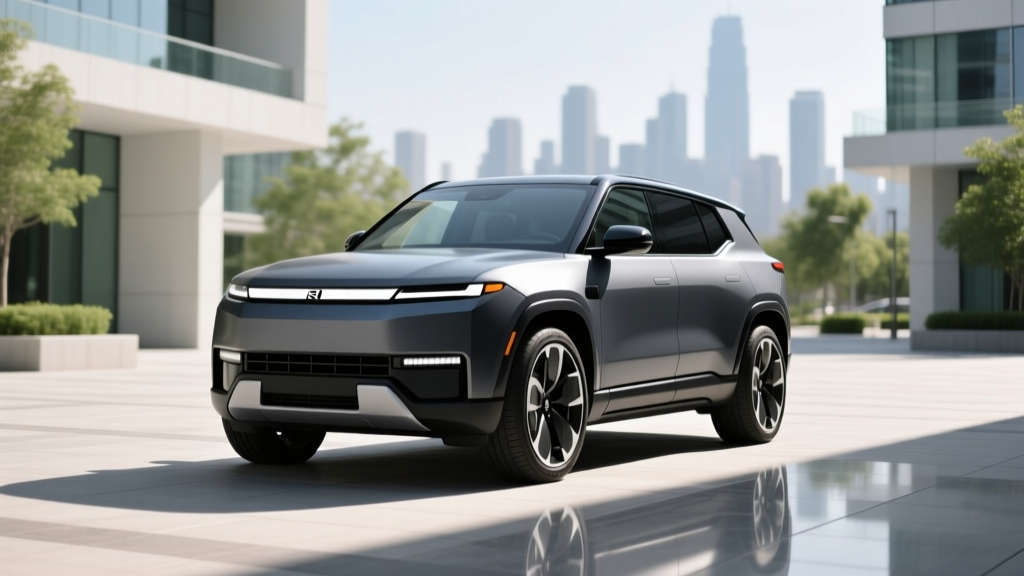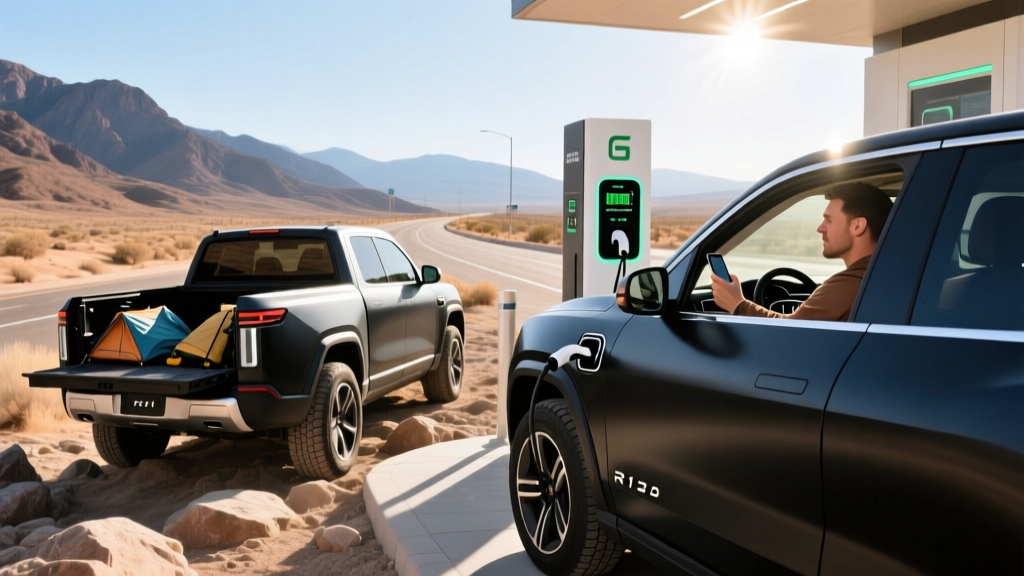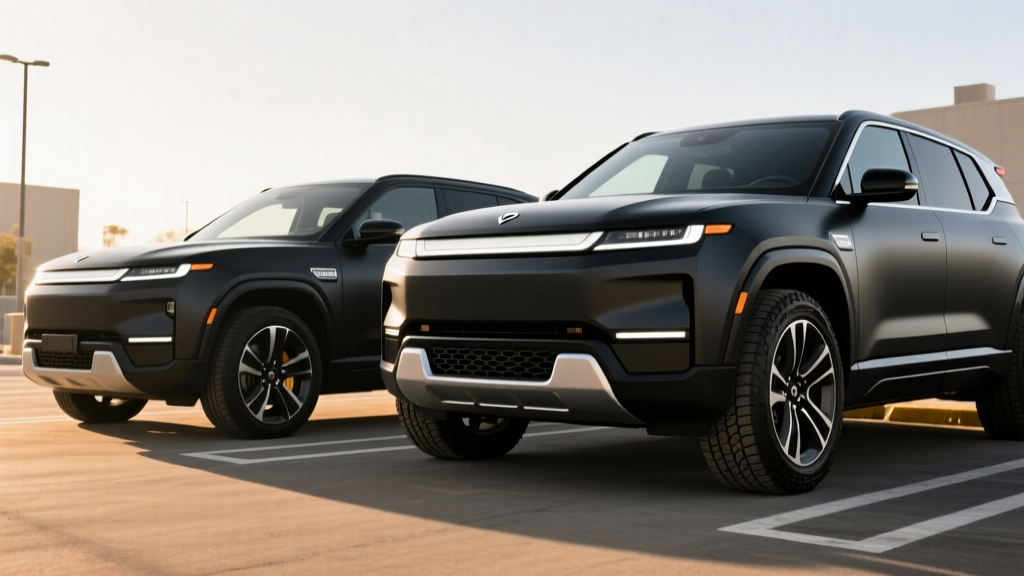
Rivian's air suspension system is one of the most versatile in the EV truck and SUV segment, offering everything from 14.9 inches of ground clearance for off-road trails to a party trick that makes daily life easier: Rivian kneel mode. If you've watched an R1S SUV or R1T pickup crouch down as the driver approaches, you've seen kneel mode in action — but what exactly does it do, how far does it drop, and does the rest of the vehicle live up to this clever feature?
This review covers everything you need to know about Rivian kneel mode and the 2025–2026 R1 platform it lives on, including real-world range, charging speeds, pricing after federal tax credits, and how the R1S and R1T stack up against the Tesla Model X, Ford F-150 Lightning, and GMC Hummer EV.
What Is Rivian Kneel Mode and How Does It Work?
Rivian kneel mode is a feature of the R1S and R1T's available adaptive air suspension that lowers the vehicle's ride height by approximately 2.4 inches from its standard position when parked or when the driver approaches with the key fob or phone-as-key. The purpose is straightforward: reducing the step-in height for passengers, making it easier to load cargo into the rear, and improving accessibility for children, shorter adults, or anyone with mobility considerations.
The system activates automatically when the vehicle is shifted into Park and the driver's door is opened, or it can be triggered manually via the center touchscreen or the Rivian mobile app. Kneel mode works across all R1S and R1T trims equipped with the Gen 2 air suspension — which is standard on Adventure and Ascend trims and unavailable on the base Standard package (which uses conventional coil springs).
- Drop height: ~2.4 inches below standard ride height
- Standard ride height: 10.1 inches ground clearance
- Kneel ground clearance: ~7.7 inches
- Max off-road height: 14.9 inches ground clearance
- Activation: Automatic on Park + door open, manual via screen/app
- Availability: Adventure and Ascend trims with air suspension (Gen 2)
Beyond kneel mode, the Gen 2 air suspension offers six driver-selectable ride heights. Highway mode drops the vehicle 0.6 inches at speed to improve aerodynamic efficiency and range. Off-Road modes raise the suspension in two stages for rock crawling and trail clearance. The system self-levels when towing or hauling heavy loads — a feature that matters whether you're towing a boat with the R1T or loading the R1S cargo area to its 104.7 cu-ft maximum.
Rivian R1S and R1T: Full Specs at a Glance
The current-generation Rivian R1 platform (refreshed for 2025 with Gen 2 hardware) offers dual-motor and quad-motor powertrains across two battery pack sizes. Here's how the numbers break down:
| Spec | Dual-Motor Standard | Dual-Motor Max Pack | Tri-Motor (Ascend) |
|---|---|---|---|
| EPA Range (R1S) | 270 mi | 410 mi | 380 mi |
| EPA Range (R1T) | 270 mi | 420 mi | 390 mi |
| Battery (usable) | ~95 kWh (LFP) | ~141 kWh (NMC) | ~141 kWh (NMC) |
| Horsepower | 533 hp | 533 hp | 850 hp |
| 0–60 mph | 4.5 sec | 4.5 sec | 2.9 sec |
| Drivetrain | AWD (dual-motor) | AWD (dual-motor) | AWD (tri-motor) |
| Max DC Fast Charge | 200 kW | 220 kW | 220 kW |
| 10–80% DCFC Time | ~27 min | ~30 min | ~30 min |
| Level 2 Home Charging | 11.5 kW (~25 mi/hr) | 11.5 kW (~25 mi/hr) | 11.5 kW (~25 mi/hr) |
| Towing Capacity | 7,700 lb | 7,700 lb | 7,700 lb |
| Efficiency (R1S MPGe) | 69 MPGe | 73 MPGe | 65 MPGe |
Sources: EPA fueleconomy.gov, Rivian official specifications.
Real-World Range: What the EPA Sticker Doesn't Tell You
EPA estimate: 270 mi (Standard) / 410 mi (Max Pack R1S)
Real-world highway (70 mph, 75°F): ~230–250 mi (Standard) / ~340–370 mi (Max Pack)
Cold-weather (20°F, highway): ~180–210 mi (Standard) / ~270–310 mi (Max Pack)
Towing (5,000 lb trailer, R1T): Range drops 40–50% — expect ~130–160 mi (Standard)
Rivian's EPA-rated range figures are competitive on paper, but the real-world numbers tell a more nuanced story. The R1S and R1T are heavy vehicles — curb weight exceeds 6,800 pounds for the R1S and 7,100 pounds for the R1T — and that mass shows up in highway efficiency. At sustained 70–75 mph speeds, expect to use between 42 and 48 kWh per 100 miles depending on conditions, which translates to meaningful range reduction versus the EPA combined cycle.
The Max Pack's 141 kWh NMC battery provides a genuine safety net for road trips. Even with highway and cold-weather penalties, 270+ real-world miles in winter is workable for most routes with a single DC fast-charge stop. The Standard pack's LFP chemistry, meanwhile, trades range for longevity — LFP cells tolerate regular 100% charging without the degradation concerns that NMC owners manage by staying below 80–90% for daily use.
Towing is where range becomes a genuine planning exercise. The R1T's 7,700-pound max tow rating is legitimate, but pulling a 5,000-pound camper at highway speeds will cut range nearly in half. Plan charging stops accordingly, and use Rivian's built-in route planner which factors in trailer load when estimating range and charging times.
Charging Speed: DC Fast Charging and Home Level 2
Rivian's Gen 2 platform supports peak DC fast-charge rates up to 220 kW on Max Pack and Tri-Motor configurations, and 200 kW on the Standard pack. On a 350 kW-capable Electrify America or Rivian Adventure Network station, the Max Pack charges from 10% to 80% in approximately 30 minutes.
| Charging Level | Power | Miles Added per Hour | Notes |
|---|---|---|---|
| Level 1 (120V) | ~1.4 kW | ~3 mi/hr | Emergency/top-up only |
| Level 2 (240V, 48A) | 11.5 kW | ~25 mi/hr | Full charge overnight (~12 hr for Max Pack) |
| DC Fast Charge | Up to 220 kW | ~600+ mi/hr (peak) | 10–80% in ~30 min; tapers above 80% |
The charge curve matters here. Like most large-battery EVs, the Rivian sustains its peak rate only through roughly 30–40% state of charge. From 60% to 80%, the rate tapers to approximately 100–120 kW, and above 80% it drops sharply to protect cell health. For road trips, the 10–80% window is where you want to spend your charging time — plan stops accordingly and avoid charging past 80% unless you're at your overnight destination.
For home charging, the onboard 11.5 kW Level 2 charger is competitive. A full overnight session on a Level 2 wall connector adds roughly 25 miles of range per hour, meaning even the 141 kWh Max Pack can go from near-empty to full in about 12 hours. Rivian sells the Rivian Wall Charger at 11.5 kW / 48 amps, which requires a 60-amp dedicated circuit. Budget $800–$1,500 for a professional electrician to install a NEMA 14-50 outlet or hardwire the charger, depending on your panel capacity and run distance.
Rivian also uses the NACS (Tesla-style) connector on 2025+ models, granting native access to Tesla Supercharger stations with 15,000+ locations — a significant advantage over CCS-only vehicles that still rely on adapters for Supercharger access.
Pricing, Trims, and Federal Tax Credit Eligibility
The 2025–2026 Rivian lineup is structured across Standard, Adventure, and Ascend tiers, with pricing that places it firmly in the premium EV segment:
| Model / Trim | Base MSRP | §30D Credit Eligible? | Est. After Credit |
|---|---|---|---|
| R1T Dual-Motor Standard | $69,900 | Yes (if under $80K MSRP cap) | ~$62,400 |
| R1S Dual-Motor Standard | $74,900 | Yes (SUV cap is $80K) | ~$67,400 |
| R1T Dual-Motor Adventure | $79,900 | Borderline (verify trim MSRP) | ~$72,400 |
| R1S Tri-Motor Ascend | $99,900 | No (exceeds $80K SUV cap) | $99,900 |
Tax credit eligibility per IRS §30D clean vehicle rules. Verify current-year battery sourcing and critical mineral requirements before purchase.
- MSRP cap: ≤$80,000 for SUVs (R1S), ≤$55,000 for pickups (R1T) — Note: IRS classifies R1T as a pickup, subject to the lower cap; verify current classification with your dealer
- Buyer income cap: ≤$300,000 MFJ / ≤$150,000 single / ≤$225,000 head of household (modified AGI)
- Battery sourcing: Critical minerals and battery components must meet escalating domestic-sourcing thresholds — Rivian has been working to qualify, but rules tighten annually
- Point-of-sale transfer: Eligible buyers can apply the $7,500 credit at purchase, reducing out-of-pocket cost immediately
- Consult a tax professional to confirm your specific eligibility before relying on the credit
A critical note on the R1T: IRS classification of the vehicle as a "pickup truck" versus a "SUV/van" determines whether the $55,000 or $80,000 MSRP cap applies. As of the most recent guidance, Rivian R1T configurations above $55,000 MSRP may not qualify — which effectively limits the credit to the most basic Standard configuration, if at all. The R1S, classified as an SUV, has a more generous $80,000 cap, making most Adventure trims eligible. Always verify with your dealer and the IRS before assuming eligibility.
Cargo, Passenger Space, and Daily Practicality
The R1S is a three-row SUV with seating for up to seven, while the R1T is a crew-cab pickup with a 4.5-foot bed and the innovative Gear Tunnel — a lockable, pass-through storage compartment that runs the width of the vehicle between the cab and bed.
R1S cargo volume: 104.7 cu ft (all rows folded), 46.7 cu ft (third row folded), 11.5 cu ft (all rows up). Third-row legroom is 30.4 inches — tight for adults on long trips but workable for children. Front legroom is generous at 41.3 inches.
R1T bed and storage: 4.5-foot bed (54 inches), plus the 11-cu-ft front trunk (frunk) and the ~11-cu-ft Gear Tunnel. The Gear Tunnel is a genuine differentiator — it's ideal for storing skis, fishing rods, or camping gear out of sight and out of the elements. Rivian offers the Gear Tunnel Shuttle, a slide-out cargo tray that extends the tunnel's utility.
This is where kneel mode ties back to daily usability. With the suspension lowered, loading the R1S cargo area or stepping into the R1T cab requires noticeably less effort. For families loading car seats, or for anyone regularly accessing the bed or cargo floor, kneel mode transforms from a novelty into a feature you'll use every day.
Tech, Driver Assistance, and Standout Features
Rivian's infotainment runs on a custom operating system displayed on a 15.6-inch center touchscreen and a 12.3-inch driver display. The system is responsive and well-organized, with native integration for route planning, charging stop optimization, and over-the-air updates that have added features like pet mode, camp mode, and enhanced regenerative braking profiles since launch.
Driver assistance comes via Rivian's Driver+ system, which includes adaptive cruise control with lane centering, automatic emergency braking, blind-spot monitoring, and rear cross-traffic alert. Driver+ is a SAE Level 2 system — it assists with steering and speed but requires the driver to remain fully engaged at all times. It is not self-driving, and Rivian does not market it as such. In practice, Driver+ is competent for highway cruising but not class-leading compared to GM's Super Cruise or Ford's BlueCruise on mapped divided highways.
Rivian Driver+ provides lane centering and adaptive cruise control simultaneously, but the driver must maintain hands-on-wheel (or torque-sensing) awareness and full attention at all times. This is not a Level 3 or Level 4 system — you are the driver, and the system is an assistant.
Other standout tech includes the Rivian Gear Guard (a cable lock system integrated into the bed for securing outdoor equipment), Camp Mode (which maintains climate control and levels the suspension for sleeping in the vehicle), and the front trunk (frunk) with a drain plug — useful as a cooler for tailgating.
Notable drawbacks: The R1 platform does not currently offer hands-free driving on par with Super Cruise. The second-row seats in the R1S don't fold completely flat, limiting cargo flexibility. And while the infotainment is good, it lacks Apple CarPlay and Android Auto — a deliberate choice by Rivian, but one that frustrates some buyers who prefer phone projection.
Rivian R1S / R1T vs. the Competition
| Attribute | Rivian R1S (Max) | Tesla Model X | Ford F-150 Lightning | GMC Hummer EV SUV |
|---|---|---|---|---|
| EPA Range | 410 mi | 335 mi | 320 mi | 314 mi |
| 0–60 mph | 2.9 sec (Tri) | 2.5 sec (Plaid) | 3.8 sec | 3.5 sec |
| Max DCFC | 220 kW | 250 kW | 150 kW | 350 kW (capable) |
| Towing | 7,700 lb | 5,000 lb | 10,000 lb | 7,500 lb |
| Ground Clearance | 14.9 in | ~8.2 in | ~8.9 in | 15.9 in |
| Starting MSRP | $69,900 | $79,990 | $54,995 | $98,845 |
The Rivian's combination of range (with the Max Pack), off-road capability, and tech-forward design makes it difficult to match head-to-head. The F-150 Lightning wins on towing and price. The Model X wins on acceleration and Supercharger convenience (though Rivian's NACS adoption narrows this gap). The Hummer EV competes on off-road theatrics but costs significantly more. Kneel mode and the Gear Tunnel are features none of these competitors offer.
Battery Warranty and Long-Term Ownership
Rivian provides an 8-year / 175,000-mile battery and drive unit warranty, which is among the most generous mileage limits in the industry. The warranty covers battery capacity degradation below 70% of original capacity — meaning if your Max Pack drops below ~99 kWh of usable capacity within the warranty period, Rivian will repair or replace it.
The vehicle limited warranty is 5 years / 60,000 miles, which is competitive. For LFP Standard pack owners, the chemistry's inherent longevity — LFP cells degrade more slowly than NMC and tolerate 100% state-of-charge storage — provides additional peace of mind for high-mileage drivers and daily commuters who charge nightly.
Maintenance costs are low compared to ICE trucks and SUVs: no oil changes, no transmission fluid, and regenerative braking dramatically extends brake pad life. Expect to spend primarily on tire rotation and cabin air filter replacement. Insurance premiums for the R1S and R1T run 15–25% higher than comparable ICE vehicles due to repair costs and parts pricing — get quotes before committing.
Pros and Cons
- Class-leading range with Max Pack (410 mi EPA)
- Air suspension with kneel mode, off-road height, and self-leveling
- Gear Tunnel (R1T) is genuinely useful storage innovation
- NACS connector for native Supercharger access
- 8-yr / 175,000-mi battery warranty
- Strong OTA update track record adding features post-purchase
- Tri-Motor performance (2.9 sec 0–60) rivals sports cars
- Premium pricing — $70K+ before options
- No Apple CarPlay or Android Auto
- Driver+ lags Super Cruise/BlueCruise for hands-free highway
- Heavy curb weight impacts highway efficiency and tire wear
- Towing cuts range dramatically (~50% loss)
- Tax credit eligibility uncertain for many trims (R1T especially)
- Third-row space in R1S is tight for adults
Who Should Buy the Rivian R1S or R1T?
- Choose Rivian if: You need genuine off-road capability combined with daily-driving refinement, want the longest available range in an electric SUV/truck, regularly carry outdoor gear (Gear Tunnel), and value air suspension features like kneel mode for family loading.
- Look elsewhere if: Your budget is under $60K (consider the F-150 Lightning or Hyundai Ioniq 5), you need best-in-class towing (F-150 Lightning at 10,000 lb), you rely on Apple CarPlay, or you want hands-free highway driving (GM Super Cruise vehicles).
- Max Pack vs Standard: Choose Max Pack for road trips and cold climates. Choose Standard (LFP) for commuting, lower cost, and maximum battery longevity with daily 100% charging.
Frequently Asked Questions
Does Rivian kneel mode work on all R1S and R1T models?
No. Kneel mode requires the available air suspension, which comes standard on Adventure and Ascend trims. The base Standard package uses conventional coil springs and does not offer kneel mode or any ride-height adjustment.
How much does a Rivian cost after the federal tax credit?
If eligible for the full $7,500 §30D credit, a base R1T Standard at $69,900 drops to approximately $62,400, and a base R1S Standard at $74,900 drops to ~$67,400. However, eligibility depends on MSRP caps (especially restrictive for the R1T as a pickup), buyer income limits, and battery sourcing requirements that tighten each year. Confirm with a tax professional and your dealer before relying on the credit.
What is the real-world range of the Rivian R1S and R1T?
Expect approximately 230–250 highway miles from the Standard pack and 340–370 from the Max Pack in moderate temperatures. Cold weather (below freezing) reduces range by 20–30%. Towing a trailer cuts range roughly in half regardless of pack size.
Does the Rivian R1T qualify for the $7,500 EV tax credit?
Possibly, but it's uncertain. The IRS classifies the R1T as a pickup truck, subjecting it to a $55,000 MSRP cap under §30D. Most R1T trims exceed this cap. The R1S, classified as an SUV, has an $80,000 MSRP cap and is more likely to qualify on Adventure trims. Always verify current-year rules on IRS.gov.
Can the Rivian R1T tow a camper?
Yes — the R1T is rated to tow up to 7,700 pounds, which covers most mid-size travel trailers and boat trailers. However, towing at or near max capacity will reduce range by 40–50%, so plan charging stops carefully on longer trips and use Rivian's route planner with the trailer profile enabled.
Does Rivian support Tesla Superchargers?
Yes. Starting with 2025 models, Rivian equips R1S and R1T vehicles with the NACS connector natively, enabling direct access to Tesla's Supercharger network without an adapter. Older models with CCS connectors can use a NACS adapter provided by Rivian.