If you've searched for "Rivian key" you likely want to know how Rivian handles vehicle access — whether it's the phone-as-key system, the NFC key card, or the physical key fob. But understanding the Rivian key ecosystem also means understanding the vehicles it unlocks: the R1T electric pickup and R1S electric SUV. This review covers the digital access system in detail, then dives deep into the specs, charging performance, real-world range, and ownership economics that matter if you're considering either model in 2026.
How the Rivian Key System Works
Rivian uses a multi-layered digital access system rather than a traditional ignition key. Here's what you need to know:
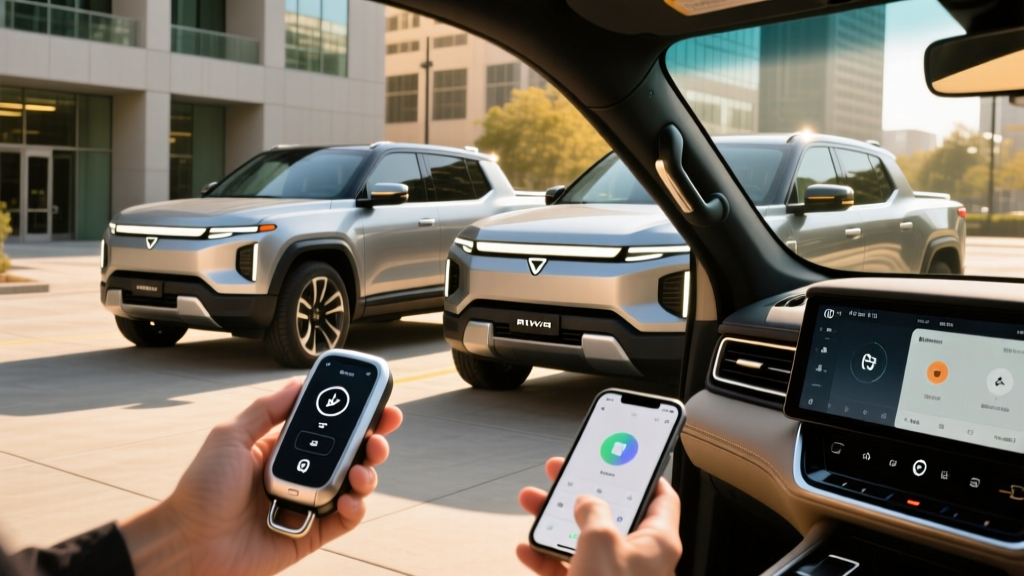
- Phone-as-Key: The primary method. Your smartphone uses Bluetooth Low Energy (BLE) to authenticate and unlock the vehicle as you approach. Once inside, the car recognizes your profile and adjusts seats, mirrors, climate, and drive settings automatically. Most owners never take their phone out of their pocket.
- NFC Key Cards: Rivian provides backup key cards (credit-card sized) that tap on the driver's side B-pillar to unlock and on the center console to start. These are essential backups if your phone dies or you're near heavy RF interference.
- Key Fob (optional): Available as an accessory, the fob mimics phone-as-key functionality with buttons for lock, unlock, frunk, and the signature Rivian gear tunnel (R1T only).
- Driver Profiles: Each key method is tied to a profile — the R1T and R1S support up to 6 profiles, so family members each get personalized settings linked to their phone or card.
The system works well in practice, though owners occasionally report Bluetooth handshake delays in extreme cold (below 10°F) or in underground garages with poor signal. Rivian has improved reliability through OTA updates, and the NFC card backup ensures you're never truly locked out. If you're coming from a Tesla, the experience is comparable but slightly more polished in profile management.
R1T and R1S: 2026 Specs at a Glance
For 2026, both the R1T (pickup) and R1S (three-row SUV) ride on Rivian's updated Gen 2 platform, featuring a new electrical architecture, in-house drive motors, and improved battery chemistry options. Here's the core spec comparison:
| Spec | R1T Dual-Motor | R1S Dual-Motor | R1T Tri-Motor | R1S Tri-Motor |
|---|---|---|---|---|
| EPA Range (Max Pack) | 352 mi | 340 mi | 420 mi (est.) | 405 mi (est.) |
| EPA Range (Standard) | 270 mi | 260 mi | — | — |
| Battery Capacity (usable) | 106 kWh (Std) / 141 kWh (Max) | 106 kWh (Std) / 141 kWh (Max) | 141 kWh (Max) | 141 kWh (Max) |
| Battery Chemistry | NMC (Max) / LFP (Std) | NMC (Max) / LFP (Std) | NMC | NMC |
| Horsepower | 533 hp | 533 hp | 850 hp | 850 hp |
| 0-60 mph | 4.5 sec | 4.6 sec | 2.9 sec | 3.0 sec |
| Drivetrain | AWD (dual-motor) | AWD (dual-motor) | AWD (tri-motor) | AWD (tri-motor) |
| Max Tow Capacity | 11,000 lbs | 7,700 lbs | 11,000 lbs | 7,700 lbs |
| Efficiency (MPGe) | 73 MPGe combined | 71 MPGe combined | 68 MPGe (est.) | 66 MPGe (est.) |
| kWh/100 mi | 46 | 48 | 50 (est.) | 52 (est.) |
Real-World Range: What the EPA Number Doesn't Tell You
Rivian's LFP (lithium iron phosphate) Standard battery offers a critical ownership advantage: you can charge it to 100% daily without accelerated degradation concerns, unlike the NMC Max Pack which benefits from an 80% daily charge limit. LFP cells are heavier and less energy-dense — hence the lower range — but their cycle life and thermal stability are superior. If your daily commute is under 80 miles round-trip, the LFP Standard pack is arguably the smarter long-term play.
The Tri-Motor models sacrifice some efficiency for staggering performance. The 850-hp R1T Tri-Motor will likely see real-world highway range around 340-360 miles with the Max Pack — still excellent for a truck this capable, but the higher kWh/100mi consumption means more frequent charging on long hauls.
Charging Performance: DC Fast, Level 2, and the Curve
Rivian's Gen 2 architecture brought meaningful charging improvements. Here's the full breakdown:
| Charging Level | Power / Rate | Speed | Notes |
|---|---|---|---|
| DC Fast Charge (peak) | 220 kW (Max Pack) | 10-80% in ~21 min | Peak rate sustained to ~55% SoC, then tapers; Standard pack peaks ~180 kW |
| DC Fast Charge (Standard) | 180 kW | 10-80% in ~25 min | LFP chemistry tolerates higher SoC charging better |
| Level 2 (home, 48A) | 11.5 kW | ~25 mi/hr (Max) / ~21 mi/hr (Std) | Requires NACS connector; Rivian Wall Connector or equivalent |
| Level 2 (40A) | 9.6 kW | ~21 mi/hr (Max) / ~18 mi/hr (Std) | Common for 50A circuit installations |
| Level 1 (120V) | 1.4 kW | ~3 mi/hr | Emergency/trickle only; a full Max Pack takes 100+ hours |
A critical detail most spec sheets bury: the charge curve taper. Rivian's Max Pack hits 220 kW peak but holds that rate only to roughly 55% State of Charge. From 55-80%, power tapers progressively to around 90-110 kW. This is why the 10-80% time is ~21 minutes rather than the ~14 minutes a flat 220 kW rate would suggest. Plan road-trip stops accordingly — charging from 80-100% on DC fast is painfully slow (the taper becomes severe above 90%) and rarely worth the wait.
Rivian now uses the NACS (Tesla-style) connector natively on 2026 models, granting access to Tesla Superchargers via the Rivian app integration. This is a major practical advantage over CCS-only vehicles, as Supercharger reliability and coverage remain best-in-class. The Rivian Adventure Network — the brand's own DC fast-charging network near national parks and adventure destinations — continues to expand, though coverage is still limited compared to Electrify America or Tesla.
Pricing, Trims, and Federal Tax Credit Eligibility
Rivian's pricing has shifted significantly since launch. Here's where the 2026 lineup stands:
| Model / Trim | Base MSRP | As-Tested (Typical) | §30D Credit Eligible? |
|---|---|---|---|
| R1T Dual-Motor Standard | $69,900 | $72,000-$76,000 | Possible — see rules below |
| R1T Dual-Motor Max | $83,900 | $87,000-$94,000 | No — exceeds $80,000 truck MSRP cap |
| R1T Tri-Motor Max | $99,900 | $104,000-$115,000 | No — exceeds $80,000 truck MSRP cap |
| R1S Dual-Motor Standard | $74,900 | $77,000-$82,000 | No — exceeds $80,000 SUV MSRP cap |
| R1S Dual-Motor Max | $88,900 | $92,000-$99,000 | No — exceeds $80,000 SUV MSRP cap |
| R1S Tri-Motor Max | $104,900 | $110,000-$120,000 | No — exceeds $80,000 SUV MSRP cap |
The IRS §30D federal tax credit imposes an MSRP cap of $80,000 for trucks, vans, and SUVs. This is the critical constraint for Rivian buyers. The only model that might qualify is the R1T Dual-Motor Standard at $69,900, since pickups fall under the truck MSRP cap of $80,000. However, eligibility also depends on:
- Buyer income caps: Modified AGI must not exceed $300,000 (joint), $225,000 (head of household), or $150,000 (single).
- Battery sourcing requirements: Critical minerals and battery components must meet escalating percentage thresholds from qualified trade partners. Rivian has been working to comply, but specific eligibility can change — always verify at the point of sale.
- Point-of-sale transfer: If eligible, you can transfer the credit to the dealer at purchase for an immediate price reduction rather than waiting for tax filing.
Most Rivian configurations exceed the MSRP cap. If the federal credit is a dealbreaker, explore your state's incentive programs — many states offer their own rebates without the same MSRP restrictions (check your state energy office or AFDC state incentive database).
Interior, Cargo, and Tech: The Daily Ownership Experience
The R1T and R1S interiors reflect Rivian's adventure-first philosophy. Materials are durable and premium without being ostentatious — think vegan leather, ash wood trim, and rugged-yet-refined surfaces that won't guilt you about trail dust.
R1T Cargo: The 4.5-foot bed (54 inches) is shorter than a full-size truck but compensated by the legendary Gear Tunnel — a 11.7 cu ft pass-through compartment behind the cab accessible from both sides. Combined with the 11.0 cu ft frunk (front trunk) and a lockable under-bed storage area, the R1T offers more secure, weather-protected cargo space than any conventional pickup. Bed payload is rated at 1,760 lbs.
R1S Cargo: With all three rows up, you get 21.7 cu ft behind the third row. Fold the third row for 57.6 cu ft, and fold both rear rows for a max 104.7 cu ft. The frunk adds 11.0 cu ft. Third-row legroom is 32.7 inches — usable for kids or shorter adults on trips under an hour but tight for long hauls.
Tech highlights:
- 15.6-inch center display running Rivian's in-house OS — responsive, well-organized, with native navigation, camp/trail guides, and over-the-air updates.
- Driver+ (ADAS): Rivian's Level 2 driver-assistance system includes adaptive cruise, lane centering, and automatic lane changes on mapped highways. It's competent but not class-leading — Tesla's Autopilot and GM's Super Cruise remain smoother in lane-centering confidence. Driver+ requires hands-on-wheel supervision at all times (this is SAE Level 2, not self-driving).
- Camp Mode, Pet Mode, and Gear Guard: Unique Rivian features that keep climate running while parked, monitor pets via cabin cameras, and use external cameras to watch your bed/tailgate cargo — all tied to the Rivian key profile system.
- Powered tonneau cover (R1T optional) and camp kitchen slide-out (Gear Tunnel accessory) are popular add-ons.
Notable drawbacks: The R1T's 4.5-foot bed limits full-sheet plywood (you'll need to lower the tailgate). The R1S third row is best for children. Infotainment lacks Apple CarPlay/Android Auto — Rivian insists on its native system, which is good but frustrating for users who prefer phone projection. And insurance premiums run high; expect quotes 20-35% above a comparable ICE truck.
Warranty and Long-Term Battery Outlook
Rivian provides competitive warranty coverage:
- Battery & Drive Unit: 8 years / 175,000 miles (whichever comes first), with a capacity retention threshold of 70%.
- Limited Vehicle Warranty: 5 years / 60,000 miles bumper-to-bumper.
- Corrosion Warranty: 12 years, unlimited miles.
The 175,000-mile battery warranty is generous — it exceeds the industry-standard 100,000-mile threshold. For context, Tesla offers 8 years / 150,000 miles on the Model X and 120,000 miles on the Model 3/Y. Ford's F-150 Lightning matches at 8 years / 100,000 miles.
Long-term degradation data on Rivian's Gen 2 packs is still accumulating (the platform launched for 2025 models), but Gen 1 R1T owners report roughly 5-7% capacity loss at 50,000 miles, which is within normal NMC behavior. The LFP Standard pack should show even less degradation — LFP cells routinely retain 90%+ capacity past 100,000 miles in fleet data from other manufacturers.
Who Should Buy a Rivian — and Who Shouldn't
Choose Rivian if:
- You need a genuine truck (R1T) with 11,000-lb towing and serious off-road capability, or a three-row electric SUV (R1S) for family adventures
- You value the Gear Tunnel, frunk, and lockable storage over a traditional long bed
- You want NACS native charging with Supercharger access
- You plan to keep the vehicle 5+ years and value the 175,000-mile battery warranty
- You regularly haul gear for skiing, camping, biking, or trailering
Look elsewhere if:
- Budget is under $65,000 — even the base R1T starts at $69,900 and options add up fast
- You need a full-size 6.5-foot truck bed for construction work (consider the F-150 Lightning or Silverado EV)
- Federal tax credit eligibility is essential — most Rivian trims exceed the MSRP cap
- You rely on Apple CarPlay or Android Auto for infotainment
- You want the most polished hands-free highway driving assist (GM Super Cruise or Ford BlueCruise lead here)
Frequently Asked Questions
What is the real-world range of the Rivian R1T?
The EPA rates the R1T Dual-Motor Max Pack at 352 miles. Real-world highway driving yields roughly 290-310 miles in mild weather and 240-270 miles in cold conditions (below 30°F). The Standard pack's 270-mile EPA rating translates to about 220-240 miles highway in practice.
How fast does the R1T charge at home and on the road?
On a Level 2 home charger at 48 amps (11.5 kW), the Max Pack gains approximately 25 miles of range per hour — a full overnight charge from 20% to 100% takes about 12 hours. On DC fast chargers, the Max Pack peaks at 220 kW and charges from 10-80% in roughly 21 minutes. The Standard LFP pack peaks at 180 kW with a 10-80% time around 25 minutes.
How much does a Rivian cost after tax credits?
The R1T Dual-Motor Standard starts at $69,900 and is the only trim potentially eligible for the $7,500 federal §30D credit, bringing it to roughly $62,400 if you meet income caps and battery-sourcing requirements. All other trims exceed the $80,000 MSRP cap for trucks/SUVs and are ineligible for the federal credit. Check the IRS clean vehicle credit page for current sourcing rules.
Is the Rivian R1T worth buying over the F-150 Lightning or Silverado EV?
The R1T wins on innovation (Gear Tunnel, camp kitchen, camp mode), off-road capability, and build quality feel. The F-150 Lightning offers a more conventional truck experience with a longer bed, lower starting price (~$55,000), and broader dealer service network. The Silverado EV provides the longest range (up to 440 mi EPA on 4WT trim) and a more usable midgate bed extension. Your choice depends on whether you prioritize adventure-tech innovation (Rivian), familiar truck utility (Ford), or maximum range (Chevrolet).
Does Rivian's phone-as-key system work reliably?
Yes, with caveats. The BLE-based phone-as-key works seamlessly in most conditions, automatically unlocking and loading your driver profile. Occasional handshake delays occur in extreme cold or RF-dense environments. Always carry an NFC key card as backup — it's the size of a credit card and lives in your wallet.
What is the Rivian battery warranty?
Rivian covers the battery and drive unit for 8 years or 175,000 miles, whichever comes first, guaranteeing at least 70% capacity retention. This is among the most generous battery warranties in the EV truck/SUV segment.