Why the Rivian Key Card Matters for R1S and R1T Owners
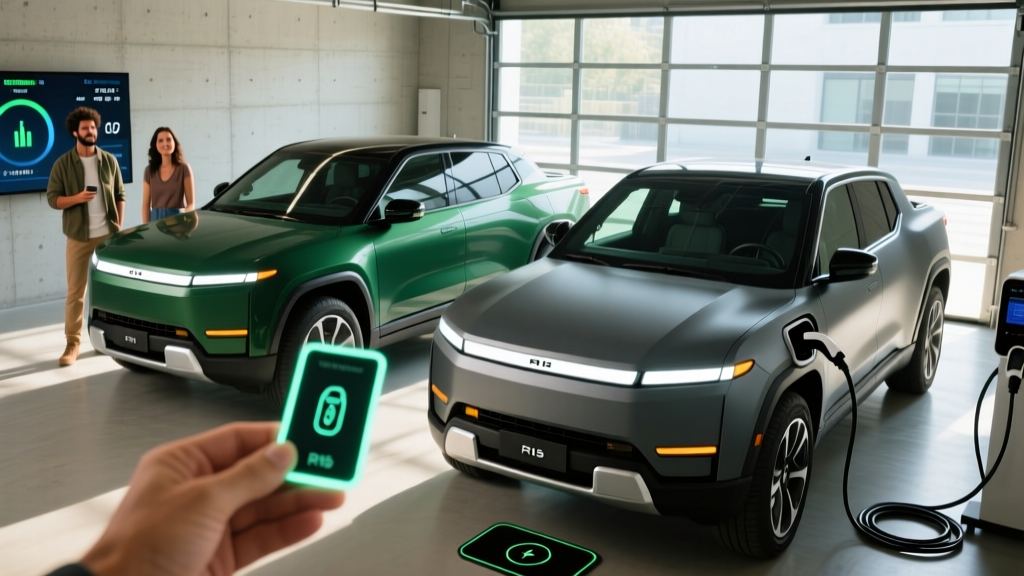
If you've ordered a 2026 Rivian R1S SUV or R1T pickup, one of the first surprises in your delivery walkthrough is the Rivian key card — a slim, credit-card-sized NFC fob that replaces the traditional key blade entirely. Unlike Tesla's key card, which you tap on a B-pillar, the Rivian key card communicates via near-field communication (NFC) with readers embedded in the driver-side door handle and the center console. It serves as your primary backup to phone-as-a-key (Bluetooth Low Energy) and the optional key fob.
But access tech is only part of the ownership story. Below, we break down the full 2026 Rivian R1S and R1T platform — range, charging speed, battery chemistry, pricing, and federal tax credit eligibility — so you can evaluate these trucks beyond the key card handshake.
2026 Rivian R1S & R1T: Platform Specs at a Glance
Rivian refreshed the R1 platform for the 2025 model year, and the 2026 lineup carries forward the updated Dual-Motor, Performance Dual-Motor, and Tri-Motor configurations, plus the new Standard and Max battery tiers. Here are the core numbers:
| Spec | Dual-Motor (Standard) | Dual-Motor (Max) | Tri-Motor (Max) |
|---|---|---|---|
| Battery (usable) | 92 kWh (LFP) | 141 kWh (NMC) | 141 kWh (NMC) |
| EPA Range (R1S) | 270 mi | 410 mi | 380 mi |
| EPA Range (R1T) | 270 mi | 420 mi | 390 mi |
| Horsepower | 533 hp | 533 hp | 850 hp |
| 0–60 mph | 4.5 sec | 4.5 sec | 2.9 sec |
| Drivetrain | AWD (dual-motor) | AWD (dual-motor) | AWD (tri-motor) |
| Max DC Fast Charge | 200 kW | 220 kW | 220 kW |
| 10–80% DCFC Time | ~28 min | ~42 min | ~42 min |
| Level 2 Home Rate | 11.5 kW (~30 mi/hr) | 11.5 kW (~30 mi/hr) | 11.5 kW (~30 mi/hr) |
| Efficiency (R1S) | 73 MPGe / 46 kWh/100mi | 70 MPGe / 48 kWh/100mi | 65 MPGe / 52 kWh/100mi |
| Base MSRP (R1S) | $79,900 | $94,900 | $104,900 |
| Base MSRP (R1T) | $71,700 | $86,700 | $99,700 |
| Battery/Powertrain Warranty | 8 yr / 175,000 mi | 8 yr / 175,000 mi | 8 yr / 175,000 mi |
Source: fueleconomy.gov, Rivian official specs.
Real-World Range: What the EPA Sticker Doesn't Tell You
EPA (R1T Max Pack): 420 miles
Highway (70–75 mph, 65°F): Expect ~340–360 miles
Cold weather (30°F, highway): Expect ~280–310 miles
Towing (5,000 lb trailer): Expect ~200–220 miles
The 420-mile EPA figure on the R1T Max Pack is legitimate, but it's a blended city/highway cycle. At sustained highway speeds of 70–75 mph, aerodynamic drag on these boxy vehicles cuts range by roughly 15%. Rivian's heat pump — standard on all 2026 models — mitigates cold-weather losses better than resistive heating, but you'll still shed 25–30% of range in sub-freezing temperatures.
If your use case involves regular towing, plan for roughly half the EPA range. The R1T's 11,000-lb max towing capacity is real, but pulling a loaded camper flattens the efficiency curve to around 80–90 kWh/100mi.
Charging Speed: DC Fast Charge and Home Level 2
Rivian upgraded the R1 platform's electrical architecture for 2025, bumping peak DC fast-charge rates to 220 kW on Max Pack models (200 kW on Standard). Here's what that translates to in practice:
| Charge Level | Power | Miles Added/Hour | Notes |
|---|---|---|---|
| Level 1 (120V) | 1.4 kW | ~3 mi/hr | Emergency/trickle only |
| Level 2 (240V, 48A) | 11.5 kW | ~30 mi/hr | Home / destination charging |
| DC Fast Charge (Max) | 220 kW peak | ~140 mi in 20 min | 10–80% in ~42 min; tapers above 80% |
Charging curve reality: The 220 kW peak is not sustained. On a 350 kW Electrify America or Tesla Supercharger (with NACS adapter), the R1 Max Pack holds roughly 190–210 kW from 10–40% SoC, then tapers to ~120 kW through 60%, and drops below 60 kW past 80%. The 10–80% time of ~42 minutes reflects this taper. For road trips, plan stops around 20–25 minutes to reach 60–70% SoC — that's the sweet spot where you're adding miles fastest.
Rivian's Rivian Adventure Network continues to expand, with chargers strategically placed near national parks and overlanding routes. However, most daily fast-charging will happen on Electrify America, EVgo, or Tesla Superchargers (via the NACS adapter Rivian began shipping in 2024).
How the Rivian Key Card Actually Works
The Rivian key card uses NFC to authenticate with the vehicle. Here's the practical workflow:
- Unlock: Tap the card on the driver-side door handle sensor. Doors unlock within ~1 second.
- Start: Place the card on the center console NFC pad (below the wireless phone charger). The vehicle recognizes the key and enables drive mode.
- Lock: Tap the card on the door handle again, or walk away if phone-as-a-key is active.
When the key card matters most: Phone-as-a-key (Bluetooth) is the default for daily use, but the card is essential when your phone battery dies, when you're handing the vehicle to a valet, or when you're in areas with heavy Bluetooth interference (parking garages, dense urban environments). Rivian includes two key cards with each vehicle; replacements cost ~$25 through the Rivian app.
Compared to Tesla's key card (tap the B-pillar), Rivian's implementation is slightly less seamless — you must tap the door handle rather than just pulling it — but the center console authentication is straightforward. The optional key fob (~$150) adds passive entry and a physical button for the frunk and tailgate.
Pricing, Trims, and Federal Tax Credit Eligibility
The 2026 Rivian lineup is premium-priced, and the federal tax credit situation is nuanced:
| Model / Config | Base MSRP | As-Tested (typical) | §30D Credit Eligible? |
|---|---|---|---|
| R1T Dual-Motor Standard | $71,700 | $76,000 | No (MSRP > $80K truck cap) |
| R1T Dual-Motor Max | $86,700 | $92,000 | No (MSRP > $80K truck cap) |
| R1S Dual-Motor Standard | $79,900 | $84,000 | Possible (MSRP under $80K SUV cap) |
| R1S Dual-Motor Max | $94,900 | $100,000 | No (MSRP > $80K SUV cap) |
| R1S Tri-Motor Max | $104,900 | $112,000 | No (MSRP > $80K SUV cap) |
Key §30D rules for 2026 (per IRS.gov):
- MSRP caps: $80,000 for SUVs, vans, and pickups. Most Rivian configs exceed this.
- Income caps: $150K single / $300K joint modified AGI.
- Battery sourcing: Critical minerals and battery component requirements phase in annually; verify current-year compliance on the IRS eligible vehicle list.
- Point-of-sale transfer: If eligible, you can apply the credit at purchase to reduce the sale price.
Bottom line: Only the base R1S Dual-Motor Standard, if optioned carefully to stay under $80K MSRP, may qualify — and only if battery sourcing requirements are met for that production batch. Consult a tax professional and verify on the IRS portal before assuming eligibility.
Cargo, Passenger Space, and Practical Dimensions
The R1T and R1S are midsize vehicles, not full-size trucks or large SUVs. Here's what fits:
R1T (pickup):
- Bed length: 54.2 inches (short by full-size standards)
- Front trunk (frunk): 11.1 cu ft — lockable, drainable, fits two carry-on bags
- Max payload: ~1,760 lb
- Towing: 11,000 lb max
R1S (SUV):
- Cargo (behind 3rd row): 20.5 cu ft
- Cargo (2nd row folded): 57.7 cu ft
- Cargo (all rows folded): 104.7 cu ft
- 3rd-row legroom: 30.4 inches (tight for adults on long trips)
- Towing: 7,700 lb max
The R1T's gear tunnel (optional, behind the cab) adds 11.7 cu ft of enclosed storage — ideal for camping gear, wet wetsuits, or tools. This is a differentiator no competitor offers in the EV truck segment.
Driver Assistance, Tech, and Notable Drawbacks
Rivian Driver+ is a Level 2 driver-assistance system. It combines adaptive cruise control, lane centering, and automatic lane changes on highways. The driver must remain engaged and hands on the wheel at all times. This is not self-driving.
Standout tech:
- 15.6-inch landscape touchscreen with Rivian OS (regular OTA updates)
- Wireless Apple CarPlay and Android Auto (added in 2024 OTA)
- Over-the-air performance upgrades (Rivian has unlocked additional horsepower via software)
- Quad-motor tank turns (Tri-Motor and Quad-Motor only)
- Integrated air compressor with multiple nozzle presets
- Camp mode: maintains climate control and powers 120V outlets overnight
Notable drawbacks:
- No Apple CarPlay/Android Auto on 2022–2023 models (retrofit not available)
- Driver+ lacks hands-free highway driving (unlike Ford BlueCruise or GM Super Cruise)
- Service center network is still limited in rural areas
- Insurance premiums run 20–30% higher than comparable gas trucks (verify quotes before purchase)
Who Should Buy the 2026 Rivian R1S or R1T?
- You need a daily-driver truck that can also tow a boat or trailer on weekends
- You value the frunk and gear tunnel for secure, weatherproof storage
- You want instant torque off-road without the noise and heat of a gas truck
- You need 3-row seating for a family (though 3rd row is best for kids)
- You want SUV cargo volume with EV running costs
- You tow occasionally but not at the R1T's 11,000-lb capacity
- Your budget is under $65K (consider the Ford F-150 Lightning or Chevy Silverado EV)
- You need hands-free highway driving (Ford BlueCruise or GM Super Cruise)
- You live far from a Rivian service center and can't tolerate mobile-service delays
Rivian R1 vs. Key Competitors
The R1T competes most directly with the Ford F-150 Lightning, Chevy Silverado EV, and GMC Sierra EV. The R1S slots against the Tesla Model X, BMW iX, and Mercedes EQS SUV, though none of those offer serious off-road capability.
R1T vs. F-150 Lightning: The Lightning is larger (full-size), cheaper ($55K–$90K), and has a longer bed (67 in vs 54 in). The R1T is more refined, faster, and better off-road, but you pay a premium. The Lightning also qualifies for the §30D credit on lower trims.
R1S vs. Tesla Model X: The Model X offers more range (348 mi EPA) and access to the Supercharger network natively. The R1S is more rugged, has a more practical interior, and doesn't suffer from Tesla's panel-gap variability.
Frequently Asked Questions
Can I use the Rivian key card if my phone is dead?
Yes. The key card is a fully independent authentication method. Tap it on the driver door handle to unlock, place it on the center console NFC pad to start the vehicle, and tap the door handle again to lock. Always carry a key card as backup to phone-as-a-key.
How much does a replacement Rivian key card cost?
Approximately $25, ordered through the Rivian app. Delivery takes 5–7 business days. You can have up to four key cards paired to a single vehicle.
Does the Rivian key card work if the 12V battery is dead?
No. Unlike some passive RFID systems, the Rivian key card requires the vehicle's 12V system to be active. If the 12V battery is depleted, you'll need to jump-start the 12V system (Rivian provides jump-start terminals under the hood) before the key card will authenticate.
Is the Rivian key card waterproof?
The card is water-resistant (IP67-rated) and can survive rain, splashes, and brief submersion. It's safe to carry in a pocket while kayaking or hiking, but avoid prolonged exposure to saltwater.
Can I share a Rivian key card with a family member?
Yes. You can pair multiple key cards to one vehicle, and any paired card can unlock and drive. For temporary access (e.g., a valet or mechanic), use the Rivian app to grant time-limited digital keys instead of handing over a physical card.
Does the 2026 Rivian R1 qualify for the $7,500 federal tax credit?
Only the base R1S Dual-Motor Standard, if optioned under the $80K SUV MSRP cap and if the buyer meets income limits ($150K single / $300K joint). Battery sourcing rules must also be satisfied for that specific production batch. Most R1T and higher-trim R1S configs exceed the MSRP cap and are ineligible. Verify current eligibility at fueleconomy.gov and consult a tax professional.
Final Verdict: Is the 2026 Rivian Worth It?
The 2026 Rivian R1S and R1T remain the most capable and refined electric adventure vehicles on the market. The 420-mile Max Pack range, 220 kW DC fast charging, and genuine off-road capability are unmatched in the segment. The key card, while not as seamless as Tesla's tap-and-go, is a reliable backup to phone-as-a-key and essential for valet or dead-phone scenarios.
The trade-offs are real: premium pricing (most configs over $80K), limited §30D tax credit eligibility, and a service network that's still maturing. If you can charge at home, live within reasonable distance of a service center, and value capability over value, the R1 platform delivers. If budget is the priority, the F-150 Lightning or a used Rivian (eligible for the $4,000 used-EV credit) may be smarter.