Rivian's over-the-air software strategy has always been one of the brand's strongest selling points, but the latest Rivian infotainment update improves performance in ways that go well beyond cosmetic tweaks. The Gen 2 R1S SUV and R1T pickup — now the core of Rivian's lineup heading into 2026 — have received a substantial software revision that sharpens UI responsiveness, optimizes thermal-management algorithms, and refines the driver-assistance stack. If you're evaluating a Rivian today, this update materially changes the ownership experience.
Below, we break down everything that matters: real-world range versus EPA estimates, DC fast-charging curves, the latest pricing and federal tax credit picture, and whether the R1S or R1T makes more sense than a Tesla Model X, Ford F-150 Lightning, or BMW iX in 2026.
What the Latest Rivian Software Update Actually Changes
The newest Gen 2 OTA release targets three areas:
- Infotainment responsiveness: Map rendering, voice-command latency, and media-app switching are measurably faster. Rivian re-architected portions of the middleware layer, cutting cold-boot times and reducing the lag that early Gen 2 owners reported when navigating the 15.6-inch center display.
- Thermal management and efficiency: Revised battery preconditioning logic warms the pack more aggressively ahead of DC fast charging, which Rivian says shaves minutes off 10–80% sessions in cold weather. The heat-pump calibration has also been refined, improving winter cabin-heating efficiency.
- Driver+ assistance: The Highway Assist and Lane Centering algorithms now handle construction-zone lane shifts and faded pavement markings with fewer disengagements, though this remains an SAE Level 2 system that requires active driver supervision at all times.
Range, Battery, and Real-World Efficiency
Rivian offers the Gen 2 R1 Dual-Motor and Tri-Motor configurations on a skateboard architecture with an NMC (nickel manganese cobalt) lithium-ion pack. The Standard battery provides approximately 92 kWh of usable capacity, while the larger Max pack pushes usable capacity to roughly 141 kWh. (Rivian has not adopted LFP chemistry in the R1 line as of the 2026 model year.)
| Spec | R1S Dual-Motor (Standard) | R1S Dual-Motor (Max) | R1T Tri-Motor (Max) |
|---|---|---|---|
| EPA Range | 270 mi | 410 mi | 380 mi |
| Usable Battery | ~92 kWh (NMC) | ~141 kWh (NMC) | ~141 kWh (NMC) |
| Efficiency | 2.9 kWh/mi (34 MPGe combined) | 2.8 kWh/mi (36 MPGe combined) | 3.0 kWh/mi (33 MPGe combined) |
| 0–60 mph | 4.5 sec | 4.5 sec | 2.9 sec |
| Horsepower | 533 hp | 533 hp | 850 hp |
| Drivetrain | AWD (Dual-Motor) | AWD (Dual-Motor) | AWD (Tri-Motor) |
Charging Speeds: DC Fast, Level 2, and the Preconditioning Advantage
One of the most tangible benefits of the latest software update is improved preconditioning. When you navigate to a DC fast charger in the Rivian navigation system, the vehicle now begins warming the battery earlier and more aggressively, which is critical for hitting peak charge rates — especially below 50°F ambient.
| Charging Level | Power / Rate | Speed (mi/hr or time) | Connector |
|---|---|---|---|
| Level 1 (120V) | ~1.4 kW | ~3–4 mi/hr | NACS (native) |
| Level 2 (240V, 48A) | ~11.5 kW | ~25–28 mi/hr | NACS (native) |
| DC Fast Charge (peak) | 220 kW peak (Max pack) | 10–80% in ~21 min (preconditioned) | NACS (native) |
| DC Fast Charge (Standard pack) | 190 kW peak | 10–80% in ~24 min (preconditioned) | NACS (native) |
Charging-curve reality: The 220 kW peak on the Max pack is not sustained. Expect the rate to taper to roughly 150 kW around 50% SoC and drop below 80 kW past 70%. The 10–80% time of ~21 minutes assumes proper preconditioning and a capable 350 kW station (such as a Tesla Supercharger V4 or Electrify America 350 kW pedestal). At a 150 kW station, plan for 28–32 minutes for the same session.
Rivian ships all Gen 2 vehicles with the native NACS (North American Charging Standard) port. This gives you direct access to the Tesla Supercharger network — over 25,000 stalls in North America — without an adapter, which is a significant practical advantage over CCS-equipped competitors still relying on adapter dongles.
Interior, Cargo, and Practicality
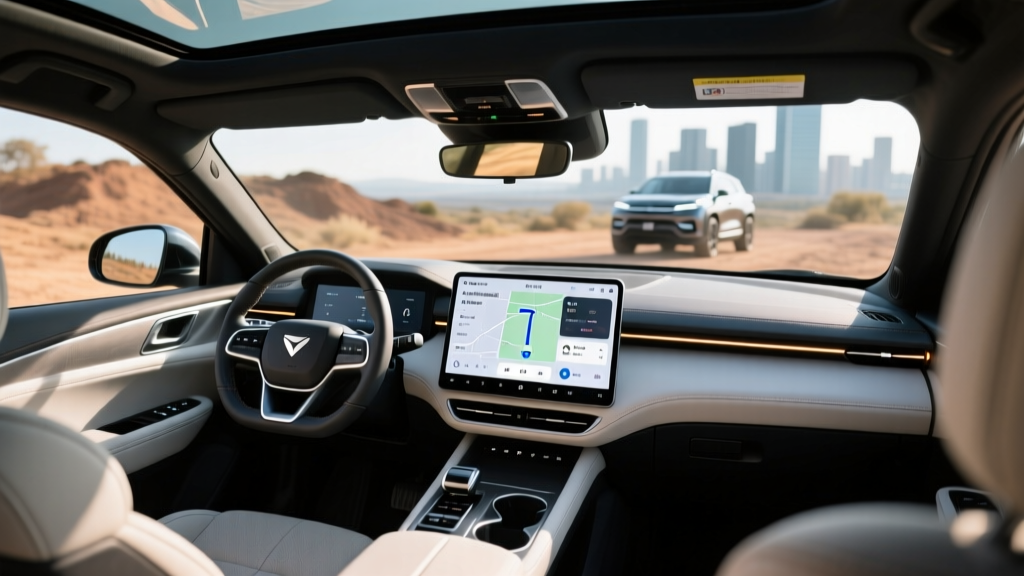
The R1S three-row SUV and R1T crew-cab pickup share a common interior architecture centered on a 15.6-inch landscape touchscreen running Rivian's custom infotainment OS and a 12.3-inch digital driver display. The latest update noticeably reduces the swipe-lag on map pinch-zoom and speeds up Spotify/Apple Music app transitions.
R1S cargo volume: 21.0 cu ft behind the third row, 56.4 cu ft behind the second row, and 104.7 cu ft with both rear rows folded. The front trunk (frunk) adds 11.0 cu ft — large enough for a carry-on and a backpack.
R1T bed: 4.5-foot bed (54 inches long) with a unique Gear Tunnel option that provides 11.7 cu ft of lockable, pass-through storage between the cab and bed — ideal for skis, fishing rods, or camping gear. The R1T also offers a powered tonneau cover and an integrated camp kitchen option.
Passenger space: Front-row legroom is 41.3 inches, second-row is 38.2 inches (R1S). The third row is best suited for children, with 30.4 inches of legroom. Heated and ventilated front seats are standard; a panoramic glass roof with electrochromic dimming is available.
Pricing, Trims, and Federal Tax Credit Eligibility
Rivian simplified its trim structure for 2026. Both the R1S and R1T are available in Adventure (base) and Ascend (premium) trims, with the Dual-Motor and Tri-Motor powertrain options layered on top.
| Model / Trim | Base MSRP | Est. §30D Credit | Effective Price |
|---|---|---|---|
| R1T Dual-Motor Standard (Adventure) | $69,900 | Up to $7,500* | ~$62,400 |
| R1S Dual-Motor Max (Adventure) | $83,000 | Up to $7,500* | ~$75,500 |
| R1T Tri-Motor Max (Ascend) | $99,500 | Up to $7,500* | ~$92,000 |
| R1S Tri-Motor Max (Ascend) | $101,000 | Up to $7,500* | ~$93,500 |
*Federal EV tax credit eligibility under IRS §30D is not guaranteed for every buyer. The credit phases based on:
- MSRP cap: Vans, SUVs, and pickups must have an MSRP at or below $80,000. This means the R1T Dual-Motor Standard qualifies, but Tri-Motor Ascend trims above $80,000 do not qualify for the new-vehicle credit. (The R1S is classified as an SUV and is subject to the same $80,000 cap.)
- Buyer income cap: AGI must not exceed $150,000 (single), $225,000 (head of household), or $300,000 (joint filing).
- Battery sourcing: A percentage of critical minerals and battery components must be sourced from the U.S. or free-trade-agreement countries. Rivian has been working to localize its supply chain, but the exact credit amount ($3,750 or $7,500) depends on current-year sourcing compliance.
- Point-of-sale transfer: Eligible buyers can transfer the credit to the dealer at purchase, reducing the purchase price upfront rather than waiting for a tax refund.
Always verify your specific eligibility with a tax professional and consult the latest fueleconomy.gov listings before purchasing.
Pros and Cons: Living With the Updated R1S and R1T
Pros
- Class-leading real-world range on Max pack (320–350 mi highway)
- Native NACS port — no adapter needed for Tesla Superchargers
- Tri-Motor performance is supercar-quick (2.9 sec 0–60)
- Gear Tunnel (R1T) is genuinely useful, not a gimmick
- OTA updates meaningfully improve the vehicle post-purchase
- Strong off-road capability with quad-motor torque vectoring (Tri-Motor)
- Spacious frunk and well-designed storage solutions
Cons
- Tri-Motor Ascend trims exceed $80K MSRP cap — no federal credit
- Third-row space in R1S is tight for adults
- DC fast charging, while improved, still lags Hyundai Ioniq 5 / Kia EV9 class
- No Apple CarPlay or Android Auto — Rivian's native OS only
- Insurance premiums run 15–25% higher than comparable ICE trucks/SUVs
- Service center network still expanding; rural owners may face long tow distances
Warranty and Long-Term Ownership
Rivian backs the Gen 2 R1S and R1T with an 8-year/100,000-mile battery and driveunit warranty, with a capacity-retention threshold of 70% — consistent with industry norms. The bumper-to-bumper limited warranty covers 5 years or 60,000 miles.
The NMC chemistry in Rivian's packs is energy-dense and proven, but it is more sensitive to sustained high-state-of-charge storage than LFP. Best practice: set your daily charge limit to 80–90% and only charge to 100% before long road trips. Rivian's app makes this straightforward with scheduled-departure and charge-limit controls.
Competitor Comparison: R1S/R1T vs. the Field
| Attribute | Rivian R1S (Dual-Motor Max) | Tesla Model X (Long Range) | BMW iX xDrive50 |
|---|---|---|---|
| EPA Range | 410 mi | 335 mi | 324 mi |
| 0–60 mph | 4.5 sec | 3.8 sec | 4.4 sec |
| DC Fast Charge (10–80%) | ~21 min | ~20 min | ~31 min |
| Base MSRP | $83,000 | $79,990 | $87,250 |
| Third Row | Yes (tight) | Yes (tight) | No |
| Off-Road Capability | Excellent | Limited | Moderate |
| Native NACS | Yes | Yes | No (CCS) |
Who Should Buy the Rivian R1S or R1T?
Choose the R1S if: You need three rows for family duty, want genuine off-road capability for backcountry camping, and value the longest available EPA range in a three-row electric SUV.
Choose the R1T if: You want an electric pickup that drives like a performance SUV, need the Gear Tunnel for adventure gear, and tow occasionally (max 11,000 lb rating on Dual-Motor).
Look elsewhere if: You prioritize the fastest possible DC charging (Hyundai Ioniq 5 / Kia EV9 charge faster on 800V architecture), need Apple CarPlay, or want the lowest possible price point (Ford F-150 Lightning starts significantly lower).
Frequently Asked Questions
What is the real-world range of the Rivian R1S and R1T?
The EPA rates the R1S Dual-Motor Max at 410 miles and the R1T Tri-Motor Max at 380 miles. In real-world highway driving at 70–75 mph, expect 320–350 miles (Max pack) and 220–240 miles (Standard pack). Cold weather below freezing can reduce range by 20–30%, so winter road-trippers should plan around ~260–290 miles on the Max pack.
How fast does the Rivian R1 charge at home and on the road?
At home on a 240V Level 2 charger (48A), the R1 adds roughly 25–28 miles of range per hour at 11.5 kW — enough to fully replenish overnight. On DC fast chargers, the Max pack peaks at 220 kW and charges 10–80% in approximately 21 minutes when properly preconditioned. The Standard pack peaks at 190 kW with a 10–80% time of about 24 minutes.
How much does a Rivian cost after the federal tax credit?
The R1T Dual-Motor Standard Adventure starts at $69,900 and may qualify for up to $7,500 under IRS §30D, bringing the effective price to roughly $62,400. However, any trim with an MSRP above $80,000 (including most Max-pack and Tri-Motor configurations) is ineligible for the new-vehicle credit due to the SUV/pickup MSRP cap. Buyer income limits also apply ($150K single / $300K joint). Verify eligibility at irs.gov and consult a tax professional.
Is the Rivian R1 worth buying versus a Tesla Model X or Ford F-150 Lightning?
The R1S offers more range than the Model X and far better off-road capability, but the Model X charges slightly faster and has access to the same Supercharger network natively. The F-150 Lightning is significantly cheaper and offers a larger bed, but it uses CCS (requiring an adapter for Superchargers) and has less range. If adventure capability and range are your top priorities, the Rivian stands alone in its niche.
Does the Rivian R1 support Apple CarPlay or Android Auto?
No. Rivian uses its proprietary infotainment platform and does not support Apple CarPlay or Android Auto. The native system includes built-in navigation, Spotify, Apple Music, and other apps, and the latest software update has substantially improved responsiveness. However, if phone-mirroring integration is a must-have, this is a notable drawback.
How reliable is Rivian's Driver+ system?
Driver+ is an SAE Level 2 highway-assist system with lane centering and adaptive cruise. The latest OTA update improved construction-zone handling and reduced phantom braking events, but it still requires active driver supervision. It is not a hands-off or eyes-off system, and Rivian does not currently offer a supervised-autonomy product comparable to Tesla's FSD (Supervised) in terms of city-street capability.