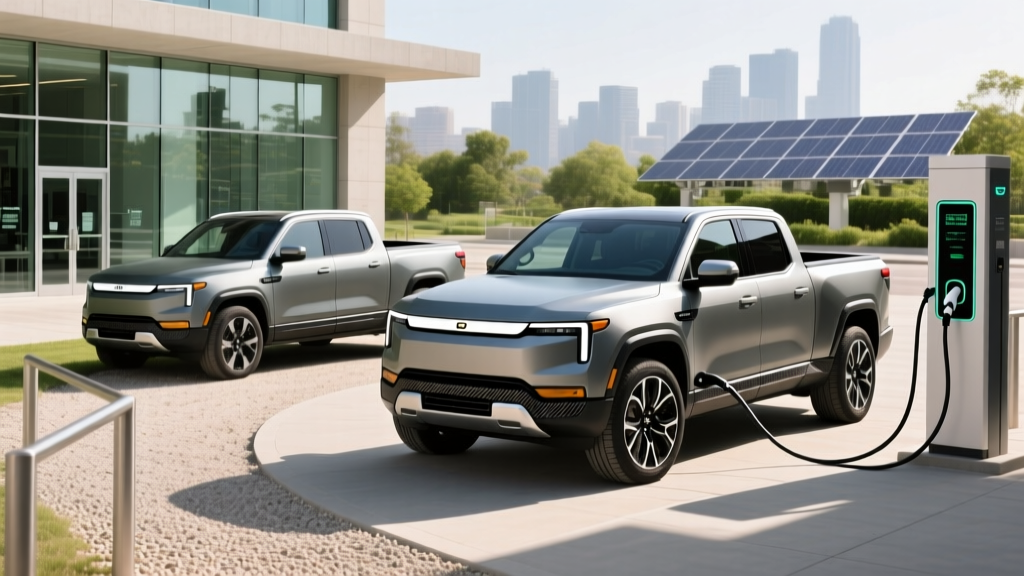
If you are shopping for an electric truck or three-row SUV, the Rivian R1T and R1S sit at the premium end of the market — and that makes understanding Rivian incentives critical to the purchase decision. Federal tax credits, state rebates, and utility programs can shift the effective price of these vehicles by thousands of dollars. But eligibility is not automatic. IRS §30D rules impose MSRP caps, income limits, and battery-sourcing requirements that change year to year.
This guide breaks down exactly which Rivian models qualify for incentives in 2026, what the real-world range and charging performance look like, and whether the R1T or R1S makes financial sense compared to competitors like the Ford F-150 Lightning, Tesla Cybertruck, and Hyundai Ioniq 9.
Rivian R1T and R1S: 2026 Lineup Overview
For 2026, Rivian offers the R1T pickup and R1S SUV across multiple battery and motor configurations. Both vehicles share the same skateboard platform, battery options, and powertrain choices. The R1T is a crew-cab midsize truck; the R1S is a three-row SUV built on the same wheelbase.
| Spec | R1T (Dual-Motor Standard) | R1S (Dual-Motor Standard) |
|---|---|---|
| EPA Range | 270 mi (Standard) / 352 mi (Max) | 261 mi (Standard) / 330 mi (Max) |
| Battery (usable) | ~95 kWh (Standard) / ~128 kWh (Max) | ~95 kWh (Standard) / ~128 kWh (Max) |
| Chemistry | NMC (nickel manganese cobalt) | NMC |
| Drivetrain | Dual-Motor AWD | Dual-Motor AWD |
| Horsepower | 533 hp (Dual) / 665 hp (Performance) / 1,025 hp (Tri-Motor) | 533 hp (Dual) / 665 hp (Performance) / 1,025 hp (Tri-Motor) |
| 0–60 mph | 4.5 sec (Dual) / 3.0 sec (Tri-Motor) | 4.6 sec (Dual) / 3.1 sec (Tri-Motor) |
| Max DC Fast Charge | 220 kW peak | 220 kW peak |
| 10–80% DC Time | ~27 min (Standard) / ~38 min (Max) | ~27 min (Standard) / ~38 min (Max) |
| Level 2 Home Rate | 11.5 kW (~25 mi/hr) | 11.5 kW (~25 mi/hr) |
| MPGe (combined) | 73 MPGe (Standard Pack) | 69 MPGe (Standard Pack) |
| Cargo Volume | 54 cu ft bed + 11 cu ft frunk + Gear Tunnel 17 cu ft | 105 cu ft (seats folded) |
| Base MSRP | $69,900 (Dual-Motor Standard) | $74,900 (Dual-Motor Standard) |
| Battery Warranty | 8 yr / 120,000 mi | 8 yr / 120,000 mi |
Both models offer Standard, Large, and Max battery packs, with Dual-Motor, Performance Dual-Motor, and Tri-Motor configurations. Prices climb quickly with larger batteries and more motors — a Tri-Motor Max R1T can exceed $100,000 before options.
Rivian Incentives: Federal §30D Tax Credit Eligibility
The single most impactful Rivian incentive is the federal EV tax credit under IRS §30D, worth up to $7,500. However, eligibility for Rivian vehicles is not guaranteed and depends on three factors that trip up many buyers:
- MSRP Cap: Vans, SUVs, and pickup trucks must have an MSRP at or below $80,000. The R1T Dual-Motor Standard ($69,900) and R1S Dual-Motor Standard ($74,900) qualify. However, R1T/R1S models with the Max Pack battery or Tri-Motor powertrain often exceed $80,000, disqualifying them from the federal credit.
- Buyer Income Cap: Modified adjusted gross income (MAGI) must not exceed $150,000 (single), $225,000 (head of household), or $300,000 (married filing jointly).
- Battery Sourcing & Critical Minerals: A percentage of battery components must be manufactured or assembled in North America, and a percentage of critical minerals must be sourced from the U.S. or a free-trade-agreement country. These thresholds tighten annually. For 2026, vehicles must meet both the component and mineral requirements to receive the full $7,500; partial compliance yields $3,750.
As of early 2026, Rivian's Dual-Motor Standard and Large Pack configurations assembled at their Normal, Illinois facility have qualified for the full $7,500 credit, but buyers should verify current eligibility on fueleconomy.gov before purchasing, as battery-sourcing compliance can shift with supply-chain changes.
Point-of-Sale Transfer: Since 2024, buyers can transfer the §30D credit to the dealer at purchase, converting the tax credit into an immediate price reduction rather than waiting to claim it on their tax return. Rivian participates in this program — confirm with your advisor before delivery.
| Trim | MSRP | §30D Eligible? | Effective Price |
|---|---|---|---|
| R1T Dual-Motor Standard | $69,900 | Yes (if under $80K MSRP & sourcing met) | ~$62,400 |
| R1T Dual-Motor Large | $75,900 | Yes | ~$68,400 |
| R1T Tri-Motor Max | $99,900 | No (exceeds $80K cap) | $99,900 |
| R1S Dual-Motor Standard | $74,900 | Yes | ~$67,400 |
| R1S Dual-Motor Large | $79,900 | Yes (at cap limit) | ~$72,400 |
| R1S Tri-Motor Max | $104,900 | No | $104,900 |
Note: State incentives (e.g., California CVRP, Colorado state credit, utility rebates) may stack on top of the federal credit and are not subject to the $80K MSRP cap. Check your state and local utility for additional programs.
Real-World Range: What the EPA Number Doesn't Tell You
EPA Sticker: R1T Dual-Motor Standard — 270 miles | R1T Max Pack — 352 miles
Real-World Expectation: Plan for 230–250 miles on the Standard Pack at highway speeds (70+ mph), and roughly 290–310 miles on the Max Pack under similar conditions. In cold weather (below 30°F), expect an additional 15–25% range reduction due to battery heating demands and cabin climate load.
Rivian's boxy, truck-style aerodynamics hurt highway efficiency. While the R1T achieves its EPA rating in mixed city/highway driving, sustained 75-mph highway travel typically drops efficiency to around 2.4–2.6 kWh/mile (compared to the EPA-rated ~2.1 kWh/mile). That is physics, not a Rivian flaw — the Ford F-150 Lightning and GMC Hummer EV exhibit the same pattern.
For towing, the story changes dramatically. Expect range to drop by 40–55% when pulling a 5,000-lb trailer at highway speed. A Standard Pack R1T towing may deliver as little as 120–140 miles before needing a charge. The Max Pack extends this to roughly 170–190 miles — adequate for shorter hauls but requiring route planning for longer trips.
Charging Speed: DC Fast Charge and Home Level 2
Rivian uses the NACS (North American Charging Standard) connector on 2026 models, granting native access to the Tesla Supercharger network — the most reliable and widespread DC fast-charging network in the U.S.
| Charging Level | Power / Rate | Miles Added per Hour |
|---|---|---|
| Level 1 (120V outlet) | ~1.4 kW | ~3 mi/hr |
| Level 2 (240V, 48A home charger) | 11.5 kW | ~25 mi/hr |
| DC Fast Charge (Standard Pack) | 220 kW peak, tapering above 80% | 10–80% in ~27 min |
| DC Fast Charge (Max Pack) | 220 kW peak, tapering above 80% | 10–80% in ~38 min |
Charging-curve reality check: The 220 kW peak rate is achieved only between roughly 10–30% state of charge (SoC) on a preconditioned battery. Above 50% SoC, the rate tapers to ~120 kW, and above 80% it drops below 50 kW. This is standard for NMC lithium-ion chemistry. For road trips, plan stops around the 10–80% window to minimize time at the charger.
At home, a 48-amp Level 2 charger (hardwired, requiring a 60-amp circuit) replenishes roughly 25 miles of range per hour. A full Standard Pack charge from 10% to 100% takes about 9 hours — easily done overnight. The Max Pack requires roughly 12 hours for a full charge, which means you will want a dedicated Level 2 circuit if you opt for the larger battery. Installation costs typically run $800–$2,000 depending on your electrical panel capacity and run length; a panel upgrade to 200A service can add $1,500–$3,000 if needed.
Performance, Tech, and Daily Livability
The R1T Dual-Motor delivers 533 horsepower and a 4.5-second 0–60 mph time — quicker than any gas truck in its class. The Tri-Motor variant, with 1,025 hp, hits 60 mph in roughly 3.0 seconds, which is sports-car territory in a 7,000-lb vehicle.
Rivian's driver-assistance system, Driver+, is a Level 2 system per SAE classification. It includes adaptive cruise control, lane centering, and automatic lane changes on divided highways. It is not self-driving — you must keep your hands on the wheel and eyes on the road at all times. The system works well on interstates but is not as assertive as GM's Super Cruise or Ford's BlueCruise on mapped highways.
Interior tech highlights include a 15.6-inch center touchscreen running Rivian's proprietary OS, a digital driver display, a built-in air compressor (useful for tire inflation and camp accessories), and a camp kitchen option that slides out of the Gear Tunnel. The R1T's Gear Tunnel — a pass-through storage compartment behind the rear seats — offers 17 cubic feet of lockable, weatherproof space that no competitor matches.
Passenger space is adequate but not class-leading. The R1T rear seat offers 36.4 inches of legroom, which is tight for tall adults on long trips. The R1S third row is best suited for children. Cargo space in the R1S reaches 105 cubic feet with both rear rows folded.
Notable drawbacks: The R1T's ride quality on rough pavement can be firm, especially with the 21-inch all-terrain wheels. The glass roof admits significant heat in summer — many owners add an aftermarket shade. Rivian's service center network is still growing, and wait times for collision repair can stretch to weeks in some markets.
Rivian vs. Competitors: Value After Incentives
Choose the Rivian R1T if: You want a premium adventure truck with genuine off-road capability, the Gear Tunnel for gear storage, NACS Supercharger access, and a refined software experience — and you can configure under the $80K MSRP cap.
Choose the Ford F-150 Lightning if: You need a full-size truck bed, higher towing capacity (up to 10,000 lbs), and a lower starting price ($55,000 range), and you are willing to use CCS charging or a NACS adapter.
Choose the Tesla Cybertruck if: You prioritize stainless-steel durability, maximum range (340+ mi AWD), and the lowest per-mile charging cost on the Supercharger network — and you accept the polarizing design and limited service infrastructure.
Choose the Rivian R1S if: You need three rows, want NACS native charging, and prefer a more car-like driving experience than the Chevrolet Tahoe-sized EVs.
After the $7,500 federal credit, the R1T Dual-Motor Standard at ~$62,400 competes with the F-150 Lightning Lariat ($65,000–$70,000 range) and the Cybertruck AWD ($79,990). The Rivian's advantage is build quality, software polish, and the Gear Tunnel; the Ford's advantage is bed size and dealer network depth.
Pros
- NACS connector: native Tesla Supercharger access (no adapter needed)
- Gear Tunnel: 17 cu ft of unique, lockable, weatherproof storage
- Strong off-road capability with adjustable air suspension (up to 14.9" ground clearance)
- Over-the-air updates continuously add features
- 8-year/120,000-mile battery warranty (exceeds the industry-standard 100K)
Cons
- Tri-Motor and Max Pack trims exceed $80K — no federal credit
- Highway range drops significantly due to boxy aerodynamics
- Towing range is severely limited (120–190 mi depending on pack)
- Service center availability still limited in rural and some metro areas
- Rear-seat legroom (R1T) and third-row space (R1S) are tight for the class
5-Year Ownership Cost Snapshot
Rivian's total cost of ownership benefits from the federal credit and lower fuel/maintenance costs versus gas trucks, but insurance premiums and depreciation offset some savings. A 2026 R1T Dual-Motor Standard driven 12,000 miles/year with home charging at $0.14/kWh costs roughly $1,800/year in electricity — compared to $3,200+/year in gasoline for a comparable F-150 at 18 mpg combined and $3.50/gallon.
Insurance for the R1T averages $2,800–$3,500/year depending on your state and driving record — roughly 30–50% higher than a gas F-150 due to repair costs and vehicle value. Factor this into your budget.
Maintenance is minimal: no oil changes, no transmission fluid, and regenerative braking extends pad life. Expect cabin air filter replacement ($50–$80/year) and tire rotation. Rivian offers a 5-year/60,000-mile bumper-to-bumper warranty and the 8-year/120,000-mile battery and drive unit warranty.
Frequently Asked Questions
Does every Rivian qualify for the $7,500 federal tax credit?
No. Only trims with an MSRP at or below $80,000 qualify. The R1T Dual-Motor Standard ($69,900) and Large ($75,900) qualify, as does the R1S Dual-Motor Standard ($74,900) and Large ($79,900). Tri-Motor and Max Pack configurations typically exceed $80,000 and are ineligible. Buyer income limits and battery-sourcing requirements also apply under IRS §30D rules.
What is the real-world highway range of the R1T?
The EPA rates the R1T Dual-Motor Standard at 270 miles. In real-world highway driving at 70–75 mph, expect 230–250 miles. With the Max Pack (EPA 352 miles), plan for 290–310 highway miles. Cold weather (below 30°F) reduces these figures by an additional 15–25%.
Can I charge a Rivian at Tesla Superchargers?
Yes. All 2026 Rivian vehicles come with the NACS charge port natively, providing direct access to the Tesla Supercharger network without an adapter. This is a significant advantage for road-trip charging reliability.
How long does home charging take?
With a 48-amp, 240V Level 2 home charger (11.5 kW), the Standard Pack charges at roughly 25 miles of range per hour, taking about 9 hours from 10% to full. The Max Pack takes approximately 12 hours. Most owners charge overnight and wake up to a full battery.
Is the Rivian R1T good for towing?
The R1T is rated to tow up to 11,000 lbs (Dual-Motor) and has strong low-end electric torque for trailer acceleration. However, towing range is the limiting factor: expect 120–140 miles on the Standard Pack and 170–190 miles on the Max Pack when towing 5,000 lbs at highway speed. Plan routes around DC fast-charger availability.
How does Rivian's warranty compare?
Rivian provides an 8-year/120,000-mile battery and drive unit warranty (covering capacity loss below 70% of original), which exceeds the industry-standard 8-year/100,000-mile coverage. The bumper-to-bumper warranty is 5 years/60,000 miles, in line with premium competitors.
Are there state incentives beyond the federal credit?
Many states offer additional EV incentives that can stack with the federal credit and are not subject to the $80K MSRP cap. Examples include California's CVRP rebate (income-dependent), Colorado's $5,000 state credit, and various utility company rebates for home charger installation. Check your state energy office and local utility for current programs, as these change frequently.
Sources: EPA fuel economy data from fueleconomy.gov, IRS §30D credit rules from irs.gov, and manufacturer specifications from Rivian's official press materials. Tax credit eligibility is subject to change; consult a tax professional before purchasing.